

Overview of 23 Health-Focused Commercial Insurers Established by Listed Companies (2015–2016)
2015–2016 witnessed explosive growth in the commercial insurance sector. As a core element of healthcare cost containment, commercial health insurance has gradually become one of the most important branches of commercial insurance. During this period, a total of 23 commercial insurance companies were established, all of which offered health insurance products. VCBeat (WeChat Official Account: vcbeat) has compiled and analyzed the relevant data; highlights are presented below:
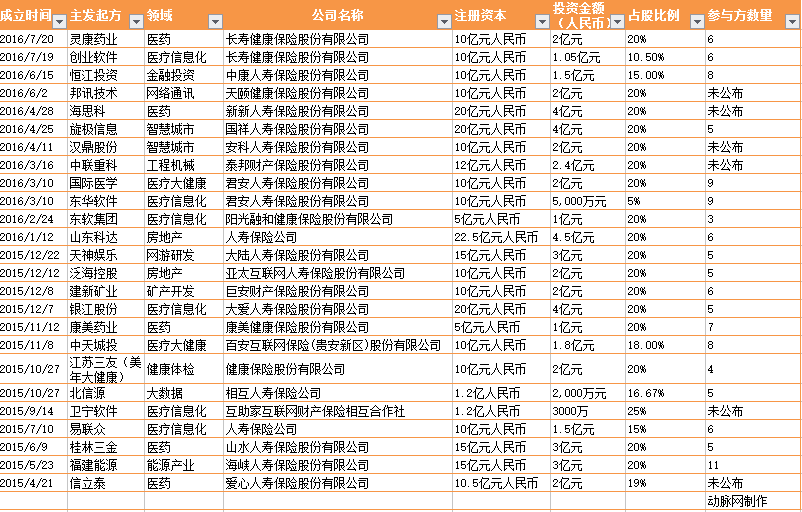
List of 23 Newly Established Commercial Insurance Companies from 2015 to 2016
1Policy and the Macro Environment Are Key External Drivers of the Rapid Growth in Commercial Health Insurance
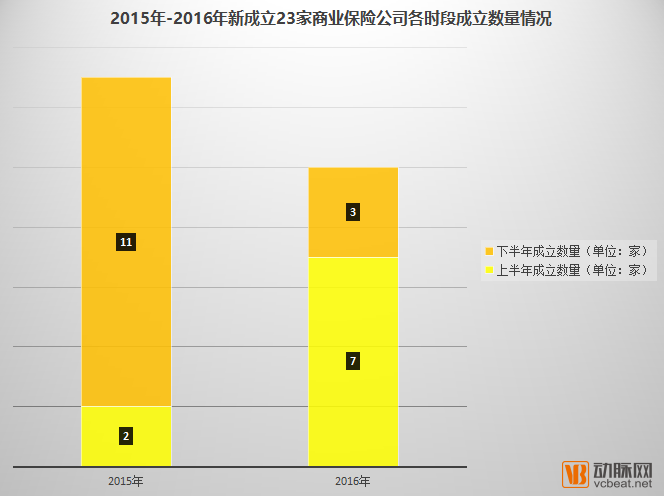
From 2015 to 2016, a total of 23 newly established commercial insurance companies
In early 2015, there were only two listed companies that had established commercial insurance companies. However, in the second half of the year, as the Ministry of Finance, the State Administration of Taxation, and the China Insurance Regulatory Commission successively issued the Notice on Launching Pilot Programs for Individual Income Tax Policies on Commercial Health Insurance in May, the Interim Measures for the Administration of Tax-Advantaged Personal Health Insurance Business in August, and the Notice on Implementing Pilot Programs for Individual Income Tax Policies on Commercial Health Insurance in December, the pilot program for tax-advantaged commercial health insurance was expanded from the four municipalities of Beijing, Shanghai, Tianjin, and Chongqing to 31 cities across China. According to the regulations, funds used to purchase designated health insurance products are exempt from individual income tax, with an annual tax-exemption cap of RMB 2,400.
With the continuous opening of national healthcare reform and commercial insurance policies, listed companies establishing commercial insurance companies have witnessed leapfrog growth. As shown in the figure, the number of newly established commercial insurance companies in the second half of 2015 was more than five times that in the first half.
Data from Changjiang Securities shows that the current shares of government, public, and individual payments in China’s healthcare expenditure are 30%, 37%, and 33%, respectively, with commercial insurers accounting for only 1%. Going forward, as health insurance policies continue to provide guidance, the proportion of out-of-pocket payments by individuals will gradually decline, while the share paid by commercial insurers will steadily increase. Initiatives such as critical illness insurance and supplementary medical insurance for urban employees will further elevate the role of commercial insurance companies as primary payers in the healthcare sector.
Driven by the broader market environment, ten new commercial insurance companies have been established since 2016. It is foreseeable that commercial health insurance, as a core component of healthcare payment, is becoming a highly coveted asset for listed companies across various sectors.
2Specialized Health Insurance Companies Hold a Minor Share, with Industry Competition Still in a Blue Ocean
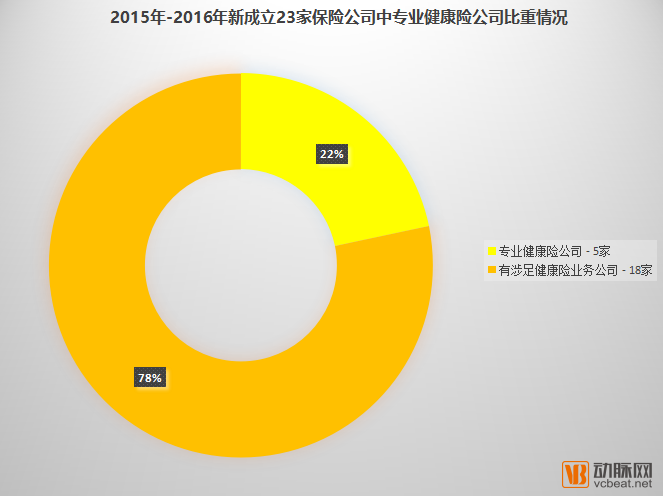
Proportion of Pure Health Insurance Companies Among the 23 Newly Established Insurance Companies in 2015–2016
Data from December 2015 shows that more than 100 insurance companies across China were engaged in commercial health insurance business, offering over 2,300 related products. However, there were only five specialized commercial health insurance companies: PICC Health, Kunlun Health, Hexie Health, Ping An Health, and CPIC-Allianz Health.
Even with the addition of three new commercial health insurance companies established in 2016, specialized health insurers still account for a small proportion. Most insurers offer major lines such as life and property insurance in addition to health coverage. This also indicates that commercial health insurance in China remains in a blue-ocean competitive stage.
3Significant Differences in Investment Objectives Between Listed Companies in the Healthcare and Non-Healthcare Sectors
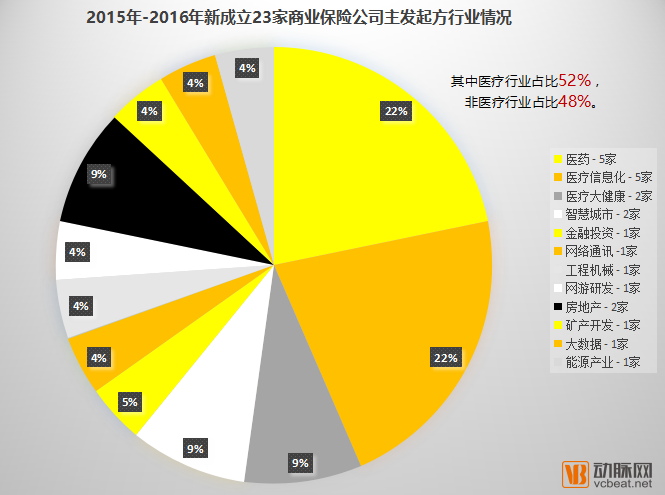
Industry Profile of the Primary Sponsors of 23 Newly Established Commercial Insurance Companies (2015–2016)
Among the 23 commercial insurance companies, those primarily initiated by listed companies in the medical industry account for 52%, while those initiated by non-medical industry companies account for 48%, with both proportions being nearly equal. This indicates that although listed medical companies are the mainstream force in laying out commercial insurance, non-medical enterprises also demonstrate considerable enthusiasm for commercial health insurance.
From an investment perspective, VCBeat (WeChat Official Account: vcbeat) analyzes:
① Pharmaceutical, Medical, and Broad Healthcare Companies
For listed pharmaceutical companies such as Haisco Pharmaceutical and Lingkang Pharmaceutical, intensifying competition within the pharmaceutical industry, coupled with the progressive refinement of new healthcare reform policies and significantly strengthened government oversight over drug production and price regulation, has created bottlenecks for revenue and profit growth. Consequently, the medical and broader health industry has become the mainstream direction for inorganic expansion among publicly traded pharmaceutical enterprises.
Consequently, listed pharmaceutical companies have increasingly embarked on extensive expansion into the broader healthcare industry, with key investment focuses including medical devices, medical consumables, healthcare institutions, and health checkup services.
Given the limited resources of medical insurance, preventive and rehabilitative services—including health check-ups—are strictly price-controlled within the coverage scope. As these ancillary medical services constitute the core of the broader healthcare industry’s development, it has become an inevitable strategic choice for listed pharmaceutical companies and healthcare enterprises to invest in securing a foothold in the medical payment sector.
Commercial health insurance not only has a significant opportunity to collaborate with basic medical insurance to become a primary payer in the future healthcare landscape, but also holds strategic value for listed pharmaceutical companies in boosting their profits, as it represents an entirely new consumption model.
② Healthcare IT Companies
Medical informatics companies such as Winning Health and Neusoft Group have secured entry points into local medical insurance cost-control systems through their Hospital Information Systems (HIS), thereby effectively gaining access to electronic medical records. By leveraging vast amounts of big data and knowledge base resources accumulated over the long term, these companies identify high-net-worth patient populations and design commercial health insurance products tailored to this segment, ultimately driving profit growth.
Furthermore, Pharmacy Benefit Management (PBM) is currently one of the primary strategies employed by the state to control pharmaceutical expenditures. It manages and guides the entire medical service process through the collection and analysis of patient visit data, prescription audits, and other measures. As a specialized third-party service, PBM companies generate profits by securing a strategic position with health insurance funds—the largest payer—and through collaborations with upstream pharmaceutical manufacturers, healthcare institutions, and other health providers such as medical device companies.
Healthcare IT companies are uniquely positioned between payers in the healthcare market (such as commercial insurance institutions and employers), pharmaceutical manufacturers, hospitals, and pharmacies. Therefore, compared with healthcare enterprises in other sectors, healthcare IT companies are better suited to leverage their role as third parties to oversee, regulate, and coordinate the entire healthcare service delivery process.
It is precisely for this reason that healthcare IT companies are strategically positioning themselves in the commercial insurance sector, creating synergies with medical and health services such as medical cost containment, precise insurance pricing, chronic disease management, and disease prevention. This approach drives the establishment of a complete PBM (Pharmacy Benefit Management) closed loop, fosters new service models, and secures a proactive stance within the industry.
③ Non-Medical Companies
There are two primary reasons why non-healthcare enterprises have entered the commercial insurance sector:
One approach is to leverage insurance as an entry point into the internet finance sector, uncover investment opportunities within the internet finance industry and emerging sectors, refine the strategic layout of financial ecosystem services, and thereby cultivate new profit growth drivers.
Second, it closely follows the policy environment and market demand. The “Ten New National Guidelines for Insurance” issued by the State Council in 2014, along with the “Individual Income Tax-Preferential Commercial Health Insurance” policy released by the China Insurance Regulatory Commission (CIRC) in 2015, clearly defined the role of the modern insurance industry within the overall framework of economic and social development. These preferential policies covered numerous areas, including health insurance and pension insurance, thereby creating significant policy opportunities, reform dividends, and room for growth for the insurance sector.
Coupled with the continuous rise in China's per capita GDP, which has surpassed $8,000 in most regions, and the progressively deepening issue of population aging, commercial health insurance and life insurance are poised for substantial growth potential.
4Profitability and Operational Risks of Commercial Insurance Drive Listed Companies Toward Long-Term Investment
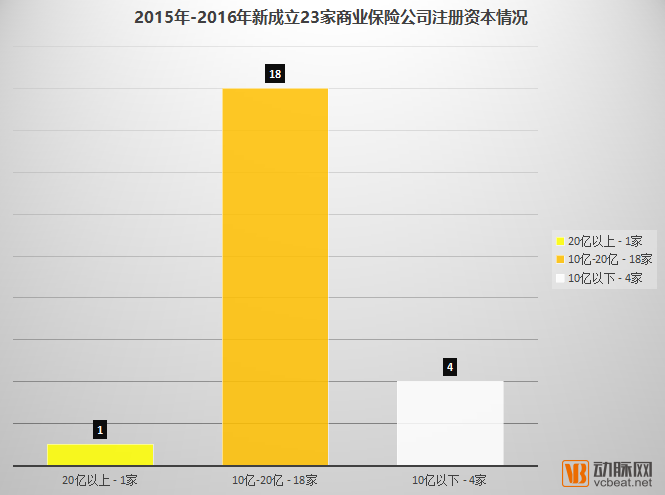
Registered Capital of 23 Newly Established Commercial Insurance Companies (2015–2016)
In terms of scale and cost control, establishing insurance companies with a registered capital of RMB 1 billion to 2 billion has become the preferred choice for listed companies.
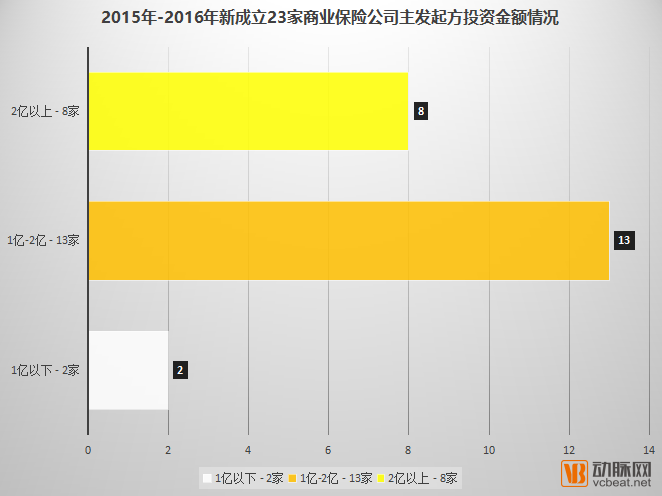
Investment Amounts by the Main Initiators of 23 Newly Established Commercial Insurance Companies (2015–2016)
Listed companies, as the lead sponsors, generally invest between RMB 100 million and RMB 200 million, adopting a relatively conservative approach.
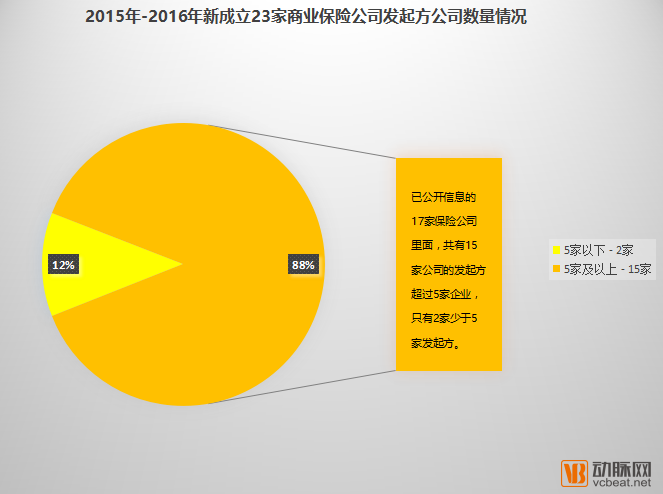
Number of Founding Companies for the 23 Newly Established Commercial Insurance Companies in 2015–2016
Among the 23 insurance companies, 17 listed firms have disclosed information on their promoters. Of these, 15 insurance companies were jointly established by more than five promoters, while only two had fewer than five. Although various stakeholders maintain a positive outlook on commercial insurance, investment returns are proportional to operational capabilities, and profitability remains uncertain. Consequently, risk-sharing among multiple enterprises has become the predominant model.
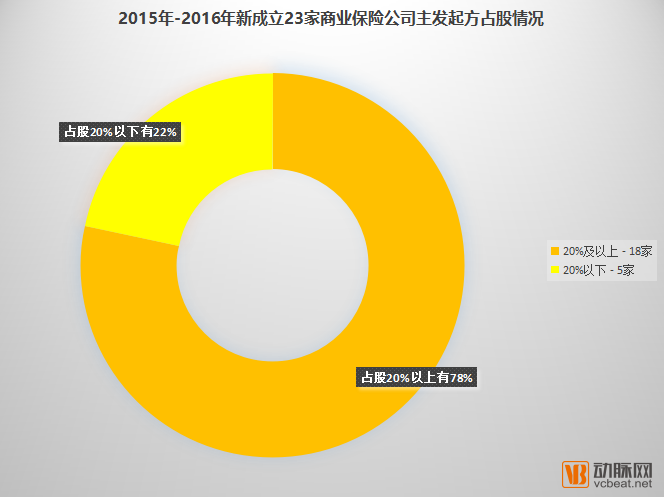
Shareholding Ratios of the Primary Sponsors in the 23 Newly Established Health Insurance Companies from 2015 to 2016
As shown in the figure, 78% of the lead sponsor listed companies hold a stake of 20% or more in insurance companies, with only five listed companies holding less than 20%. This shareholding structure indicates that stakeholders view commercial insurance as a long-term investment, given that insurance operations require a certain period to generate returns. From a risk perspective, information asymmetry between insurance companies and medical institutions has prevented commercial health insurance products from achieving strong profitability. Consequently, listed companies have tacitly avoided seeking absolute controlling stakes, a trend that can be further corroborated by examining the investment patterns of lead sponsors and the number of sponsors involved.
5VCBeat Analysis and Summary
Listed companies have successively embarked on a “land grab” in the commercial insurance sector. National policies and the industry environment serve as external drivers, while internal motivations vary among healthcare companies, non-healthcare companies, and even across different healthcare firms, each with distinct investment objectives.
From an industry perspective, driven by the urgent need to strengthen the comprehensive health industry chain and capture the medical payer market, listed companies in the pharmaceutical and healthcare IT sectors have become the primary participants in investing in commercial insurance.
Overall, as the market acceptance of commercial health insurance has yet to achieve a breakthrough, the share of specialized health insurance companies remains relatively low. Although listed companies demonstrate strong investment enthusiasm, their approach is comparatively conservative, favoring long-term investment models characterized by multi-party participation and low capital commitment.