

Analyzing the U.S. Model to Explore the Development Prospects of China's Digital Healthcare Industry | Digital Healthcare Sector Report (Part II)
|Source: FellowData WeChat Official Account, ID: FellowData
Not long ago, the Digital Health Conference held in Las Vegas, USA, showcased the rapid development of the United States in this field over the past two decades. As the pioneer of digital health, the U.S. has driven the growth of the entire industry through investment and policy support. Through an in-depth analysis of the forms and profit models of digital health in the U.S., FellowData has identified future development opportunities for China in the digital health sector. Not only is the policy-driven market expanding, but profit models involving insurance coverage, pharmaceutical company payments, and patient fees are also becoming increasingly clear.
The high degree of privatization in the United States has significantly driven the development of third-party service providers. In 2015, more than 100 companies exited the U.S. digital health sector. Many of these firms focused on developing a few niche products, freeing them from concerns about distribution channels and competition; they could thrive simply by selling their well-crafted niche products to larger corporations.
Currently, the key subsectors of digital health prioritized for development in the United States encompass the following forms:
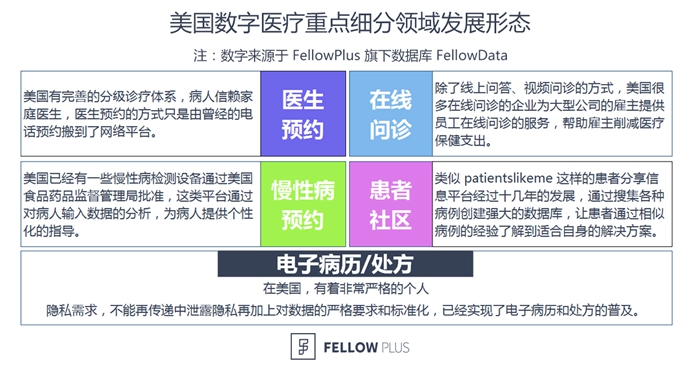
The market-oriented healthcare system in the United States has imposed fewer restrictions on the development of digital health, allowing the aforementioned subsectors to reach a relatively mature stage and establish diverse revenue models.
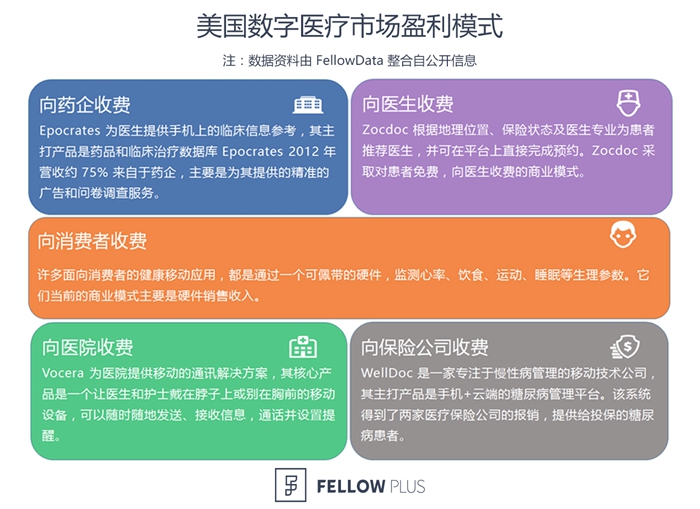
Let’s take a look at the profit models of several representative companies:
Medical Resources: Doctors are already a scarce resource in China, and the irrational allocation of medical resources has led to patients flocking to certain facilities, leaving doctors overwhelmed.
Healthcare System: China's healthcare system is government-owned, making it difficult for physicians to practice independently of hospitals.
Healthcare Insurance System: China’s healthcare insurance system is inadequate, and the inability to afford medical care has become commonplace.
Medical Data: Lack of Privacy Protection and an Unestablished Pharmaceutical Data System.
Traditional Mindset: Visit the hospital only when ill; choose Grade 3A hospitals; select expert-level physicians.
Overcoming these challenges, China’s digital health sector presents numerous opportunities for exploration, both in terms of form and business models.
China is already on the path toward healthcare marketization. The policies of “tiered diagnosis and treatment” and “multi-site practice for physicians” have initially spurred the development of digital health. If, driven by both government and industry, medical resources become less concentrated or community-level healthcare capabilities improve rapidly, tiered diagnosis and treatment will play a significant role. In that scenario, products similar in model to ZocDoc may seize new opportunities for growth.
Big data integration and R&D data confidentiality systems are creating more opportunities for collaboration between tech giants and the healthcare industry. In the near future, cloud-based electronic health records (EHRs) and e-prescriptions are expected to be widely adopted in China. Furthermore, while numerous domestic companies produce mobile health monitoring hardware that resembles medical devices, their large-scale deployment still requires government approval. Nevertheless, market demand will accelerate the application of such products in the healthcare sector.
Insurance Bill Payment:Recently, Ping An Good Doctor’s $500 million financing round has sparked intense debate over whether insurance will become the business model for internet healthcare. For the insurance industry, data mining through big data enables more accurate assessments of disease probability. In other words, as public health declines in the future, disease probabilities will rise, leading to higher insurance claim payouts. With users paying the same premiums, leveraging innovative internet-based approaches to reduce disease incidence can expand profit margins. If the government further promotes the opening-up of commercial insurance, the “insurance-paid” profitability model will soon become a reality.
Pharmaceutical Company Payment:The second viable revenue model is payment by pharmaceutical companies. First, pharmaceutical companies have the incentive to pay: digital health technologies enable drug marketing to gradually shift from extensive to refined approaches within an increasingly compliant regulatory environment, facilitating outcome-based payment models. Second, pharmaceutical companies have the financial capacity to pay: there are nearly 5,000 licensed pharmaceutical companies in China, plus foreign pharmaceutical firms entering the domestic market, with a total annual marketing budget exceeding RMB 800 billion.
Patient Billing:The development of mobile health hardware can be regarded as an innovative direction toward the lightweighting of medical devices. However, companies in this sector currently focus on acquiring customers through high-quality, low-cost hardware before offering sticky services. Nevertheless, due to the general lack of compelling, must-have features in these hardware products themselves, achieving profitability through service fees remains challenging.
Overall, digital healthcare is an industry that requires a prolonged development period to reach maturity. Policy liberalization, coupled with technological and business model innovations, should gradually foster a virtuous cycle of mutual reinforcement. Although the sector remains in its early growth stage, barriers to expansion are being systematically dismantled. We are highly optimistic about the significant opportunities that advanced technologies and high-quality services will bring to the industry in the coming years.