

Dispatch Health Files for IPO: Disrupting Acute Care with At-Home Medical Services at 10% of Traditional Hospital Costs

Dispatch Health, founded in 2013 and headquartered in Denver, Colorado, is a mobile online-to-offline (O2O) healthcare provider whose core business involves delivering physician house calls to patients via mobile devices such as iPads.
The company’s team comprises healthcare professionals with extensive experience in industry innovation, dedicated to helping patients achieve optimal care experiences at home or in the workplace. Currently, the team has 25 employees. Its founder and CEO, Mark Prather, brings over 20 years of frontline healthcare service experience and has personally witnessed the time-consuming and inefficient nature of the current healthcare system, which ultimately led to the creation of Dispatch Health.
Provide Appropriate Care: Dispatch Health’s licensed physicians, nurse practitioners, and physician assistants have extensive experience in assessing acute injuries and illnesses. These clinicians are drawn from healthcare facilities within local communities; indeed, the same professionals who serve patients in hospital emergency departments or urgent care centers also provide care through Dispatch Health.
Location-Independent Service Delivery: Whether at home, in the office, or elsewhere, Dispatch Health’s care team will come to you and provide dedicated medical services.
Immediate Arrival: Amidst busy work and daily life, patients do not need to queue at hospitals. Whenever needed, Dispatch Health’s care team will arrive promptly at the patient’s side.

Dispatch Health primarily delivers care to patients through local municipal governments, 911 first-response systems, and skilled nursing facilities. When a user calls 911 or Dispatch Health’s contact number, the company employs a clinical algorithm to assess whether its medical team can assist the patient. If deemed appropriate, a mobile care team composed of acute-care clinicians is dispatched in an ambulance. The ambulance is equipped with Clinical Laboratory Improvement Amendments (CLIA)-certified laboratory equipment, medical devices, medications, intravenous infusion supplies, Wi-Fi connectivity, and other resources.
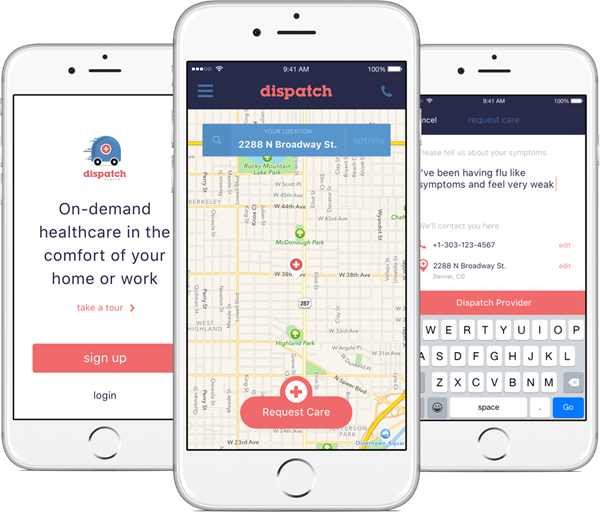
Dispatch Health adopted DrChrono as its electronic health record (EHR) system and actively sought partnerships with other medical device companies to co-develop applications for iPad and iPhone, launching its first consumer-facing app in November 2015.
“Our model of medical care has been proven effective. In terms of acute care, patients can be safely treated in the comfort of their homes or wherever they need it,” said Mark Prather, CEO of Dispatch Health, in a statement. “Whether caring for elderly parents, children with accidental injuries, or patients suffering from sudden acute illnesses, there is now a new option to address individual healthcare needs—Dispatch Health—without incurring unnecessary costs, navigating cumbersome processes, or enduring long wait times.”
Currently, Dispatch Health has partnered with the Denver Metro Fire Department, enabling more than 400 patients to receive in-home physician consultations through this channel. Additionally, Dispatch Health has deployed private vehicles on the road and collaborated with hospitals to facilitate more rapid management of high-risk patient populations.
Dispatch Health, with its years of experience in the healthcare industry, adopts a unique perspective when developing related products, focusing on key pain points within the sector: 37% of emergency department visits are unnecessary; these unnecessary visits incur annual costs totaling $4.4 billion; avoidable admissions to high-acuity hospital units cost over $4 billion annually; research indicates that the expansion of Medicaid coverage has led to a 40% increase in emergency department visits; there is currently a shortage of 50,000 primary care physicians; and 3.8 million ambulance transports via 911 are unnecessary.
To this end, Dispatch Health has addressed these industry pain points through initiatives in three key areas:
1. Provide high-quality, convenient in-home treatment services that achieve optimal outcomes;
2. Avoid unnecessary emergency department visits, thereby reducing medical costs;
3. It can increase the frequency of medical visits for at-risk patients, avoiding unnecessary episodic acute care.
Dispatch Health has entered into contracts with major payers in Colorado to provide medical care directly in accordance with insurance regulations. For uninsured patients, it charges only a low, fixed fee. Consequently, its service market is extensive, primarily covering the following areas:
1. A mobile "treatment device" with advanced processing capabilities, including intravenous administration, intravenous infusion, wound suturing, splint fixation, and replacement of urinary catheters and feeding tubes;
2. Laboratory equipment certified under the Mobile CLIA Waiver Program, enabling immediate testing at home or in the workplace;
3. In accordance with advanced pharmaceutical prescribing regulations, curative treatments for various diseases are permitted to be administered in home or workplace settings;
4. Its broad-spectrum clinical treatment algorithm review supports safe, high-quality disease care at home or in the workplace;
5. Low-cost outpatient imaging;
6. Integrate health information exchange in Colorado to enable physicians to rapidly access patients’ past medical histories and overall health status, thereby reducing redundant and unnecessary services and facilitating more accurate clinical decision-making;
7. Supervise primary healthcare institutions and their care teams to monitor patients' treatment processes and improve treatment outcomes.
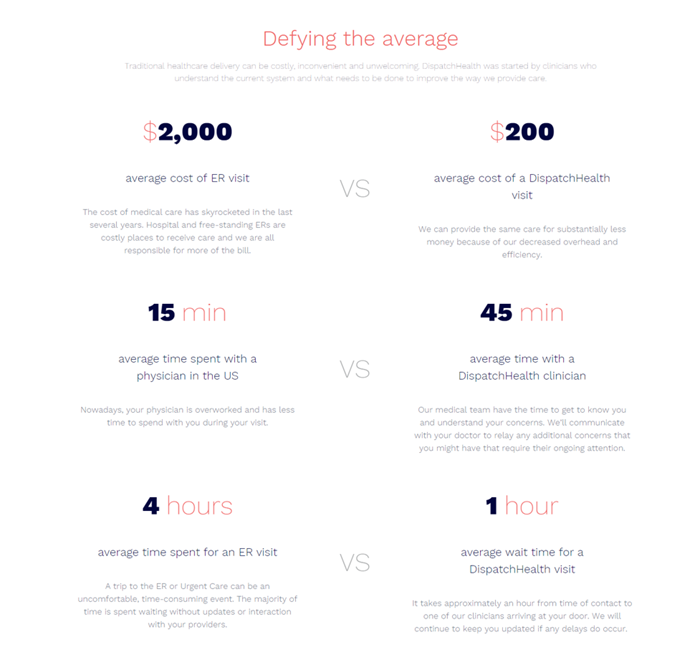
Traditional healthcare is not only cumbersome in the process of seeking medical attention but also incurs high economic costs.Dispatch HealthHaving gained insight into the shortcomings of the existing healthcare system, we have also begun to guide patients toward a more time- and cost-efficient pathway.
In the United States, the average cost of treatment at hospital emergency departments is $2,000. Over the past few years, this cost has risen sharply, making emergency care at hospitals and clinics prohibitively expensive, with patients bearing the full financial burden. Due to the heavy workload of emergency room physicians and nurses, there is insufficient time for comprehensive and in-depth communication with patients regarding their conditions; the actual consultation time averages only 15 minutes. However, prior to this brief 15-minute consultation, patients typically endure a four-hour wait due to cumbersome hospital procedures and high patient volume.
Compared with traditional medical approaches, the services provided by Dispatch Health are more cost-effective. While delivering care quality comparable to that of traditional healthcare institutions, the average cost per patient is only $200, and each visit lasts approximately 45 minutes, allowing the care team ample time to thoroughly assess the patient’s condition. In terms of response time, the care team can arrive on-site within about one hour after the patient contacts Dispatch Health. The team maintains communication with the patient en route, and will notify the patient in case of any delays due to special circumstances.

In early August 2015, Dispatch Health completed its seed funding round, raising $3.6 million from investors including EMP Holdings. The funds were primarily allocated to expanding its existing operations. The seed round was led by EMP, LLC, which had previously invested in iTriage (acquired by Aetna in 2011) and Stat Health (acquired by Teladoc in 2015). EMP aims for Dispatch Health to become a leader in the home care reform sector by enhancing care accessibility and reducing costs while ensuring high-quality nursing services.
One example is Pager, a New York-based company that raised $14 million in July 2015. Pager is a telemedicine provider offering “on-demand doctor services” from 8 a.m. to 10 p.m. for non-emergency patients within New York City. Patients can summon an “Uber-like doctor” to their home or office for diagnosis and treatment. The fee for the initial house call is $50, while follow-up visits cost $200 and include on-site testing, treatment, suturing, and prescription medications. Customers may also opt for a physical examination for $100. For issues resolved via telephone consultation, the fee is only $25.
Another example is Heal, a Los Angeles-based company that raised $5 million in June 2015. Heal provides in-home physician consultations within 60 minutes. Appointments are available seven days a week from 8:00 AM to 8:00 PM. The service charges a flat fee of $99. However, this $99 fee covers only the physician’s visit; costs for prescribed medications or laboratory tests are billed separately through the patient’s insurance or as out-of-pocket expenses. A physician accompanied by a medical assistant visits the patient’s home, bringing a medical kit equipped with basic health devices to meet common patient needs.
With the development of overseas house-call services by physicians, several domestic physician platforms, such as Haodf, Chunyu Doctor, and KanChufang, have successively launched private physician services. On these platforms, after initial communication between physicians and patients through online consultations, patients can schedule appointments with physicians online. House-call services by physicians are gradually gaining popularity. This mode of practice not only resolves the inconvenience of visiting hospitals for minor ailments such as headaches and colds, but also frees up substantial space and resources for patients who truly require hospital-based care. In the United States, seeking care at large hospitals is not only expensive but also involves cumbersome procedures; therefore, many people favor the affordable and convenient house-call service offered by Dispatch Health.
Currently, Dispatch Health is actively exploring its next market for expansion and plans to make significant strides in 2016.
Related Links: