

Jiajiakang Achieves Sales of Over 10,000 Units in Six Months with Daily Active User Rate Exceeding 20% for Its Smart Home Rehabilitation Devices

Lin Xu, Founder of Jiajiakang
During an interview with Lin Xu, founder of Jiajiakang, the 2008 Wenchuan earthquake emerged as the initial topic of discussion; this catastrophic event has since become a significant catalyst accelerating the development of rehabilitative medicine in China.
Compared with the century-long history of rehabilitation medicine development in developed countries such as the United States, China’s field did not truly take off until the 1980s, when the first batch of Chinese physicians went to Japan to specialize in rehabilitation medicine. The first department of rehabilitation medicine in China was established in 1984 at the China-Japan Friendship Hospital.
However, rehabilitation medicine continued to develop at a slow pace for a considerable period thereafter. It was not until the Wenchuan Earthquake triggered a sudden, concentrated surge in demand for rehabilitation services that the state began to place special emphasis on rehabilitation hospitals. In response, the Ministry of Health explicitly highlighted two key priorities in its Guiding Opinions on the Development of the Rehabilitation Medical Service System: first, the establishment of rehabilitation hospitals; and second, the construction of a tiered management system. These measures aimed to incentivize the transformation of certain secondary-level hospitals or enterprise-affiliated hospitals into rehabilitation hospitals, while also encouraging private capital to enter the rehabilitation hospital sector.
Despite increased efforts in recent years, rehabilitation medical institutions and beds remain in severe short supply. Data show that approximately 3,000 general hospitals in China have established departments of rehabilitation medicine, accounting for only 24.6% of all general hospitals nationwide; among these, only half have dedicated rehabilitation wards. There are 338 specialized rehabilitation hospitals, and the number of approved rehabilitation beds constitutes merely 1.18% of the total bed capacity across all healthcare institutions in China. Taking Shanghai as an example, only one out of every 60 patients requiring rehabilitation is able to be hospitalized for rehabilitative treatment.
From the perspective of market size, the gap with developed countries is more palpable, reflecting a vast unmet market demand: the U.S. rehabilitation medical market (including long-term care) has exceeded $200 billion, or approximately $800 per capita; whereas China’s rehabilitation medical market currently stands at only RMB 20 billion, equivalent to merely RMB 15 per capita.
The market potential of rehabilitation medicine is unquestionable; however, there are many different perspectives on how to segment this market.
Similar to the currently popular tiered diagnosis and treatment system, rehabilitation medicine also features a clear hierarchical structure. Acute clinical rehabilitation primarily takes place in tertiary hospitals; however, once the patient’s condition stabilizes, they should be transferred as soon as possible to secondary hospitals or specialized rehabilitation hospitals, and eventually to long-term rehabilitation settings such as nursing homes, community health centers, and home-based care.
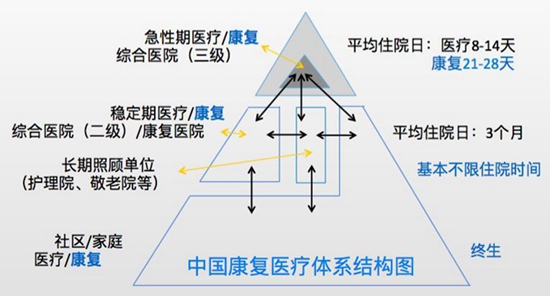
Diagram of the Structure of China's Rehabilitation Medical System
As shown in the figure above, rehabilitation needs at different levels represent distinct entrepreneurial opportunities. Currently, well-capitalized players, such as listed companies, are predominantly opting for asset-heavy models—such as establishing specialized rehabilitation centers—to capture shares of the rehabilitation medical market; Tasly is a notable example. Additionally, capital firms that have acquired general hospitals are also entering the rehabilitation market to a certain extent.
However, for many startups, leveraging the unique features and advantages of smart hardware and internet-based healthcare to target the community and home rehabilitation market represents a lower-cost, more affordable entry point.
Lin Xu stated that 80% of patients have rehabilitation needs following clinical treatment. In addition to well-known cases involving severe conditions such as trauma or stroke, many patients with chronic diseases and individuals in a sub-health state also require rehabilitation, which entails extensive patient education on rehabilitation.
After obtaining dual degrees in Business Administration and Psychology from Canada in 2008, Lin Xu returned to China. He initially worked at Jiangsu Tianrui, a rehabilitation medical device company, and later became its distributor in the Guangdong region. Years of experience in the rehabilitation industry enabled Lin Xu to recognize the vast market potential of rehabilitation healthcare. His motivation for founding Jiajiakang in 2012 was to categorize the diverse range of rehabilitation needs and identify those suitable for home-based care.
The R&D team at Jiajiakang spent over two years developing a smart home rehabilitation device—the Kubao Smart Pulse Therapy Device.
This device is specifically designed for soft tissue injuries in younger populations, such as joint sprains, muscle soreness, and inflammation, and features dual capabilities for both injury diagnosis and treatment. In traditional models, injuries are typically diagnosed by physicians, with devices serving only a therapeutic function. Therefore, a major challenge facing home-use medical devices is how to bridge the gap in professional knowledge and skills between users and doctors or physical therapists within a short timeframe, enabling users to operate the devices correctly to ensure therapeutic efficacy.
Lin Xu provided VCBeat with a trial of the device. After downloading the KuBao app and pairing it with the device, users simply need to follow the in-app instructions to operate the equipment. First, they use the probe to precisely locate the injured area, and then apply electrode pads to the affected site for treatment. These two straightforward steps guide users through both diagnosis and therapy independently, enabling KuBao to deliver therapeutic efficacy comparable to that of medical-grade devices.
According to Lin Xu, the pulse device primarily operates on two core mechanisms. The first is bioelectrical impedance measurement technology, which involves delivering a small alternating current and voltage to the subject via an electrode system placed on the body surface. It then detects the corresponding electrical resistance and its variations, thereby acquiring relevant physiological and pathological information based on specific application objectives to complete the diagnostic process.
Adaptive neuroelectric stimulation therapy is characterized by the delivery of bidirectional, sinusoidal, asymmetric oscillating pulses at frequencies between 90 Hz and 100 Hz to the human body. The waveform of these pulses closely resembles that of endogenous neural electrical signals, thereby enabling more effective activation of peripheral nerve receptors and achieving superior therapeutic outcomes.
Jiajiakang’s R&D team comprises senior technical experts from Huawei and BAT (Baidu, Alibaba, and Tencent). Its Chief Scientist, Hu Yidan, is a graduate student in the Department of Rehabilitation Medicine at Sun Yat-sen University. She has participated in three national-level research projects and published two SCI-indexed papers.
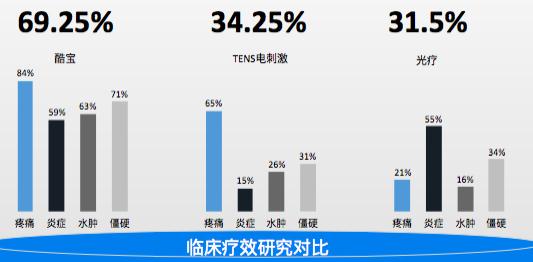
Comparison of Clinical Efficacy Studies on the Kubao Pulse Device
According to Lin Xu, since its launch in January 2016, the Kuobao Pulse Device has sold over 10,000 units, with a daily active user rate exceeding 20%. In late July, Jiajiakang will upgrade the Kuobao product line by adding features such as fitness tracking and insomnia treatment.
The company is also expanding into multiple channels, such as insurance and fitness centers. For instance, it has partnered with Wukong Bao, a customized internet insurance service provider, to launch related insurance products. Additionally, it is collaborating with the rehabilitation clinic “Qingsongxia” to introduce professional rehabilitation programs.
Existing traditional rehabilitation service models are predominantly institution-centric, relying on physicians, rehabilitation therapists, and specialized equipment to deliver rehabilitation services.
This model has three major pain points: excessive time costs, high treatment expenses, and poor patient adherence, which significantly undermine the effectiveness of rehabilitation therapy. These factors also clearly restrict the development of the rehabilitation healthcare industry.
If hospital-based rehabilitation medicine were fully adapted to home settings, enabling everyone to conveniently access professional rehabilitation medical services, the potential of the rehabilitation healthcare market would be fully unlocked.
Jiajiakang aims to leverage intelligent rehabilitation devices, such as pulse therapy instruments, to shift certain steps in the medical process to patient self-management, thereby reducing the demand for healthcare professionals. Meanwhile, software-driven data collection facilitates the development of unified analytical models, promoting greater standardization in rehabilitation therapy. Ultimately, remote physicians can analyze patient data and related materials to formulate diagnostic conclusions and prescribe treatment plans, enabling patients to undergo therapy at home. By advancing the home use of medical equipment, democratizing professional skills, digitizing industry-standard data, and delivering rehabilitation services remotely, Jiajiakang seeks to establish a comprehensive, one-stop home-based rehabilitation medical service system.
According to Lin Xu, Jiajiakang is collaborating with the Second Affiliated Hospital of Soochow University to provide thousands of sets of user rehabilitation data from Jiajiakang for research on rehabilitative treatment of soft tissue injuries. Collecting such large-sample data through traditional manual methods would be virtually impossible.
In addition, the rehabilitation medical market is also benefiting from numerous favorable policies. In March 2016, the National Health and Family Planning Commission, in conjunction with five other departments, issued the "Notice on Including Additional Medical Rehabilitation Services in the Basic Medical Insurance Coverage," requiring that by June 30 of that year, 20 new rehabilitation services—including "comprehensive rehabilitation assessment"—be added to the list of reimbursable items under basic medical insurance, expanding upon the original nine covered rehabilitation services.