

How Winning Health Navigated Its Strategic Investment in KeyCircle with RMB 60 Million in Capital Increases Within One Year
Zhou Wei served as General Manager of Shanghai Tiger Technology Development Co., Ltd. and as Chairman and President of Shanghai Kingstar Winning Medical Information Technology Co., Ltd. from 1993 to 2004. He joined Winning Health in 2004, where he subsequently held the positions of Chairman and President.
As the chairman of Winning Health, China’s first publicly listed company purely focused on healthcare information technology (HIT), his connection with this obscure company is indeed thought-provoking. Just as various parties were striving to uncover the intricate ties between these two companies, Winning Health’s subsequent series of actions clarified the entire situation. The following presents VCBeat’s independent perspective (WeChat Official Account: vcbeat).
1Winning Health's Combination Strategy
On October 27, 2015 (please note this date), Winning Health Technology Group Co., Ltd. issued an announcement stating that it, together with Sinopharm Health Industrial (Shanghai) Co., Ltd. (hereinafter referred to as “Sinopharm Health”) and Zhou Wei, would collectively inject RMB 13.5 million in capital into Keyshiquan. Specifically, Winning Software contributed RMB 6.5294 million, Zhou Wei contributed RMB 441,200, and Sinopharm Health contributed RMB 6.5294 million. As a result, Winning Health acquired a 32.647% equity stake in Keyshiquan, becoming one of its largest shareholders. Meanwhile, Zhou Wei’s equity holding in Keyshiquan decreased from the original 76.92% to 27.206%, and Keyshiquan’s total assets surged from RMB 6.5 million at its inception to RMB 20 million.
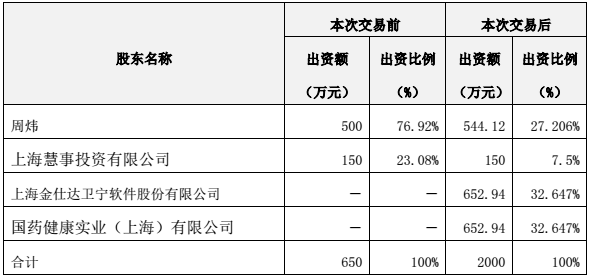
Key World Circle's First Equity Transaction Details
On June 13, 2016, Winning Health announced that it had signed an equity transfer agreement with Zhou Wei to acquire the 13.164% equity interest in Yaoshiquan held by Zhou Wei for RMB 2.6328 million. In addition, Shanghai Huishi Investment Co., Ltd. (hereinafter referred to as “Huishi Investment”) contributed RMB 1.5 million to complete the acquisition of a 7.5% equity stake in Yaoshiquan.
At this point, Winning Health’s stake in Yaoshi Circle surged from 32.647% to 45.811%, while Sinopharm Health maintained its unchanged holding of 32.647%. The newly added Huishi Investment held a 21.542% stake. As for Zhou Wei’s remaining shares, Winning Health acquired a portion of his equity in Yaoshi Circle based on his initial capital contribution cost, and the remainder was transferred to a management team holding company to incentivize the management team. Consequently, Zhou Wei’s shareholding dropped directly from 27.206% to zero. Thus, from this juncture onward, Yaoshi Circle completed its integration and officially entered a phase of absolute control by Winning Health (things are starting to get interesting).
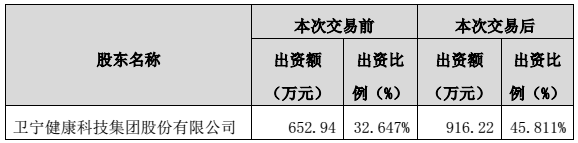
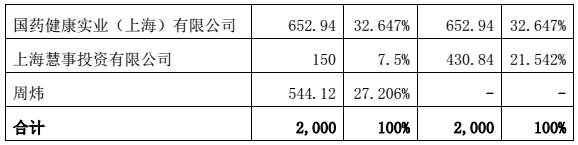
Details of Key World Circle’s Second Equity Transaction
On July 25, 2016, Winning Health Technology Group Co., Ltd. issued another announcement stating that Keyshiquan, Winning Health, Sinopharm Health, Huishi Investment, and Shanghai Qianji Xinghe Venture Capital Center (Limited Partnership) (hereinafter referred to as the “Qianji Xinghe Fund”) jointly signed the Capital Increase and Share Expansion Agreement, under which the Qianji Xinghe Fund agreed to make a unilateral capital injection of RMB 50 million into Keyshiquan (of which RMB 4 million would be recorded as Keyshiquan’s registered capital, and the remaining RMB 46 million would be recorded as Keyshiquan’s capital reserve). Upon completion of this capital increase, Keyshiquan’s registered capital would increase from RMB 20 million to RMB 24 million, and the Qianji Xinghe Fund would hold a 16.667% equity interest in Keyshiquan.
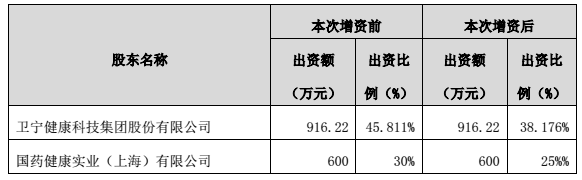

Key World Circle: Details of the Third Equity Transaction
In other words, within a mere nine months, Keyshiquan achieved a capital premium of more than tenfold (Keyshiquan’s growth momentum has been exceptionally strong). Additionally, what exactly is this “mystery” entity known as Qianji Xinghe Fund, which suddenly emerged on the scene? Stay tuned as we delve deeper below.
On July 1 last year, Qianji Xinghe Fund obtained the Business License issued by the Shanghai Xuhui District Administration for Market Regulation. Who is the investor behind it? Winning Health.
On May 27 this year, Winning Health Technology Group Co., Ltd. once again announced the joint establishment of the Qianji Xinghe Fund with five enterprises, including Shanghai Gopher Xinxi Investment Center, Shanghai Gopher Pengli Investment Center, Shanghai Venture Capital Co., Ltd., and Puzhong Xincheng Asset Management (Beijing) Co., Ltd. The fund raised a total of RMB 756.65 million, among which Winning Health committed RMB 40 million, accounting for 5.28% of the total capital contribution.
At this point, everything has become clear. This is a typical case of corporate internal entrepreneurship followed by M&A. Zhou Wei, Chairman of Winning Health, established a new company, Shanghai Yaoshiquan Cloud Health, in his personal capacity. After steering the company onto the right track, he stepped back, allowing Winning Health to lead a capital increase and successfully complete the equity integration. To better manage and operate the assets of the rapidly expanding Yaoshiquan and to introduce professional investment capital, the successful investment in Yaoshiquan by the Qianji Xinghe Fund was undoubtedly facilitated by Winning Health’s intermediation.
2Financial Status of KeyShiQuan
OK, having discussed the investment aspect, let us turn our attention back to KeyShiQuan. What exactly is its allure that has driven Winning Health to spare no effort in bringing it under its wing and continuously funneling resources to it?
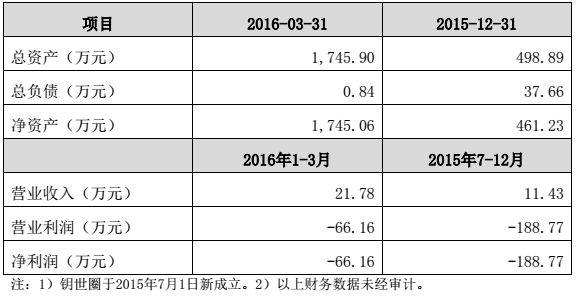
Key Financial Highlights of VBInsight (2015–2016)
An analysis of the financial statements reveals that Yaoshiquan’s operational performance was lackluster during the six-month period from its establishment in July last year to the end of the year. The company reported not only a meager revenue of RMB 114,300 but also a net loss of RMB 1.8877 million.
However, the company’s financial situation quickly shifted in 2016. In the first quarter, operating revenue increased by 3.8 times year-on-year compared to the previous two quarters, representing an increase of approximately RMB 155,000. Net profit and operating profit both rose by one-third year-on-year, with an increase of approximately RMB 280,000. This indicates not only steady profit growth but also increasingly effective cost control. Within less than half a year, the company had entered a phase of healthy growth, demonstrating that Yaoshiquan’s market positioning was sound.
Furthermore, the RMB 13.5 million capital increase from Winning Health, Sinopharm Health, and Zhou Wei has endowed Yaoshiquan with exceptionally ample total assets and nearly zero total liabilities. Warren Buffett once stated that a good company must meet at least three criteria: low operating costs, high profitability, and a low debt ratio. Judged by these three metrics, although Yaoshiquan has not been in operation for long, it already possesses the characteristics of a high-quality company.
One point that may cause confusion warrants clarification: in these financial statements, Yaoshiquan’s total assets as of December 31, 2015, amounted to only RMB 4.9889 million. Given that the company received a capital injection of RMB 13.5 million in October 2015, why is this not reflected? The reason is straightforward: Yaoshiquan did not complete its business registration change with the Shanghai Zhabei District Administration for Market Regulation until January 4, 2016. Consequently, this transaction does not appear in the 2015 financial report.
3Winning Health’s “4+1” Strategy
Having discussed the financial report, let us now analyze the business composition. As previously mentioned, KeyShiQuan’s product business holds significant strategic value for Winning Health. To clarify this point, it is essential to first understand Winning Health’s “4+1” strategy, which comprises Cloud Medical Services, Cloud Wellness, Cloud Insurance, Cloud Pharmacy, and an Innovation Service Platform.
According to Founder Securities’ interpretation, the “4+1” strategy (Cloud Healthcare, Cloud Wellness, Cloud Insurance, Cloud Pharmacy + Innovation Service Platform) represents Winning Health’s overall layout for its Internet-plus-healthcare services. Leveraging its coverage of more than 4,000 medical institutions in the traditional healthcare informatics sector, along with its in-depth understanding of user operations and the health services industry, Winning Health has developed a new suite of technologies, products, and innovative value-added services.
Winning Health currently fully owns and leads Yunyi, which serves as a direct extension of the company’s traditional business. Its products, including Winning Health Cloud HIS, Nali Health, and the Winning Health Cloud Hospital Platform, have already connected hundreds of medical institutions. Centered on tiered diagnosis and treatment and supported by physical hospitals, the Yunyi platform has been successfully implemented at Sir Run Run Shaw Hospital. To date, it has integrated more than 300 medical institutions and is poised for nationwide expansion across China, positioning itself as the core entry point and primary competitive barrier for the company’s healthcare big data initiatives.
Yunkang’s business directly interfaces with end consumers, adopting an equity participation model. By using health checkup management and chronic disease services as entry points, it extends into other areas of the broader healthcare sector, positioning itself to become a significant data gateway and monetization channel in the future.
The key focus is on Cloud Insurance and Cloud Pharmacy. From a business perspective, although Winning Health can leverage its years of advantage in Health Information Technology (HIT) to rapidly extend its services into traditional medical institutions and health check-ups, it faces significant challenges in the pharmacy and commercial insurance sectors.
In the realm of commercial insurance, Winning Health has indeed entertained the idea of “going it alone.” On September 14 last year, Winning Software issued a indicative announcement regarding its participation in the establishment of the “Huzhu Jia Internet Property Insurance Mutual Cooperative,” marking Winning Health’s formal foray into the commercial health insurance business.
However, contrary to expectations, data from late 2015 showed that in addition to Winning Health, there were 20 other projects applying to establish mutual insurance organizations, none of which received approval from the China Insurance Regulatory Commission (CIRC) that year.
Regarding the market entry of mutual insurance companies, Liang Tao, Vice Chairman of the China Insurance Regulatory Commission (CIRC), once provided a specific explanation: “Mutual insurance companies will be selected for pilot programs on a prudent basis, adhering to the principles of ‘gradual progress and risk controllability.’ Eligible market entities that are well-prepared and possess strong development prospects will be chosen. The market access process for mutual insurance will be advanced in an orderly, phased manner, alongside continuous improvements to review standards and access mechanisms.” Thus, the current situation is that while many are eager to rush through the door, the regulators are simply not “opening the gate.”
Consequently, Winning Health had to forge a new path. In April this year, it entered into a strategic partnership with China Life, a heavyweight in the insurance industry, whereby China Life made a unilateral capital injection of RMB 192 million into Winning Technology. Winning Health sought entry into the commercial health insurance market, while China Life was interested in Winning Health’s medical insurance cost-control system. The two parties quickly reached an agreement, marking the point at which Winning Health essentially brought the “construction team” for building its “Cloud Insurance” platform on board.
Unlike the insurance sector, the pharmacy retail industry is asset-intensive and its market is already mature. For Winning Health to enter this space through an asset-heavy model would not only incur prohibitively high costs but also yield suboptimal results; therefore, strategic partnerships are the only viable approach.
There are two options: first, to collaborate directly with chain pharmacies by leveraging one’s own advantages in informatization and management to exchange resources with the pharmacies’ offline channels; second, to partner with third-party platforms that handle informatization for chain pharmacies, utilizing their mature solutions to rapidly enter the market.
Both options were highly feasible, but Winning Health ultimately chose the latter due to considerations of time and cost. (It is worth noting that Zhou Wei, a major shareholder of Winning Health, is the founder of KeyWorld Circle; he was well aware of what Winning Health lacked.) With all favorable conditions in place—timing, location, and human resources—the emergence of KeyWorld Circle became a natural outcome.
Examining the business structure of Key World Circle now, one can sense a strong sense of purpose and targeted intent. According to the official statement from Key World Circle, “Key World Circle” is a homophone for “Pharmaceutical Affairs Circle.” It aims to integrate industry advantages such as Sinopharm’s drug supply system, physical pharmacy retail networks like Guoda Drugstore, hospital HIS systems like Winning Health, and pharmaceutical benefit management tools. By coordinating hospitals, pharmacies, pharmaceutical companies, basic medical insurance, and commercial insurance, it seeks to improve service efficiency for patients and insured individuals, reduce information asymmetry, and maximize social resources.
Currently, Yaoshi Quan’s product portfolio primarily includes pharmaceutical-related offerings such as the developed “Key Card,” “Keychain,” and “Cloud Pharmacy Platform.” As of June this year, the company has signed contracts with 10,000 pharmacies, distributed over 30,000 “Key Cards,” and partnered with six commercial insurance providers.
“The Key Card” services primarily encompass three aspects: First, users can make purchases by swiping the card for credit-based transactions within their personal account balance at designated physical pharmacies. Second, users can shop at specified online pharmacies (Kangaiduo, Jinxiang.com, and Haoyaoshi), complete the checkout process by providing delivery information, and finalize the transaction by entering the card number and password. Third, value-added services include appointment scheduling and health checkup packages through over 100 partner institutions nationwide in collaboration with iKang Guobin and Meinian Onehealth, as well as dental cleaning packages at 35 partner locations across China in collaboration with Arrail Dental.
In line with Winning Health’s platform-oriented strategy, the “Cloud Pharmacy” platform should possess two key characteristics: pharmaceutical distribution capabilities and comprehensive informatization capabilities. Yaoshiquan not only carries the genetic heritage of healthcare informatization, but it is also important to note that it is backed by the strong support of Sinopharm Health.
With the support of Sinopharm Health’s offline network, KeyWorld faces no shortage of pharmacies willing to integrate with its platform. Once commercial insurance operations are fully launched, it will naturally bridge the “Cloud Pharmacy” and “Cloud Insurance” platforms by leveraging its dual advantages as a medical insurance payer and a pharmacy access point. This integration will further consolidate its dominance in drug pricing, ultimately establishing a comprehensive Pharmacy Benefit Management (PBM) system.
In terms of business model, under the “Cloud Pharmacy” and “Cloud Insurance” frameworks, KeyShiQuan not only covers C-end users, but also pharmacies and pharmaceutical companies will become its payers. Therefore, based on the financial indicators from last year and this year, KeyShiQuan’s step-by-step vision is gradually being realized.
4Final Reflections
Regarding mergers and acquisitions, Zhou Wei, Chairman of Winning Health, once remarked, “No matter how favorable your conditions may be, a deal can only be finalized if both parties can reach an agreement. Even when all conditions are aligned, a partnership is not guaranteed. We place greater emphasis on achieving a ‘meeting of minds,’ as only through such alignment can we solidify our products, market presence, and marketing efforts, and deliver superior customer service.” Revisiting this statement in light of the KeyShiQuan case lends it even deeper significance. For more insightful content, please follow VCBeat (WeChat Official Account: vcbeat).