Shenzhen Pioneers China's First Medical Insurance Mobile Payment System with Tech-Driven Innovation
In mid-July, a progress table listing the names of numerous Shenzhen hospitals circulated online, detailing the work progress of Yunyi Technology, the technical contractor for Alipay’s Shenzhen Medical Insurance Mobile Payment Platform.
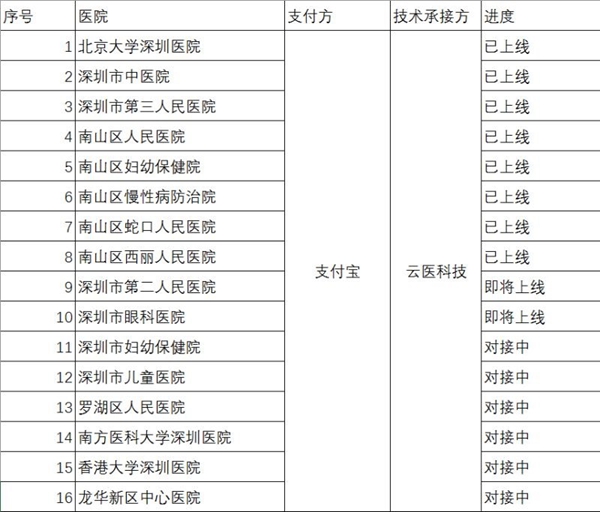
As shown in the table, as of the time the table was compiled, Yunyi Technology had simultaneously launched mobile payment services at eight hospitals, including Peking University Shenzhen Hospital, Shenzhen Traditional Chinese Medicine Hospital, Shenzhen Third People’s Hospital, and five hospitals in Nanshan District. Additionally, two hospitals—Shenzhen Second People’s Hospital and Shenzhen Eye Hospital—are scheduled to launch soon, while six other hospitals are currently in the integration phase.
It has been less than two months since Alipay announced its collaboration with the Shenzhen Human Resources and Social Security Bureau to launch a mobile payment platform for medical insurance, marking an astonishingly rapid rollout.
As the vanguard of China’s reform and opening-up, how did Shenzhen become the first city in China to implement mobile payment for medical insurance?
1Shenzhen Government Leads Smart Healthcare Initiative; Alipay Takes the Lead
The Shenzhen Smart Healthcare Project is a medical service platform led by government agencies and implemented with the support of third-party market entities. The primary partners in the mobile payment platform for medical insurance are the Shenzhen Human Resources and Social Security Bureau and Alipay.
On May 31, Alipay partnered with the Shenzhen Human Resources and Social Security Bureau to launch China’s first mobile medical insurance payment platform, initiating trial operations at six hospitals in Shenzhen. Starting June 15, Shenzhen residents can make online medical insurance payments via a mobile app at seven public Grade A tertiary hospitals, including Peking University Shenzhen Hospital and Shenzhen Traditional Chinese Medicine Hospital.
The rapid advancement of the mobile medical insurance payment platform, which was successfully launched in multiple public Grade A tertiary hospitals in Shenzhen within just half a month, underscores the considerable coordination and communication challenges involved. As a key department driving this project,The Shenzhen Public Hospital Management Center (hereinafter referred to as the “Shenzhen Medical Management Center”) has effectively managed and coordinated public tertiary Grade A hospitals in Shenzhen, rapidly advancing cooperation on mobile payment for medical insurance. This initiative has successfully enabled patients to access medical services via mobile platforms and alleviated the longstanding issue of “three long waits and one short consultation” in hospitals.Played a significant role in the smooth implementation of the Human Resources and Social Security Bureau’s “Smart HRSS” project.
Data shows that since the trial launch on May 31, the number of users making online payments by linking their financial social security cards to Alipay has been rising sharply on a daily basis. Currently, eight of the 17 pilot hospitals have gone live, with two more scheduled to launch in late July. If the well-performing Shenzhen model can be replicated and promoted to other cities, it will benefit more ordinary citizens across China, enabling all 1.3 billion people to enjoy tangible mobile healthcare services.
2Regional Platformization Breaks Through Medical Insurance Payment; Emerging Tech Players Provide Full Support
Under the active encouragement of the Shenzhen Municipal Government,Major Tech Giants Race to Capture Shenzhen’s Appointment Registration and Payment Market, aiming to seize the first-mover advantage in the vast future market, while innovative companies with unique technological strengths are also presented with excellent opportunities.
In this collaboration between Alipay and the Shenzhen Human Resources and Social Security Bureau, CloudMed Technology, which undertook the technical component of the smart healthcare project, has drawn particular attention.
To verify the authenticity of the content in the progress table at the beginning of this article and to obtain detailed updates, VCBeat contacted the relevant person in charge at Guangzhou Yunyi Technology Co., Ltd. (hereinafter referred to as “Yunyi Tech”).
The official stated that the integration progress shown in the table is largely accurate.In this project, Yunyi Technology integrated medical insurance, Alipay, and Hospital Information Systems (HIS) to create a four-party system. It also brought together eight entities in total, including the Shenzhen Healthcare Management Center, the Shenzhen Human Resources and Social Security Bureau, the Nanshan District Health and Family Planning Commission, and five hospitals in Nanshan District, fostering close multi-stakeholder collaboration. By leveraging a platform-based and regionalized approach, Yunyi Technology established an “Internet + Healthcare” operational platform. This enabled the simultaneous launch of services across eight hospitals within just over two months, creating a regional clustering effect and facilitating rapid, convenient information exchange as well as services such as triage and patient referral.
According to the official website, Guangzhou Yunyi Technology Co., Ltd. is located in the CBD of Guangzhou and is China’s first internet enterprise dedicated to integrating mobile internet with urban medical services. Its core product, “Yunyitong,” provides national-level smart healthcare solutions. By enabling interoperability and mobile access for public hospital information systems, it achieves unified management and standardized services across urban healthcare, thereby establishing a three-tiered mobile healthcare framework: one city, one province, and one nation.
YunYiTong enables urban residents to access a wide range of convenient healthcare services and experiences—including appointment scheduling, payment processing, report retrieval, 3-kilometer medical and lifestyle circles, medication delivery, and bed reservations—through a single account across all hospitals. It also centrally manages patients’ consultation records and medical history from different hospitals, thereby providing a solid and reliable foundation for the implementation of various healthcare services such as tiered diagnosis and treatment, family doctor programs, chronic disease management, and health management.
Yun Yi Tong also provides a big data support platform for government agencies in areas such as disease prevention and control, drug regulation, public health education, and oversight of medical services.
It is understood that the company’s co-founders hail from Fortune 500 companies and leading domestic enterprises. The entire team boasts many years of experience in the healthcare and internet sectors, having provided mobile health solutions to nearly 100 Grade A tertiary hospitals across China, with its technical development capabilities ranking among the industry’s leaders.