

How to Shed the 'Too Light' Label of Mobile Healthcare: Insights from Zhou Congjun of WeiWenZhen
On the evening of July 27,VCBeat (WeChat ID: vcbeat) invited Mr. Zhou Congjun, Deputy General Manager of Wei Wenzhen, as a guestVBGroup Interview, with70Multiple WeChat groups, exceeding2Tens of thousands of industry professionals engage in joint discussions“How to Shed the Label of “Too Light” from Mobile Health”this topic. Based on the interview transcript, Mr. Zhou Congjun’s insightful remarks are summarized below for our readers’ benefit.
Mobile Health: A Crowded Entrance, a Lonely Exit
Currently, there are two main perspectives and voices within the industry regarding mobile health:
The first view is that mobile health is dead, a rather extreme assertion made by many professionals;
The second perspective concerns mobile health startups: the entry point is bustling, but the exit is desolate. This reflects the predicament faced by many companies that rushed into the industry only to find themselves unable to identify viable revenue models or clear directions for growth.
Why Does This Situation Arise? An Analysis from the Perspectives of Physicians, Users, and Startups
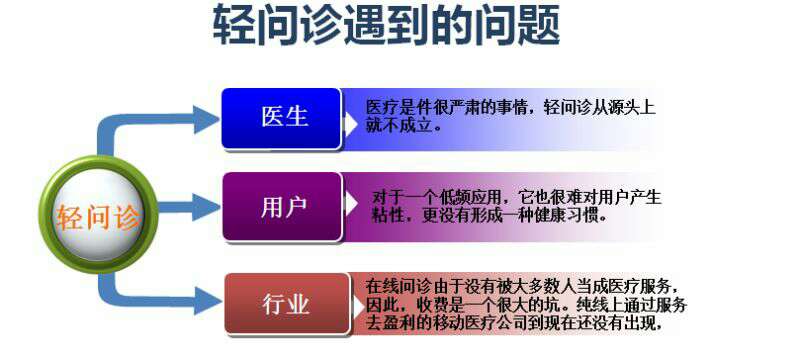
From the Physician's Perspective.Representing traditional physicians, hospital directors, and others, a significant proportion hold the view that healthcare is a highly serious matter, and that “light consultation” is fundamentally untenable from the outset. In particular, regarding the “light consultation” model initially proposed by Chunyu Doctor, they believe that text-and-image consultations cannot resolve practical clinical issues.
From the user's perspective.When health issues arise, users rarely turn to mobile healthcare as their first option. Instead, they have a wide range of alternatives, such as online searches and relying on family experience, which means mobile healthcare accounts for only a small fraction of these choices. Consequently, even the largest companies in the mobile healthcare sector find that their products remain low-frequency applications for users. It is difficult for users to develop genuine stickiness or habitual usage, posing a major challenge for the mobile healthcare industry today.
From the Perspective of Startups.From the perspective of mobile health startups, online consultations are not widely regarded as a medical service, which is why monetization in the mobile health sector has yet to gain traction. To date, no mobile health company has successfully achieved profitability through online fee-based models.
Therefore, from these three perspectives, mobile healthcare still faces numerous challenges. The underlying reason is that the light-consultation model has not gained acceptance among physicians and users.
How to Shed the “Too Lightweight” Label of Mobile Health
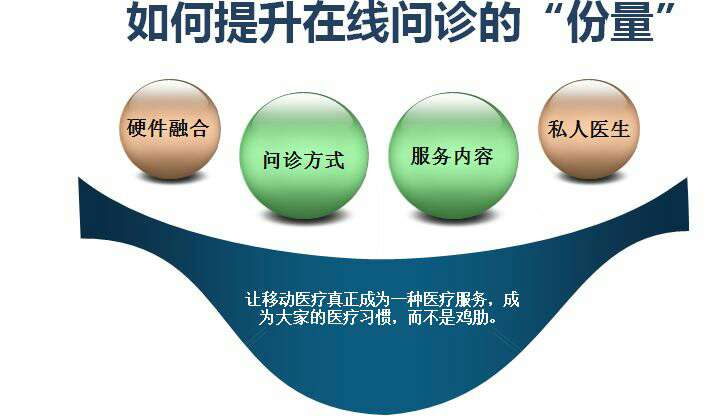
How to Enhance the Value of Online Consultations and Shed the “Lightweight” Label Associated with Mobile Health’s Brief Consultation Model? How Can We Gain Greater Physician Acceptance of Online Consultation Services, Improve User Adoption, and Encourage Patients to Pay for These Services? Through two years of development and exploration, Wei Wenzhen believes that efforts should be focused on four key areas.
First, transform the consultation approach. The so-called “light consultations” traditionally referred to text-and-image-based inquiries; however, current consultation modalities have expanded far beyond mere text and images.
Second, expand the scope of services. Mobile healthcare should not be limited to simple Q&A exchanges; we can also develop highly specialized, vertically integrated service offerings to create a closed-loop service ecosystem, thereby enriching the content of services provided to users.
Third, hardware integration. As diagnostic equipment becomes miniaturized and adapted for home use, mobile healthcare can be fully integrated with these devices to cover the entire process of traditional Chinese medicine diagnosis—inspection, auscultation and olfaction, inquiry, and palpation—thereby providing data-driven references and enhancing the efficiency and quality of our online diagnoses.
Fourth, private physician services. In China, the development of private physician services remains immature within the traditional healthcare framework. However, private physicians represent a high-quality health service model that has already been proven effective in China. By leveraging mobile health applications, it is possible to promote and expand private physician services, which also aligns with the nation’s overall strategic development goals.
Four Points to Transform Mobile Medical Consultation
To enhance consultation methods, consider the following four aspects:
The first point is the transition from text-and-image consultations to video consultations. Wei Wenzhen adopted video consultations from the outset, as we believe that video consultations are more timely, faster, and clearer than text-based communication, thereby making it easier to build user trust in physicians.
The second point is the transition from unfamiliar services to health management. The national "Three Ones Project" aims to provide every resident with a complete health record; however, due to limitations in the construction of medical information systems, this has not yet been fully realized. Therefore, in the development of mobile healthcare, electronic health records (EHRs) should be established for users from the outset. These records should include consultation histories, medical images, and clinical visit reports. With such data, users can better understand their health status and engage in corresponding health management. More importantly, these records are accessible to physicians during online consultations, thereby improving diagnostic efficiency and accuracy. This represents a significant advantage of mobile healthcare over traditional medical care.
Third, the shift from utilizing physicians’ fragmented time to providing dedicated, full-time services. In China’s mobile health sector—whether it be Chunyu Yisheng, WeDoctor, or Haodafu Online—platforms have relied on physicians’ spare moments to conduct text-and-image consultations. Precisely because these interactions occur during fragmented intervals, video consultations have not been feasible, as they demand a higher degree of time commitment and real-time availability from physicians.
Weiyiwen has adopted a model of dedicated, full-time physicians from the outset. Its physician workforce is built through two approaches: the first involves direct recruitment, having established a team of over 100 doctors; the second leverages technology to partner with hospitals in setting up online clinics, where hospitals manage scheduling and provide video consultations akin to offline outpatient services. Currently, only two companies in China operate self-built teams of dedicated, full-time physicians: Ping An Good Doctor and Weiyiwen.
Fourth, expanding from online services to offline presence. Mobile healthcare is a novel approach to delivering health and medical services; it should not be confined to smartphone apps but rather develop multi-channel capabilities. In addition to its app, Wei Wenzhen has established numerous service points in pharmacies, having signed agreements with over 10,000 locations to date—the most extensive offline network in China. Furthermore, the platform is accessible via smart TVs, enabling remote consultations through television interfaces. This is particularly beneficial for elderly users, who can conduct remote medical consultations from home using their TV remotes.
The Private Physician Phase Will Be the Hallmark of Mobile Health Success
Compared with traditional healthcare, mobile healthcare delivers its greatest value through lower costs, greater convenience, a stronger service orientation, and enhanced safety. The most critical change needed in the future is how people accept and approach health services. Currently, when individuals fall ill in their daily lives, only about 30% actually visit a hospital. So what do the remaining 70% do? Some self-medicate based on personal experience, others adopt a wait-and-see approach, some consult pharmacy sales staff, and others turn to Baidu for online queries—none of which are optimal strategies. Through mobile healthcare’s online consultations, particularly video consultations, patients can actually receive higher-quality care.
Private physician services represent an enhancement built upon online consultation platforms. As the public gradually embraces mobile healthcare, there is a natural progression toward more advanced service models and content, namely private physician services. With the implementation of mobile healthcare and private physician services, the longstanding pain points of difficult and costly access to medical care should be effectively addressed.
The difficulties and high costs associated with seeking medical care in China are not due to a shortage of medical resources, but rather to their uneven distribution. Drawing on successful international experiences, if the value of private physicians and mobile health services can be fully leveraged, accessing medical care will become significantly easier, as many healthcare issues can be managed at the primary care level.
Private physicians will represent the next phase in the development of mobile health; once mobile health reaches this stage of integrating private physician services, it will have achieved significant success.
Q&A Highlights:
Q:When it comes to online medical consultations, one cannot help but mentionTeldoc,Its pricing model is subscription-based.+Pay-per-visit. So how does WeDoctor charge and make a profit? What are the differences between China and the United States??
Weiyiwen is currently free of charge in China. This July, Weiyiwen partnered with the U.S.-based CyberMed to launch Cdoc, the American version of Weiyiwen, bringing its service model to the United States. The platform adopts a pay-per-visit pricing structure, with subscription-based options also available.
Q: In August 2015, CVS announced partnerships with three telemedicine providers—American Well, Doctor on Demand, and Teladoc—to enhance its telemedicine capabilities and services, thereby offering patients more access to healthcare. With 7,800 pharmacies across the United States, CVS expanded into telemedicine because prior surveys indicated that patients preferred receiving care through video or online consultations. How do you see the differences between the WeWenzhen model and the model implemented by CVS?
Cdoc’s business model and service offerings are broadly aligned with those of CVS. The differences lie primarily in certain details; for instance, CVS boasts significant resource advantages, including a network of 7,800 pharmacies through which it delivers remote consultation services. This model also encompasses the “MinuteClinic” concept previously adopted by some companies in the United States, where clinics were operated within supermarkets.
Thus, the competitive advantage of WeDoctor’s Cdoc in the United States primarily stems from its partnerships with over 200 hospitals, leveraging their physicians and patient access points to deliver online consultation services.
Q: Are trustworthiness and authority necessary conditions for online medical consultation platforms? Do you agree with this view?
I do not fully agree with this viewpoint. In providing mobile healthcare services, it is essential to establish trust, but it is not necessary to position oneself as an authoritative institution. Once authority is established, patients tend to seek out the most prestigious hospitals and doctors for all medical conditions, regardless of severity. This undermines the universal value that mobile healthcare aims to deliver. Therefore, while authority is not our strategic direction, trust is indispensable. Trust can be cultivated through attention to detail, such as assigning dedicated personnel to specific roles, implementing standardized protocols for physicians, and enhancing their professional competence and patience in patient care.
Q: Both Chunyu Yisheng and DXY are actively expanding their offline operations recently. Does the later stage of mobile healthcare development necessarily require a physical presence? Does Wei Wenzhen also have offline plans?
I believe that micro-consultation services must be implemented in practice, yet the approaches to implementing mobile healthcare vary significantly. Establishing clinics is one approach; facilitating the transition from online consultations to offline visits; managing offline referrals; and offering private physician services are all viable implementation models. Another model involves providing medication following initial consultations. Thus, delivering medical services necessarily requires an integration of online and offline components. The specific implementation strategy differs substantially across enterprises. Collaborations between micro-consultation platforms and pharmacies or hospitals represent critical aspects of practical implementation.
Q: What is the value of lightweight consultation for physicians?
Regarding the value of mobile healthcare to physicians, we have interviewed several doctors, many of whom feel that serving on mobile healthcare platforms has broadened their professional horizons. As an ordinary physician practicing at a single hospital, if the hospital is not well-known, the patient base one can serve is very limited. In contrast, within the mobile healthcare ecosystem, physicians can reach patients across China and even among overseas Chinese communities. This broader reach presents greater professional challenges while also enabling higher earnings. Furthermore, the greater flexibility offered by these enterprises is also highly valued by physicians.