

Galaxy Securities: Overview of U.S. Physician Group Development Models and Product Offerings
On July 28, the 14th edition of “Frontiers in Medicine,” organized by Li Pingzhu’s team at Galaxy Pharma, titled “Exploring Development Models for Physician Groups,” was held at the Beijing International Enterprise Building. Below is the content compiled by VCBeat (WeChat ID: vcbeat) based on the remarks delivered by Qu Wei, CEO of Huimei Medical.
The original intent of foreign physician groups is to focus on three areas: 1. assisting physicians with logistical and administrative tasks in the background; 2. enhancing physicians’ clinical practice capabilities; and 3. supporting physicians in improving their professional expertise through scientific research.
In the United States, physician organizations play a pivotal role in healthcare, as evidenced by: 1. Establishing medical standards and quality control systems, which constitute the core of healthcare delivery; 2. Providing healthcare management services; 3. Enhancing physicians’ business acumen and market competitiveness; 4. Collaborating with insurance companies: In the U.S., insurers are the primary clients of physicians and wield significant influence, enabling them to impose requirements on both healthcare institutions and individual practitioners.
In the United States, healthcare is divided into two tiers. The first tier comprises renowned medical institutions that closely integrate clinical practice with scientific research, such as Mayo Clinic, Massachusetts General Hospital, and Johns Hopkins Hospital. The second tier consists of clinics that provide consumer-oriented healthcare and routine services rather than cutting-edge treatments. These clinics include both general practices and specialized centers. For instance, although a respiratory sleep center is a specialized facility, it can still deliver standardized services. Such specialized practices place significant demands on business operational capabilities.
Three Practice Models for Physicians in the United States:Private practice (individual practitioners), physician groups (ranging from dozens to thousands of physicians practicing under the group’s umbrella), and hospital-employed physicians.In 2015, the distribution among these three models was as follows: physician groups accounted for the largest share (76%), followed by solo practice (17%), and hospital employment representing the smallest proportion (7%). Hospital-employed physicians are typically found only in very large institutions (such as Mayo Clinic and Johns Hopkins); however, at Massachusetts General Hospital, one of the premier hospitals in the United States, physicians primarily practice within physician groups. An analysis of trends from 1984 to 2015 reveals a substantial increase in the proportion of physician groups (group practice), a significant decline in solo practice, and fluctuations in the proportion of hospital-employed physicians.
Reasons for the Increasing Proportion of Physician Group Models:U.S. physicians are significantly influenced by insurance companies. Individual practitioners have limited negotiating power with insurers, whereas group practices possess stronger bargaining leverage. Physicians employed by hospitals may face more restrictions, but this arrangement also offers certain advantages.
The Rise and Fall of American Physician Groups:The United States began implementing managed care in the 1980s, leading to a gradual increase in physician groups. In the 1990s, the first physician group went public (PHP Healthcare). Driven by economic growth, the number of publicly traded physician groups peaked in 1998 at 39. However, as healthcare became increasingly influenced by economic factors, the sector was adversely affected following the burst of the internet bubble in 2000, with a downturn beginning as early as 1999. Subsequently, the physician group landscape saw significant consolidation through mergers and acquisitions at the capital level, reaching its lowest point in 2011 with only three publicly traded entities remaining. Since 2012, however, physician groups have shown signs of recovery. This resurgence has been fueled by the development of the internet, which has enhanced communication among physicians and created a greater need for organized structural arrangements.
Operating Models of Physician Groups:Physicians primarily interact with patients, hospitals, and insurance companies. Physician groups operate under two models: 1. Contracting directly with insurance companies (insurance-centric); 2. Contracting with hospitals, which then contract with insurance companies (hospital-centric). The most prominent example of the former is the Kaiser Permanente Medical Group, while an example of the latter is Sanctus Medical Group, which operates six large hospitals in its local area.
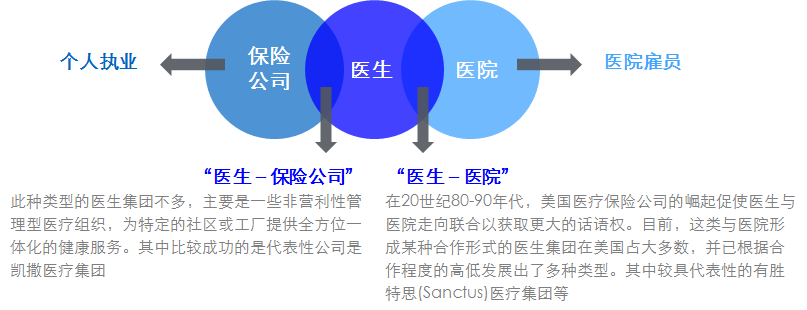
Examples of Physician Groups:
1. Kaiser is a very large physician group in the United States, with 9 million members and annual revenue of approximately $60 billion. The organization operates primarily as an insurer, with its own hospitals and physicians. A key feature of Kaiser is its low-cost insurance; however, this affordability comes at the expense of relatively basic medical care. Its user base consists mostly of young people (who have fewer health issues and perceive minimal risk in purchasing cheaper insurance). To control costs, the level and quality of medical services are limited (for example, in the event of a car accident, patients are first taken to a Kaiser-owned hospital because external hospitals would incur higher costs; transfer to other hospitals occurs only if treatment cannot be provided within the Kaiser system).
2. The Massachusetts General Hospital Physicians Organization (MGPO): Massachusetts General Hospital maintains partnership, rather than affiliation, relationships with leading institutions such as Harvard Medical School and Boston Children’s Hospital. Faculty members often hold dual roles, serving as department chiefs at the hospital and professors at the medical school. As physicians at Massachusetts General Hospital are contracted providers, they may advise patients during consultations, “Your condition is relatively straightforward and does not require care at Massachusetts General Hospital; you can schedule an appointment at my clinic on Tuesdays or Thursdays.” This practice exemplifies the referral system in the United States:Complex cases are treated at major hospitals, while routine, consumer-oriented cases are managed by clinics.
3. TriHealth Physician Groups: Comprising over 150 physicians across 20 specialties, serving 200,000 patients annually.
In the United States, physician groups with more than a few hundred doctors are rare, those with over a thousand are exceedingly scarce, and most consist of only dozens of members. The purpose of these physician groups is to enable doctors to band together when negotiating with insurance companies. In the U.S., it is very easy for physicians to attract patients, as patients’ primary consideration when seeking medical care is proximity and convenience. The mandatory pathway for patients seeking medical care in the U.S. follows a structured sequence: from a primary care physician to a specialist, and then to a large hospital, with arbitrary bypassing of these steps not permitted. There is no significant issue of difficulty in accessing medical care for patients in the U.S., nor is there a widespread shortage of patients for physicians; supply and demand have remained consistently balanced, with the ratio of physicians to the population served remaining stable for many years.
The relationship between physician groups and hospitals, from“Loose”To“Tight”In order:
Independent Physician Organizations:Doctors collaborate with insurance companies; physicians can provide outpatient services at various medical institutions, while insurers refer patients to them.
Open Physician-Hospital Organizations:Physicians rely on hospital resources such as equipment, nursing care, and inpatient beds; however, they remain economically independent from the hospitals. This independence is achieved through contractual revenue-sharing arrangements between the physicians (or physician groups) and the hospitals.
Tight Physician-Hospital Organizations:Physicians are required to align with hospital arrangements to provide collaborative medical services; in more advanced cases, they must sign exclusive agreements. As physician services become increasingly internalized within hospital organizations, hospitals have begun to provide physicians with a portion of fixed income.
Integrated Organization:i.e., hospital employees, such as those at Mayo Clinic.
For physicians, the advantages of private practice (such as physician groups in China today) include greater autonomy and higher income; the disadvantages involve handling numerous administrative trivialities and limited opportunities for advancement in scientific research. The benefits of being an employee at large institutions such as Mayo Clinic include higher social status, access to platforms that enhance research capabilities, and comprehensive benefits packages, including insurance and pensions.