Guizhou Province Adjusts Remote Consultation Pricing: National-Level Sessions Reduced to RMB 1,200 per Hour
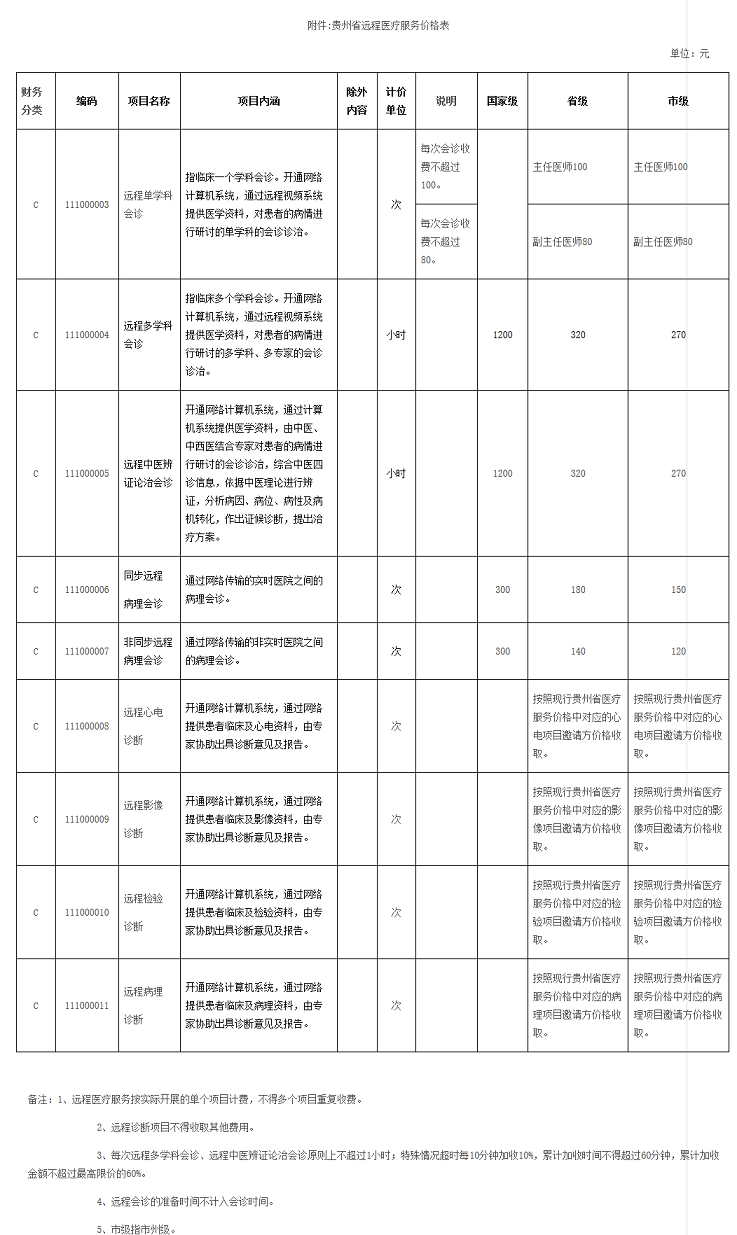
VCBeat (WeChat Official Account: vcbeat) learned from the official website of the Guizhou Provincial Health and Family Planning Commission that, to promote province-wide coverage of telemedicine and alleviate the financial burden of medical care on the public, the Guizhou Provincial Development and Reform Commission, in conjunction with three other departments, issued the "Notice on the Plan for Adjusting and Improving the Pricing of Telemedicine Services Provided by Public Medical Institutions in Guizhou Province." Service fees are charged on an hourly or per-visit basis. Among these adjustments, the price for national-level remote consultations has been reduced from RMB 1,550 per hour to RMB 1,200 per hour.
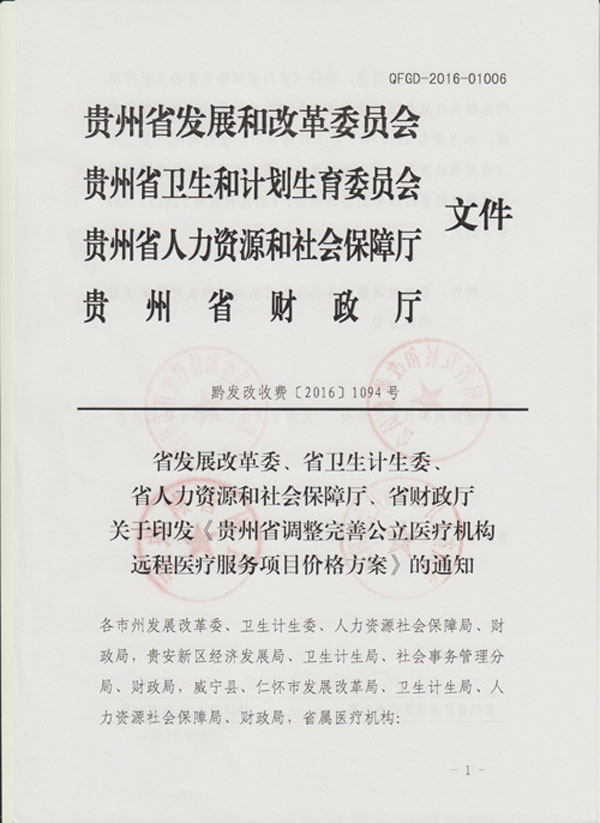
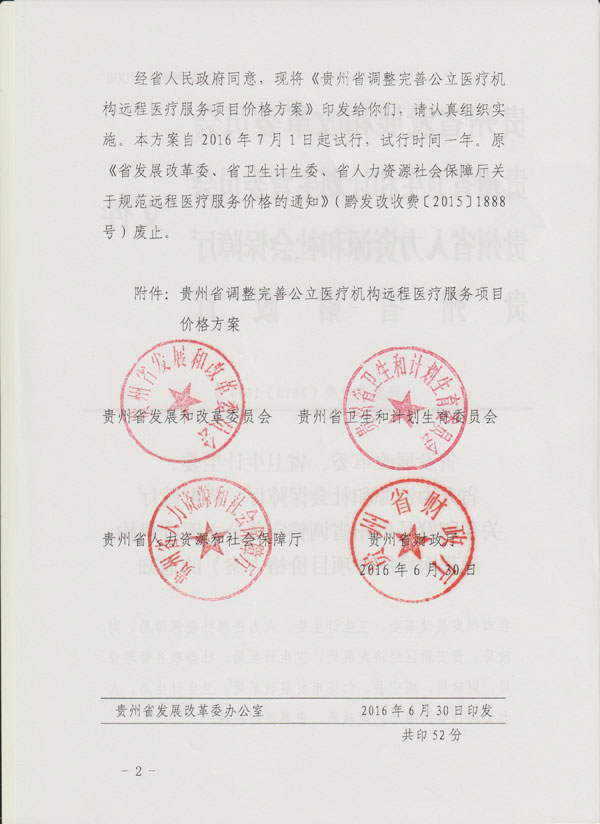
The following is the original text of the protocol:
I. Overall Objectives
Adjust and improve the pricing of telemedicine services by category and item, promote province-wide coverage of telemedicine, facilitate the downward flow of high-quality medical resources, effectively reduce the operational costs of telemedicine in public medical institutions at all levels, ensure that the financial burden on patients seeking medical care is not increased, and strive to provide satisfactory telemedicine services to the public.
II. Basic Principles
(I) Safeguarding Public Welfare
Uphold the public welfare nature of public medical institutions and prioritize the protection of people's health rights and interests. Establish a telemedicine service network covering the entire population to effectively safeguard the health of all people.
(2) Strengthening Cost Control
In accordance with clinical practice and cost-containment requirements, further standardize telemedicine service items and significantly reduce telemedicine costs. Include telemedicine services within the reimbursement scope of the Urban Resident Basic Medical Insurance, the Urban Employee Basic Medical Insurance, and the New Rural Cooperative Medical Scheme funds.
(III) Reasonable Benefit
In accordance with the principles of “fairness, impartiality, reasonableness, and mutual benefit,” establish a performance-based distribution mechanism for telemedicine services that fully mobilizes the enthusiasm of all parties and adequately reflects the technical and labor value of medical personnel.
III. Service Items and Pricing
(I) Standardized Items
Remote Consultation Projects: Remote Single-Specialty Consultation, Remote Multidisciplinary Consultation, Remote Traditional Chinese Medicine Syndrome Differentiation and Treatment Consultation, Synchronous Remote Pathology Consultation, Asynchronous Remote Pathology Consultation.
Remote Diagnostic Projects: Remote ECG Diagnosis, Remote Imaging Diagnosis, Remote Laboratory Diagnosis, Remote Pathology Diagnosis.
(2) Standardize Pricing
1. Prices for remote medical services provided by public medical institutions are subject to government-guided pricing. These services are categorized into four levels—national, provincial, municipal, and county-level—determined by the classification of the invited remote medical institution. Each public medical institution shall determine its actual implementation price for remote medical services within the bounds of the government-guided price.
2. When serving as invitees for telemedicine services, Guiyang First People's Hospital, Guiyang Second People's Hospital, Guiyang Maternal and Child Health Care Hospital, and Zunyi First People's Hospital shall apply the provincial-level pricing standards for telemedicine services.
3. The pricing for remote consultation services provided by county-level (including cities, districts, and special zones) public medical institutions to township or community medical institutions shall be determined by municipal-level authorities, but must not exceed 85% of the municipal-level price; for remote diagnostic services provided, the prices corresponding to the items at township or community medical institutions shall apply.
4. The pricing for remote consultation services shall be determined in accordance with the principles of “precise calculation and break-even operation,” taking into account appropriate compensation for medical personnel’s labor and the minimum costs of operation and maintenance. One-time government investments in information systems, equipment, and facilities for telemedicine services shall not be included as pricing factors. Remote diagnostic services shall be charged at the rates corresponding to the diagnostic items specified in the current Guizhou Province Medical Service Price List, with no additional fees for telemedicine services.
For specific items and pricing of telemedicine services, please refer to the attached document.
IV. Allocation Mechanism
Primary healthcare institutions that initiate telemedicine services shall serve as the inviting party, while medical institutions providing remote guidance shall serve as the invited party. Fees for telemedicine services shall be collected centrally by the inviting party and allocated according to the following principles, primarily to subsidize the labor costs of medical personnel.
(I) Remote Single-Specialty Consultation
Under the paired assistance model, all service fees are paid to the inviting party, while the invited party independently establishes subsidy standards for its own medical staff.
In the non-paired assistance model, all service fees are paid to the invited party, and the inviting party independently establishes subsidy standards for its own medical staff.
(II) Remote multidisciplinary consultation, remote TCM syndrome differentiation and treatment consultation, synchronous remote pathology consultation, and asynchronous remote pathology consultation
National-level consultation projects: All service fees shall be paid to the invited party, while the inviting party shall independently establish subsidy standards for its own medical staff.
For provincial- and municipal-level inter-provincial consultation services, the inviting party and the invited party shall negotiate to determine the distribution ratio of service fees.
For provincial-level and municipal-level consultation projects within the province, the service fees shall be distributed between the inviting party and the invited party at a ratio of 2:8.
(3) Remote ECG Diagnosis, Remote Imaging Diagnosis, Remote Laboratory Diagnosis, Remote Pathology Diagnosis
The inviting party and the invited party shall negotiate and determine the allocation ratio of service fees.
V. Improve the payment policies for funds of basic medical insurance for urban employees, basic medical insurance for urban residents, and the New Rural Cooperative Medical Scheme
By July 30, in accordance with this Plan, the Provincial Department of Human Resources and Social Security shall formulate payment policies for the basic medical insurance funds for urban residents and urban employees, while the Provincial Health and Family Planning Commission, in conjunction with the Provincial Department of Finance, shall further improve the payment policies for the New Rural Cooperative Medical Scheme (NRCMS) fund.
VI. Work Requirements
(I) Strengthen Publicity and Provide Active Guidance
All regions should, in light of local conditions, vigorously promote telemedicine services to ensure that the general public fully recognizes and understands the significant importance of the provincial party committee and provincial government’s major decision to achieve province-wide coverage of telemedicine—namely, its benefits to public welfare and support for grassroots healthcare—thereby expanding the influence of telemedicine and promoting its widespread adoption.
(II) Strengthening Leadership and Enhancing Coordination
The pilot implementation of the fee schedule for telemedicine services shall be jointly advanced by the Provincial Development and Reform Commission, the Provincial Health and Family Planning Commission, the Provincial Department of Human Resources and Social Security, and the Provincial Department of Finance. All localities and relevant departments shall, in accordance with provincial requirements, carefully organize efforts, cooperate closely, fulfill their responsibilities, promptly address emerging issues, regularly report on progress, and ensure that all work is carried out in a positive and prudent manner.
(3) Strengthening Management and Implementing Responsibilities
All public medical institutions shall strictly implement the price disclosure system by displaying prices in prominent locations through electronic screens, notice boards, price lists, and other means; and shall implement their respective cost settlement and subsidy systems in accordance with the allocation mechanism to ensure the orderly provision of telemedicine services.