

Putian Medical Innovation: New Platform Introduces 'Grab Order, Assignment, and Backup' Model for Radiology Services
On July 30, the “2016 Fujian Province Medical Imaging Big Data Application Summit Forum and Putian City’s 6th Health Information Technology Exchange Conference” was grandly held in the third-floor ballroom of the DoubleTree by Hilton Hotel Sandi in Putian, Fujian.
This summit, themed “Focusing on Health Big Data to Drive Future Medical Value,” was hosted by the Fujian Provincial Health Information Association and the Putian Municipal Health Information Association, and organized by Hangzhou Lianzhong Medical Technology Co., Ltd. During the conference, the Putian Municipal Imaging Physician Contracted Service Platform for Grassroots Healthcare was officially launched. Mr. Zhang Qilin, Deputy Director of the Putian Municipal Health and Family Planning Commission of Fujian Province, provided an introduction to the platform.
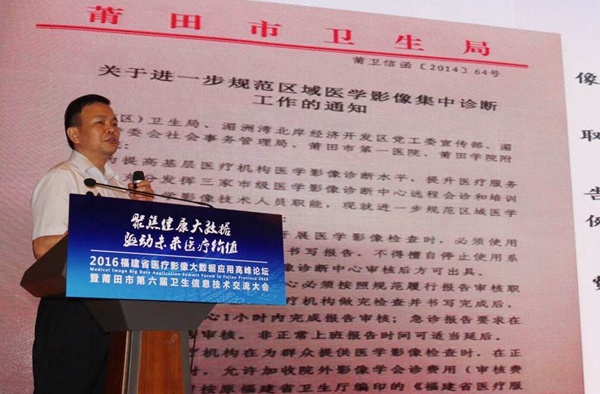
Mr. Zhang Qilin, Deputy Director of the Putian Municipal Health and Family Planning Commission, Fujian Province, at the conference venue
According to reports, Putian City began uniformly constructing a regional Picture Archiving and Communication System (PACS) across all medical institutions in the city in 2012, implementing centralized remote imaging consultations. Three municipal-level imaging diagnostic centers were established, each affiliated with one of three Grade A tertiary hospitals, to provide centralized remote imaging consultation services for 49 affiliated primary healthcare institutions. To date, over 120,000 imaging reports from these primary healthcare institutions have been reviewed and revised.
To further promote the centralized diagnosis of medical imaging in Putian City, the Putian Municipal Health Bureau has specially issued relevant regulatory notices to establish a supporting mechanism for the development of medical imaging.
1. It is mandatory to use the PACS system for imaging examinations; primary healthcare institutions are prohibited from issuing imaging examination reports without review by the Imaging Center;
2. Clarify the time limits for review by the Imaging Center: if the review exceeds 2 hours, the review fee will be waived; if it exceeds 24 hours, the review fee will be deducted.
3. Clarify the allocation of imaging examination fees: equipment examination fees, report writing fees, and report review fees shall, in principle, be distributed in a ratio of 70:15:15;
4. Clarify that primary healthcare institutions may charge an additional fee for imaging consultation, with such costs included in the reimbursement scope of the New Rural Cooperative Medical Scheme.
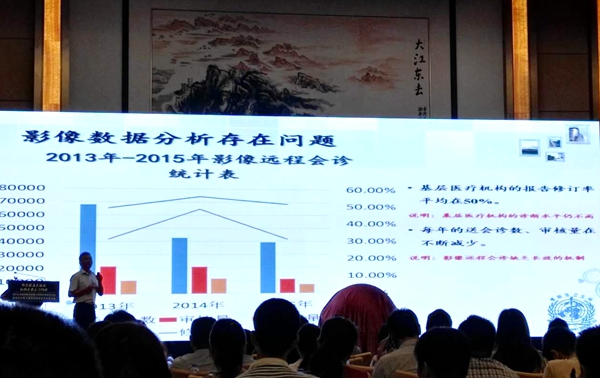
According to the statistical data of remote imaging consultations in Putian City from 2013 to 2015:The report revision rate at primary healthcare institutions averages 50%, with the annual number of cases referred for consultation and the volume of reviews steadily declining. In certain specific months, despite an increase in the number of referrals for consultation, the review rate at municipal medical imaging diagnostic centers has dropped sharply.These data highlight three issues in the development of imaging data:
The diagnostic capabilities of primary healthcare institutions remain suboptimal, and doctor-patient conflicts are predominantly concentrated within these settings.
Lack of a long-term mechanism for remote imaging consultations;
Settlement Issues with Remote Imaging Consultation Fees Lead to Decreased Enthusiasm Among Senior Physicians for Review
Since 2015, the Chinese government has vigorously promoted the “Internet Plus” initiative, supporting third-party institutions in building medical information-sharing service platforms for medical imaging, health records, laboratory reports, and electronic medical records. In response, Fujian Province has launched the “Project for Comprehensively Enhancing Medical Service Capacity,” advancing its health informatization infrastructure, implementing “Internet Plus Healthcare,” establishing the “Global Imaging Cloud,” promoting cloud-based imaging storage applications, and achieving filmless operations in hospitals.
The implementation of the Global Imaging Cloud has expanded the scope of Fujian’s regional PACS and promoted the application of “Internet + Healthcare,” yet it has not truly resolved the need for a sustainable, long-term mechanism to support remote imaging consultations. Therefore,To effectively address issues such as the timeliness of review in remote imaging consultations and to establish a long-term mechanism for remote imaging consultations, taking into account the actual situation of remote imaging consultations in our city, broaden horizons, innovate the model of remote imaging consultations, and build a grassroots platform for contracted imaging physician services.
The development of the grassroots platform for contracted imaging physician services is primarily divided intoEstablish an imaging expert pool based on voluntary contracting, implement a "first-come-first-served" assignment model with backup allocation, and strengthen imaging quality control as well as the graded evaluation of diagnostic capabilities at primary care levels.These four key areas. With the advancement of the signing platform, significant platform benefits will be demonstrated in five aspects.
1. The remote imaging consultation center has transitioned from a physical “hard center” to a virtual “soft center,” expanding the scope and expertise of imaging specialists. This transformation frees imaging experts from constraints of time and geography, facilitating remote consultations for primary healthcare institutions.
2. The contracting model has shifted from agreements between large hospitals and primary healthcare institutions to direct contracts between radiologists and primary healthcare institutions, while introducing a performance evaluation mechanism for physicians to enhance the sense of responsibility and motivation among radiologists;
3. The application of models such as order grabbing, assignment, and fallback mechanisms has resolved the limitations of the previous single consultation model. This not only expands the range of consultation options for primary healthcare institutions but also balances the interests of primary healthcare institutions, radiologists, and patients, achieving a win-win outcome for all parties and reducing patient waiting times;
4. By leveraging the third-party remote imaging consultation center integrated into the platform, it is convenient to provide consultations for complex and rare cases in Putian, while also offering a platform for radiology experts participating in free clinics.
5. Filmless imaging applications and centralized internet cloud storage enable real-time access to imaging data for both physicians and patients. QR code-based authorization facilitates expert consultations while safeguarding patient privacy. Meanwhile, it reduces hospitals’ investments in manpower and resources for imaging archival equipment, printed consumables, and optical disc recording.
Mr. Zhang Qilin stated that, following the establishment of a grassroots platform for contracted radiologist services, Putian City will continue to vigorously advance platform development and deeply explore its functionalities. Leveraging channels such as the “Healthy Putian” WeChat official account and mobile apps, the city will offer convenient services including examination appointment scheduling, payment processing, resident health record inquiries, proactive report delivery, and self-service imaging printouts.
Meanwhile, drawing on the new model of remote imaging consultations under the “Internet + Healthcare” framework, we will further expand internet-based remote consultation systems for laboratory testing, electrocardiography, chronic disease management, and pathology. This will advance the development of a tiered diagnosis and treatment system and strive to build a comprehensive virtual general practitioner platform. By leveraging statistical analysis, data mining, and analytics of health big data, we will enable intelligent clinical diagnosis, strengthen disease prevention, and promote health management.