

Mayo Clinic Files IPO Prospectus: Unveiling the Blueprint of America's Top-Ranked Medical Center
Founded in 1863, the U.S.-based Mayo Clinic is the largest and most technologically advanced integrated healthcare system in the United States. What are its distinctive features and experiences in building a healthcare system? The following content is compiled by VCBeat (WeChat ID: vcbeat) based on the remarks delivered by Qu Wei, CEO of Huimei Healthcare, the keynote speaker at the 14th session of Galaxy Securities’ “Pharma Frontier Talk” series.
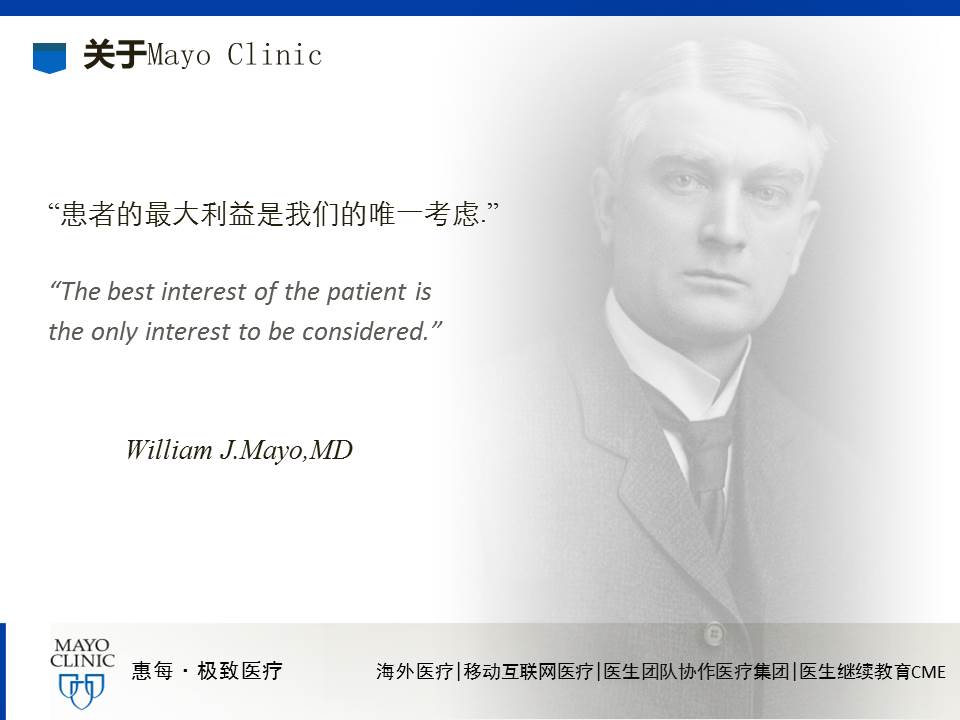
At Mayo, technology, research, and healthcare,All Centered on the Patient——“The patient’s best interests are our sole consideration.”
The physician compensation system ensures the quality of medical services: Physicians at Mayo Clinic are employees whose salaries are not tied to the volume of tests ordered or prescriptions written. They are paid an annual salary, with income levels that are relatively high and stable within the U.S. context (e.g., $500,000–$600,000 for specialties such as orthopedics and neurology, and $200,000–$300,000 for smaller specialties).
Patients are seen by appointment, with each session lasting one hour. A physician’s schedule is considered fully saturated after seeing seven to eight patients per day, leaving additional time for scientific research. Patient evaluations of physicians consist of satisfaction surveys focusing on service-related aspects (e.g., satisfaction with the ward environment, clarity of the physician’s explanations) and do not address clinical outcomes.
Mayo Clinic is a “patient-centered” healthcare institution: it strives to provide the best possible patient service, demonstrates care for patients in every detail of hospital operations, and ensures a comfortable experience for patients. Physicians engage in equitable communication with patients, focusing not merely on understanding the patients’ problems themselves, but on helping patients understand their own conditions. Through patient education and clear explanations, they enable patients to comprehend the causes of their diseases and the necessary lifestyle modifications.
MayoAchieving Countless Firsts in the History of Human Medicine:The discovery of cortisone in the 1950s earned a Nobel Prize. U.S. presidents across administrations have undergone surgery here, making it the “Supreme Court” of medical diagnosis and a global benchmark for healthcare. In the 2015–2016 U.S. News & World Report rankings of America’s Best Hospitals, Mayo Clinic ranked among the top ten in 15 out of 16 specialties, securing first place in eight (Diabetes & Endocrinology, Urology, Gastroenterology & GI Surgery, Geriatrics, Gynecology, Nephrology, Pulmonology & Lung Surgery, and Neurology & Neurosurgery) and placing in the top three in four others. (By comparison: Massachusetts General Hospital ranked first only in Otorhinolaryngology; other listed hospitals are mostly specialized institutions, with none achieving more than two first-place rankings.) Furthermore, Mayo Clinic pioneered and excelled in implementing Multidisciplinary Teams (MDT). As early as the Civil War era, it assembled physicians from various departments to diagnose patients, initiating MDT practices at the outpatient stage (whereas in China, MDT is primarily applied to inpatients).
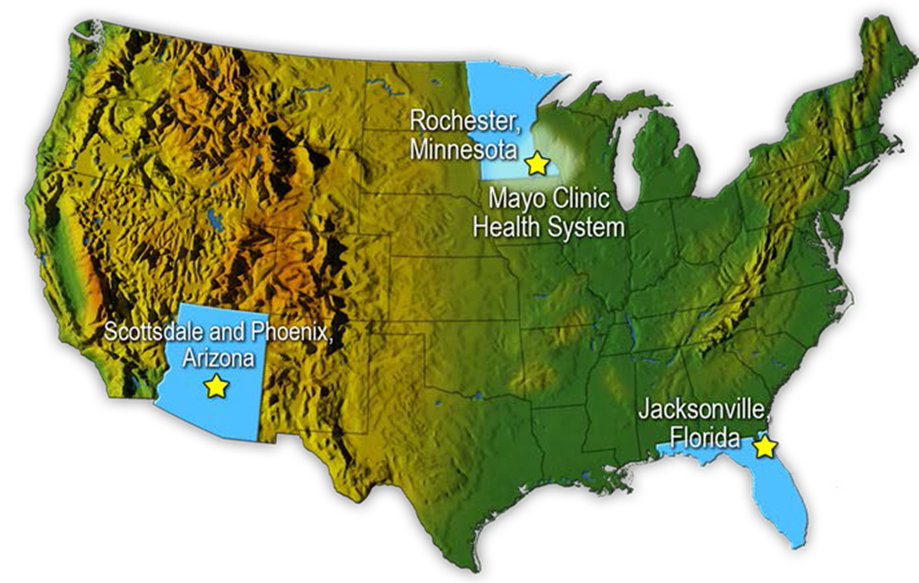
Mayo Clinic from a Data Perspective:Three campuses, with its headquarters in Rochester, a small city of only 100,000 people located north of Chicago in Minnesota, where 60,000 residents are Mayo Clinic employees. Mayo’s objective is to establish itself as the global destination for medical care. Additionally, it operates two branch campuses in Florida and Arizona. It was not until 2010 that these two branches achieved break-even status. Despite having been established for many years, they still lag behind the headquarters. This indicates that,Hospitals are not an industry for quick profits, but a long-term and sustainable endeavor.MayoAverage profitability and average profit margins.5%. The hospital employs nearly 61,000 staff members and serves patients from over 140 countries worldwide, including more than 1,000 Chinese nationals annually (such as Pan Shiyi).
In 1919, Mayo Clinic transitioned into a non-profit medical institution, channeling all hospital profits into the Mayo Foundation. The foundation makes external investments, with returns reinvested into the hospital. It does not distribute dividends, relying instead on reinvestment for continuous growth, and currently has an asset base of approximately $15 billion. Since 2000, the Mayo Foundation has also made investments in China, with its presence evident behind firms such as Sequoia Capital and Hillhouse Capital.
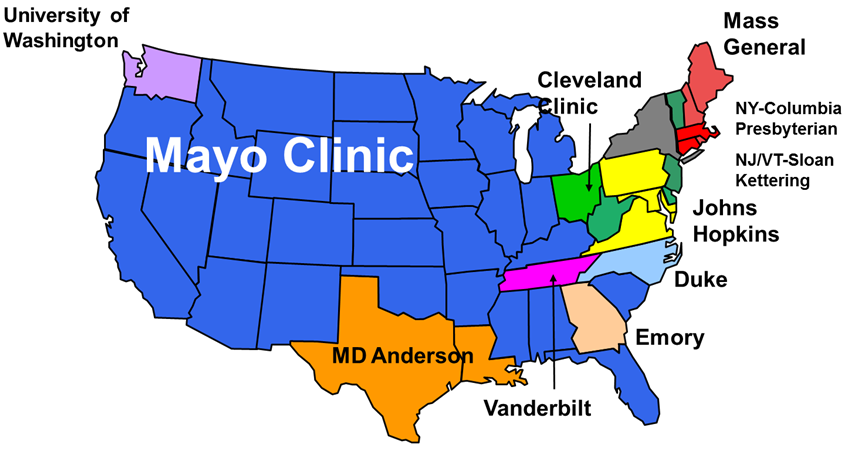
Radiation Impact Range of U.S. Hospitals:
Massachusetts General Hospital: Northeast
NewYork-Presbyterian Hospital: New York
Johns Hopkins: Eastern Region
Cleveland: Local
MD Anderson: South
Mayo Clinic exerts a monopolistic influence in the Midwestern United States.
Conclusion: Healthcare is localized; cross-regional healthcare is not a sustainable trend.。
MayoCore Health System:It is not an isolated hospital like Peking Union Medical College Hospital, but a complete tiered diagnosis and treatment system.
Primary Care: 70 Standardized Urban Clinics
General Hospitals: 17 Urban General Hospitals
Nursing Homes: 7, leveraging their strengths in orthopedics and neurology.
Conclusion: From general practice outpatient clinics to headquarters-based surgeries and top-tier scientific research, establishing a comprehensive healthcare system.
HeightITSmart Healthcare:Mayo Clinic has over 60,000 employees, but only 4,200 of them are physicians (7%), while it employs more than 7,000 IT staff (also 7%). Mayo Clinic provides a wide range of apps for patients and physicians, covering areas such as education and health management, delivering IT services valued at the billion-dollar level.
The “Health” app pre-installed on Apple iPhones was co-developed by Apple Inc. and the Mayo Clinic, with its underlying medical data supported by the Mayo Clinic. When searching for medical information on Google, the results displayed are highly professional and sourced from the Mayo Clinic. These global tech giants have chosen to partner with the Mayo Clinic for medical knowledge services, owing to its expertise in systematizing medical knowledge and its strong integration with information technology.
MayoHealthcare NetworkMCCN——Overseeing the Output of the Medical Knowledge System“Medical Consortium”
Hospital branding is central to Mayo Clinic’s strategy in the United States. With a brand valuation of $26 billion, Mayo Clinic ranks 16th among global brands. Exporting the Mayo brand is equivalent to exporting its medical knowledge system. Since 2011, more than 40 hospitals worldwide have joined the Mayo Clinic Care Network (MCCN). Membership in this network enables physicians and patients around the world to access Mayo Clinic’s expertise, making it a core strategic initiative for Mayo Clinic. (Currently, Raffles Medical in Singapore is the only Asian member; there are no members in China at present.)
Mayoincome:In 2015, Mayo Clinic’s revenue was approximately $10.3 billion, including $8.6 billion from medical services and about $500 million from donations, along with other income streams such as fees from the Mayo Clinic Care Network (MCCN). Beyond its hospitals, Mayo Clinic leverages additional resources, such as Mayo Medical Laboratories, which generates an annual revenue of $1.4 billion and processes more than 30,000 specimens daily from around the world. It collaborates with hospitals globally on diagnostic services—all of the top 20 hospitals in the United States partner with Mayo Clinic, and more than 4,000 hospitals or clinics across the country maintain collaborative relationships with it. (However, biological specimens from China are not permitted to leave the country. Therefore, Mayo Clinic has invested in establishing a diagnostic company in China and hopes to expand cooperation with China in laboratory testing in the future. Should there be a need for collaboration, the company can serve as a liaison.)
Mayo—The Success of the Physician Team-Based Collaborative Care Model
Multidisciplinary Practice, High Physician Compensation, and Peer Accountability Promote Team-Based Collaborative Patient Care (MDT Team Collaboration in Healthcare)
Robust logistical support organizations and technical infrastructure enable physicians and other healthcare professionals to focus on their core clinical competencies: hospital management operates along two distinct tracks—clinical and administrative.
Physician-Led Healthcare Management Model: Cultivating a Culture Where All Decisions Prioritize Patient Interests, with Departmental Leadership Rotating Among Physicians for Terms of 4–8 Years.
Coordinated Managed Care: A single physician coordinates care with other Mayo specialists and referring physicians.
A Deliberate Examination: One Hour of Patient Consultation.
Everything for the Convenience of Patients: Scheduling patients' fractionated appointments within a shorter cycle, with well-coordinated processes.
Case: A 27-year-old patient in China was found to have testicular cancer with lung metastasis during a routine health examination. Multiple diagnoses in Beijing, Hong Kong, and other regions of China indicated that he had only five months left to live. After reviewing his medical records, the Mayo Clinic urged him to seek treatment in the United States within one week, as its physicians were confident there was an 85% probability of curing him. During the course of treatment, timely and rapid referrals among various departments led to a swift improvement in the patient’s condition.
MayoStandardization of Medical Knowledge:The influence of the Mayo Clinic system stems from transforming medical knowledge into a resource repository through teamwork. In the United States, patients can choose clinics nearby largely due to the standardization of medical care. Mayo’s success also lies in its collaborative approach to building a “knowledge library” of diseases within its IT systems, where conditions are described in a standardized manner, covering diagnosis, treatment plans, medication, prognosis, and more. Based on this foundation, Mayo has established standardized clinical pathways and developed a patient self-assessment system that allows individuals to input their symptoms for intelligent disease identification and narrowing down potential diagnoses. This June, Mayo’s collaboration with Google on the “Google Doctor” initiative, as well as its patient education and continuing medical education programs for physicians, are all built upon this knowledge base. In contrast, physicians in China lack a comparable level of standardization.
MayoExample of the Medical Consultation Process
6:30AM Laboratory (Blood and Urine)
8:00 AM General Internal Medicine Consultation
Supplementary Examinations (ECG, X-ray, Ultrasound, Stress Test, etc.)
Specialty 1
Specialty 2
Specialty 3
Supplementary Examinations (CT, MRI, Colonoscopy, Biopsy, etc.)
3:00 PM (Day 2) General Internist Provides Summary and Final Diagnosis
4:00 PM (Day 2) Specialist Consultation (1-4): Confirm the list of surgical or therapeutic procedures for the following day
Conclusion: The hospital provides a systematic arrangement, progressively involving additional physicians through preliminary examinations to conduct continuous evaluation and diagnosis of patients.
Mayo Clinic's Core Values:Mayo Clinic believes that value equals quality divided by cost—only by improving quality (including outcomes, patient safety, services, etc.) and reducing costs can hospitals enhance the value they deliver to patients.