

Konfuzi Files IPO Prospectus: Building an AI-Powered Medical Brain with Knowledge Graphs and Intelligent Diagnosis
When discussing the prospects of artificial intelligence and big data in healthcare, the first question that comes to mind is: What level of accuracy must these “cutting-edge technologies” achieve to enable large-scale adoption?
According to the latest test results from Beijing Kangfuzi Technology Co., Ltd., their intelligent diagnostic system has achieved an accuracy rate of over 90% for typical symptoms of common diseases, surpassing the symptom checker of a leading international medical clinic by 10 percentage points. Relevant data indicate that the average misdiagnosis rate in hospitals across China is approximately 30%.
To this end, VCBeat (WeChat ID: vcbeat) contacted Mr. Zhang Chao, founder of Kangfuzi, to gain an understanding of their intelligent diagnosis system from the perspective of its technical principles.
Beijing Kangfuzi Technology Co., Ltd. is a technology-driven company founded in 2015, dedicated to the research and development of artificial intelligence applications in the healthcare sector. Leveraging knowledge graph construction technologies—including knowledge extraction, reasoning, and representation—Kangfuzi has developed two core knowledge graphs: the “Medical Brain” and “Dietary Nutrition.”
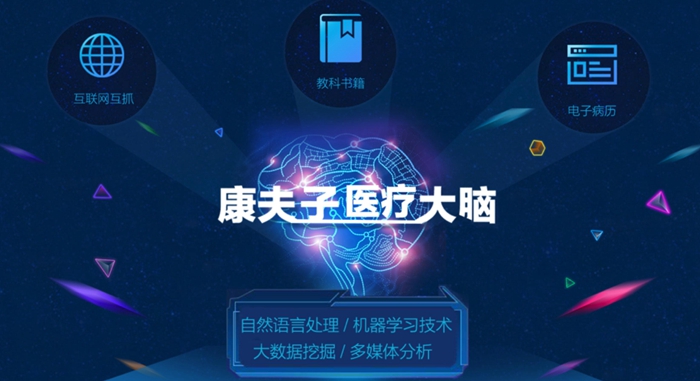
“Medical Brain” has been hailed by the industry as a “down-to-earth” clinical decision support and evidence-based medicine product. Built upon tens of thousands of medical textbooks, nearly one million clinical case records, and tens of millions of medical research papers, it ensures scientific rigor in its data foundation. Furthermore, by leveraging tens of millions of real-world consultation records in layman’s terms, it establishes lexical associations between colloquial medical language and formal medical literature, accurately mapping the general public’s descriptions of symptoms and understanding of diseases onto the framework of professional healthcare. “Medical Brain” effectively optimizes healthcare service workflows, enhancing both the efficiency of healthcare delivery and the overall performance of the industry.
In addition to its “Medical Brain,” Kangfuzi has launched China’s largest nutrition knowledge graph and developed the “Pregnancy Diet Assistant” app specifically for pregnant women, providing convenient and accurate dietary guidance during pregnancy to nearly one million users. Through search partnerships, Kangfuzi’s nutrition knowledge graph delivers data services to millions of pregnant women on a daily basis.
It is reported that the core team members of Kangfuzi all possess profound technical expertise in the industry. Founder and CEO Zhang Chao graduated with a degree in Computational Mathematics from the University of Electronic Science and Technology of China and conducted research in artificial intelligence at the National University of Singapore. He joined Baidu in 2010, serving as a Senior R&D Engineer in the Natural Language Processing Department and leading the text knowledge mining initiative. He is an expert in knowledge graphs and entity modeling.
Zhang Chong, CTO of Kangfuzi, graduated from the Department of Computer Science at Shandong University. A former Senior R&D Engineer at Baidu, he possesses extensive experience in architecture and engineering development. He joined Baidu in 2011, where he worked in the Web Search and Natural Language Processing departments on R&D related to search ranking, web page weight calculation, ontology knowledge bases, and knowledge graphs.
Li Zhipeng, CMO, is a former division director at the Disease Control and Prevention Department of the National Health and Family Planning Commission and a former attending physician at Beijing Ditan Hospital. He holds a bachelor’s degree from Peking University Health Science Center and a master’s degree from the University of New South Wales in Australia. With over 20 years of experience in the healthcare industry, he has amassed extensive clinical expertise and medical resources.
According toZhang ChaoIt was revealed that the high accuracy of intelligent diagnosis is mainly achieved through three steps: knowledge extraction, knowledge representation, and logical application.
Step 1: Knowledge Extraction, Analogous to a Physician's Retention of Medical Knowledge.The primary task of medical AI is to construct a medical knowledge graph, thereby supporting a series of applications. Knowledge graphs have long been a strategic focal point for major AI companies. Unlike tech giants such as Google and Baidu, which build their knowledge graphs based on semi-structured sources like Wikipedia and online encyclopedias, Kangfuzi has adopted an approach that extracts information from unstructured text. This strategy is driven by the complexity of medicine, where much of the knowledge remains embedded in unstructured texts such as textbooks, academic papers, and popular science articles.
Meanwhile, Kangfuzi possesses leading proprietary technologies in knowledge extraction: 1. Its system can automatically learn the “patterns” of documenting specific types of knowledge from massive volumes of literature, thereby enabling large-scale automated secondary extraction; 2. Kangfuzi has designed a high-performance computing framework to alleviate the complex computational demands involved in the preceding step.
Step 2: Knowledge Representation, Similar to How Physicians Accumulate Clinical Experience.After acquiring structured medical knowledge, Kangfuzi aims to endow this knowledge with reasoning capabilities. This is divided into two aspects:
1. Knowledge Quantification Based on Deep Learning: Diseases and symptoms are represented quantitatively to enable reasoning capabilities. For instance, when a patient reports “stomach discomfort,” the system interacts with the user to determine whether the specific symptom is “nausea,” “acid reflux,” or “bloating.”
2. Representation of Knowledge Relationship Weights: Many traditional probabilistic statistical models are built upon the assumption of independence, which is often unreasonable in practice. For instance, when inferring potential diseases from a set of symptoms, it is essential to account for the evolutionary logic among the symptoms.
Step 3: Logical Application, Similar to Physician Consultation Services.Constrained by the complexity of medicine and knowledge barriers, not only patients but sometimes even doctors fail to consider all aspects comprehensively. In such cases, the system needs to engage in intelligent interaction, analyze the patient’s condition, and pose smart questions to gather additional patient characteristics.
When discussing the differences in efficacy compared to traditional diagnostic products, Zhang Chao believes that traditional diagnostic thinking will quickly reach a bottleneck in terms of effectiveness, primarily due to four factors:
1. Knowledge Scale:Traditional diagnostic reasoning largely relies on manually curated knowledge bases, which are limited in scale. In contrast, Kangfuzi leverages advanced automated information extraction technologies, with its diagnostic knowledge base comprising over 5 million entries.
2. Knowledge Update:Taking lobar pneumonia as an example, its classic symptom is “rust-colored sputum.” This knowledge was discovered decades ago and is widely documented in various clinical knowledge bases. However, in contemporary clinical practice, patients with lobar pneumonia often do not present with rust-colored sputum. This is because a significant proportion of patients self-administer antibiotics such as amoxicillin in the early stages, which can suppress or prevent the appearance of this characteristic sign. The lag in information updates within traditional diagnostic tools has consequently led to a decline in diagnostic accuracy.
3. Knowledge Reasoning:Traditional diagnostic reasoning mostly adopts a decision tree structure. For instance, when a patient presents with chief complaints such as “toothache, cough, and headache,” conventional diagnostics would typically lean toward a diagnosis of periodontal disease upon noting the “toothache.” In contrast, Kangfuzi Intelligent Diagnosis leverages knowledge-based reasoning to determine that the “toothache” is caused by a cold, thereby providing a more accurate diagnosis.
4. Knowledge Representation:To make clinical tools truly “grounded,” significant effort must be invested in natural language processing, enabling machines to understand the diversity of user problem descriptions—a critical challenge that traditional diagnostic tools urgently need to overcome.
It is reported that the Kangfuzi Intelligent Diagnostic System has currently studied nearly 10,000 medical books and 20 million medical papers, constructing a knowledge graph encompassing knowledge on more than 10,000 diseases, thousands of symptoms, laboratory indicators, and drug responses. In version 1.0.1 released in mid-July 2016, it covered 5,000 common symptoms and 4,000 common diseases classified under ICD-10. For the symptom diagnosis section of physician licensing examinations, its accuracy rate for Top-1 hits (the single most likely inferred disease) exceeded 75%, and for Top-3 hits (the three most likely inferred diseases) exceeded 90%.
Regarding application scenarios, Zhang Chao explained that the essence of medical AI is to expand the supply of healthcare resources; therefore, it delivers significant value in settings where such resources are scarce. In terms of clinical decision support for physicians, medical AI can assist community doctors and general practitioners/family physicians in delivering better care. For patient services, it enables self-diagnosis and triage functionalities through B-side healthcare institutions. Meanwhile, Kangfuzi will also open up its medical knowledge graph to help healthcare institutions enhance the intelligence level of their products, such as Hospital Information Systems (HIS) and smart hardware.
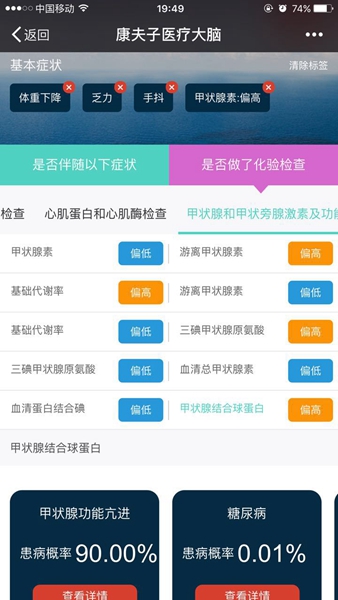
In terms of clinical decision support, Zhang Chao shared a case study: An intern at Kangfuzi visited the university hospital with chief complaints of “weight loss” and “fatigue,” but showed no improvement after medication. Later, at a tertiary Grade A hospital, the physician noted the patient’s “mild hand tremors” and recommended thyroid function tests, leading to a final diagnosis of hyperthyroidism. At this point, using the Kangfuzi WeChat demo would have revealed that, based on symptoms such as “weight loss,” “fatigue,” and “hand tremors,” the system could accurately suggest hyperthyroidism as a likely diagnosis. If laboratory findings such as “elevated thyroxine levels” were also provided, the probability of hyperthyroidism would be further increased.
Thus, it is evident that the Kangfuzi Intelligent Diagnostic System can significantly assist general practitioners in making diagnoses. The physician’s role is to listen to the patient’s description of symptoms, capture relevant information for input into the clinical decision support system, and ultimately formulate a treatment plan by integrating the system’s recommendations.
The Kangfuzi Plan is considering incorporating additional diagnostic features to improve diagnostic accuracy and even achieve personalized diagnosis, such as patient population characteristics (age, gender, time, geographic region, etc.), medical history, and lifestyle habits, thereby making diagnosis more intelligent. However, Zhang Chao stated that intelligent diagnosis is only one component of the “Medical Brain” (medical knowledge graph + reasoning logic). The aim is to use the “Medical Brain” to integrate various workflows, such as providing treatment recommendations, medication advice, and prognosis management following an initial diagnosis. To date, Kangfuzi has provided its knowledge core and related technical services to several well-known enterprises in the healthcare sector, including Baidu, 360 Search, COFCO Digital Health, and Shenzhen Jingbai Medical.