

AnalyticsMD Files IPO Prospectus: AI-Powered Hospital Decision Intelligence Platform Gains Traction
As artificial intelligence applications continue to expand across various sectors, VCBeat (WeChat ID: vcbeat) will publish a series of reports on the global “AI + Healthcare” landscape, covering typical case studies, investment and financing trends, and industrial strategic layouts, to provide insights for investors and entrepreneurs in the industry.
This article introduces to readersYesA startup providing intelligent decision analysis system technology for hospitals, the company focuses on addressing operational challenges in systems such as emergency departments and operating rooms, leveraging real-time data tracking, analysis, prediction, and optimization to enhance hospital operations.

The Future of Artificial Intelligence Lies in Creating Machine Algorithms with Deep Learning Capabilities. Traditional artificial intelligence systems rely solely on manual programming, whereas companies like Google DeepMind teach computers to think like humans and conduct in-depth data analysis, thereby enabling them to solve a wider range of practical problems. This advancement is particularly evident in the field of healthcare.
By collecting vast and complex medical data and analyzing it through unique algorithms, auxiliary decision-making information is provided to hospital administrators, doctors, and nurses. This helps healthcare institutions improve clinical outcomes, patient safety, cost optimization, and operational efficiency. Many entrepreneurs have seized this opportunity, aiming to leverage artificial intelligence to enhance the efficiency of care delivery between patients and hospitals. AnalyticsMD is a pioneer in this field.

AnalyticsMD is a startup that provides intelligent decision-making analytics systems for hospitals. Founded in 2013 and headquartered in Palo Alto, California, the company was co-founded by Mudit Garg, Brent Newhouse, and Ian Christopher. The team possesses extensive experience in the healthcare sector and big data processing.
Founder and CEO Mudit Garg previously worked in the Healthcare Practice at McKinsey & Company and is a seasoned technology engineer. Prior to founding AnalyticsMD, he had a successful entrepreneurial track record, having established Vdopia, which became one of India’s largest online video platforms.Mudit GargWe firmly believe that technology can help us solve practical problems more quickly and bring convenience to our lives.
Brent Newhouse graduated from the Stanford Graduate School of Business. He and Mudit Garg previously worked together at McKinsey & Company, where they focused on business analysis and research, demonstrating unique insights and a keen sense for emerging business models. After leaving McKinsey, Brent served as an Associate in Business Operations and Strategy at Google. His two years of experience there enabled him to identify more precise insights and strategic entry points when he assumed the role of Customer Success Manager (CSM) at AnalyticsMD.
As the team’s technical luminary, Ian Christopher was a quintessential academic achiever at the University of Rochester, specializing in deep learning algorithms for machines. He was a recipient of the Rush Rhees Scholarship and won first place in the 2010 ICPC Competition. He previously worked as a software engineer at Google and Microsoft. Starting in September 2011, he spent three months launching a digital project that automatically classified patents using machine learning techniques (such as NN and SVM), which shares commonalities with AnalyticsMD’s intelligent data processing algorithms. Ian Christopher’s extensive experience is precisely what AnalyticsMD needs to advance along its path toward artificial intelligence.
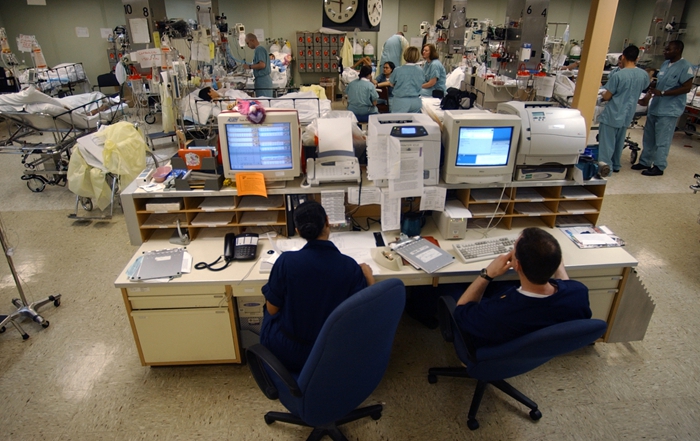
In response to the inefficiencies of traditional hospital management and the resulting waste of substantial resources, AnalyticsMD focuses on addressing operational challenges in systems such as emergency departments and operating rooms, leveraging real-time data tracking, analysis, prediction, and optimization to enhance hospital operations.
In the United States, annual healthcare expenditures approach $3 trillion, accounting for over 18% of GDP. More distressing is the fact that $750 billion of this amount is wasted. For instance, an operating room incurs a cost of $5,000 per hour even when no surgery is being performed. Waste of medical resources remains a persistent problem. Consequently, improving the efficiency of healthcare services has become a significant challenge for the government.
Most importantly, healthcare reform has far-reaching implications. The Affordable Care Act (ACA), signed into law by President Obama in 2010, introduced payment system reforms that replace traditional fee-for-service models—based on the volume and type of services provided—with value-based payment. It is estimated that nearly 80% of U.S. hospitals will adopt value-based care models by 2020. The reformed payment systems impose stricter requirements on cost control, service quality, and operational efficiency, thereby driving market demand for new medical technologies that enhance treatment efficacy and improve quality of care.
So, what is the actual patient experience in hospitals? In the absence of intelligent healthcare systems, it is common for patients to wait for hours at emergency department entrances without receiving treatment, or for medical staff and hospital beds to remain idle while there are patients in need. Co-founder Brent Newhouse explained that from the outset, the team decisively targeted the “hospital emergency department” as their entry point, providing hospitals with big data analytics and organization. This facilitates timely and accurate medical care for patients, shortens waiting times, and significantly enhances service efficiency and resource utilization for hospitals.
Not only ordinary chain hospitals, but also top-tier medical institutions such as Cedars-Sinai Medical Center, Stanford Children’s Health, and the Mayo Clinic—even highly digitalized hospitals like Caminus Hospital that have implemented Computerized Physician Order Entry (CPOE) systems—still face thousands of daily challenges for administrators and frontline healthcare staff, such as staffing allocation and estimated operating room occupancy times. Consequently, the overall efficiency of management and patient care processes remains low, placing high demands on physicians’ experience.
Currently, AnalyticsMD’s HIPAA-compliant SaaS system has been widely adopted by healthcare institutions in San Francisco. It aggregates detailed data from U.S. government healthcare websites, consolidating information on all medical facilities that accept Medicare and Medicaid funds. By leveraging its real-time analytics SaaS platform to analyze this data, the system generates actionable recommendations to support decision-making for hospital administrators and healthcare professionals.
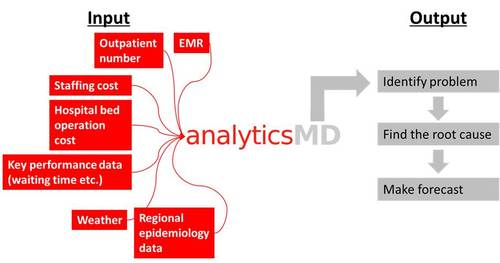
How to analyze the resulting massive datasets, output intuitive and actionable insights, and reduce the waste of medical resources is a formidable challenge for AnalyticsMD, as well as its key competitive advantage.
AnalyticsMD helps hospitals establish SaaS systems with two primary objectives. First, it enables hospital administrators to monitor current operational status and progress in real time, facilitating better decision-making and ensuring they remain competitive within the industry. Second, it aims to enhance the quality and efficiency of care for both patients and medical staff. For instance, resources such as healthcare personnel and hospital beds can be utilized immediately upon becoming available, thereby preventing situations where patients remain untreated at emergency department entrances. Furthermore, by leveraging data analytics from the AnalyticsMD system, hospitals can receive actionable insights, such as recommendations on how to help patients avoid treatment bottlenecks.
Previously, the key to reducing healthcare costs lay with frontline medical personnel, clinicians, and nurses, whose experience was critical in determining both cost and service levels. In reality, however, they are constantly managing one emergency case after another, leaving them no time to analyze extensive patient records to improve efficiency.
With the introduction of DecisionOS, a built-in feature of the AnalyticsMD development system, the landscape has changed. By extracting big data from hospitals’ own Electronic Medical Record (EMR) systems—compatible with most mainstream EMR platforms and encrypted to ensure HIPAA compliance—the system employs machine learning algorithms to automatically analyze, monitor, and predict outcomes. It provides clinicians with optimal recommendations, enabling them to deliver the most appropriate treatments and services to patients in a timely manner. Physicians no longer need to spend excessive time sifting through complex case reports and other data. As a result, key challenges related to patient safety, satisfaction, and healthcare cost control are effectively addressed.
Through large-scale machine learning predictions, analyzed metrics such as patient length of stay and patient volume, presented via data visualization, will provide healthcare professionals with enhanced decision support. By analyzing hospital-specific patient service data, root causes of issues such as insufficient ward or operating room capacity can be identified, thereby helping administrators optimize hospital resource allocation.
The market is vast, and investors have a keen sense of smell. Investment in the healthcare sector has shifted from wearable devices and telemedicine to digital therapeutics and startups focused on improving medical efficiency. Since its inception in spring 2013, the startup has attracted attention from the non-profit incubator StartX. In December 2014, AnalyticsMD secured $120,000 in investment from Y Combinator (YC). In April 2015, it received further funding from three institutions: Fenox Venture Capital, FundersClub, and Safa Rashtchy. As of May 2015, the company had raised over $720,000 in total investment.

How to Achieve Real-Time Feedback in Data Analysis? The core lies in DecisionOS—an intelligent algorithmic system that continuously evolves. By collecting comprehensive and extensive data, such as electronic medical records, admission and discharge registration systems, bed sensor data, emergency call data, and even external factors like weather, seasonal diseases, and local trending events that may impact medical decision-making, the system employs sophisticated algorithms to analyze this information. It enables immediate understanding and assessment of hospital operations. If issues are detected, the system rapidly identifies the underlying causes and provides optimal recommendations for optimization and resolution, facilitating resource adjustment and reallocation by administrators. In internal testing, the accuracy of predictive results consistently exceeded 90%.
DecisionOS delivers auxiliary decision-making support or early-warning alerts to doctors and nurses via SMS or phone calls, enabling them to adjust their strategies in a timely manner.
In terms of pricing, AnalyticsMD calculates the computational complexity of its business functions based on different medical procedures offered by hospitals and charges fees on a quarterly basis after verification. Since the SaaS system eliminates the need for additional hardware costs and features highly secure encrypted data, it significantly enhances hospital operational efficiency, with technological advancements delivering tangible conveniences. In the future healthcare landscape, AnalyticsMD must maintain strict cost control to achieve widespread adoption; achieving optimal predictive and analytical outcomes at the lowest possible cost is the true path to corporate development, while everything else is merely noise.
Links to the Series:
$1.4 Billion in Global AI + Healthcare Financing from 2011 to H1 2016