

MedyMatch Files IPO Prospectus: Pioneering AI-Powered Stroke Diagnosis in Medical Imaging
As artificial intelligence applications continue to expand across various sectors, VCBeat (WeChat ID: vcbeat) will publish a series of reports on the AI + healthcare sector both in China and globally, covering typical case studies, investment and financing activities, and industry landscape developments, to serve as a reference for investors and entrepreneurs in the field.
This article introduces an emerging Israeli startup that applies artificial intelligence technology to the field of medical imaging, serving as a typical case study for entrepreneurship in the AI-plus-healthcare sector.
MedyMatch is an Israeli AI healthcare company dedicated to analyzing medical images using “deep vision and high-level cognitive capabilities.” The company was founded in October 2013.
Unlike other medical imaging companies, MedyMath specializes in stroke diagnosis, assisting radiologists and emergency physicians in detecting subtle abnormalities that are difficult to identify, thereby enabling accurate clinical assessment and ensuring that stroke patients receive appropriate and effective treatment.
According to data released by the American Heart Association, stroke is the fourth leading cause of death in the United States, and the cost of treating stroke is projected to rise from $71.6 billion in 2010 to approximately $183 billion by 2030. Dr. Gabriel Polliack, Head of Strategic Development at TEREM, Israel’s emergency medical center network, stated that despite advances in medical imaging technology, the rate of medical misdiagnosis has remained around 30% for decades.
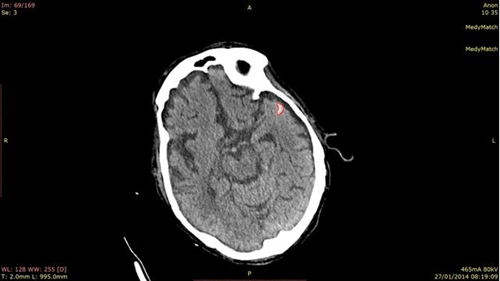
Medical Imaging
Stroke is primarily categorized into two types: hemorrhagic stroke and ischemic stroke. Hemorrhagic stroke involves the rupture of intracerebral arteries, causing blood to leak into brain tissue; this type accounts for approximately 30%–40% of all stroke cases. Ischemic stroke is characterized by clot formation within cerebral blood vessels, which impedes blood flow to other regions of the brain and results in cerebral hypoperfusion; it constitutes about 60%–70% of all stroke cases. The treatment approaches for these two types are fundamentally different. For patients with ischemic stroke, physicians prescribe anticoagulant medications to restore normal blood flow. Conversely, if a physician misdiagnoses the stroke type and administers anticoagulants to a patient with a ruptured cerebral vessel, the consequences could be catastrophic.
MedyMatch’s product is a software solution that extracts images from standard tomographic scans. Leveraging deep learning technology, the system establishes diagnostic benchmarks by importing a series of annotated case examples into the computer. Subsequently, as a series of images are uploaded, the computer “learns” to recognize the visual characteristics of hemorrhage. Through this training with annotated cases, the computer becomes capable of independently interpreting medical images.
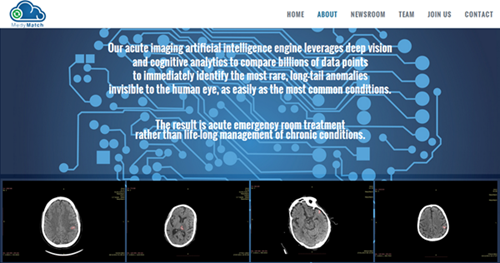
MedyMatch Website Image
The product is specifically designed for use in emergency rooms and intensive care units. The software leverages MedyMatch’s proprietary algorithms to process images in the cloud, annotate them with notes, and highlight key findings for physicians. Upon completion of these tasks, the software sends both the original images and the processed imaging data to the physician’s platform. For conditions such as stroke, where diagnostic and treatment speed is critical, MedyMatch’s software enables physicians to determine the stroke subtype within 3–5 minutes, thereby reducing diagnosis-to-treatment time and ensuring patients receive timely care.
Currently, MedyMatch has established partnerships with Hadassah Medical Center in Jerusalem, Israel, and Massachusetts General Hospital in Boston, USA, gaining access to billions of images from their millions of cases. Gene Saragnese, Chairman of the Board and CEO of MedyMatch, stated, “Our experts come from these hospitals, and they help us train our software’s image interpretation capabilities.”
Although this assessment cannot replace a physician’s clinical judgment, it provides doctors with an opportunity for self-reflection; if their initial assessment differs from the machine’s output, emergency department physicians will re-evaluate the case with greater caution.
According to VCBeat (WeChat: vcbeat), in addition to its clinical value, this software can also indirectly reduce nursing costs. MedyMatch is leveraging this to establish a gold standard for the healthcare industry—improving patient outcomes while lowering costs.
Compared with large hospitals, MedyMatch’s technology may be more suitable for township and village hospitals where professional expertise is somewhat lacking, as physicians in large hospitals are experienced and possess solid professional knowledge. In contrast, physicians in township and village hospitals may have relatively less experience; this software can precisely compensate for such gaps in clinical experience, thereby minimizing the risk of stroke misdiagnosis to the greatest extent possible.
In March 2016, MedyMatch secured $2 million in seed funding from Exigent Ventures and Genesis Capital. Genesis Capital is an Atlanta-based investment firm specializing in healthcare and biotechnology. This seed round enabled the company to pursue its goal of launching its AI-powered product in the first half of 2017. Following this round, MedyMatch is actively seeking a new round of financing amounting to $8 million.
Although some companies are dedicated to machine learning for medical imaging, their applications are predominantly focused on cancer treatment, leaving MedyMatch’s product without direct competitors at present. Given that stroke is a global health challenge and the product currently faces no competition, this presents a significant opportunity for the company’s global expansion.
However, Saragnese noted that MedyMatch also faces challenges, one of which is ensuring that its cloud infrastructure operates effectively to enable seamless upload of images from hospitals to the cloud. Such infrastructure is a key focus for industry giants such as IBM, General Electric, and Philips. He expressed hope that MedyMatch will be able to stand alongside these companies developing cloud infrastructure in the future.
In terms of its revenue model, MedyMatch is actively exploring multiple monetization strategies, one of which is a subscription-based approach, where hospitals pay less than $10 per use for image analysis with the software.

From left to right in the image above are Gene Saragnese, Netanel Peri, and Jacob Cohen.
Gene Saragnese serves as Chairman of the Board and CEO of MedyMatch. A graduate of Rutgers University with a degree in Mechanical Engineering, he previously held the position of Vice President and CTO of Global Technical Services at GE Healthcare, and served as CEO of Philips Medical Imaging Systems.
Netanel Peri is the founder and Chief Innovation Architect of MedyMatch. A law graduate of Bar-Ilan University, he previously served as Vice President at B-Cure Laser, a smart hardware company specializing in the research and development of devices for massaging painful areas.
Jacob Cohen serves as Co-founder and CTO of MedyMatch. Dr. Cohen earned his Ph.D. in Condensed Matter Physics from Ben-Gurion University. He previously worked as a Project Manager at Applied Materials and as a Product Manager at Orbotech.
Meanwhile, MedyMatch boasts a professional team of medical advisors, including Michael Lev, Director of the Emergency Radiology and Acute Care Center at Boston City Hospital and Professor at Harvard Medical School; Professor Moshe Gomori, Director of the Magnetic Resonance Imaging and Therapy Center at Hadassah Medical Center; and Gabriel Polliack, Chairman of the Diagnostic Imaging Center at the American College of Radiology.
Links to the Series:
Global Financing in AI + Healthcare Reached $1.4 Billion from 2011 to H1 2016