

National Health Commission Eases Restrictions on Private Healthcare Providers and Strengthens Tiered Diagnosis and Treatment System
On August 8, the National Health and Family Planning Commission issued the Guiding Principles for the Planning of Medical Institution Establishment (2016–2020) to guide localities in strengthening the management of medical institution establishment during the 13th Five-Year Plan period.
The following is the original content:
In accordance with the Regulations on the Administration of Medical Institutions, the Notice of the General Office of the State Council on Issuing the Outline Plan for the National Medical and Health Service System (2015–2020) (Guo Ban Fa [2015] No. 14, hereinafter referred to as the “Outline Plan”), and other relevant provisions, the Guiding Principles for the Planning of Medical Institution Establishment (2016–2020) (hereinafter referred to as the “Guiding Principles”) are hereby formulated. Local health and family planning administrative departments at all levels shall formulate the Plan for the Establishment of Medical Institutions within their respective administrative areas (hereinafter referred to as the “Plan”) in accordance with the Guiding Principles. The establishment of medical institutions shall fully leverage the role of government macro-control and market-based resource allocation, further promote the optimized allocation of medical and health resources, achieve coordinated development of urban and rural medical service systems, comprehensively enhance medical service capacity, and effectively improve the equity and accessibility of medical services.
"The Plan" is based on the actual medical service needs of residents within the region, with the aim of rationally allocating and utilizing healthcare resources to provide safe and effective basic medical services fairly and accessibly to all residents. It unifies the planning, establishment, and layout of medical institutions at all levels and of various types, regardless of their administrative affiliations or ownership structures. This approach facilitates the rational allocation of healthcare resources, maximizes the efficiency and effectiveness of limited resources, and establishes a medically service system that is structurally sound, covers both urban and rural areas, aligns with China’s national conditions and population policies, and reflects Chinese characteristics. Ultimately, it seeks to provide the public with basic medical and health services that are safe, effective, convenient, and affordable.
(1) Principle of Equity and Accessibility. Medical institutions shall have appropriate service radii and convenient transportation access, forming a comprehensive medical service network with a rational layout. Guided by actual healthcare service demands and oriented toward urban and rural residents, this approach emphasizes the integration of scientific rigor and coordination, as well as the balance between equity and efficiency, to ensure that all residents have equitable and accessible access to basic medical and health services.
(II) Principle of Coordinated Planning. Medical institutions at all levels and of all types must comply with local plans for the establishment of medical institutions and standards for the allocation of health resources, ensuring that partial interests yield to overall interests to enhance the overall efficiency of healthcare resources.
(3) Principle of Scientific Layout. Clarify and implement the functions and tasks of medical institutions at all levels, adopting a strategy of “central control and peripheral development.” This entails strictly controlling the number of public hospitals in central urban areas with abundant medical resources, while encouraging the establishment of new medical institutions in densely populated residential areas surrounding the city center, as well as in regions with inconvenient transportation and prominent healthcare demands.
(4) Principle of Coordinated Development. In accordance with the demand for medical services, we shall uphold public hospitals as the mainstay, clearly define the scope and quantity of government-run healthcare institutions, and reasonably control the number and scale of public hospitals. Public hospitals shall implement a strategy of “comprehensive control and specialized development,” curbing unreasonable growth in public general hospitals while encouraging newly established public hospitals to focus primarily on specialized care in pediatrics, obstetrics and gynecology, oncology, psychiatry, infectious diseases, and stomatology. We shall also promote rapid growth in service sectors such as rehabilitation and nursing care.
(V) Principle of Equal Emphasis on Traditional Chinese Medicine and Western Medicine. Adhering to the basic guidelines for health and family planning work, equal emphasis shall be placed on Traditional Chinese Medicine (TCM) and Western medicine, ensuring rational layout and resource allocation for medical institutions providing TCM, integrated TCM and Western medicine, and ethnic minority medicine services, thereby fully leveraging the role of TCM in the diagnosis, treatment, and rehabilitation of chronic diseases.
(I) Key Indicators. The establishment of medical institutions shall be subject to macro-level control based on key indicators such as healthcare service demand, healthcare service capacity, number of hospital beds per 1,000 population (number of Traditional Chinese Medicine (TCM) hospital beds per 1,000 population), number of physicians per 1,000 population (number of TCM physicians per 1,000 population), and number of nurses per 1,000 population. Specific target values for these indicators shall be determined by each province, autonomous region, and municipality directly under the Central Government in light of local conditions, but shall not exceed the control targets specified in the Outline Plan.
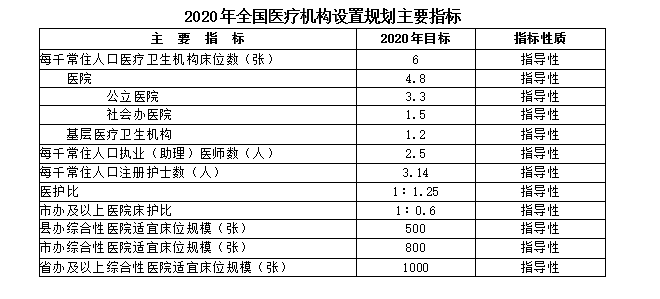
(II) General Requirements. Medical institutions shall be established in accordance with the Plan, adhering to the principles of overall planning and coordinated development. The total scale and individual scale of public hospitals shall be strictly regulated, while social forces shall be standardized and guided in establishing medical institutions. Informatization construction shall be strengthened to gradually build an integrated healthcare service system and a tiered diagnosis and treatment pattern. This system shall be led by National Medical Centers and Regional Medical Centers, supported by Provincial Medical Centers, anchored by municipal and county-level hospitals, and grounded in primary healthcare institutions. It shall feature public hospitals as the mainstay and privately run medical institutions as a supplement, adapting to the level of national economic and social development and matching health needs, thereby forming a complete system with clear division of labor, complementary functions, and close collaboration.
1. Improve the urban and rural medical service system. Clarify the functional positioning of diagnosis and treatment services for medical institutions at all levels and of all types. Enhance the new urban healthcare service system based on community health service institutions, and establish a mechanism for division of labor and collaboration between urban hospitals and community health service institutions; further strengthen the rural medical service network led by county-level hospitals and based on township health centers and village clinics; ensure that urban hospitals of all levels and types, community health service institutions, county-level hospitals, township health centers, and village clinics have clear hierarchies, rational structures, and properly fulfilled functions, thereby facilitating overall effectiveness and establishing an orderly tiered diagnosis and treatment model.
2. Develop medical institutions for chronic diseases. Actively support the development of rehabilitation hospitals and nursing homes (hereinafter collectively referred to as “medical institutions for chronic diseases”), and encourage some secondary hospitals in areas with abundant medical resources to transform into medical institutions for chronic diseases. Implement the diagnostic and treatment functions for both acute and chronic conditions across medical institutions at all levels and of all types, establish a scientifically sound and rational mechanism for division of labor and collaboration among hospitals, primary healthcare institutions, and medical institutions for chronic diseases, improve the service chain encompassing treatment, rehabilitation, and long-term care, and provide patients with continuous diagnostic and treatment services.
3. Establish and improve the medical emergency network. Each city divided into districts shall establish one emergency center. For counties (county-level cities) not covered by the pre-hospital medical emergency network of cities divided into districts due to geographical or transportation constraints, a county-level emergency center may be established either by relying on county-level hospitals or as an independent entity. The pre-hospital medical emergency network shall consist primarily of emergency centers (stations) and network hospitals that undertake pre-hospital medical emergency care and emergency rescue tasks for sudden incidents. This network shall be established in accordance with the principles of proximity, safety, speed, and effectiveness, under unified planning, establishment, and management. County-level public hospitals shall establish departments of critical care medicine; those lacking the necessary conditions shall set up intensive care units (ICUs), thereby ensuring effective coordination among pre-hospital emergency care, emergency department services, and intensive care.
4. Encourage the development of privately run medical institutions. Accelerate the large-scale, high-quality development of such institutions by incorporating them into relevant planning frameworks and reserving a designated proportion of resources, including hospital beds and large-scale medical equipment. Subject to overall planning targets and structural requirements, remove restrictions on the number and location of privately run medical institutions. Give priority to the establishment and approval of non-profit specialized medical institutions operated by social forces that address scarce resource needs. Encourage licensed physicians with intermediate or senior professional titles to establish private clinics and explore the creation of physician studios (stations).
5. Promote the integration of medical and health services with elderly care services. Enhance hospitals’ capacity to serve elderly patients; general hospitals at Level II and above, where conditions permit, shall establish geriatrics departments to ensure effective diagnosis and treatment of geriatric diseases. Increase the proportion of rehabilitation and nursing beds in primary healthcare institutions, and encourage them to add beds for elderly custodial care and hospice care based on service demand.
6. Promote the sharing of regional medical resources. Strengthen information technology infrastructure, integrate existing medical resources within the region, and advance mutual recognition of examination and test results among medical institutions at the same level. Resources such as existing examination and testing facilities and sterile supply centers in secondary hospitals and above shall be made accessible to primary healthcare institutions and chronic disease management facilities. Explore the establishment of independent regional medical laboratory institutions, pathological diagnosis centers, medical imaging examination centers, sterile supply centers, and blood purification centers, with a view to gradually achieving shared access to regional medical resources.
7. Establish a medical service system encompassing Traditional Chinese Medicine (TCM), integrated TCM and Western medicine, and ethnic minority medicine. Fully leverage the role of TCM (and ethnic minority medicine) in disease prevention and control, response to public health emergencies, and medical services; strengthen the development of clinical research bases for TCM and TCM hospitals; and promote the inheritance and innovation of TCM.
(I) Analysis of the Current Situation. With reference to the National Health Services Survey and other relevant frameworks, conduct surveys on medical resources and healthcare services within this region to determine residents’ healthcare service needs, utilization patterns, and influencing factors. Reasonably plan the layout by comprehensively considering factors such as urbanization, population distribution, geographical and transportation conditions, and disease spectrum.
1. Overview of Socioeconomic Development. This includes population size, demographic structure (age and gender), level of economic development, gross national product, and per capita income and expenditure levels.
2. Analysis of Demand for Medical Services. This includes service radius, annual number of visits due to illness or injury, two-week consultation rate among residents, hospitalization rate among residents, annual number of emergency department visits, annual number of hospitalizations, annual number of surgeries, and total inpatient days.
3. Analysis of Medical Resources. This includes medical institutions, healthcare personnel (physicians, pharmacists, nurses, and medical technologists), medical technologies, medical equipment, and medical costs. It covers the total number of existing medical institutions at all levels and types, their classification and categorization, total bed count and beds by level, utilization status, and major diseases (and disease subtypes) treated by each specialty; the total number of existing professional health technical personnel, their categories, workload, and work efficiency; total health expenditure, total health expenditure per square meter of total hospital building area, and total health expenditure per total hospital bed.
(II) Clarify the factors influencing health. Based on the current situation analysis, and according to the ranking of diseases and causes of death, identify the main health problems of residents in this region and their influencing factors (including the supply and demand status of medical services, the development of medical undertakings, and social impacts, etc.), so as to determine the rationale for the rational allocation of medical institutions in this region.
1. Supply and Demand Status of Medical Services. Assess whether the supply and demand for medical services are balanced by estimating the gap between medical service utilization and the medical service needs of residents in the region (annual number of illness episodes per resident, annual number of individuals with chronic diseases, total annual days of illness, and total annual bedridden days).
2. Development of the Healthcare Sector. The impact of advancements in medical technology, improvements in healthcare security levels, and the expansion of coverage on residents' potential demand for medical services.
3. Socioeconomic Development Factors. With socioeconomic development, residents' income levels continue to rise, and the demand for healthcare is growing, thereby impacting medical services.
(3) Determination of Healthcare Institution Configuration. Based on the analyses in (1) and (2), and taking into comprehensive consideration the tiered diagnosis and treatment framework, payment capacity, accessibility of medical services, and the potential for conversion into service demand, annual forecasts and planning of medical service demand shall be conducted to determine the required levels, categories, quantities, scales, and distribution of healthcare institutions, as well as the total number of essential beds and the total number of essential physicians and nurses. The configuration of healthcare institutions must clearly define the setup and development plans for public hospitals, leverage their leading role, and reserve space for medical institutions established by non-public sectors.
1. Required number of beds.
(1) The number of general hospital beds shall be calculated according to the following formula:

Where: ∑ denotes the sum, and A represents the stratified regional population by age (the population figure should be the sum of the registered population, temporary residents, and the daily average of the floating population);
B: Hospitalization rates stratified by age, with age groups defined in 5-year intervals;
C represents inpatients flowing into this region from other areas;
D is the number of inpatients from this region who are hospitalized outside the region.
(2) Calculation of the number of beds in each specialty: The calculation can be performed by substituting the admission rate, bed occupancy rate, and number of inpatients in the aforementioned formula with the corresponding figures for each specialty. The number of specialty beds includes beds in specialized hospitals and specialty ward beds in general hospitals, which are determined based on the total population and its composition, the incidence of specialty-specific diseases among residents, service radius, and the status of medical and health resources. Where conditions for precise calculation are not yet met, a reference standard of one specialty bed per 1,000 population may be applied.
(3) Determination of the number of hospital beds in medical institutions at all levels and of various types: Based on the tiered diagnosis and treatment framework, conduct prospective assessments of the specialty-specific conditions that should be treated at hospitals of different levels. Then, calculate the number of beds for each level of hospital based on the bed requirements for each specialty, while reserving a certain number of beds for emergency response to public health emergencies.
2. Required Number of Physicians. Based on local healthcare demands, determine the total number of physicians and the number of physicians by specialty within the region. Determine the staffing levels of physicians for medical institutions at all levels and of various types according to actual conditions.
3. Required Number of Nurses. Determine the total number of nurses in the region based on local healthcare needs. Determine the staffing level of nurses in medical institutions according to actual conditions.
4. Layout of Medical Institutions. The layout of medical institutions shall meet the demand for medical services at all levels, facilitate the formation of a tiered diagnosis and treatment model, and ensure convenient access to medical consultations and referrals for residents.
(4) Determining the allocation of medical technologies. Medical technology resources shall be rationally allocated based on healthcare service demands, disease spectrum and the prevalence of complex and critical conditions, functional positioning of medical institutions, and technical characteristics; meanwhile, interim and ex-post supervision shall be strengthened to ensure medical safety.
(5) Design and produce maps depicting the current status of medical institutions and plans for their establishment. Strengthen communication and coordination with urban planning departments, and enhance macro-level regulation and dynamic management of medical institutions within the region by taking into account the existing distribution of healthcare facilities, service population radii, and actual medical needs.
(1) Rationally determine the number of public general hospitals. The establishment of public hospitals shall be rationally planned by comprehensively considering factors such as local urbanization, population distribution, geographical and transportation conditions, disease spectrum, and emergency response capabilities, with bed allocation principles formulated on a regional basis. At the county level, in principle, one county-administered general hospital and one county-administered traditional Chinese medicine (TCM) hospital (including TCM hospitals, integrated TCM and Western medicine hospitals, and ethnic medicine hospitals) shall be established; counties with a population exceeding 500,000 may appropriately increase the number of county-level public hospitals. At the prefecture-level city level, 1–2 prefecture-administered general hospitals shall be established for every 1 to 2 million people, with a service radius generally around 50 kilometers; population thresholds may be appropriately relaxed in sparsely populated areas with vast territories. At the provincial level, regions shall be divided into zones, with 1–2 general hospitals planned for every 10 million people; population thresholds may be appropriately relaxed in sparsely populated areas with vast territories. A number of National Medical Centers and Regional Medical Centers shall be planned and established nationwide. Occupational disease hospitals and stomatological hospitals shall be established at the provincial level according to actual needs for medical services. Standardized maternal and child health care institutions operated by the government shall be established at the provincial, prefecture-level city, and county levels. At the prefecture-level city level and above, specialized hospitals for pediatrics, psychiatry, obstetrics and gynecology, oncology, infectious diseases, and rehabilitation shall be established based on actual demands for medical services. Counties (cities, districts) with large populations that are not covered by prefecture-level medical institutions may build psychiatric specialized hospitals as needed, thereby forming a relatively comprehensive medical service system.
(II) Strictly control the unreasonable expansion of bed capacity in individual public hospitals (single practice sites). Public hospitals shall reasonably determine the number of departments and wards based on their functional positioning and service capabilities. The bed capacity of each ward shall not exceed 50 beds. For newly established county-administered general hospitals (single practice site, hereinafter the same), the bed capacity should generally be around 500; it may be appropriately increased for counties with a population exceeding 500,000, and in principle, shall not exceed 1,000 for counties with a population exceeding 1 million. For newly established prefecture-level city-administered general hospitals, the bed capacity should generally be around 800; it may be appropriately increased for prefecture-level cities with a population exceeding 5 million, and in principle, shall not exceed 1,200. For newly established provincial-level or higher-administered general hospitals, the bed capacity should generally be around 1,000, and in principle, shall not exceed 1,500. The bed capacity of specialized hospitals shall be determined based on actual needs. Provincial health and family planning administrative departments shall determine the minimum control standards for the construction area per bed unit and the ratio of outpatient visits to outpatient construction area.
(3) Strictly control the number of beds in tertiary general hospitals. In principle, the total number of beds in tertiary general hospitals in each province, autonomous region, and municipality directly under the Central Government shall not exceed 30% of the total number of beds in all medical institutions within the region, nor shall it exceed 35% of the total number of hospital beds within the region. Tertiary hospitals should fully leverage their leading role in medical science, technological innovation, and talent development, focusing primarily on the diagnosis and treatment of critical, severe, and complex diseases. During the approval process for establishing tertiary general hospitals, efforts should be made to guide these hospitals to increase the scale and proportion of beds in surgical departments and critical care medicine specialties. For regions where the average length of stay in tertiary general hospitals exceeds eight days, no new tertiary general hospitals shall be established, and no additional beds shall be added to existing tertiary general hospitals.
Local health and family planning administrative departments at all levels (including traditional Chinese medicine administrative departments), under the leadership of their respective governments, are specifically responsible for the formulation and organizational implementation of the Plan. Provincial- and county-level Plans shall be based on the Plans of cities divided into districts. The authority and procedures for formulating the Plan include:
(I) County-level health and family planning administrative departments.
1. Within the planning framework of the municipal health and family planning administrative department of a districted city, formulate and demonstrate the county-level plan for the establishment of medical institutions, and submit it to the municipal health and family planning administrative department of the districted city;
2. Configure and layout county-level medical institutions in accordance with the planning scheme;
3. In accordance with the municipal-level "Plan" for districts divided into cities, submit the relevant sections on the establishment of medical institutions in this county to the county-level government for approval and implementation.
(II) Municipal-level health and family planning administrative departments of cities divided into districts.
1. Draft and evaluate the "Plan" proposal;
2. Organize and carry out specific tasks in accordance with the Plan;
3. After the macro-adjustment by the provincial health and family planning administrative department and the completion of the allocation layout of county-level medical institutions, the final version of the Plan shall be formed and submitted to the people's government of the city divided into districts for approval and implementation;
4. Organize the implementation of the Plan.
(3) Provincial health and family planning administrative departments.
1. When cities divided into districts formulate the "Plan," the provincial health and family planning administrative department shall provide guidance for macro-level regulation;
2. Formulate the provincial-level Plan in accordance with relevant national regulations and policies, the actual conditions of this province, and by integrating the Plans of all cities divided into districts;
3. Submit the provincial-level "Plan" to the provincial government for approval and implementation;
4. Organize the implementation of the Plan.
“The Plan” is updated every five years, with the established indicators revised based on assessment and evaluation outcomes, as well as changes in local social, economic, healthcare needs, medical resources, and disease patterns. The updated “Plan” shall be reviewed, approved, released, and implemented in accordance with the aforementioned procedures.