

Atomwise Files for IPO: AI-Powered Drug Discovery Platform Slashes Billions from Traditional R&D Costs
As artificial intelligence applications continue to expand across various sectors, VCBeat (WeChat: vcbeat) will publish a series of reports on the global “AI + Healthcare” landscape, covering typical case studies, investment and financing trends, and industrial strategic layouts, to provide insights for investors and entrepreneurs in the industry.
This article introduces a San Francisco-based startup that applies deep learning to new drug development, aiming to reduce the high costs of research and development. It is a typical example of applying artificial intelligence technology to the medical and healthcare sector.
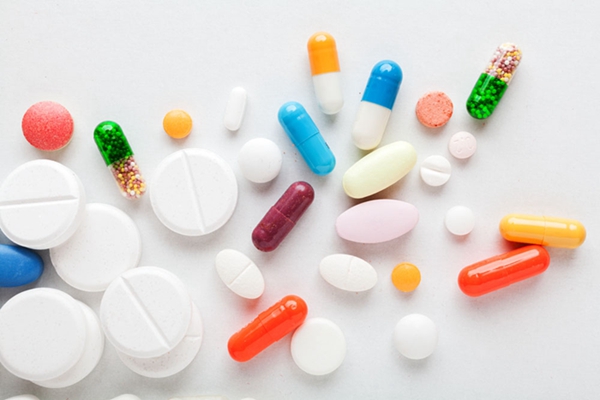
Atomwise, founded in June 2012, is a company that leverages supercomputers for drug research and development. The project aims to simulate the pharmaceutical process using supercomputers, artificial intelligence (AI), and complex algorithms to predict the efficacy of new drugs while reducing R&D costs. The company is headquartered in San Francisco, USA.
A 2014 report from the Tufts Center for the Study of Drug Development indicated that the average cost to bring a new drug to market was approximately $2.585 billion, comprising about $1.395 billion in direct out-of-pocket expenditures and roughly $1.163 billion in indirect costs attributable to research and development failures. Notably, this figure represents an increase of approximately 145% compared with data from 2003.
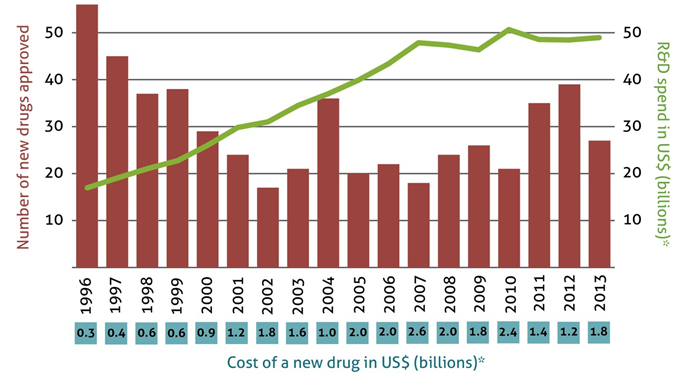
1996–2013 Chart of U.S. Drug R&D Costs (Including Costs for Successfully Marketed Drugs and Failed Drug Candidates)
The report also points out that after a new drug is successfully launched, an average of $312 million will be invested in further evaluation studies, including validating new indications, formulations, and dosages. Therefore, throughout the entire R&D cycle before and after launch, a successfully developed new drug may cost a total of $2.9 billion.
Tufts’ analysis draws on data from 106 R&D projects across 10 pharmaceutical companies. These companies vary in size but are well-represented, collectively accounting for 35% of the sales and R&D investment of the top 50 global pharmaceutical firms.
The development of a new compound discovered in a laboratory into a therapeutic drug for disease treatment requires the following stages: preclinical trials, Investigational New Drug (IND) application, Phase I clinical trials, Phase II clinical trials, Phase III clinical trials, New Drug Application (NDA), and market approval.
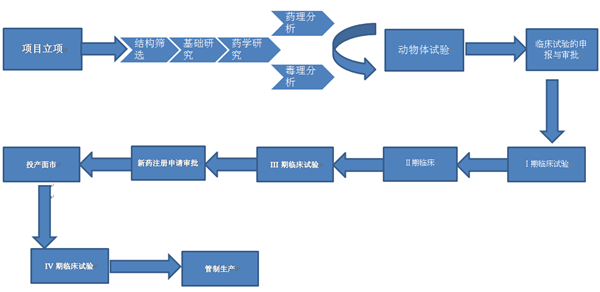
Drug R&D Process Flowchart
If the costs of failed R&D projects are included in pharmaceutical companies’ total expenditures, the actual cost of developing a drug will be even higher. For example, GlaxoSmithKline had 10 new drugs approved between 1997 and 2011, with an average cost of $8.2 billion per new drug; during the same period, its total R&D spending amounted to approximately $81.7 billion.
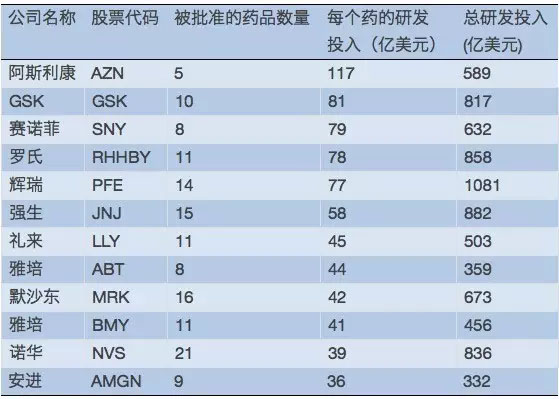
Number of Approved Drugs and R&D Costs for Selected Large Pharmaceutical Companies, 1997–2011
Researchers state that the high cost of drug development is driven by factors such as increasing complexity of clinical studies, larger study scales, and rising failure rates in clinical trials.
Currently, the mainstream approach to improving R&D efficiency and reducing the probability of R&D failure is to streamline R&D organizations, outsource and collaborate on development, and acquire promising biotechnology companies, thereby indirectly reducing drug development costs.
However, for the success rate of new drug development, projects originating from internal R&D actually have a 20% higher success rate than those acquired through external technology transfer. The reduction in the overall probability of R&D failure is primarily driven by a decrease in late-stage clinical trial failures. This requires early identification of potential drug hazards and adverse reactions during the initial phases of new drug development, coupled with a rational assessment of R&D risks, to enable the timely termination of unpromising drug development programs.
Atomwise utilizes supercomputers to analyze existing databases and employs AI along with complex algorithms to simulate the drug development process. This approach enables early-stage assessment of new drug development risks, reducing drug research costs to just a few thousand dollars and completing the evaluation within days. Atomwise provides candidate drug prediction services to pharmaceutical companies, startups, and research institutions. Its services can predict which new drugs are truly effective and which are not.
In January 2013, Atomwise received a $225,000 grant from Grand Challenges Canada. In December 2014, the company secured $120,000 in seed funding from Y Combinator. In March 2015, Atomwise raised an additional $225,000 in seed funding. In June 2015, the company closed another $6 million seed round, with investors including OS Fund, Khosla Ventures, DFJ (Draper Fisher Jurvetson), AME Cloud Ventures, and Data Collective.
What sets Atomwise’s project apart is its ability to extract vast amounts of data across the entire drug lifecycle, from inception to market exit. By addressing the high costs and time-intensive nature of drug development, this capability tackles the pharmaceutical industry’s critical “life-or-death” challenges. Atomwise claims to have achieved world-leading results in new drug discovery, binding affinity prediction, and toxicity screening.
Currently, the Atomwise software platform runs on IBM’s Blue Gene/Q supercomputer. Its powerful computational capabilities enable the completion of numerous tasks, such as evaluating 8.2 million compounds and identifying potential treatments for multiple sclerosis within days. In 2015, the company announced progress in the search for Ebola virus treatments: among the drugs predicted by Atomwise, two were found to potentially combat the Ebola virus. These candidates were identified within one week at a cost of no more than $1,000.
Atomwise Website Image
In the process of developing new drugs to combat the Ebola virus, the Atomwise platform created a model of the “claws” used by the Ebola virus to invade host cells. It then employed artificial neural networks, analogous to the human brain, to analyze drug compounds, identifying 7,000 existing drugs capable of targeting these “claws” for screening and combination.
In terms of partnerships, in addition to undertaking confidential projects with Merck and Autodesk, Atomwise continues to conduct research collaborations with academic institutions and corporate clients.

Atomwise CEO Abraham Heifets
Abraham Heifets serves as the CEO of Atomwise. He graduated from Cornell University with a Bachelor of Science degree and a Master’s degree in Engineering, and earned his Ph.D. from the University of Toronto. Heifets is an expert in the fields of big data and high-performance computing. He previously worked at the IBM T. J. Watson Research Center, focusing on high-performance computing. During his time at the University of Toronto, he established a project named “SCRIPDB” large public chemical structure patent database, and developed a system named “LigAlign” protein structure analysis tool. It is reported that LigAlign has been applied in more than 70 countries worldwide.
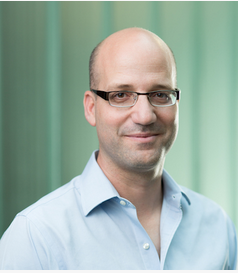
Atomwise CTO Izhar Wallch
Izhar Wallch serves as the Chief Technology Officer (CTO) of Atomwise. He holds a Bachelor of Science degree from the Technion – Israel Institute of Technology and a Ph.D. from the University of Toronto, and is a specialized researcher in the field of pharmaceutical algorithms. During his tenure at the University of Toronto, Wallch developed a novel approach to mitigate bias in molecular docking models.

Atomwise COO Alexander Levy
Alexander Levy serves as the Chief Operating Officer (COO) of Atomwise, bringing extensive experience in commercializing cutting-edge technologies from laboratory settings. During his time at the University of Toronto, Levy embarked on an entrepreneurial venture, developing a software application designed to help individuals with speech impairments access information. This software, named MyVoice, has been implemented inDiscovery Channel, Engadget, Fast Company, BNN, CBC, and CTV, with users spanning more than 30 countries worldwide. In addition to being an entrepreneur, Levy is also an independent investor. He participated in Science Exchange’s Series B financing in March 2016. Science Exchange is a platform that helps scientists outsource experimental projects and equipment procurement. It is reported that Y Combinator, the renowned U.S. startup incubator, also participated in Science Exchange’s Series B round. Levy was named Entrepreneur of the Year by PROFIT magazine and Investor of the Year by the University of Toronto.
Series Report:
$1.4 Billion in Global Financing for AI + Healthcare from 2011 to H1 2016
[AI Series] How Does AnalyticsMD Leverage AI to Support Hospitals in Data-Driven Decision-Making?
[AI Series] MedyMatch Precisely Diagnoses Stroke: A Typical Application of AI + Medical Imaging