

Sentrian Files IPO Prospectus: Pioneering AI-Driven Remote Patient Monitoring Platform for Early Disease Detection
As artificial intelligence applications continue to expand across various sectors, VCBeat (WeChat: vcbeat) will publish a series of reports on the AI + healthcare sector both in China and abroad, covering typical case studies, investment and financing activities, and industrial landscape developments, to provide insights for investors and entrepreneurs in the industry.
This article introduces a U.S.-based AI startup that applies deep learning technology to healthcare systems and integrates with wearable devices to deliver precise pre-onset warnings for patients, representing a typical case of entrepreneurship in the AI + healthcare sector.

Sentrian Website Image
Sentrian, founded in 2012 and headquartered in California, USA, is dedicated to remote patient health monitoring through biosensors and machine learning technologies. The company aims to implement a telehealth model centered on “early detection and early intervention,” thereby reducing the likelihood of patient hospitalization.
The idea behind the founding of Sentrian stemmed from the growing number of chronic disease patients in the United States.According to a report released in recent years by the U.S. National Institutes of Health, nearly half of Americans suffer from at least one chronic disease, and this figure is expected to rise in the coming years, with a trend toward younger onset of chronic conditions.A paper published in the Journal of the American Medical Association in February 2010 indicated that, among 5,001 U.S. children tracked individually from 1988 to 2006, approximately 2,000 children aged 8 to 14 developed chronic conditions requiring long-term treatment, such as obesity and asthma.
Currently, chronic disease management in developed countries primarily employs the following seven models: the Chronic Disease Passport model, the Peer Support Management model, the Professional-Led Group Communication Management model, Self-Management Skills Training Programs, Peer Coaching, the Chronic Disease Management System, and the Community-Based Care Management model. Sentrian’s project focuses on the Chronic Disease Management System model.

Sentrian is committed to building a medical system compatible with wearable devices. This system collects patient data and analyzes it using machine learning algorithms. It incorporates data on physiological changes associated with chronic diseases, against which patient information is matched and compared. By observing subtle correlations, the system enables early diagnosis.
The platform’s service workflow is as follows: First, the company collaborates with physicians to assess the patient’s condition and develop personalized disease management interventions. Subsequently, the company provides patients with cost-effective biosensors and wearable devices that minimize disruption to daily life. During device usage, the platform employs a four-step process—“Detect,” “Monitor,” “Analyze,” and “Act”—to identify changes in the patient’s condition and take appropriate actions. These devices can automatically notify the patient’s care team upon detecting clinical changes, thereby enabling remote disease monitoring. Remote Patient Monitoring (RPM) is central to addressing healthcare cost challenges.
Sentarian targets any healthcare organization that needs to analyze biosensor data, including hospitals, clinics, and individual physicians. The company’s machine learning-powered predictive analytics platform significantly enhances the efficiency of clinical diagnosis and treatment while ensuring the accuracy of diagnostic results.
Company founder Jack Kreindler stated that the more patients the system “treats,” the more feedback it receives, enabling it to learn more. While the human brain can typically retain information on only the 30 most recently treated patients, this system can store data on over 300,000 patients.
Building on the aforementioned system, the company launched the “Sentarian Patient Intelligence Platform (Sentarian RPI),” which enables physicians to remotely establish disease control models and continuously refine and optimize them. This facilitates autonomous model development by clinicians based on individual patient conditions, paving the way for precision medicine.
In January 2013, Sentarian raised $950,000 in seed funding from Frost Data Capital. In October of the same year, the company secured another $1.58 million in seed funding from Frost Data Capital and Tech Coast Angels. In March 2014, the company obtained $1.37 million in seed funding. In May 2014, it raised $3.82 million in angel funding. In November 2014, Sentarian completed an $8 million Series A financing round, with investment from REV and Frost Data Capital. To date, Sentarian has raised a total of $15.72 million in funding.
It is reported that Sentarian’s platform has expanded beyond its initial chronic disease management projects and is currently being piloted to treat patients with heart disease, chronic obstructive pulmonary disease (COPD), high-risk conditions, and cancer in the United Kingdom and the United States. For patients with these conditions, even subtle physiological changes can constitute highly valuable statistical data and may serve as early warning signs of disease progression. The platform’s artificial intelligence system promptly detects these changes. It can report potential alerts to care teams up to 10 days before clinical deterioration becomes apparent, thereby providing patients and physicians with valuable time to initiate interventions before an acute exacerbation occurs.
Company CEO Dean Sawyer stated, “If we can detect disease deterioration in a timely manner and intervene with treatment ahead of time, millions of healthcare institutions could save tens of billions of dollars in annual expenditures.”
In addition to helping physicians promptly detect subtle changes in patients’ physical conditions as mentioned above, patients can also provide feedback and rate the HEDIS metrics of relevant services. The platform will leverage machine learning to gradually reduce error rates and improve patient satisfaction.
It is understood that Sawyer’s father passed away due to congestive heart failure. What angered Sawyer was that the deterioration in his father’s condition had not been detected in time by healthcare professionals. In the aftermath of this tragedy, Sawyer recognized that pathophysiological changes associated with heart failure can precede the clinical manifestation of symptoms by up to 14 days. Following discussions with Kreindler, Sawyer began to explore ways to enhance patient–provider interaction, ensuring that disease detection and diagnosis would not occur too late. This also served as another foundational motive for the two to establish Sentarian.
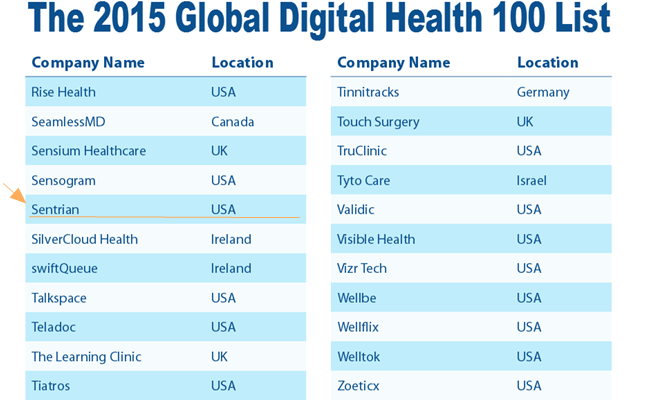
2015 Global Top 100 Digital Health Companies List (Partial)
In 2015, Sentarian was named one of the “Global Top 100 Digital Health Companies of the Year” by the medical journal The Journal of mHealth, and its intelligent remote patient platform received the Innovation Award from the American Telemedicine Association.

From left to right: Jack Kreidler, Founder; Dean Sawyer, CEO
Jack Kreindler, founder of Sentarian, holds a Bachelor’s degree in Clinical Medicine and a Master’s degree in Physiology and Cardiac Rehabilitation from University College London. Kreindler also serves as a General Partner at Frost Data Capital and as Co-founder and Advisor to Klarismo. Although previously a physician, Kreindler is primarily an innovation pioneer in the fields of health and technology. In 2007, he founded the renowned Centre for Health & Human Performance (CHHP) in London, providing tiered pharmaceutical interventions aimed at improving physical condition for a broad clientele ranging from the general public to professional athletes. Dr. Kreindler seeks to extend CHHP’s practices into the realms of high technology and behavioral science, thereby helping even the most critically ill patients achieve optimal clinical outcomes.
Dean Sawyer, CEO of Sentarian, graduated from the University of the Pacific and earned a Master’s degree in Pharmacy from Singularity University. Co-founded by Google and NASA, Singularity University is located within NASA’s Ames Research Center in the heart of Silicon Valley, California, with the mission of cultivating future scientists. Sawyer is a partner at Frost Data Capital and serves as an advisor to Singularity University’s startup programs, providing consulting services on business models, fundraising, and team building for healthcare startups. Previously, Sawyer served as Chief Business Officer at Physicians Interactive. During his tenure, the company’s revenue grew from $1 million to $32 million over four years, prior to its successful acquisition by Merck.
Series Report:
【AI Series】How Does AnalyticsMD Leverage AI to Support Data-Driven Decision-Making in Hospitals?