

Huiying Medical: Powering Smart Imaging Cloud Platforms with AI and Medical Imaging

HY Medical
Provider of Medical Imaging and Oncology Radiotherapy Platforms
Undoubtedly, artificial intelligence has rapidly come into the public spotlight. As domestic and international IT giants such as Google, IBM, Microsoft, Baidu, and Alibaba continue to increase their investments in the field of artificial intelligence, AI has positioned itself at the forefront of rapid industrial growth.
In the “13th Five-Year Plan for National Scientific and Technological Innovation” released earlier this week, artificial intelligence has emerged as a key priority. The Plan explicitly states that the development of natural human-computer interaction technologies should focus on intelligent perception and cognition, integration of virtual and real environments with natural interaction, semantic understanding, and intelligent decision-making. It aims to achieve significant breakthroughs in human-like intelligence based on big data analytics, realizing human-like vision, hearing, language, and thinking, thereby supporting the growth of the intelligent industry and establishing demonstrative applications in key sectors such as education, office work, and healthcare.
August 12–13, 2016: The Global Conference on Artificial Intelligence and Robotics (CCF-GAIR) opened in Shenzhen. Hosted by the China Computer Federation (CCF), the conference focused on fields such as artificial intelligence and robotics. As the most prestigious industry event in China’s AI and robotics sector, it was attended by Gao Wen, an academician of the Chinese Academy of Engineering, who served as Conference Chair. Wang Juhong, Vice Chairman of the CCF and Vice President of Tencent Group, served as Chair of the Conference Steering Committee. The event brought together top academic experts, corporate leaders, star startup teams, and venture capitalists from around the world.
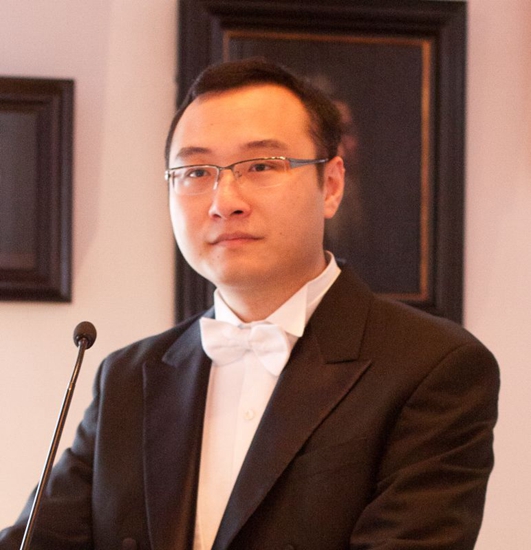
Mr. Chai Xiangfei, Founder of HY Medical
According to VCBeat (WeChat ID: vcbeat), as artificial intelligence is a hot sector in the healthcare industry, many healthcare representatives will attend the conference. Prior to the event, reporters interviewed the founder of Huiying Medical Technology Co., Ltd. (hereinafter referred to as “HY Medical”).Mr. Chai Xiangfei.HY Medical, as a company focused on “AI + medical imaging”As a startup founder, Chai Xiangfei is also deeply interested in artificial intelligence and shared his views on the integration of AI with the healthcare sector.
As a branch of computer science, artificial intelligence seeks to understand the nature of intelligence and develop intelligent robots, as well as language and image recognition systems, that mimic human intelligence.
In 2015, the number of institutions investing in artificial intelligence (AI) in China reached 48, a year-on-year increase of 71.4%, with the total investment amounting to RMB 1.423 billion, a year-on-year increase of 75.7%. Excluding revenue from hardware product sales (such as robots, drones, and smart home devices), information search, news distribution, and targeted advertising, the AI market size is projected to approach RMB 10 billion by 2020.
In the medical field, several high-tech companies both domestically and internationally have already applied advanced technologies such as cognitive computing and deep learning, giving rise to “robot doctors,” such as IBM’s “Watson Doctor.” Through deep learning, robot doctors can continuously learn from vast amounts of medical textbooks, medical journals, clinical diagnosis manuals, electronic health records, and other sources, thereby storing nearly all the latest medical knowledge in a timely manner.
More importantly, robotic doctors can apply learned knowledge in practice. By leveraging cognitive analytics technologies and vast amounts of data collected from various sources, they can rapidly generate diagnostic and treatment recommendations, thereby assisting physicians in making diagnoses and clinical decisions. In this process, patients gain faster access to medical services, while healthcare institutions can achieve significant cost savings.
The applications of artificial intelligence in the medical field can be broadly categorized into three types: First, data processing based on electronic health records to enable healthcare cost containment and drug development. Second, image recognition based on imaging and pathological data to facilitate intelligent diagnosis in imaging reports. Third, data mining of genomic data to achieve disease prediction and personalized treatment.
Among these three categories, information processing based on electronic medical records (EMRs) has the broadest applicability and highest universality, yet it relies relatively less on artificial intelligence algorithms. In contrast, information mining from genetic data is highly dependent on AI technology, but its current practical utility remains relatively limited. The application of medical imaging falls between these two extremes.
Regarding the key to integrating healthcare with artificial intelligence, Chai Xiangfei stated that the crux lies in algorithms plus effective data. Effective health data serves as the foundation for AI applications. A characteristic of medical data is its limited availability; due to the finite number of patients, the volume of medical records for any single disease is also limited. Furthermore, medical data is distributed across different healthcare institutions, resulting in high acquisition costs.
According to a study, the annual growth rate of medical imaging data in the United States is 63%, while the annual growth rate of radiologists is only 2%. Artificial intelligence can effectively bridge this gap. Meanwhile, deep learning-based medical image recognition achieves an accuracy rate of 90% or higher, demonstrating significant efficacy in assisting diagnosis.
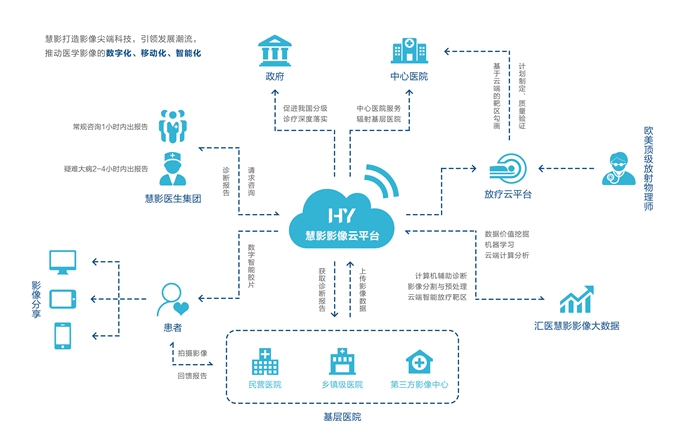
HY Medical is dedicated to building an AI-powered smart imaging cloud platform, aiming to enhance the efficiency and accuracy of clinical diagnosis and treatment while addressing the mismatch between medical resources and patient needs in certain regions.
Huiying Medical Technology (Beijing) Co., Ltd. was established in April 2015, providing a full-chain closed-loop service ranging from the application layer of imaging cloud SaaS technology to medical imaging interpretation services. It comprises six major product modules: Imaging Cloud Platform, Radiotherapy Cloud Platform, Electronic Film, Outsourced Routine Imaging Interpretation Services, Expert Consultation for Complex and Critical Cases, and Physician Group. Among these, the outsourced routine imaging interpretation service helps imaging centers achieve online diagnostic capabilities, thereby facilitating tiered diagnosis and treatment.
Currently, HY Medical has established a "three-terminal interconnection" system linking doctors, patients, and medical institutions. On the doctor’s side, the platform provides services such as case management, online physician discussions, and expert learning resources. On the patient’s side, patients can consult with specialists and receive real-time responses; additionally, the platform offers image sharing and health management services. For medical institutions, the platform enables access to specialist resources, storage and backup of medical images, user tracking, and the provision of value-added services. All these functions are accessible across desktop, tablet, and mobile devices.
Compared with other platforms, the advantage of Huiying Smart Imaging lies in its use of a distributed cloud platform. By adopting technologies such as compression and TCP optimization, Huiying’s cloud technology enables real-time synchronous transmission and viewing. Features like read-write separation and distributed deployment facilitate image uploads from across China and remote reading by radiologists nationwide. Furthermore, the ability to review images on mobile phones and tablets significantly reduces geographical constraints for physicians and improves their utilization of fragmented time.
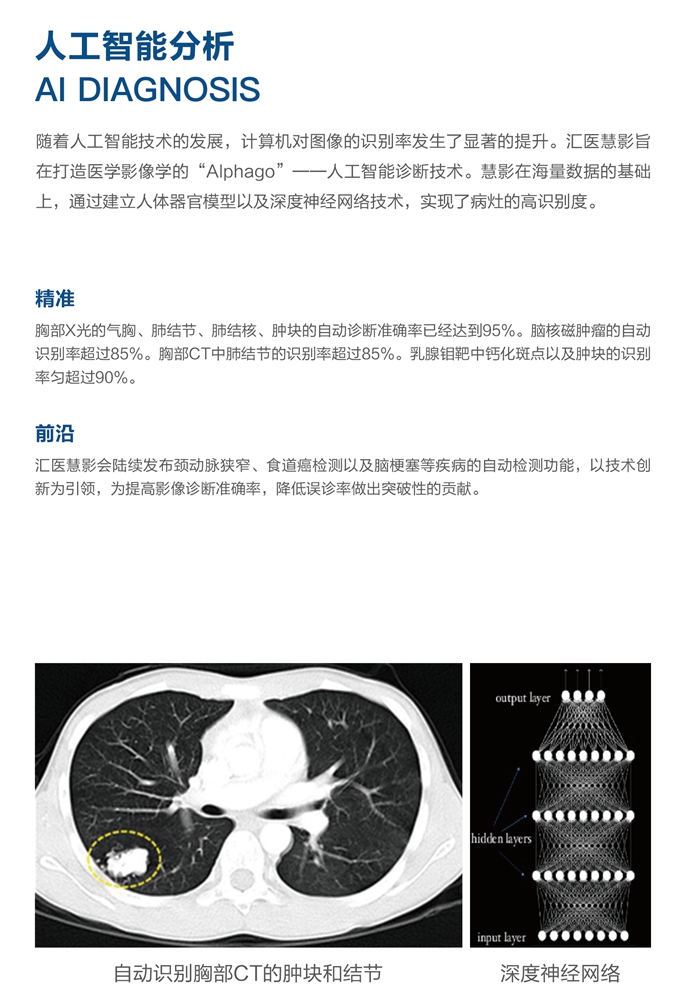
Currently, HY Medical has achieved an automatic diagnostic accuracy rate of 95% for pneumothorax, tuberculosis, and masses in chest X-rays. The automatic recognition rate for brain MRI tumors exceeds 85%, and the detection rate for pulmonary nodules in chest CT scans also surpasses 85%.
At the technical level, HY Medical integrates imaging cloud services, image interpretation services, and intelligent diagnosis. Structured data obtained through image interpretation is fed into a deep learning engine for computation. The results generated by machine learning are then applied to physicians’ image interpretation workflows. When the system makes an erroneous judgment, physicians correct the diagnostic results and feed them back into the system for secondary learning. Through this closed-loop online learning process, we continuously update valid data and steadily improve algorithmic accuracy.
Another advantage of HY Medical lies in its direct access to Tsinghua University’s medical resources, as the company’s founders hail from Stanford University in the United States and Tsinghua University. The platform possesses core technologies in deep learning for medical imaging and has independently developed the Smart Imaging Cloud Platform and the Precision Radiotherapy Cloud Platform. In collaboration with Topray.Co, an image recognition company based in Mountain View, Silicon Valley, USA, it is jointly committed to advancing research and promotion in intelligent diagnosis and big data analytics for medical imaging. By leveraging Amazon’s distributed cloud storage technology, the company enables real-time online availability and high-concurrency access to imaging data.
Discussing the application of artificial intelligence in the healthcare sector, Chai Xiangfei stated that medical imaging is the most viable area for integrating AI with healthcare, and is likely to be the first to achieve significant breakthroughs.
It is reported that HY Medical has established collaborations with medical institutions such as Peking University Third Hospital, Peking University Cancer Hospital, and the PLA General Hospital (301 Hospital). Currently, it has integrated with more than 400 medical institutions, and the experts in its physician group are all top-tier specialists from large Grade III Class A hospitals in Beijing, Shanghai, and other regions.
Meanwhile, HY Medical aims to introduce the mature and well-established 20-year physician evaluation system from the United States into China. While providing medical imaging consultation services nationwide, it has established a rating and screening mechanism centered on a “peer review system” and has published the annual “Top 100 Imaging Physicians in China” list since 2016. The Huiying Physician Group is patient-centric, leveraging high-value medical services to help physicians establish their true market value and industry brand.
Finally, Chai Xiangfei told VCBeat (WeChat ID: vcbeat) that HY Medical will successively roll out automated detection features for conditions such as breast mammography, carotid artery stenosis, esophageal cancer, and cerebral infarction. Led by technological innovation, the company aims to make breakthrough contributions to improving the accuracy of imaging diagnosis and reducing misdiagnosis rates.