

Rethinking Healthcare Innovation: Insights from Public Mindset on Pharmacies, Clinics, and Health Insurance
2016 marked a turning point for the healthcare industry. As the dust settled in the internet healthcare market, the burgeoning pharmaceutical e-commerce sector came to an abrupt halt following a directive from the China Food and Drug Administration (CFDA). Meanwhile, the promotion of tiered diagnosis and treatment systems and medical insurance cost containment measures propelled primary care clinics and commercial health insurance into the spotlight as new market favorites.
Amid this wave of reform, countless enterprises have launched a diverse array of entrepreneurial initiatives based on their understanding of business models, with venture capital (VC) and private equity (PE) firms seemingly eager to embrace them all. The total financing in the mobile health sector reached RMB 14 billion in the first half of 2016, dispelling rumors of a “capital winter” and suggesting that everything is moving in a positive direction.
But a very realistic question remains: what has the general public actually gained? Why have so many healthcare projects failed to bring about a transformation in healthcare delivery models? The booming healthcare entrepreneurship market has not broadly benefited patients; people continue with their lives as usual, seemingly separated by several dimensions from those disruptive and innovative projects. Are entrepreneurs truly drifting further away from the general public?
1Returning to the Public Mindset
The core concerns of the general public when seeking medical care are: What disease do I have? Where should I seek treatment? How should it be treated? How much will it cost? Patients always hope to minimize their time and expenses at the hospital, while expecting to be treated by the most prestigious physicians. Such is the reality.
Why was Didi Chuxing able to disrupt the ride-hailing industry? Why was Ele.me able to disrupt the food delivery industry? Because they both addressed users’ core needs. Take Didi Chuxing as an example: what users care about is how to get a ride quickly. Note that hailing a ride is not the end goal; rather, it is a cost users must bear to reach their destination. Therefore, if this cost can be reduced, users will readily accept it. The same logic applies to Ele.me: going to a restaurant is not the ultimate objective; eating is. These companies achieved disruption because they lowered user costs while delivering equivalent or even better outcomes. As a result, they disrupted their respective markets in a very short time. Moreover, once users adopt this new mindset, the shift is nearly irreversible.
What is the prevailing public mindset in healthcare? And where should we focus our efforts to disrupt the status quo and improve efficiency? The diagram below offers some insights:
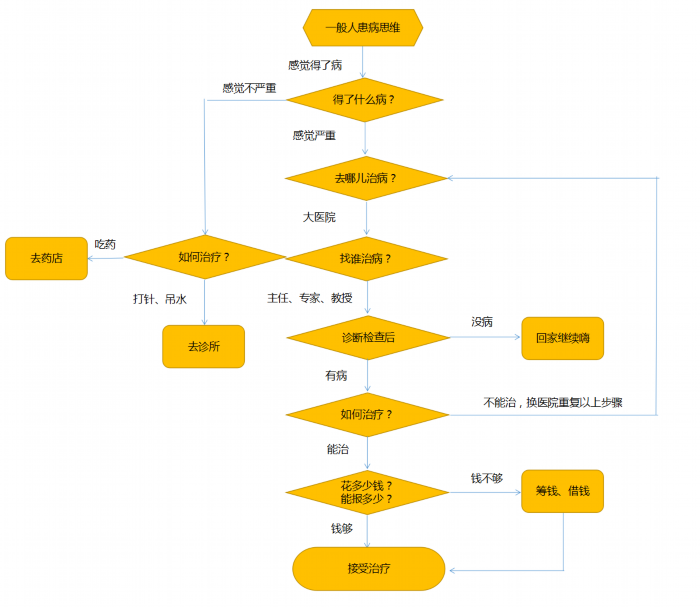
Simplified Patient Healthcare-Seeking Mindset
As can be seen, pharmacies, clinics, hospitals, physicians, and social insurance constitute the five key entities in patients’ healthcare-seeking mindset. Among these, two important branches emerge: the public is not entirely devoid of self-assessment capabilities; in fact, self-diagnosis based on personal experience and internet resources is the most common practice. Two pathways stem from such self-assessment: one leading to clinics and pharmacies, and the other to hospitals. It is predictable that medical disruption will target precisely these two pathways, which we will analyze individually below.
2Medicine Delivery O2O and Pharmaceutical E-commerce
This year does not appear to be a bumper harvest for online-to-offline (O2O) medicine delivery services, as many companies have successively encountered difficulties. Why is O2O medicine delivery so challenging? Ultimately, it comes down to the principle of cost-effectiveness. From a purely logical perspective, the O2O medicine delivery model can be self-consistent: users need to purchase medications but are required to visit physical pharmacies. By offering home delivery services similar to those in the food and beverage industry, time costs for users are reduced. Extending further along the upstream and downstream segments, a complete value chain is formed.
However, is this truly what users need? First and foremost, purchasing medication is a low-frequency activity for the vast majority of people. It is difficult to persuade users to download and retain a dedicated app for such an infrequent task (a challenge applicable to all healthcare-related apps). Under normal circumstances, the average lifespan of an app is only ten months; 85% of users delete downloaded applications from their phones within one month, and by five months, the retention rate drops to merely 5%. In other words, some users purge a portion of the apps installed on their phones every five months.
Second, even if users are ill, the benefits provided by O2O medicine delivery services are insufficient to offset their hidden costs. What are these hidden costs? There are two aspects. First is waiting time: no matter how fast O2O medicine delivery is, it typically takes up to one hour for delivery. This means that users, who could otherwise resolve the issue in just 5–10 minutes by going downstairs themselves, must wait an additional several tens of minutes simply to avoid taking a few steps. Second is price: constrained by the high operational costs of the O2O model, drug prices on these platforms are often higher than those at brick-and-mortar retail pharmacies. Compared with physical pharmacies, O2O services hold no advantage in either aspect, rendering their sole benefit—home delivery—largely insignificant.
In contrast, the business model of pharmaceutical e-commerce aligns more closely with economic principles, according to Wang Letian, CEO of Sinopharm OnlineOnce said, “OpenIn the sex market, the B2C model is bound to be disruptive; the elimination of information asymmetry will crush the few barriers that once protected offline transactions.”
Although the CFDA recently issued an official notice to halt third-party internet platforms due to regulatory complexities and other reasonsPharmaceuticalsOnline retail pilot programs may appear to be a headwind for the industry, but they do not block all paths forward. For consumers, although purchasing medication is a low-frequency activity, it remains an essential need. Most households still choose to stock up on common medications at home for emergencies, leading users to often purchase multiple varieties in bulk. Furthermore, consumers who make infrequent purchases tend to be more price-sensitive; given the same medication, they will inevitably choose the cheaper option, which is the natural outcome of broken information asymmetry.
Compared with physical pharmacies, B2C pharmaceutical e-commerce companies represented by “1 Drug Network” and Tmall Pharmacy not only save users the time of going to a pharmacy to make purchases but also provide more price options. Once pharmaceutical e-commerce becomes standardized in the future, and policies cease to tighten or gradually ease, the non-open drug market will be fully activated, generating enormous market value. Data show that Tmall Pharmacy recorded sales of RMB 6.7 billion in 2016, maintaining an 80% compound annual growth rate over the previous three years. Had it not been for the China Food and Drug Administration (CFDA) halting its pilot program, Alibaba would undoubtedly have delivered impressive results this year.
Although the potential for growth in pharmaceutical e-commerce is vast, the sector has currently entered a "cooling-off period." So, what should offline pharmacies do next?
According to statistics, as of November 2015, the total number of pharmacies in China reached 448,057, with a growth rate of 3.02%; the total number of chain pharmacy enterprises was 4,981, representing a year-on-year growth of 16.76%, and the chain affiliation rate had exceeded 45%. Although market competition continues to intensify, compared with developed countries such as the United States, pharmaciesThe level of centralization remains low, and the average chain scale is generally small.
Although traditional pharmaceutical retail enterprises such as Sinopharm Group, Tongrentang, Yixintang, and Neptune Stars have operated in the offline market for many years, with mature sales channels and brand building, intensifying competition and significant regional market fragmentation have compelled these traditional retailers to exhaust every effort in expanding their business scope. Examples include Renhe Pharmaceutical’s launch of the pharmaceutical O2O platform Dingdang Kuaiyao; Laobaixing Pharmacy partnering with Chunyu Doctor and Yitikang to enter the smart wearables sector; and Yixintang collaborating with Xiaowei Wenyao to provide users with value-added health services.
Furthermore, numerous pharmacies are attempting to penetrate the user diagnosis and treatment process by entering the fields of online consultation and chronic disease management. By leveraging broader usage scenarios, they utilize information technology and big data to build more precise user profiles, thereby providing users with scientific pharmaceutical care management services.
However, from the perspective of public perception, for pharmacies to integrate into the healthcare delivery system, they must at least overcome two major hurdles: hospitals and clinics. As mentioned earlier, patients’ fear of undiagnosed conditions is their primary concern. In such situations, users are less sensitive to monetary and time costs; instead, the brand strength of medical institutions and physicians becomes their top choice. Although pharmacies have far more frequent contact with users than hospitals do, their interactions remain largely confined to medication sales. In contrast, community clinics engage in treatment activities much more frequently than both hospitals and pharmacies. It is not easy for pharmacies to break away from their traditional sales-oriented role. Personally, I am more optimistic about innovations in pharmacy-based sales services.
3Primary Care Clinics and Physician Groups
Clinics should rank first among healthcare delivery settings with the genuine potential to drive significant market transformation. Why? Let us analyze this from the perspective of public perception. Why do patients choose to seek care at large hospitals? Because community health centers are perceived as lacking renowned physicians and advanced diagnostic equipment. Even if patients visit a community health center for consultation and examination, they remain uneasy, feeling that such visits are ultimately futile.
Is there a way to change this entrenched mindset? This inevitably involves China’s current healthcare environment and the main directions of deepening healthcare reform. Primary care serves as the entry point for tiered diagnosis and treatment, with clinics and general practitioners (GPs) at its core. The implementation of tiered diagnosis and treatment in China primarily needs to address two aspects: First, from the hospital perspective, the service facilities and capabilities of primary healthcare institutions urgently need improvement, and standardized referral systems driven by clinical pathway management must be gradually established. Second, from the physician perspective, the training and management of general practitioners, along with physicians’ free practice, are the key drivers and sources for facilitating the downward flow of high-quality medical resources.
In short, the three biggest challenges currently facing community hospitals are: first, a lack of trust; second, a shortage of high-quality general practitioners; and third, inadequate medical equipment. Although patients do not consider distance and time as primary factors, this does not mean that community hospitals have no market opportunities in competition with large tertiary hospitals. On the contrary, the oversaturated patient volume in large hospitals creates a clear need for patient diversion to community clinics. Why has the tiered diagnosis and treatment system not yielded significant results thus far? Precisely because of the insufficient development of community hospitals themselves. If community hospitals can improve in terms of public trust, medical standards, and physician competency, it will significantly influence patients’ mindset and behavior.
Why Is It Necessary to Enhance Trust in Primary Care Hospitals? The public’s unconditional trust in large hospitals stems from their decades of accumulated medical expertise and the governmental endorsement enjoyed by public institutions, which ensures that accountability and compensation can be pursued through legal channels in the event of medical incidents. In contrast, small hospitals and private facilities often suffer from a lack of recognition, primarily due to perceived deficiencies in medical technology, an absence of long-established trust, and a higher incidence of doctor-patient disputes resulting from inadequate technical capabilities. The most critical issue, however, is the lack of governmental backing, which leads to a sense of insecurity among patients. To address these challenges, two key strategies can be adopted: First, public hospitals should provide remote diagnostic guidance and training systems, enabling community clinics to resolve complex cases through referrals and telemedicine. Second, governmental endorsement should be strengthened by introducing models such as Public-Private Partnerships (PPP), thereby blurring the systemic boundaries between large and small hospitals and establishing a more deeply integrated medical consortium. This approach will reduce the perception of primary care institutions as peripheral entities and enhance public trust.
To enhance physicians’ competence, in addition to strengthening general practitioner (GP) training, scientific management should be achieved through the establishment of physician groups. Although GPs can generally provide preliminary diagnoses for patients’ conditions, this alone is insufficient to meet patients’ needs for specialized care. Initial consultations at primary care facilities do not imply that only general practice services are provided; there is also significant demand for key specialty services. Taking WeDoctor as an example, it has established a “Three-Physician Management” service system comprising health managers, responsible physicians, and expert teams. Common diseases are managed by health managers, commonly known as family doctors, while more complex specialty conditions are handled by responsible physicians and expert teams. This approach not only meets patients’ needs for initial consultations but also provides them with access to authoritative experts in specific specialty fields. Furthermore, it maximizes the value of community clinics and helps shift patients’ mindsets. Therefore, I am optimistic about the future deep collaboration between community hospitals, which are responsible for GP development, and physician groups specializing in various medical disciplines.
In early November last year, DXY launched its first DXY Clinic, marking its formal entry into the campaign to build new-style community hospitals. In June this year, Johnson Community Healthcare Group, positioned around a “family medicine general practice model,” announced the completion of tens of millions of RMB in Series A financing, led by the renowned venture capital firm Legend Capital, with participation from Pre-A investor Dehui Capital. In July this year, Ping An Group rolled out “Wanjia Clinics,” pursuing standardized development of community clinics through a franchising model—another novel attempt to advance the construction of primary healthcare infrastructure.
4Medical Insurance and Commercial Health Insurance
Cost containment within the national basic medical insurance system is the fundamental rationale behind the government’s decision to open up the sector and introduce commercial insurance into basic healthcare. The United States, a frequent benchmark, has many years of mature operational experience with Health Maintenance Organizations (HMOs) and Accountable Care Organizations (ACOs), providing an excellent reference model for domestic commercial insurers and companies seeking to enter this market (particularly publicly listed firms). Currently, health insurance accounts for only 8% of total premiums in China, compared to 40% in the United States. With annual health insurance premiums per capita reaching $16,800 in the U.S., and taking into account population size and per capita GDP, China’s health insurance market is poised to reach at least the trillion-yuan level.
According to projections by insurance professionals, basic medical coverage in China will not exceed 30% in the future, leaving 70% of the market to commercial health insurance. The business logic of commercial health insurance is also self-consistent: on top of reimbursements from critical illness medical insurance, commercial health insurance provides compensation based on the type of condition. Once a diagnosed illness matches the critical illnesses specified in the contract, full payment is made immediately, and the payout is not reduced by any reimbursements received from basic critical illness medical insurance. This effectively compensates for the shortcomings of basic medical insurance.
The government and insurance companies are naturally enthusiastic about healthcare reform, but the public is largely indifferent. To achieve basicMerely designing a sound commercial model is insufficient to ensure the widespread adoption of commercial health insurance on top of basic medical insurance. For commercial insurers to rapidly capture the trillion-yuan market, they must first overcome the significant hurdle of shifting public consumer mindsets.
The most critical aspect remains educating the public on consumer attitudes.The cost of treating minor illnesses is low and covered by basic medical insurance, so it rarely serves as a motivation for consumers to purchase health insurance. In China, most healthy individuals, driven by innate optimism and constrained by financial conditions, typically do not proactively buy commercial insurance to guard against critical illnesses. Consequently, the primary buyers of health insurance, particularly critical illness coverage, tend to be higher-income, older individuals with forward-looking consumption habits.
As a supplement to social medical insurance, the public acceptance of commercial health insurance hinges on two key factors: premium affordability and the scope of coverage. If premiums are too high, widespread adoption becomes difficult given China’s current average income levels; when households struggle to make ends meet, expecting them to spend thousands of yuan on health insurance is unrealistic. Conversely, if the scope of coverage is too broad, it places excessive operational pressure on insurers. In such cases, companies often introduce numerous hidden clauses to control costs, making it difficult for policyholders to receive claims payouts and ultimately creating a vicious cycle. Therefore, commercial insurers can gain public acceptance by lowering premiums and narrowing their product coverage to specific verticals. Although this may reduce the Average Revenue Per User (ARPU), it can significantly boost total volume and market penetration. Furthermore, products become more modular and flexible, offering users greater customization options, while diversifying the business structure of commercial health insurers beyond single-product reliance.
Of course, policy incentives also play a crucial role. In May last year, the China Insurance Regulatory Commission (CIRC) issued the "Notice on Launching Pilot Programs for Individual Income Tax Policies on Commercial Health Insurance," which stipulates that in pilot cities, funds used to purchase designated health insurance products are exempt from individual income tax, with an annual tax-exempt limit of no more than RMB 2,400. This measure has directly helped stimulate public demand for health insurance.
In addition, cultivating public awareness of commercial health insurance can also be achieved by guiding users to shift from a consumption mindset to an investment mindset. By positioning commercial health insurance outside the realm of mere consumption and reframing it as a long-term, yield-oriented health financial planning tool, we can reshape public perception.
Mutual insurance represents a novel model. Unlike traditional commercial insurance, mutual insurance shifts its operational focus from individuals to the general public. Online mutual aid platforms establish channels to aggregate individuals with shared protection needs. Each participant contributes only a minimal cost, enabling members to assist one another and share risks. A currently prominent example is Shuidi Mutual Aid, which is jointly invested by IDG Capital, Tencent, and Xinmeida.
From a public perspective, this model offers three key advantages: 1. Mutual insurance needs are initiated by the public themselves, leading to higher willingness to participate; 2. The adversarial dynamic between the public and insurance companies is shifted to interactions among members of the public, while insurers simply provide services as agreed, thereby reducing the sense of opposition felt by the public; 3. Higher claim frequency enhances users’ sense of engagement. Compared with the low-frequency, low-visibility nature of traditional insurance, users experience a stronger sense of return on their investment, akin to the short-term stimulation associated with stock trading.
Patient Healthcare Financing Beyond Social Health Insurance and Commercial Health InsuranceThis is also an urgent issue to be addressed. Many patients with limited financial means often encounter funding shortages during the process of seeking medical care,Unsecured personal loans carry significant risks for banks and microfinance companies, resulting in high interest rates for individual borrowers. This is because lenders must add a risk premium to their existing cost of capital; therefore,Seeking funds from relatives and friends has almost become the only solution.
Recently, Ping An Insurance launched a platform called “Hospital One-Account Pass,” which leverages the comprehensive financial strengths of the Ping An Group to provide users with services such as advanced payment of hospitalization deposits, installment plans for medical expenses, and small-ticket credit loans. First, Ping An has partnered with companies including HP and Qianhai Credit Reference, incorporating data from its own user base along withQianhai Creditpersonal credit reporting license, thereby enabling access to financial credit data. With user authorization, data is retrieved from partner hospitals, allowing Ping An to ascertain the specific usage scenarios of consumer loans, such as whether the funds are used for medical treatment. Furthermore, loan proceeds are ensured to be deposited directly into hospital accounts, creating a closed loop of information and capital flows, which significantly reduces Ping An’s risk costs associated with lending. Although the interest rates charged to borrowers vary based on loan amount, usage scenario, and personal creditworthiness, they remain lower thanBanks or Microfinance Companiesmuch lower. Therefore, I believe that the launch of this service can, to some extent, address patients’ financing challenges.
5Disruption and User Psychology
China’s healthcare industry is undergoing a transitional period of reform. Guided by policies and other factors, emerging trillion-yuan markets have become fertile ground for nurturing industry giants. While business models are undoubtedly important, investment logic should be more firmly rooted in addressing the core needs of the general public; this ensures that companies do not stray off course during their development. Discussing disruption without considering public sentiment is akin to building a castle in the air or a tree without roots—unsustainable in the long run. Steve Jobs disrupted the mobile phone industry, Jack Ma transformed retail, and the internet has upended various sectors. Often, it is outsiders who ultimately prevail. Only those who truly understand user psychology can become the true game-changers in an industry.