Are Chatbots Making Waves in Digital Health? Exploring Emerging Trends and Innovations
By Gu Beini, He Da
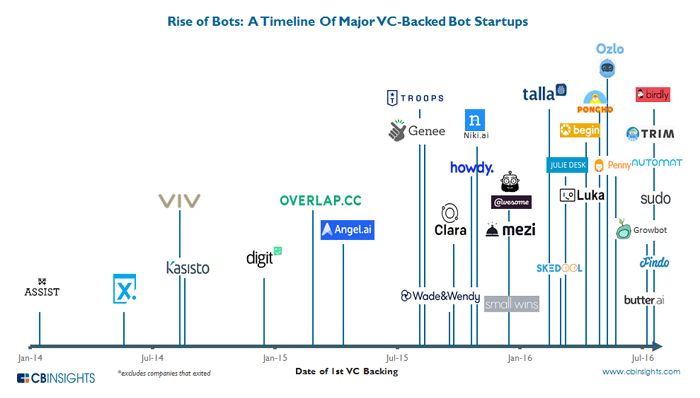
Chatbots have recently gained significant momentum, with developers flocking to the space. Indeed, many chatbot projects secured funding within the past year, with activity becoming particularly dense since the beginning of 2016.
How about chatbots in the healthcare sector? Just a few days ago, Koko, a startup leveraging chatbots as its entry point, secured $2.5 million in Series A financing. Koko applies artificial intelligence technology to cognitive therapy, primarily serving adolescents with emotional issues to help them improve their mood. Is this truly noteworthy? Let’s explore further with VCBeat (WeChat Subscription Account: VBResearch2016).
First, let’s provide some background to clarify what a chatbot actually is. A chatbot, also abbreviated as “Bot,”It refers to chatbots. Note that the term "chatbot" here does not denote a physical robot; rather, it describes a service model based on conversational interfaces—whether text-based or voice-based—that addresses user needs through dialogue, similar to virtual assistants.
According to research by VCBeat, bots are not a new concept; in fact, the technology underlying most bots is relatively simple. Most people have likely interacted with chatbots before (for instance, when you reply with a few digits via SMS to 10086, China Mobile’s customer service number, it sends you your monthly usage details). Indeed, chatbots have been around for a long time. It is only in recent years, with mobile communications beginning to surpass mobile social networking and the rise of artificial intelligence and big data, that chatbots have come to be seen as a significant opportunity.It is possible to replace the app mode., transforming the existing business models of the internet. Furthermore, this year’s press conferences held by Facebook and Microsoft have demonstrated that chatbots are a key strategic focus for their future development.
So, how do chatbots work? Currently, there are three modes of operation for chatbots:
The first type isRule Response, meaning that inquiries must be rule-based, and the chatbot can only respond if the user's input matches pre-stored phrases. This model is relatively limited and therefore represents the most basic level.
The second type isMachine Learning-Based Chatbot, on the one hand, machines can accurately recognize the irregular language you emit; on the other hand, certain logical algorithms are employed to ensure that each response she provides meets your needs to the highest possible standard.
The third model, calledRemote Manual Mode, which means that after your information is sent, it will be directly transmitted to the backend system. The backend will then forward your information to the appropriate specialist for consultation. The response will be delivered to your chat interface in the form of text or video.Primarily applied in more complex fields, such as healthcare., although this model ensures the accuracy of responses, it is relatively slow in terms of response time. It is worth noting that although this model does not employ intelligent response technology, since the service is essentially based on a chat interface to address user needs, it is also considered a chatbot by definition.
In China, WeChat and Weibo are platforms that support chatbots. Abroad, platforms such as Facebook Messenger, Slack, and Telegram serve this purpose.
In the past six months, chatbots have been highly sought after, at least in Europe and the United States. Although a large number of developers have flocked to this field, few have truly excelled.VCBeat Research Institute believes that 95% of niche scenarios remain untapped, awaiting exploration and development. Many entrepreneurs in the medical and health sector are still relatively unfamiliar with this field and hold misconceptions about how to enter it.The following aspects are worth noting.
1. The technical threshold for chatbots is not necessarily high
Upon seeing the word “robot,” many people assume it belongs to the field of artificial intelligence and entails a high technical barrier. This is not necessarily the case. Currently, neither natural language processing nor AI-driven intelligent diagnostics based on big data has reached full maturity. While certain innovative startups and tech giants have made notable progress, the perceived high technical barriers remain a concern for many, suggesting that not everyone can easily enter this space. In reality, this is not the case. As previously explained in this article regarding the concept and basic operating model of chatbots, chatbot development can range from simple to sophisticated, and numerous open technology platforms are available for use. Consequently, one does not need an in-depth mastery of artificial intelligence technologies to build and deploy them.
2. Enhancing the interactive interface experience is the primary value proposition of bots today
Many entrepreneurs still watching from the sidelines fail to grasp the value proposition of bots. In fact, the core issue that current chatbot models can address is optimizing the user interface, thereby comprehensively upgrading the interaction experience through a more human-centric communication mode. The core value lies in the interface experience, which does not necessarily entail an enhancement of the service’s intrinsic value.
Why Some Critics Believe Bots Could Fully Replace Apps: A Perspective on Interface ParadigmsSome critics argue that bots could completely replace apps, a viewpoint grounded in the evolution of interface paradigms. In other words, instead of opening individual apps to access services, users will interact with a bot through conversation to obtain those services. This shift mirrors the transition seen a few years ago when mobile phone interaction primarily relied on physical keyboards but has now fully shifted to touch-screen interfaces.
The upgrade in interface experience may not appear highly intelligent, but it aligns with people’s innate preference for convenience—lying down rather than sitting, sitting rather than standing, and using voice commands instead of manual input whenever possible. The benefits of simplicity, directness, and speed save mental effort, and a well-designed chatbot can indeed offer a superior user experience compared to traditional apps.
3. Bots are related to “guidance” and can serve as a traffic entry point
Simple, direct, and fast—these value propositions are highly suitable as entry points for users to access various services. For instance, use cases such as shopping assistance, medical triage, and navigation align well with bots. A bot with platform-aggregating capabilities can become a new traffic gateway. Naturally, tech giants that already dominate existing traffic gateways will strive by all means to maintain their control. This is precisely why major players like Google, Apple, and Facebook are heavily investing in platform-based bots.
4. Bots are not merely reactive; they can exhibit strong proactivity.
People often assume that their interaction with a chatbot is limited to asking a question and receiving a passive response. In reality, however, bots can also proactively pose questions or follow-ups based on the context. This more proactive approach better engages users and enhances user stickiness. Compared with traditional web-based interfaces, chatbots offer significantly stronger interactivity.
As an entry point, it often assumes the function of data acquisition. From the perspective of machine-driven data collection, bot interfaces are more proactive than traditional web-based models. In conventional interfaces, systems passively wait for users to input information; in contrast, bots enable continuous interaction along a timeline. They can proactively ask follow-up questions based on predefined logic and target specific inquiries, thereby making it more likely to obtain comprehensive and easily structured data.
Keywords such as interactive interfaces, personal data collection, service navigation, and traffic entry points are equally significant in the fields of digital health and internet-based healthcare, particularly for B2C models.Entrepreneurs in the digital health sector should consider how to leverage the advantages of bots to enhance their product experience, strengthen unique selling propositions, improve user stickiness, and boost conversion rates, based on their specific circumstances. It is also essential to monitor public acceptance of the bot model.
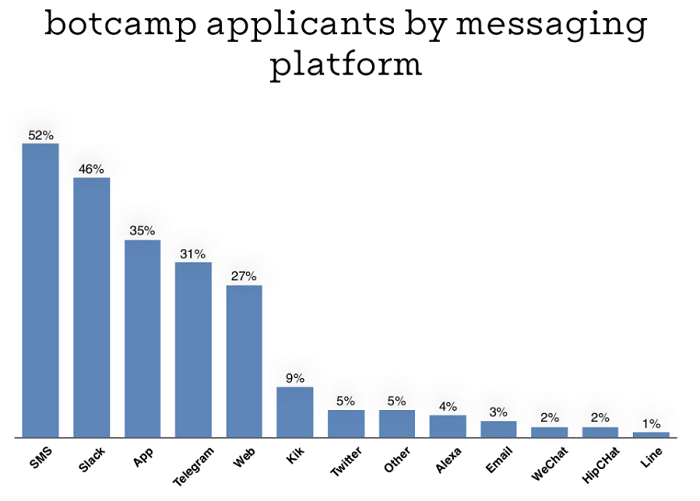
Bots are currently applied on a limited scale in the medical and healthcare sector. Data disclosed in July indicates that chatbots are deployed across various fields, with the most extensive adoption at the enterprise level, where businesses leverage chatbots to enhance operational synergy.
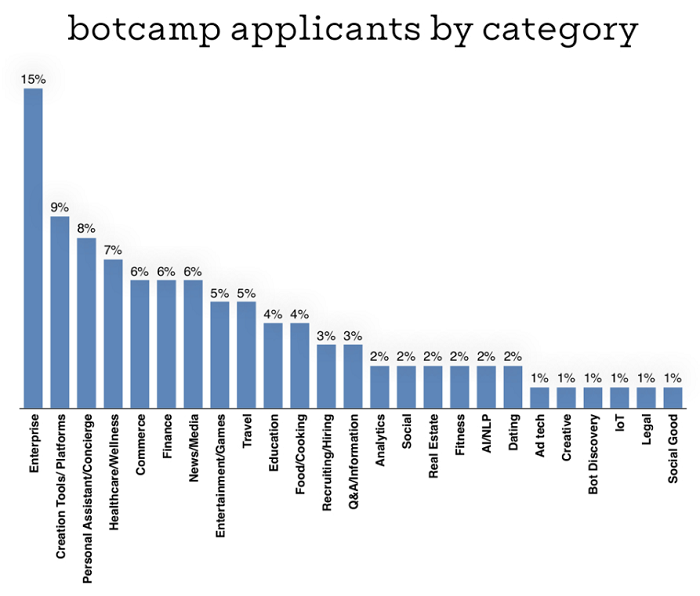
According to the categorized data on botlist.co, there are few chatbots in the health sector, with only 10 listed. Moreover, most of them are low-barrier applications focused on body shaping and dietary management.
VCBeat has compiled a list of representative applications of chatbots in the health sector, as follows.
your.md: Preliminary Diagnosis
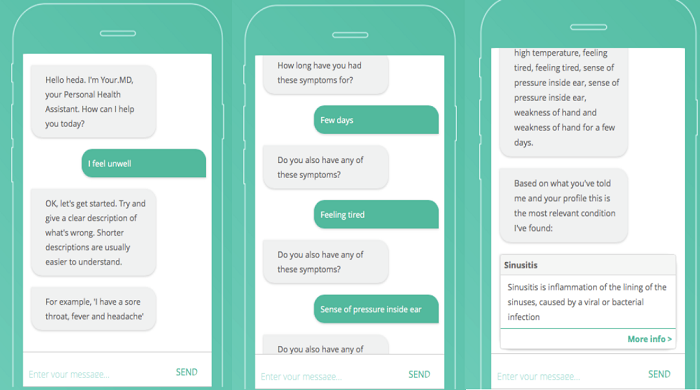
your.md is a Norwegian company, now headquartered in London, and the first to apply artificial intelligence to the field of health assistants. Its chatbot is currently available on multiple platforms. The company’s operational model is primarily based on machine learning, with its main function being to help patients identify their symptoms, akin to an initial consultation. According to its official website, the company maintains a pre-diagnostic database covering more than 1,100 diseases. Its workflow consists of three steps: first, it asks about your symptoms; then, it repeatedly presents options to categorize your symptoms through complex logistic regression and provides a diagnostic result. As it typically asks about symptoms more than five times, the accuracy rate is relatively high.
HealthTap: Pre-diagnosis and Triage
HealthTap is a renowned telemedicine company based in California, USA. Not long ago, the company launched a chatbot on the Facebook Messenger platform. This chatbot operates through a combination of machine learning and remote human assistance. Unlike Your.md, HealthTap automatically searches its own case database for similar cases upon receiving an inquiry. It is worth noting that HealthTap’s responses not only provide diagnostic results for symptoms but also offer treatment guidance. If HealthTap’s case database lacks relevant records, the system automatically switches from machine learning mode to remote human assistance mode, forwarding your consultation to all doctors on the platform. You can expect a response from a relevant physician within approximately one day. Currently, the HealthTap platform features over 100,000 doctors covering 141 specialized medical fields.
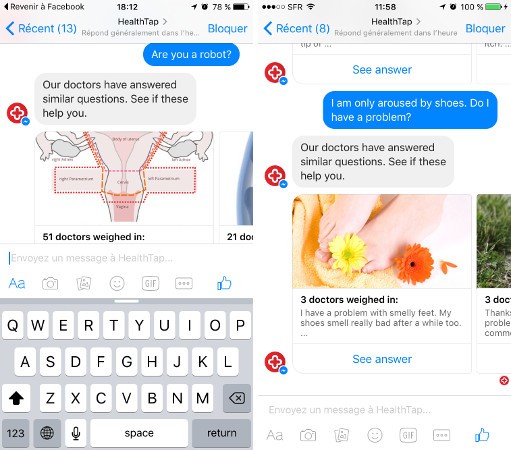
HealthTap’s model enables better reuse of historical physician Q&A data, reduces the waste of medical resources to a certain extent, and helps lower costs.
iCliniq: Bot Interface + Human Service
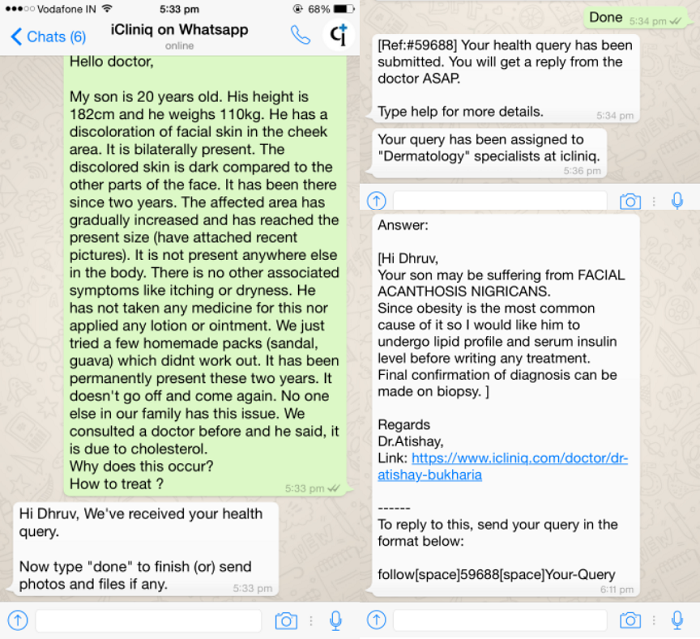
iCliniq is an Indian telemedicine company that claims to be the first chatbot to enter the healthcare sector. It currently boasts over 1,500 doctors across more than 80 specialties, with its user base reaching 110,000 as of a few months ago. iCliniq’s operational model does not involve any artificial intelligence; it relies entirely on remote human consultation, similar to HealthTap’s remote human-powered model. iCliniq charges $4.99 per question, or offers a monthly subscription for $49.
Forsky: Combining Social Features to Enhance User Stickiness
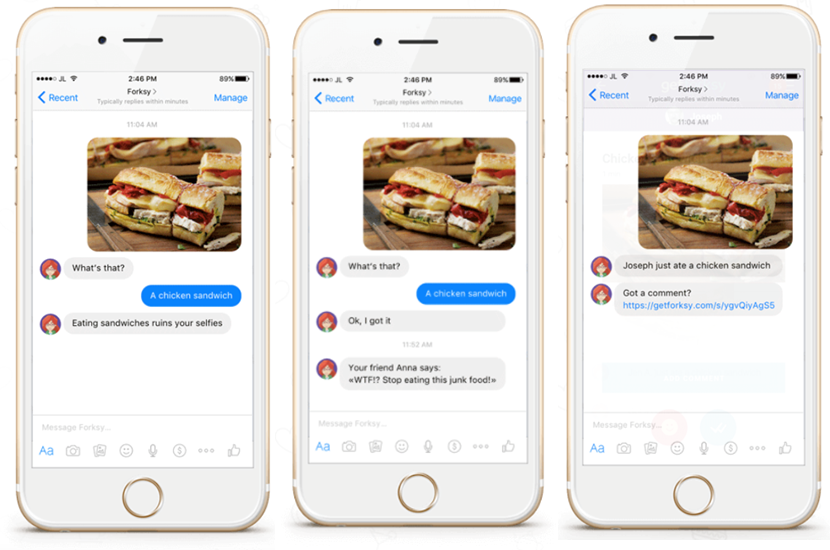
Forsky is a chatbot in the healthy eating domain, dedicated to helping users change unhealthy dietary habits. Its operational model incorporates artificial intelligence and is highly engaging. When you report food items to Forsky, it determines whether they are healthy. If an item is deemed unhealthy, Forsky provides feedback that is humorous yet blunt (for instance, when you send a photo of an unhealthy food, Forsky will recognize it and retort without hesitation, “This will ruin your selfie”). Furthermore, Forsky solicits evaluations of your food from your friends and relays their feedback to you, while also informing you who else has consumed similar items. This chatbot excels in interactivity; unlike other closed-system chatbots, Forsky integrates social features, making it innovative.
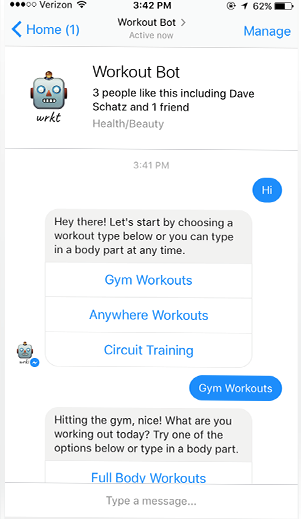
Workout Bot: Exercise Selection Wizard
Workout Bot is a chatbot designed for fitness purposes. When users inquire about exercise routines, the chatbot provides a list of workout options. All interactions are presented in a multiple-choice format, operating on a basic rule-based response model. As such, it is relatively simple and can only respond to specific requests without analyzing the user's fitness status.
Gymbot: Exercise Recommendations
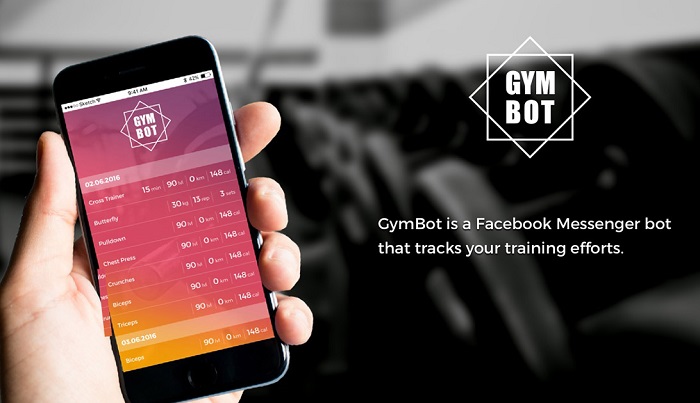
GymBot is also a fitness-oriented chatbot. However, compared to Workout Bot, it not only provides exercise recommendations but also records workout sessions (with a streamlined logging process, similar to filling in options via sliding selections) and tracks fitness progress. Finally, it offers data-driven analysis based on the collected information.
Joy: Mood Tracking
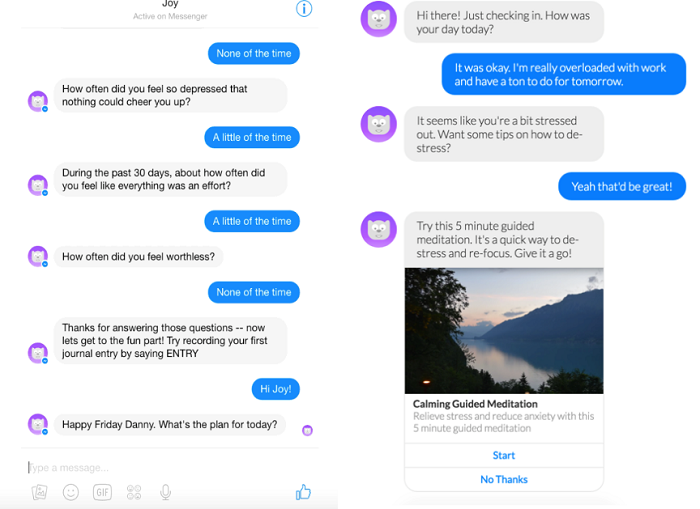
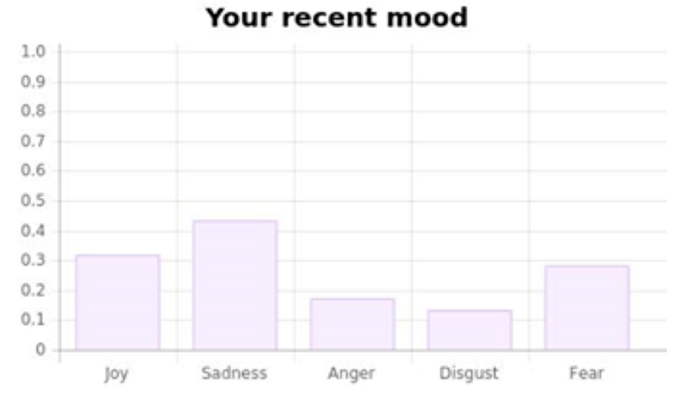
Joy is a chatbot designed for mental health support, currently available exclusively on the Facebook Messenger platform. Powered by artificial intelligence, it not only provides coping strategies for users’ negative emotions but also tracks their emotional states. Joy periodically checks in with users to assess and record their mood, offering supportive guidance when they are feeling down. It is the first chatbot specifically developed to address users’ emotional and psychological well-being.
Kokobot: Cognitive Therapy
Kokobot is the chatbot mentioned earlier. Although it has not yet been officially launched, VCBeat has learned from its official website that this chatbot leverages both artificial intelligence and collective wisdom. In terms of interactivity, this chatbot stands out significantly: users will not only receive guidance from Kokobot but also, as VCBeat speculates, benefit from peer-to-peer assistance in answering questions. This approach will greatly enhance the scalability and engagement of the responses, while reinforcing cognitive therapy through mutual support. Despite the current scarcity of information about this chatbot, these features make it highly anticipated, leaving us eager to see how it will ultimately reshape the chatbot experience.
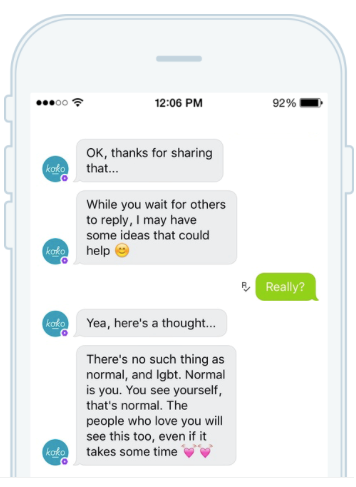
In the internet healthcare sector, a large number of apps have flooded the market over the past two to three years, with the vast majority of startup teams still searching for more mature and sustainable business models. How can chatbots help? In most application scenarios, chatbots that prioritize interface optimization as their core value are unlikely to serve as a lifeline; they can mostly only add icing on the cake. However, in certain areas, interface upgrades can align with key value propositions. VCBeat believes that applications in the following areas will be particularly interesting.
Entry into elderly care.The elderly population has low acceptance of traditional app models, as many struggle to adapt to conventional human-computer interaction interfaces. Chatbot interfaces are more readily accepted by older adults. These tools can serve as lifestyle assistants to some extent, helping manage emergencies and providing a degree of companionship. However, promoting them through a B2B2C business model may be more effective.
Quick Encyclopedia Q&A.Chatbot models may well disrupt our traditional, dictionary-style approach to knowledge acquisition. Transitioning from conventional index-based search methods to chatbot-driven interactions can significantly enhance efficiency. Moreover, the interactive question-and-answer format facilitates a more comprehensive grasp of interconnected knowledge points, thereby helping to avoid errors arising from taking information out of context. This is particularly relevant in fields such as medical health, nutrition and wellness, and sports and fitness, where much of the information is not isolated or linear in nature.
Triage, Patient Guidance, and Preliminary Diagnosis.Driven by the overarching policy of tiered diagnosis and treatment, products that can efficiently allocate medical resources, save energy for medical staff, and reduce operational costs for healthcare departments will gain a certain level of market acceptance. The chatbot interface model can better realize pre-diagnosis, triage, and patient guidance. Many internet healthcare startups have deeply cultivated this field in the past, resulting in fierce competition. Merely improving, optimizing, or newly entering the competition with a chatbot model alone cannot change the competitive landscape or resolve the fundamental dilemmas. Ultimately, multidimensional competition remains essential.
Healthcare Institution Customer Service.The use of chatbots to partially replace human agents in customer service has been widely adopted across many industries. Healthcare institutions also have significant customer service demands, similar to the call center needs of other sectors; however, this is fundamentally unrelated to medical care itself and represents a typical B2B business model.
For more potential application scenarios and innovative models of chatbots in the healthcare sector, please feel free to contact us for further discussion and exchange!
To read more articles by this author, please visitGu Beini Column
Author: VCBeat. Please credit the WeChat official account when reposting.VBResearch2016
↓↓↓
【VCBeat Research Report: Free Reading】

Interested parties, click here to view