

"Internet+" Drives the RMB 3 Trillion Maternal and Child Market: Jiajia Yue Sao App Files IPO Prospectus
According to the China Population Statistical Yearbook released by the National Bureau of Statistics, the annual number of newborns in China has been approximately 20 million in recent years. With over one-third of mothers and infants utilizing nursing and related services, the estimated customer base comprises 5 to 7 million households. Currently, the average annual per capita consumption of the new generation of parents ranges from RMB 5,000 to RMB 18,000. Institutional projections indicate that the total size of China’s maternal and infant market was expected to reach RMB 3 trillion by 2017, demonstrating substantial current demand and significant growth potential.

With the full implementation of the two-child policy and the influence of “Internet Plus,” China’s maternal and infant market is entering a fast track of rapid development. The maternal and infant industry is gradually establishing online channels for business operations.
Online maternal and infant platforms refer to digital services that provide lifestyle support for prospective parents, pregnant women, and parents of infants and young children (aged 0–6). These platforms offer a range of services, including parenting information, shared parenting experiences, early childhood education products and services, and the sale of maternal and infant products.
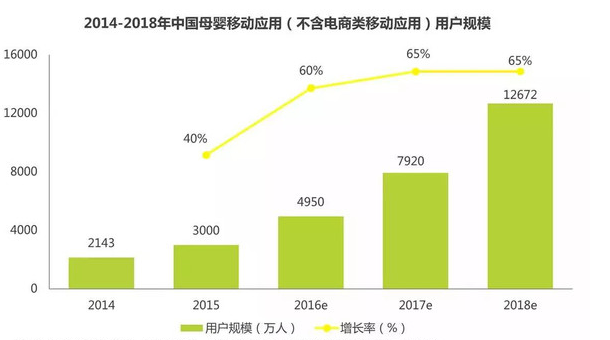
For a long time, companies in the maternal and infant product sector have largely relied on expanding offline markets to boost economic returns. However, with the rise of a consumer base dominated by parents born in the 1980s and 1990s, the landscape of the maternal and infant industry has begun to shift. A significant number of enterprises have launched maternal and infant-focused mobile applications, aiming to leverage the “Internet Plus” trend to open up new sales channels and markets within the industry.
On August 13, 2016, the founding ceremony of the China Maternal and Infant Care Industry Alliance was held in Shenzhen. Xiu Chengjuan, former Director of the Shenzhen Health Bureau and Chair of the Expert Committee of the National Strategic Alliance for Technological Innovation in the Maternal and Infant Industry, stated that the current development of China’s maternal and infant industry is plagued by numerous issues, including low professionalism, lack of service standards, and absence of effective regulation, failing to establish professionalized and industrialized industry norms.
At the conference, Shenzhen Didi Yue Technology Co., Ltd., one of the organizers, announced the launch of the “Jiajia Yuesao APP.” Dai Zixiong, President of the Jiajia Yuesao platform, stated that the goal is to enable consumers to find confinement nannies via their mobile phones, much like hailing a ride on Didi. By opening the Jiajia Yuesao app and entering their home address, users can select a confinement nanny online, schedule in-home service appointments, and view information such as the nanny’s ID card, health certificate, professional qualifications, as well as reviews from other clients. The reporter learned at the event that since its launch five months ago, the platform has served over 2,000 households and boasts more than 200 professionally trained confinement nannies.
Dai Zixiong stated that the establishment of the China Maternal and Infant Care Industry Alliance aims to leverage the comprehensive advantages of industry, academia, and research, integrate resources, and prioritize the specialization, standardization, and industrialization of the maternal and infant care sector as the alliance’s key focus.
Currently, many domestic maternal and infant enterprises have entered the fields of internet e-commerce and community apps. Examples include Mia.com, an e-commerce platform for cross-border maternal and infant products; maternal and infant communities such as Mama.cn and Babytree; and JD.com’s maternal and infant app, “JD Baby.” These infant and toddler e-commerce platforms and apps boast a large number of active users in China’s application market, with the “Mom Economy” emerging as a new market favorite.