

YouHuJia Files IPO Prospectus to Revolutionize Post-Discharge Care with Internet-Enabled Nursing and Rehabilitation Platform
China’s inverted population pyramid, aging demographics, and other challenges are becoming increasingly pronounced. The comprehensive implementation of the two-child policy, coupled with a more urgent and substantial elderly population in need of care, has driven robust demand in the nursing care market. Meanwhile, traditional fields such as accidental injury caregiving and rehabilitation continue to experience growing demand.
In 2014, the market size of China’s maternal and infant industry exceeded RMB 1.6 trillion, approaching RMB 2 trillion by the end of 2015. According to relevant data projections, the relaxation of the two-child policy will result in an additional 3 to 5 million newborns annually, generating a consumer dividend of RMB 90 to 150 billion for the market.
By the end of 2014, China’s population aged 60 and above had reached 212 million, growing by tens of millions annually, and is projected to exceed 300 million by 2025. Alongside this surge in the elderly population, the scale of China’s eldercare industry has been expanding rapidly: from RMB 1.3 trillion in 2010, it is expected to reach RMB 3.3 trillion by 2020 and RMB 8.6 trillion by 2030.
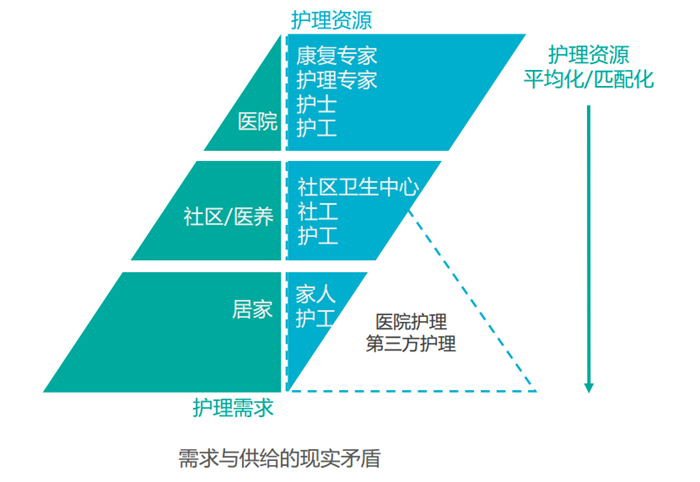
Compared to the maternal and child market, elderly care presents more pronounced complexity and contradictions. Statistics show that China has over 42 million disabled elderly individuals, driving the national elderly care market size to reach RMB 75 billion, with Beijing alone accounting for RMB 4.2 billion. Faced with such a vast potential market, the supply-demand imbalance in the traditional care sector is strikingly evident.
In China, 90% of the elderly population opts for home-based care, 7% chooses community-based care, and the proportion receiving hospital-based care is very low. However, under the traditional model, caregiving resources are predominantly controlled by hospitals, with rehabilitation specialists, nursing experts, and nurses all affiliated with medical institutions. Home-based care, which has the highest demand, is paradoxically the most resource-constrained sector, relying largely on family members or caregivers who lack professional training. For the majority of seniors who choose home-based care, they face practical challenges such as how to provide post-discharge care and how to manage daily nursing needs at home.
Mr. Shen Lin, founder of Youhujia, shares this sentiment deeply. In an interview with VCBeat (WeChat ID: vcbeat), he explained that his family had previously encountered numerous challenges and frustrations due to inadequate elderly care, which motivated him to focus on and transform this industry. Leveraging his internet industry background combined with the medical resources of his co-founders, Shen sought to apply internet thinking to disrupt the traditional healthcare services sector. After a year of offline market service and research, the team found that major platforms such as Chunyu Doctor and DXY had firmly dominated pre-consultation and in-consultation services, leaving post-consultation care largely underserved. Consequently, Youhujia ultimately targeted nursing and rehabilitation, the two largest segments of the post-consultation market.

Shen Lin, Founder of Youhujia
Youhujia was established in August 2015. Its founding team hails from top-tier internet companies such as Alibaba and Microsoft, as well as large-scale medical institutions including BD Medical and Ciming Health Checkup. Its R&D and marketing teams are also composed of professionals from major internet and healthcare companies. The founder, Shen Lin, is a graduate of Peking University. During his student years, he was selected as one of Microsoft’s 24 Global Student Partners worldwide. His medical project, CoDoc, won second place globally and first place in China in the software design category at the Microsoft Imagine Cup Global Finals. He also served as the project leader for a “National Major Science and Technology Special Project.” As an early engineer at Sinovation Ventures, he participated in projects such as Wandoujia and Umeng. He later joined Alibaba, where he was responsible for the O2O advertising data platform, gaining profound expertise in data processing and platform architecture. He left the company in 2015 to found Youhujia.
As previously mentioned, Youhu Jia primarily operates in the fields of internet-based medical nursing and rehabilitation, pioneering the “Internet + Tiered Nursing” model in the industry. Leveraging its team’s technical expertise and product architecture, Youhu Jia can be regarded as a provider and solutions vendor for mobile internet-based rehabilitation and nursing platforms. It offers both B2B and B2C solutions tailored to the nursing sector, supported by three core technology platforms: Youhu Assistant, Youhu Cloud, and Youhu Jia. These include SaaS platforms designed for B-end clients such as medical institutions and primary healthcare service providers, offering digital tools for nurses and caregiving staff; as well as C-end patient service platforms that deliver offline nursing care services.
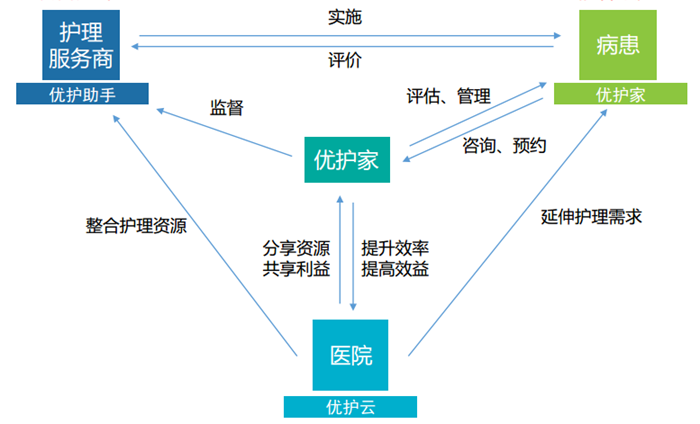
Shen LinxiangVCBeat (WeChat ID: vcbeat) Reporter IntroductionWhen developing a B2B platform, the primary prerequisite is ensuring that healthcare professionals are “online,” as internet-based services cannot function without their participation. Youhu Assistant is an online tool designed for rehabilitation specialists, nurses, and traditional caregiving personnel. It serves as a nurse-patient service platform connecting caregivers and patients, offering two separate mobile app clients: one for healthcare providers and one for patients. Its functionalities complement those of Xingshulin’s “Medical Record Folder.” While the “Medical Record Folder” enables physicians to efficiently manage patients during consultations, Youhu Assistant focuses on nurse-patient communication, helping nursing staff manage patient care more effectively and assisting nurses in delivering follow-up patient education and post-discharge care. In addition to standardizing in-hospital and home-based nursing services, it also facilitates nurses’ “multi-site practice.” Youhu Assistant provides features such as admission education, in-hospital schedule reminders, nursing plans/reports, discharge follow-ups, and the purchase of paid nursing services, thereby further aggregating patients onto the platform. Consequently, the primary application scenarios for Youhu Assistant are within hospitals and during patient hospitalization, with ideal partners being individual nurses and nursing stations.
Another B2B-oriented platform is Youhu Cloud. In simple terms, it is a SaaS platform that helps medical institutions and manufacturers systematically and intelligently manage nursing data, providing support for in-hospital nursing management and the integration of nursing information both within and outside hospitals. The Youhu Cloud infrastructure platform features two major business modules: Nursing Management Cloud and Research Cloud. The Nursing Management Cloud covers both in-hospital and out-of-hospital management. For in-hospital care, it provides nursing decision support, nursing management, and nursing education; for out-of-hospital care, it offers assessment management, follow-up management, and transitional care. The Research Cloud is a tool-based product that integrates data from inside and outside the hospital. Given the variability and independence of each follow-up model, with the assistance of research management tools, projects such as nursing project management, in-hospital nursing level management, out-of-hospital nursing cycles, and follow-up plans can ultimately be driven by research models. This model connects nursing implementers, nursing staff, department heads, and academic data collectors, enabling the platform to firmly anchor patient nursing management. Additionally, third-party health management companies can share data and collect research data through the platform to support chronic disease management processes, establishing a channel aligned with hospital management.
Compared with Youhu Assistant and Youhu Cloud, Youhu Jia is the patient service platform that users can most tangibly experience. It adopts an “Internet + Tiered Nursing” resource integration model, leveraging tertiary hospitals as its foundation to integrate and utilize nursing resources within communities and surrounding home environments, thereby providing users with continuous care services. On the Youhu Jia platform, users can access three categories of services: 1. Rehabilitation Plans: rehabilitation plans presented in text, images, and videos, along with chronic disease management plans and certain paid programs; 2. Rehabilitation Tools: users can watch health lectures via live streaming and consult directly with physicians through communication tools; 3. Offline Services: the platform offers inpatient companionship and home-based companionship services, providing comprehensive nursing and rehabilitation support for elderly care, maternal and infant care, and post-accident recovery.
Internet platforms in the industry that, like Youhujia, provide companionship, nursing, and rehabilitation services are primarily oriented toward business clients (B2B). There are few competitors adopting a combined B2B and B2C model, which has enabled Youhujia to achieve rapid growth. Compared with its competitors, Youhujia believes its competitive advantage lies in the implementability of its projects and its ability to deliver tangible service experiences to patients.
Meanwhile, Youhujia’s business model is also clearly defined: through its products, the Youhu Assistant and Optimization Cloud, it collaborates with large hospitals and specialized departments. Youhujia provides a suite of free tools, similar to Alibaba’s DingTalk client solution. Its cloud applications are charged on a pay-as-you-go basis, determined by data traffic and computational usage. Partnerships are structured according to upstream and downstream relationships. For upstream institutions, such as its collaboration with “Mingyi Zhudao,” it adopts a traffic-generation model, directing patient flow to these partners. For downstream institutions, it employs managed service and operational agency models. Traditional rehabilitation services typically require one caregiver and a dedicated rehabilitation facility; however, genuine rehabilitation services are multi-layered. Youhujia bundles traditional caregiving services into packaged rehabilitation plans for sale, and operates an agency model that links caregivers in Location A with hospital beds in Location B.
Currently, Youhu Jia has established in-depth collaborations with multiple large hospitals, including Tiantan Puhua Hospital and Aerospace 731 Hospital. Recognizing that departments such as neurology, geriatrics, and chronic disease management are the primary sources of demand in the rehabilitation and nursing sector, Youhu Jia has also partnered with over 100 independent clinical departments. Specifically, its neurology services have been implemented in the Department of Neurology at the PLA General Hospital (301 Hospital), its orthopedic services in the Department of Rehabilitation Medicine at Xuanwu Hospital in Beijing, and its diabetes management program in collaboration with the Department of Endocrinology at Peking University First Hospital.
To meet service demands, Youhujia also operates its own offline team of over 100 nursing and rehabilitation professionals, with 80% of its members serving patients in need of rehabilitative care. This approach helps validate the patient models previously provided by the platform, thereby enabling extended nursing services. According to reports, Youhujia currently maintains a customer satisfaction rate of over 98%, with strong performance observed in its online products, hospital scale, and feedback from offline service providers.
According to Shen Lin, achieving strong results in a short period requires a genuine understanding of the industry to earn its recognition. The co-founding team of Youhujia includes technical and product professionals with backgrounds in the internet sector, as well as traditional healthcare practitioners experienced in patient education within the medical field, creating an effective complementary synergy. Furthermore, before clarifying its business model, the team dedicated one year to offline services, overseeing operational processes and establishing standards. During the R&D phase, product design was based entirely on the materials and insights accumulated during this period.
When discussing the challenges faced, Shen Lin stated that the current nursing industry is similar to the diagnostic sector in that the target population’s digital literacy and health education levels remain insufficient. Many individuals do not know how to manage patient care effectively. This necessitates the development of more user-friendly internet-based products and requires a profound understanding of both nursing workflows and the nursing industry to drive progress—a significant challenge. Currently, Youhujia primarily adopts a strategy of penetration and education through communities and institutions with medical and nursing functions.
In March this year, the Ministry of Human Resources and Social Security, the National Health and Family Planning Commission, the Ministry of Civil Affairs, the Ministry of Finance, the China Disabled Persons’ Federation, and other departments jointly issued the “Notice on Including Additional Medical Rehabilitation Items in the Basic Medical Insurance Payment Scope.” The notice requires all regions to include 20 rehabilitation items, such as “comprehensive rehabilitation assessment,” in the medical insurance payment scope by June 30, while ensuring that medical rehabilitation items already covered under local payment schemes remain included. Long-term care insurance, hailed as the “sixth major insurance,” institutionally safeguards the medical and nursing needs of disabled and semi-disabled elderly individuals and fosters a new service model integrating medical care with eldercare. Since its pilot implementation in Qingdao, long-term care insurance has yielded positive social impacts. These favorable national policies have undoubtedly provided a strong boost to Youhu Jia’s focused development in the nursing care industry.
In addition to favorable national policies, the vast elderly care market is also driving demand. The market for elderly companionship and care in Beijing alone is valued at RMB 1.5 billion, while the nationwide market reaches tens of billions. When including maternal and infant care, medical rehabilitation, and basic nursing services, the market size becomes even larger, offering substantial growth potential for Youhujia. Currently, Youhujia is in discussions with multiple commercial insurance providers regarding the establishment of long-term care insurance, aiming to provide greater financial support to patients and alleviate their payment burden.
Finally, Shen Lin also revealed that Youhujia has completed its angel round of financing and is currently in discussions with investment institutions regarding its next Pre-A and Series A funding plans.