

How the Insurance Industry Thrives Amid China's Healthcare Reform: Strategies, Innovations, and Product Synergies
The new round of healthcare reform, spearheaded by the National Health and Family Planning Commission (NHFPC), is guiding and steering a major transformation in the healthcare sector. Insurance is an indispensable component of healthcare delivery and also plays a pivotal role in the healthcare reform process.
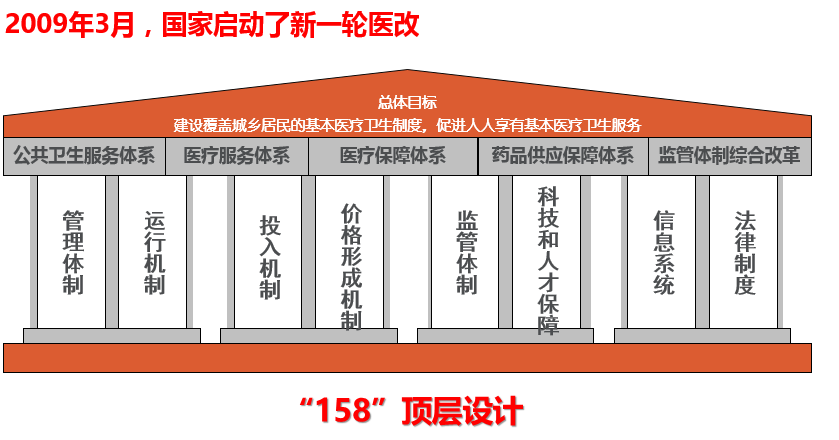
According to VCBeat (WeChat ID: vcbeat), China’s healthcare reform, which began in March 2009, is known as the “158 System.” In this framework, “1” refers to the goal of ensuring universal access to basic medical and health services for all citizens by 2020. “5” denotes the five systems that the National Health and Family Planning Commission aimed to establish: the public health service system, the medical care delivery system, the medical security system, the pharmaceutical supply guarantee system, and the comprehensive regulatory system. “8” represents the eight supporting pillars essential for achieving the aforementioned goal and building the five systems, namely: management structure, operational mechanisms, funding mechanisms, price formation mechanisms, regulatory frameworks, scientific and technological support along with talent development, information systems, and legal institutions.
Mr. Yao Jianhong, Deputy Director of the Department of Structural Reform under the National Health and Family Planning Commission, stated that the insurance industry possesses a highly favorable “genetic makeup” for healthcare reform. Following the introduction of China’s healthcare reform policies, an increasing number of patients have chosen to seek diagnosis and treatment services at hospitals. Data show that the national volume of medical consultations rose from 4.901 billion in 2008 to 7.699 billion in 2015, representing a growth rate exceeding 50%. There are two primary reasons why patients are willing to visit hospitals for care: First, hospital service conditions have improved significantly, accompanied by substantial advancements in medical expertise. Second, access to health insurance provides patients with robust financial protection during their medical care journey.
China’s commercial insurance sector offers extensive coverage, with medical insurance products encompassing a broad spectrum that includes disability insurance, income loss insurance, non-medical insurance, medical malpractice liability insurance, long-term care insurance, and critical illness insurance. VCBeat (WeChat ID: vcbeat) has learned that many insurers provide patients with specific disease insurance policies or medical insurance plans that offer payouts under particular circumstances.

At the Third Plenary Session of the 18th Central Committee of the Communist Party of China, China proposed establishing a new insurance system, namely long-term care insurance. Currently, Qingdao’s long-term care insurance program is relatively well-developed compared to other regions in China. Against the backdrop of an aging society, accelerating the establishment of long-term care insurance is a critical task. Many departments under the National Health and Family Planning Commission (NHFPC) and numerous regions across China are continuously implementing and advancing policies related to long-term care insurance.
The state has set clear goals for the development of commercial insurance. By 2020, China aims to basically establish a modern commercial insurance service industry characterized by a well-developed market system, diverse product offerings, and standardized operational procedures. Specifically, improving the market system means that all market participants can play significant roles in the insurance sector; diversifying product forms enables policyholders—including entities, individuals, and relevant organizations—to have broader choices. Commercial insurance companies can offer more diversified insurance products by aligning their offerings with their own capabilities and the needs of their target customers. Meanwhile, standardized operations, enhanced reputation, and improved service quality also occupy a crucial position in the development of commercial insurance.
In his speech, Mr. Yao Jianhong stated that the ultimate goal of developing commercial health insurance is to establish a more robust operational mechanism, significantly enhance service capabilities, broaden the scope of services, substantially increase the number of policyholders, and gradually raise the proportion of commercial insurance payouts in total health expenditure.
For the modern insurance industry and relevant authorities, developing commercial insurance requires addressing the following four points:
China has three major basic medical insurance schemes: the New Rural Cooperative Medical Scheme (NRCMS) for farmers, the Urban Resident Basic Medical Insurance for non-working urban residents not covered by formal employment systems, and the Employee Basic Medical Insurance for government agencies, public institutions, and enterprises. The commercial insurance industry should align with these three public insurance schemes and provide farmers, urban residents, and employees with more diverse insurance options. In light of China’s national conditions, the government contributes a relatively larger share to the NRCMS and urban resident medical insurance. For example, in accordance with national requirements, this year the central and local governments provide a per capita subsidy of RMB 420 for the NRCMS and Urban Resident Basic Medical Insurance, while individuals contribute RMB 150.
Health management encompasses chronic disease management, critical illness management, and more. The insurance industry can broaden its approach by integrating these concepts with chronic disease management products, thereby providing users with more targeted insurance services.
With the continuous advancement of population aging in China and the gradual increase in the elderly population, it is worth considering how to adapt to the requirements for nursing care insurance proposed by healthcare reforms and how to expand and enhance services in this field.
It is understood that some insurance companies have participated in regional imaging and laboratory centers to provide targeted insurance services to users. This approach not only conserves healthcare resources, ensuring optimal utilization of limited resources, but also facilitates hospitals and the public, thereby achieving economies of scale.
Traditional Chinese medicine (TCM) is a cherished heritage of China. Given the widespread public demand for TCM, there is significant potential to develop insurance products tailored to the field of TCM-based health preservation and wellness.
Currently, there are numerous medical institutions in China, with approximately 900,000 nationwide. The insurance industry should provide better services tailored to hospitals. According to Mr. Yao Jianhong, through this service process, the insurance industry can also identify its market value and positioning.
Insurance for Healthcare Institutions: Five Key Considerations
Medical liability insurance reduces the professional risks faced by medical institutions or physicians.
Some medical accidents are attributable to neither physician negligence nor patient fault. Given the inherent risks of healthcare, any medical intervention inevitably carries the potential for unforeseen adverse events. Insurance providers could broaden their scope by expanding accidental injury coverage to encompass such scenarios.
The specific approach is for healthcare institutions to pay insurance premiums based on a designated share, thereby providing corresponding coverage to the institutions or physicians to mitigate their professional liability risks.
For example, healthcare professionals engaged in medical imaging are susceptible to certain health impairments due to their working environment. Providing insurance coverage within the realm of occupational health protection for healthcare workers helps enhance their professional dignity.
Three Areas Worth Considering for Insurance Companies in the Development of a Universal Health Coverage System
This initiative was launched in 2012, allocating a portion of basic medical care funds to purchase critical illness insurance for the public. This funding is drawn from basic medical insurance, with no out-of-pocket contributions required from individuals. How to further leverage the advantages of commercial insurance and effectively administer critical illness insurance remains an area worthy of deeper reflection and summary by insurance providers.
Commercial insurance companies can participate in the administration of basic medical insurance. For instance, certain regions in Henan Province have implemented services where commercial insurers administer the New Rural Cooperative Medical Scheme (NRCMS), thereby providing specialized administrative services for both the NRCMS and the Urban and Rural Resident Basic Medical Insurance through commercial insurance mechanisms.
The United States has a well-known “Blue Cross Blue Shield” initiative, the core of which is for insurance companies to operate their own hospitals. This model aims to reduce costs while providing policyholders with the most direct and convenient services. How insurer-owned hospitals can control costs and offer patient-centered, diverse options is a question worth considering. If insurance institutions do not operate hospitals, then strengthening collaboration with healthcare providers becomes a key area of focus.
In addition to the aforementioned market expansion, enhanced product diversification, and embodiment of the people-centric principle in the insurance industry, it is also crucial to elevate the capabilities of insurance institutions and strengthen mutual trust between collaborating parties. Insurance companies must strive to gain greater understanding, respect, and trust from medical institutions, patients, and users across various dimensions. Regarding how to enhance bilateral trust, the following five points warrant consideration:
Insurance institutions possess the advantage of vertical and networked management capabilities, enabling them to respond swiftly to market dynamics and adjust their operational strategies in a timely manner. It is crucial to determine how to effectively leverage their specialized service capabilities.
To enhance the level of informatization, insurance institutions and medical institutions need to strengthen cooperation and mutually open up essential medical resources and information resources. Through this mechanism that extends horizontally across all sectors and vertically down to the grassroots level, the informatization level of the insurance industry can be improved.
Governments at all levels and relevant departments must strengthen oversight of insurance institutions, guiding them toward development that is honest, high-quality, and high-level.
Supportive policies encompass fiscal, taxation, and other measures, as well as internal support policies within the health system, which can guide insurance companies toward better development.
Mr. Yao Jianhong stated that insurance embodies the principle of “support from all quarters when one is in distress,” which encompasses the “law of large numbers” derived within the insurance industry. Meanwhile, commercial insurance holds a highly significant position within the overall insurance sector.
In terms of healthcare reform, the National Health and Family Planning Commission has undertaken substantial efforts in fiscal investment, management systems, organizational leadership, and key initiatives. Commercial insurance can be integrated with healthcare reform, which not only facilitates the achievement of new reform objectives but also helps commercial insurers identify new market positioning. Furthermore, this integration enables the development of product models well-suited to various insurers in China, while fostering high-quality, amicable relationships between insurers and policyholders.