

Prime Investment Opportunity in Healthcare IT: Riding the Wave of Tiered Medical System Reform
This month, China Securities launched a series of reports on tiered diagnosis and treatment. VCBeat (WeChat Official Account: vcbeat) has curated the core content from these reports to explore investment opportunities in healthcare informatization under the trend of tiered diagnosis and treatment, focusing on nine key areas. This report is the first in the series; subsequent reports will systematically review the entire industry by examining other sub-sectors benefiting from the promotion of tiered diagnosis and treatment, such as telemedicine, mobile health, third-party diagnostics, and primary care hospital development.
1Information technology is one of the key elements in promoting tiered diagnosis and treatment.
In 2014, the proportion of China’s population aged 65 and above exceeded 10% for the first time, and it was projected to surpass 20% by 2020. The following decade would witness a rapid transition into deep aging, accompanied by rising consumer spending power and awareness, leading to a swift increase in public demand for medical services. From the supply side, healthcare providers fall into two main categories: primary care institutions and hospitals. Data from the 2015 Statistical Communiqué showed that there were 34 times as many primary care institutions per million people as hospitals, yet the former accounted for only 56% of total outpatient and inpatient visits. This imbalance has resulted in hospitals becoming the preferred choice for medical consultations, thereby giving rise to the persistent challenges of difficult and costly access to healthcare.
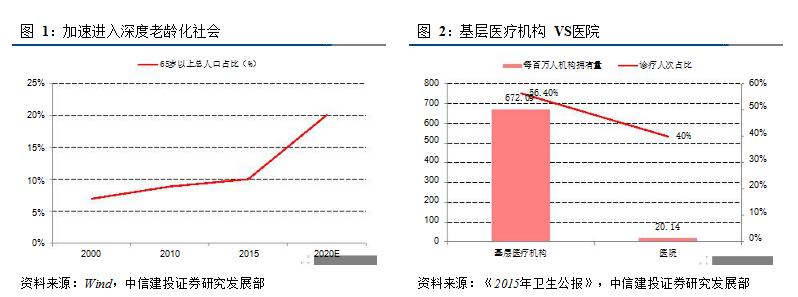
In September 2015, the State Council issued the “Guiding Opinions on Promoting the Construction of a Tiered Diagnosis and Treatment System,” marking the comprehensive deployment of tiered diagnosis and treatment. The goal is to gradually improve the tiered diagnosis and treatment system by 2017, with the gradual formation of a model featuring initial consultation at primary care institutions, two-way referrals, separate management of acute and chronic conditions, and coordination between upper- and lower-level medical institutions. Specific targets include having primary healthcare institutions account for no less than 65% of total patient visits, and achieving an annual growth rate of over 10% in the number of patients referred from secondary and tertiary hospitals to primary healthcare institutions and chronic disease management facilities. Given the significant gap between current real-world data and these targets, it is expected that various regions will introduce detailed implementation rules within the next one to two years to further advance the implementation of tiered diagnosis and treatment.
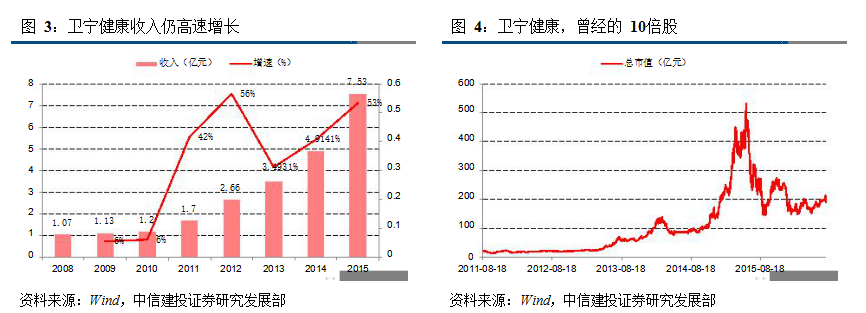
Policy-driven mandates cannot be merely wishful thinking. The training of general practitioners and the improvement and upgrading of medical informatics are two key factors in advancing tiered diagnosis and treatment. The former primarily involves issues related to education system construction within the public sector, while the latter signifies further industrial upgrading. Medical informatics itself is not a novel concept. In 2009, the New Healthcare Reform Plan, outlined in the “Opinions of the Central Committee of the Communist Party of China and the State Council on Deepening the Reform of the Pharmaceutical and Healthcare System,” proposed medical informatics as one of the “Four Beams and Eight Pillars” supporting the reform of the pharmaceutical and healthcare system. (China aims to establish a basic medical and healthcare system integrating four components: public health services, medical services, medical security, and drug supply assurance for urban and rural residents. It also seeks to improve eight major systems and mechanisms: medical management, operations, funding, price formation, regulation, science and technology and talent support, information systems, and legal frameworks.) Government investment at the local level has provided ample development opportunities for listed companies represented by Winning Health.
Reasons for Focus at This Juncture:
1. From the perspective of the industry's development stage, it is still in a phase of rising prosperity, which is also reflected in the financial data of various listed companies;
2. Healthcare reform policies, represented by the tiered diagnosis and treatment system, are accelerating industry development, driving a continuous rise in the overall securitization rate of the sector, accompanied by industry consolidation;
3. The clarification of relevant policies has meant that the government is no longer the sole client; as the market expands, it has also spurred the diversification of business models among healthcare IT companies.
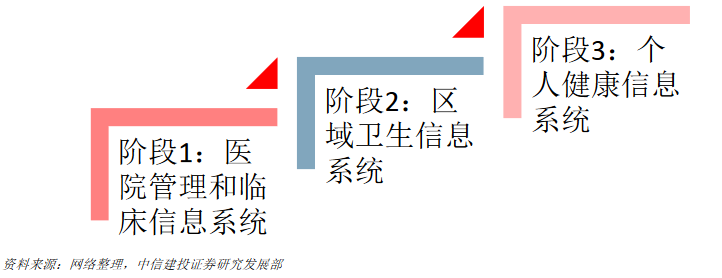
From the perspective of industrial development stages and the widely recognized progression of healthcare informatization, it is divided into three phases:
1. Hospital Information System (HIS) and Clinical Information Management System;
2. Regional Medical Information System;
3. Personal Health Management Information System.
From the perspective of stakeholders served by information systems, Phase 1 addresses hospital management needs, leading to improvements in administrative efficiency and the quality of medical services across the industry. Phase 2 establishes regional public health information systems, encompassing functions such as e-government, interoperability of medical insurance, community services, two-way referrals, personal health records, telemedicine, and online health education and consultation. This phase is typically driven by local governments or lead institutions within medical consortia. Phase 3 caters to individual health management needs. The development of each phase builds upon the foundation laid by the preceding one. Currently, China remains in the transition from Phase 1 to Phase 2, with certain developed cities progressing more rapidly.
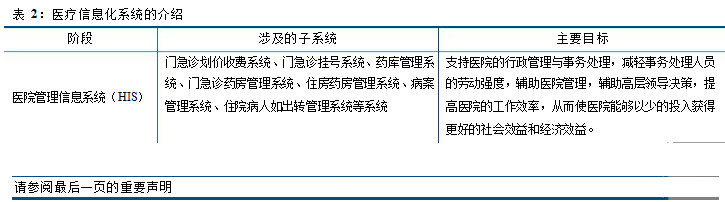
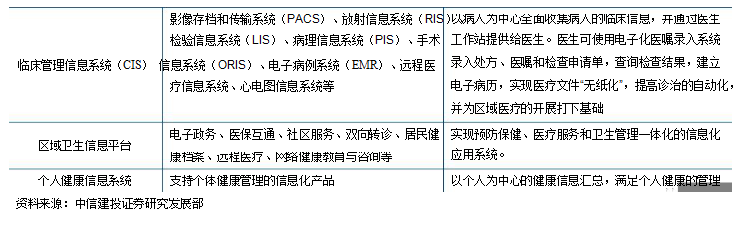
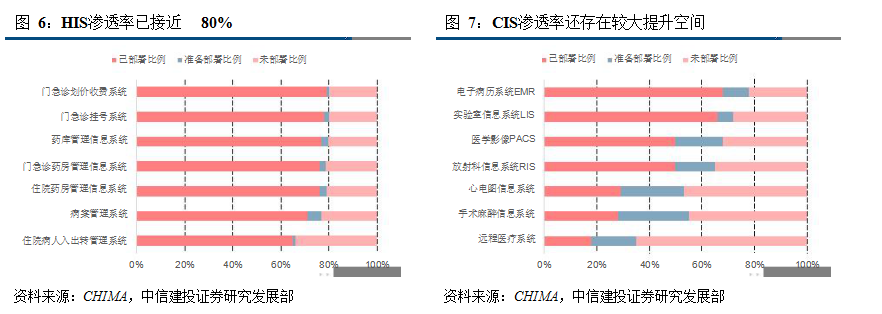
Hospital Information Systems (HIS) have achieved high deployment penetration in China, with nearly complete implementation across tertiary hospitals. Currently, healthcare informatization is transitioning from Clinical Information Systems (CIS) to Regional Health Information Systems. The former, with subsystems such as Electronic Medical Records (EMR) as its representative components, serves as the foundation for the latter. The development of both systems will be key to healthcare informatization in the coming years.
By definition, regional healthcare informatization refers to a business and technical platform that provides institutions such as healthcare providers, health administrative agencies, patients, healthcare payers, and pharmaceutical product suppliers with digital storage and transmission of health industry data. This is achieved within a defined geographic area, based on standardized construction outcomes and interoperable data sharing, to support processes in medical services, public health, and health administration. The specific functions and subsystems are illustrated in the figure below. Currently, the industry penetration rate is less than 30%, indicating substantial room for future growth.
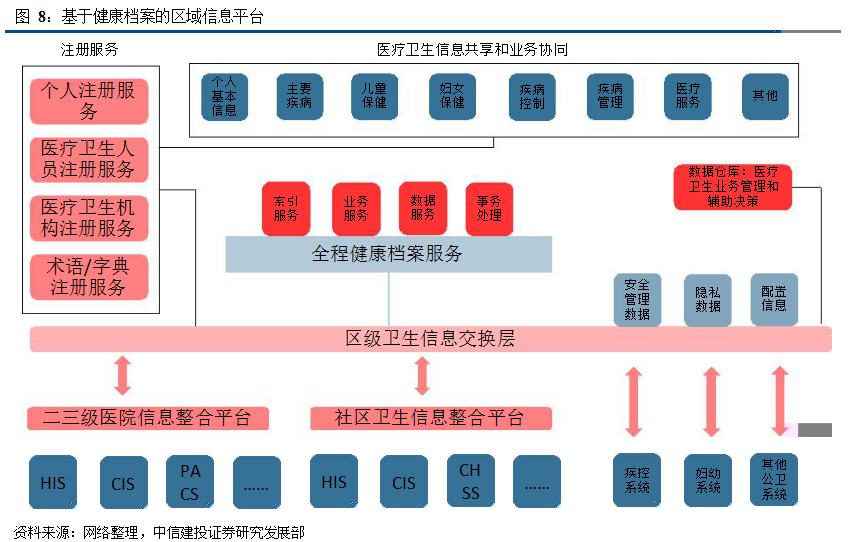
As can be seen from the definition, the functions of a regional health information platform are divided into three aspects: First, for hospitals, it enables physicians to accurately ascertain the time, location, and medical outcomes of patient visits during diagnosis, thereby enhancing diagnostic precision and treatment efficacy. Second, for patients, it facilitates timely feedback and consultations, including remote consultations. Third, for local governments, it improves the coordination of healthcare resources, reduces unnecessary medical waste, strengthens the conduct and quality of medical services, and ultimately refines service standards and quality evaluation systems, thereby maximizing the economic and managerial benefits of regional healthcare information systems.
2Four Key Directions Driving Further Development of Informatization
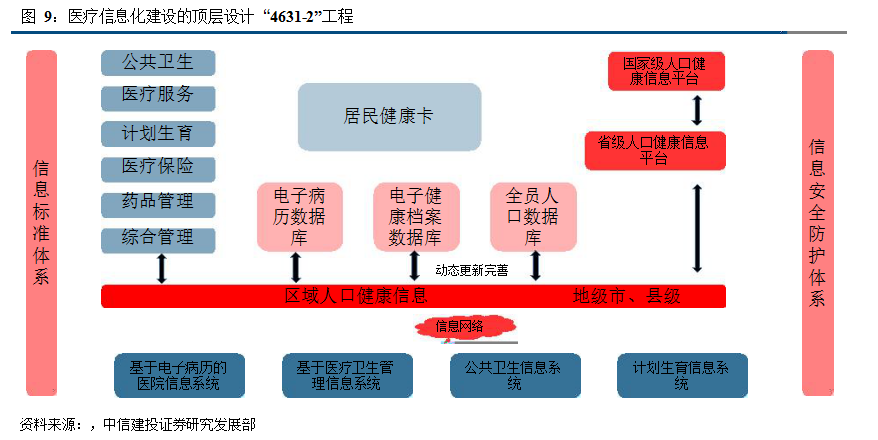
In the developmental trajectory of medical informatization from the grassroots level to regional and then national levels, top-level institutional design governs the pace and direction of implementation. Currently, the “4631-2 Project” serves as the institutional foundation for China’s medical informatization construction. As illustrated in the figure, “4” refers to the four-tier health information platforms: the National Population Health Management Platform, Provincial Population Health Information Platforms, Prefecture-level Regional Population Health Information Platforms, and County/District-level Regional Population Health Information Platforms. “6” denotes six business applications: public health, medical services, medical security, drug management, family planning, and comprehensive management. “3” represents three foundational databases: the Electronic Health Record (EHR) database, the Electronic Medical Record (EMR) database, and the Individual Population Case Database. “1” stands for one integrated network, namely the Unified Population Health Network. The final “2” refers to the Population Health Information Standard System and the Information Security Protection System. Overall, by leveraging the Traditional Chinese Medicine and Western Medicine Collaborative Public Health Information System, the Grassroots Medical and Health Management Information System, and the Medical and Health Public Service System, a comprehensive, multi-dimensional national health and family planning resource system is established.
From the perspective of core industry drivers, given the quasi-public good nature of medical services, the deepening advancement of healthcare reform will be the most significant driver for healthcare informatization construction at the current stage. Additionally, further upgrades to information systems and technologies serve as another key force propelling industry development by enhancing hospital efficiency and improving the quality of medical services.
Based on the above assertions, we believe that the following four factors will be the core drivers of healthcare informatization development: the advancement of information systems in private hospitals driven by the encouragement of social capital entering the healthcare service sector; the widespread deployment and comprehensive upgrading of information systems in primary care institutions facilitated by the tiered diagnosis and treatment model; the popularization of regional healthcare information platforms resulting from further industry development; and the renovation and upgrading of legacy systems enabled by advancements in information technology.
3The Rise of Private Medical Forces and the Relatively Affluent Population
The accelerating and deepening aging of the population has driven up demand for medical services, while the lack of market competition has resulted in subpar service quality at public hospitals. Consequently, the government is currently strongly encouraging private capital to enter the healthcare sector. Over the past three years, we have observed a significant number of companies in the secondary market expanding into healthcare services. At present, the government’s objective is for private capital to account for 30% of the total volume of medical services provided.
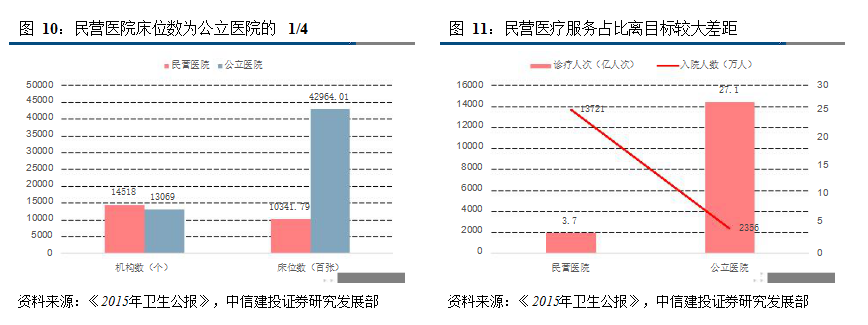
The 2015 Health Statistics Bulletin, recently released, shows that private hospitals recorded only 570 million patient visits throughout the year, a significant gap compared to the 2.71 billion visits at public hospitals. To achieve established targets, two key areas must be addressed: an increase in the number of beds and medical institutions in the private sector, and an improvement in bed occupancy rates (which stood at only 62.8% for private hospitals). The former drives new demand for healthcare informatization infrastructure, while the latter also requires enhanced healthcare IT systems to boost overall competitiveness. Furthermore, given that social capital funds informatization initiatives in private hospitals, and considering the rising rate of securitization within the industry, the influx of capital has placed private hospitals in a relatively well-funded position, thereby providing additional momentum for healthcare informatization development.
4The Digitalization of Primary Healthcare Institutions Is an Ongoing Journey
The development of medical information systems centered on resident health records in primary healthcare institutions is an ongoing endeavor. Even in Shanghai, where informatization is relatively advanced, community health service centers currently receive minimal investment. Their information management systems are rudimentary and malfunctioning, lacking integration with the information networks of large hospitals. Furthermore, there is no unified software management module or interoperable information platform established between tertiary hospitals and primary care facilities, preventing resource sharing and hindering the implementation of tiered diagnosis and treatment as well as two-way referral systems.
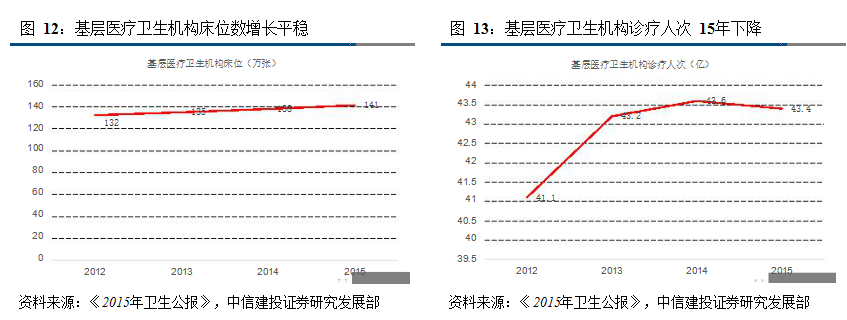
From a national perspective, we have observed that in recent years, neither the number of hospital beds nor the volume of patient visits at primary healthcare institutions has shown significant growth. However, starting last year, national policies have comprehensively deployed and advanced the tiered diagnosis and treatment system. Under the target model characterized by initial consultation at the primary level, two-way referrals, separate management of acute and chronic conditions, and coordination between upper- and lower-level institutions, the informatization development of primary healthcare institutions is expected to accelerate.
5Regional Health Information Platform: The Next Growth Engine
The state’s vigorous promotion of regional healthcare informatization is essentially a government-driven effort to establish a regional healthcare system centered on the tiered diagnosis and treatment model. Overall, it is projected that in the coming years, regional health informatization based on electronic health records (EHRs) will be the fastest-growing segment within the healthcare IT industry. This includes systems for regional medical imaging, regional electrocardiography (ECG), regional clinical laboratory testing, regional Hospital Information Systems (HIS), regional pathology, and remote consultation.
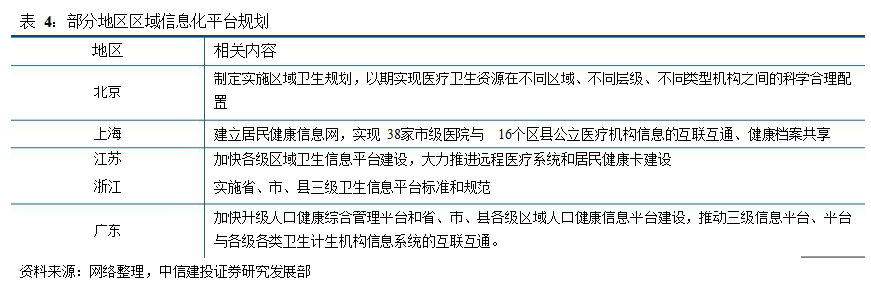
From the current perspective, overall construction progress in certain developed cities and regions, such as Shanghai and Zhejiang Province, has been relatively rapid. However, the industry’s overall penetration rate remains below 30%. The factors constraining development in other regions include:1. Ambiguous rights and responsibilities resulting from fragmented construction entities. This primarily manifests in two models: one where local people’s hospitals, under medical consortiums, propose the establishment of regional health information platforms; and another where local governments take the lead and invest in construction.2. Insufficient construction funding, which is a significant factor limiting overall industry development. For example, the recent Mianyang Population Health Information Platform project had a total budget approaching RMB 50 million. Thus, substantial capital investment is required for industry growth. Nevertheless, we are observing the emergence of Public-Private Partnership (PPP) models within the sector. Medical IT companies are securing operational rights for regional information platforms, leveraging these to explore diverse monetization strategies, and co-investing with governments in project construction.3. Inadequate laws and regulations concerning security and privacy protection. Regional healthcare informatization aims to achieve maximal information sharing on the premise of ensuring information security. Therefore, establishing institutional safeguards for privacy protection is particularly critical.
6Product Upgrades and Iterations Driven by Evolving Demand
Against the backdrop of continuously evolving requirements, the product lifecycle of information software solutions is set to shorten. As the nation advances the development of regional and public health information systems, existing Hospital Information Systems (HIS) and Clinical Information Systems (CIS) will no longer suffice to support the construction of these new frameworks. Consequently, healthcare institutions at all levels will embark on a new round of hospital informatization initiatives. For software enterprises with prior market presence, those that maintain robust R&D capabilities will be the first to benefit from this incremental demand.
7Whoever Holds the Turf Calls the Shots in the Boom Cycle
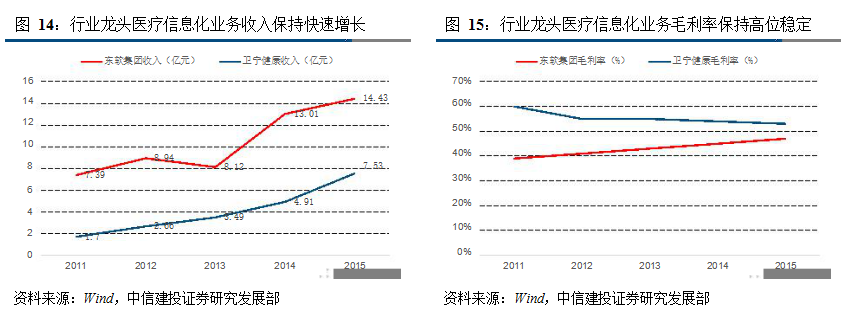
Driven by four major trends, the industry remains in a phase of rapid growth. This is further evidenced by the sustained high-speed revenue growth and consistently high gross profit margins achieved over the past five years by industry leaders such as Winning Health and Neusoft Medical. As the new healthcare reforms are progressively implemented, the sector is poised to enter a new cycle of prosperity.
According to IDC data, the scale of China’s healthcare informatics industry is expected to exceed RMB 30 billion in 2016, with the compound annual growth rate (CAGR) remaining above 15% over the next three years. Driven by the top-level design of the National Health and Family Planning Commission’s “46312 Plan” and the gradual implementation of local policies, faster-growing segments within the industry will include healthcare informatics construction in private hospitals, widespread deployment and comprehensive upgrades of information systems in primary-care hospitals, and the broad adoption of regional healthcare information platforms.
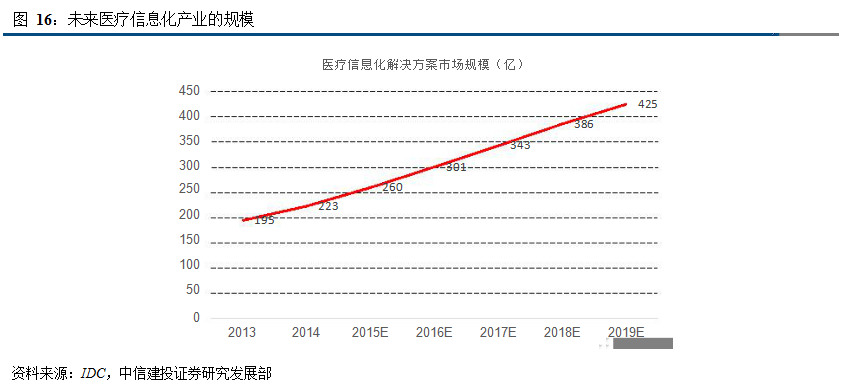
Currently, industry concentration remains relatively low, with the sector leader Neusoft Corporation holding a market share of only around 5%. As policies continue to be implemented, leading enterprises are clearly benefiting. Meanwhile, regional medical information system providers, while pursuing securitization, are also expected to accelerate intra-industry consolidation driven by capital.
8Some Glimmers of Hope Derived from Business Models
On June 21, the State Council issued the “Guiding Opinions on Promoting and Regulating the Application and Development of Health and Medical Big Data,” formally incorporating medical big data into national development strategy for the first time and putting forward requirements in four areas: (1) strengthening the foundation for the application of health and medical big data; (2) comprehensively deepening the application of health and medical big data; (3) regulating and promoting “Internet + Health and Medical” services; and (4) enhancing the construction of a safeguard system for health and medical big data.
The introduction of this policy and the gradual implementation of its detailed rules will accelerate the formation of the medical big data industry. It is conservatively estimated that the potential market size for monetizing medical big data will far exceed RMB 100 billion. Payers for medical big data services may include insurance companies, seeking to enhance actuarial capabilities and reduce claims costs; pharmaceutical manufacturers, aiming to achieve precise user marketing; government agencies, striving for more accurate control of medical insurance expenditures; and individuals, looking to better manage their health.
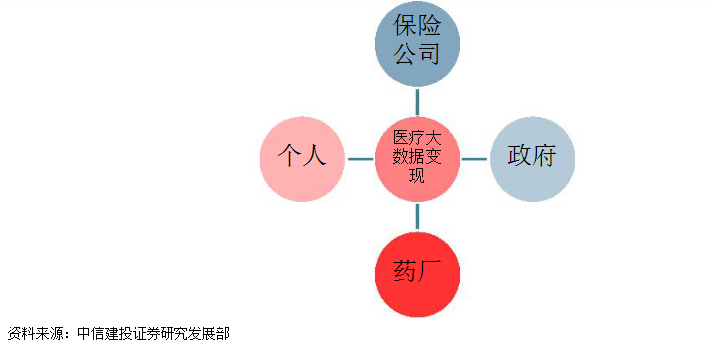
Medical information software companies, represented by Winning Health Technology Group, have participated in the construction of regional medical information platform systems through the Public-Private Partnership (PPP) model, aiming to capitalize on the derivative opportunities arising from subsequent data operations. The nascent stage of the medical big data industry begins with data collection. Hospital systems, particularly tertiary hospitals, possess abundant data resources. Leveraging their inherent channel advantages, medical informatization vendors are well-positioned to achieve business transformation. However, during the industrialization process, critical issues such as data acquisition, storage, security, and information silos warrant thorough discussion and resolution.
9Investment Directions and Opportunity Forecasting: Promising Prospects
Medical informatization is not a novel concept in itself. Our focus this week stems from the vigorous advancement of healthcare reform policies over the past year, with tiered diagnosis and treatment at their core. The industry is undergoing the following changes, which constitute our rationale for attention at this juncture:
1. Healthcare reform driven by policy mandates must not be based on wishful thinking; the development of medicalization, akin to the training of general practitioners, is one of the key supply-side elements in the downward allocation of healthcare resources;
2. Clear policy objectives will accelerate industry investment, with the construction of clinical information systems centered on Electronic Medical Records (EMR) and regional health information systems serving as the primary focus of informatization development for the foreseeable future;
3. The recent issuance of the “Guiding Opinions on Promoting and Regulating the Application and Development of Health and Medical Big Data” indicates that the medical big data industry has been elevated to a national strategic level. This also implies that potential payers for healthcare informatization initiatives are no longer limited to governments or hospitals, but may also include insurance companies, pharmaceutical manufacturers, and individuals. While this expansion enlarges the market opportunity and fosters the emergence of new business models, challenges related to data standardization and integration must not be overlooked.
4. Based on the assertion in 3), horizontal consolidation within the industry is expected to accelerate as medical IT system providers transition into data operators. Amidst uneven regional development, securing a strategic market position is crucial. Furthermore, against the backdrop of continuously rising industry securitization rates over the past year, capital-driven forces are providing additional momentum for increased industry concentration.
According to IDC data, the medical informatics industry is expected to exceed RMB 30 billion in 2016, with a compound annual growth rate (CAGR) of over 15% maintained over the next three years. Among its subsectors, private hospitals, primary healthcare institutions, and regional medical informatics platform construction are anticipated to exhibit greater elasticity, from which related companies’ strategic layouts will significantly benefit.
Note: This report is reprinted from China Securities Co., Ltd.