

2016 China Health Industry Summit: Unleashing Market Forces to Advance Healthcare Reform
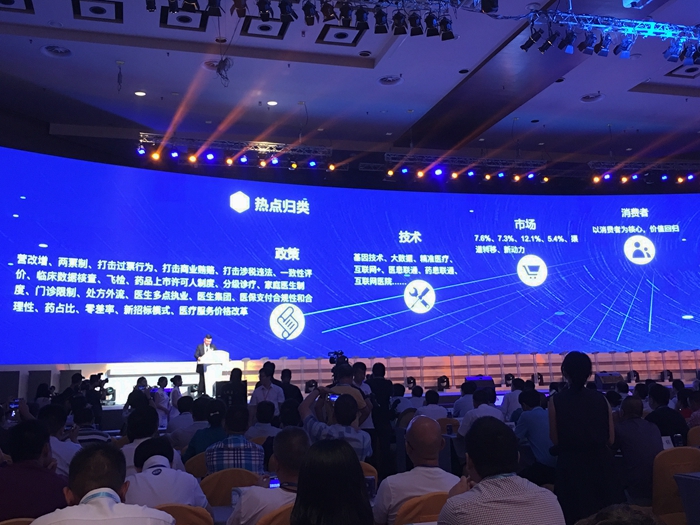
On August 22, the 2016 China Health Industry Summit (CHIS) officially opened at the Boao Forum for Asia International Conference Center in Hainan. Three thousand industry elites gathered to discuss the theme “Repositioning: Winning with C-End Resources,” jointly exploring ways to unleash market forces, advance healthcare reform, and promote the sustainable development of the health industry. Leaders from relevant government departments, including the State Council’s Healthcare Reform Office, the Ministry of Commerce, the National Health and Family Planning Commission, the Hainan Provincial Department of Commerce, the Hainan Provincial Health and Family Planning Commission, and the Food and Drug Administration, attended the conference. Government officials, association leaders, and representatives from industrial and commercial enterprises joined the organizers in launching the event. A reporter from VCBeat (WeChat ID: vcbeat) attended the entire conference and reported on its highlights.
Prior to the opening ceremony, Wu Han, Conference Chair and President of Zhongkang Information,2016An overview of the themes and discussion directions for this year's Xipu Conference was provided.
Wu Han pointed out that, as discussed at last year’s Xipu Conference, the vertical value distribution chain—centered on products and shaped by price-driven bargaining among upstream and downstream channel partners—has been broken within just one year. It is being replaced by a new networked ecosystem centered on consumers’ health needs, characterized by diverse, direct interactions between various service providers and consumers. Analyzing the underlying causes, Wu Han believes the fundamental driver is the shift in the core entities within the industry chain amid the transition from old to new industrial structures. The new ecosystem is driven by consumer health demands, whereas the old one was predominantly physician-led; this constitutes the essential difference between the two. This shift in the industry chain’s center necessitates that the health industry reposition its value proposition around consumers’ health needs. This represents a form of supply-side reform. Only by realigning with this core focus and adjusting their business models can enterprises secure their right to survive and thrive.
At the same time, “market-government synergy to advance healthcare reform” should become a consensus. Wu Han stated, “If meeting the health needs of the population is the core value of the industry, then it is highly aligned with the ultimate goal of the government’s healthcare reform!” For a long time, the industry has habitually viewed itself as the object of reform in healthcare restructuring, even positioning itself in opposition to healthcare reform policies. However, once a foundation of highly unified values is established, market entities will inevitably leverage their strengths, collaborate with the government through a clear division of labor, and jointly advance healthcare reform to better meet the health needs of the population. For example, chain pharmacies can leverage their advantages to enhance professionalism and compliance capabilities, thereby securing higher-level designated status for medical insurance reimbursement while assisting medical insurance authorities in improving the efficiency of medical insurance fund utilization. Pharmacies can also utilize their extensive network advantages to support health administrative departments in community disease prevention and control, chronic disease management, and health education, thereby collaborating with the government to achieve healthcare reform objectives.
How Can the Industry Reposition Itself to Embrace This Major Transformation? Wu Han introduced that, centering on the theme of the 2016 Westphal Conference, “Repositioning: Winning with C-Resources,” the conference provided strategic guidance for the repositioning of the health industry by analyzing national policies and industrial development trends, combined with methodologies presented by global positioning master Jack Trout and his colleagues. Meanwhile, a nationwide survey report on medication purchasers, compiled over more than six months, was released on August 22 to explore new changes in consumer health demands under the evolving environment. Furthermore, the conference will delve deeply into practical approaches for industrial repositioning, effectively unleashing market forces, and winning “C” resources, focusing on two key aspects—consumer trust and demand satisfaction—from multiple perspectives, including pharmaceutical-medical collaboration, the chronic disease market, health management, cross-industry resource integration, and the application of new technologies.
To help the industry build new models and adapt to the new ecosystem, the conference has invited a variety of cross-sector enterprises—including those in insurance, logistics, health management, and mobile internet technologies—that contribute to industrial development. The aim is to integrate these resources into an integrated service chain for the health industry, thereby creating new business models that efficiently meet consumers’ health needs and align with future development.
Wu Han pointed out that with changes in patient access to medical care and the outflow of prescriptions, retail pharmacies will become the main channel for drug distribution, facing an increasing number of patients with chronic and major diseases. In the process of integrating new resources and creating new models, the pharmaceutical retail industry must have a sense of mission and urgency to take on increasingly important responsibilities and functions, seize the opportunity of the new round of healthcare reform, proactively act, and rapidly upgrade and transform.