

Four Innovative Apps Revolutionizing Vision Care for the Visually Impaired
Thanks to advances in artificial intelligence, smartphones are driving a revolutionary transformation in care for the visually impaired. From diagnosis to “restoring sight,” smartphones are committed to providing comprehensive services to blind users.
Can you imagine that, 700 years after the invention of eyeglasses, there are still 2.5 billion people worldwide with uncorrected vision impairment? To help the blind and visually impaired regain their sight, generations of scientists have been engaged in continuous exploration and research. With the advancement of technology, various smartphone apps and related products have emerged, bringing hope to individuals with visual impairments. Furthermore, due to the ease of use and high accessibility of smartphone apps, many eye disease patients in developing countries or remote rural areas can now access professional diagnosis and treatment through these tools.
Various smartphone apps designed to combat vision loss can provide vision-related emergency care in remote areas that are far from hospitals and lack physicians. In recent years, such apps and mobile gadgets have emerged in large numbers. Vision care programs can leverage smartphone screens to display visual acuity test images, use cameras to locate sites of injury, harness computing power to process images, and utilize wireless connectivity to bridge communication between field workers and remote experts. VCBeat (WeChat ID: vcbeat) introduces several of the most successful smartphone apps and their accessories currently available, offering insights into how they help blind individuals lead better lives.
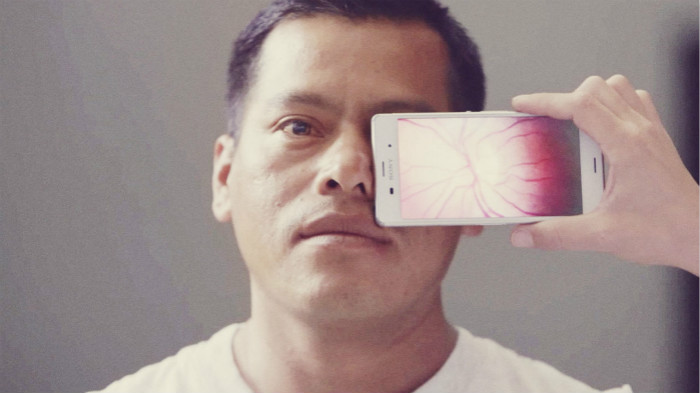
Peek Retina is a smartphone app and lens attachment developed by Peek Vision for capturing clear images of the back of the eye.
The most ambitious technology is Aipoly from Melbourne, Australia, whose app can identify objects and provide voice descriptions in seven languages. According to the company’s co-founders, Alberto Rizzoli and Marita Cheng, their inspiration came from blind friends who began losing their sight in middle age. “Although they had lost their vision, they still retained vivid memories of the physical world around them, including the colors of nearby plants and trees,” said Rizzoli. He particularly recalled an older friend: “When I was a child, I would often walk with him, describing what was around us.”
Other vision-based apps, such as TapTapSee, rely on cloud servers to process images. These apps require a wireless connection, resulting in delays of several seconds. Aipoly, by contrast, employs an AI model known as a “convolutional neural network” that runs directly on the smartphone. It does not require a Wi-Fi connection, operates significantly faster than cloud-based apps, and can identify up to seven images per second. Aipoly leverages both the phone’s CPU and GPU to perform multitasking. Nardo Manaloto, an AI engineer and healthcare consultant (who has no affiliation with Aipoly), stated, “Technology always evolves for the better, so these AI-powered apps will inevitably become mainstream in the market.”
User feedback indicates that Aipoly can correctly identify various objects, such as microwaves and champagne glasses (though, in fact, it can only label them as “glass”), and can classify items like apples as “fruit.” When it comes to animals, it has correctly identified “tabby cat” several times, although on one occasion it mistakenly recognized a cat as an “elephant.”
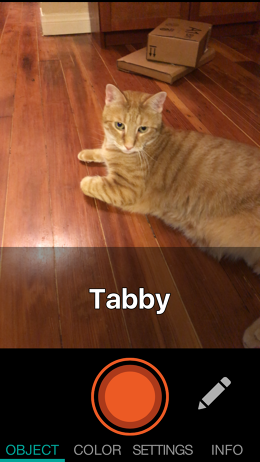
Aipoly can not only correctly identify animals, but also recognize their breeds (with varying success rates).
The next version of the app is expected to be released by the end of this year. The new version will enhance recognition capabilities, increasing the number of identifiable objects from 1,000 to 5,000. Additionally, it will reduce power consumption and expand compatibility to older iPhone models (excluding the iPhone 6 and 6s) as well as various Android devices. Currently, users can already teach the app to recognize new objects through data uploads and updates. Aipoly is also testing a new device that connects smartphones to camera-equipped glasses, allowing users to avoid having to hold their phones up at all times.
Aipoly is dedicated to assisting individuals with severe visual impairments and incurable vision loss. However, most cases of blindness are treatable, requiring nothing more than a simple device: eyeglasses. Ninety percent of blind and visually impaired people live in low-income countries, and 43% of them suffer from refractive errors, such as myopia or hyperopia. Cost is often not the primary barrier, as the price of a standard pair of eyeglasses in developing countries has dropped to approximately $2.50 or even lower. The greater challenge lies in ensuring that people in remote areas have access to accurate optometric examinations conducted by professionals using specialized equipment.
Vula Mobile is dedicated to addressing the aforementioned issues. It is a diagnostic app that connects on-site nurses and paramedics with remote physicians. To use it, hold the mobile phone approximately 6 feet (about 1.83 meters) away from the patient and open the app, which displays the letter “E” oriented in various directions. The letter gradually decreases in size until the patient can no longer determine its orientation. In addition, respondents are required to answer questions, such as whether they are experiencing any pain. Finally, respondents will provide comments and take photographs of each eye.
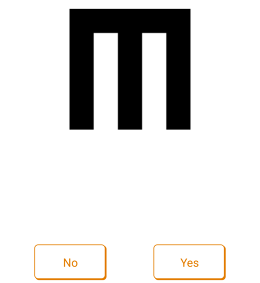
The patient indicates the orientation of the letter E, and the healthcare professional marks it as correct or incorrect based on their assessment.
After the button is pressed, the test results are sent to the app’s creator, Dr. Will Mapham of Cape Town, South Africa. He conceived the application while volunteering at a clinic in Eswatini called Vula Emehlo, which means “open your eyes” in Swati, Zulu, and Xhosa. Upon receiving the results, the doctor can communicate remotely with patients and on-site caregivers via SMS, phone calls, and other means, guiding them through further testing and treatment. The app provides professional ophthalmic care knowledge to healthcare workers in remote areas. According to Dr. Mapham’s estimates, up to 30% of patients can be treated through Vula Mobile, sparing them the need for lengthy journeys to the nearest major hospital.
Mapham and his co-founder, Debré Barrett (who also serves as the project’s sponsor), hired programmers and launched Vula Mobile in 2014. Since then, they have continuously refined the app, which can now assess eight health conditions (with counting capabilities), including heart disease, HIV/AIDS, dermatological conditions, and tumors. They also plan to expand its use from South Africa to Namibia, Rwanda, and other regions.
It is an Israeli startup called 6over6 (the metric equivalent of 20/20 vision). The app leverages basic principles of physics to enable users to determine their own prescription. The company’s app, “GlassesOn,” has not yet been officially launched on the market, but Dr. Ofer Limon, the company’s CEO, demonstrated its workflow. GlassesOn displays a pattern of red and green lines. For individuals with myopia, the boundary between the red and green lines appears blurred and takes on a yellowish hue. However, when the smartphone is held at a specific distance from each eye, the red and green lines become sharp and display their true colors, varying according to the user’s degree of myopia. By identifying the optimal distance for each eye to clearly distinguish the image, the app calculates the required lens prescription. Users need to hold up a credit card, student ID, or any other card with a magnetic stripe (as these cards share standardized dimensions), allowing the app to determine the distance by referencing the known size of the card.
In certain countries, opticians can fabricate eyeglasses as long as they have a prescription, even if it is issued via a mobile app. In the United States, 6over6 is seeking FDA validation to demonstrate the accuracy of its process. If GlassesOn obtains FDA approval, it will be able to perform certain tasks that currently require a physician. Dr. Limon emphasizes that GlassesOn is not intended to replace ophthalmologists or optometrists, as its services are limited to refraction testing for healthy individuals.
For more complex vision problems, such as cataracts, diagnosis cannot rely solely on eye charts. In these areas, smartphone cameras can play a significant role by capturing images of corneal damage or the anterior portion of the lens. However, obtaining retinal images is more challenging and requires specialized lenses. With population aging and a surge in diabetes cases, retinal diseases such as diabetic retinopathy and age-related macular degeneration are receiving increasing attention. Additionally, the retina may be damaged by rare genetic factors, such as Stargardt disease, which causes spots and blurred vision.
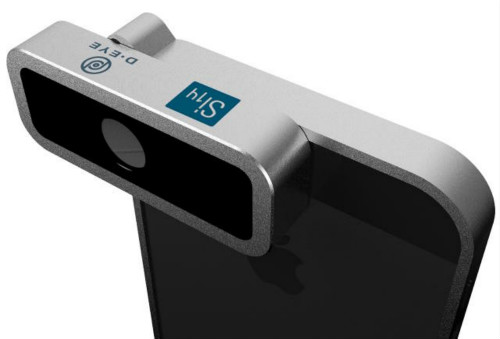
D-Eye: A Smartphone Attachment for Retinal Imaging.
Andrew Bastawrous, a British ophthalmologist, leads an organization called the Peek Vision Foundation, which has developed a smartphone app and lens attachment named “Peek Retina” capable of capturing clear images of the posterior segment of the eye. Peek has secured £50,000 (approximately RMB 430,000) in seed funding from James Chen, a Hong Kong philanthropist and chairman of the Nigeria-based family manufacturing company Wahum Group. Additionally, Peek has raised more than twice the amount needed to produce the device through Indiegogo. Although the official delivery of the product has been delayed, its prototype has undergone extensive testing on tens of thousands of individuals in Africa and has been trialed in India for several months.
When discussing the reasons for the delayed delivery, Bastawrous explained that the launch was postponed because they had to redesign the device to ensure compatibility with nearly all smartphones. The prototype he showcased in his 2014 TED Talk was 3D-printed and only compatible with specific phone models. The final version of the product will be manufactured using conventional methods. Bastawrous expects that when it hits the market in early 2017, its price will be “well below” $500.
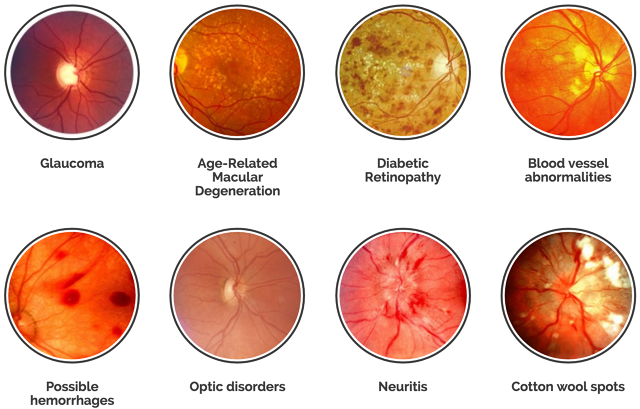
Retinal Images Captured by the D-Eye Device and Their Diagnosis
Peek Retina is merely the tip of the iceberg in the company’s business roadmap, with its core operations focused on coordination services. Bastawrous presented the following real-time screenshot, demonstrating how the system conducts vision screenings for students in Botswana and refers them to appropriate treatment specialists. Although Peek is the most well-known project among similar initiatives, there are already other for-profit companies offering devices on the market, including the D-Eye priced at $435 and the Paxos Scope at $399. Another company, oDocs Eye Care, will also launch its $299 visoScope this fall. Bastawrous emphasized that he does not intend to mandate the use of Peek Retina, as other devices are also compatible with the Peek system.
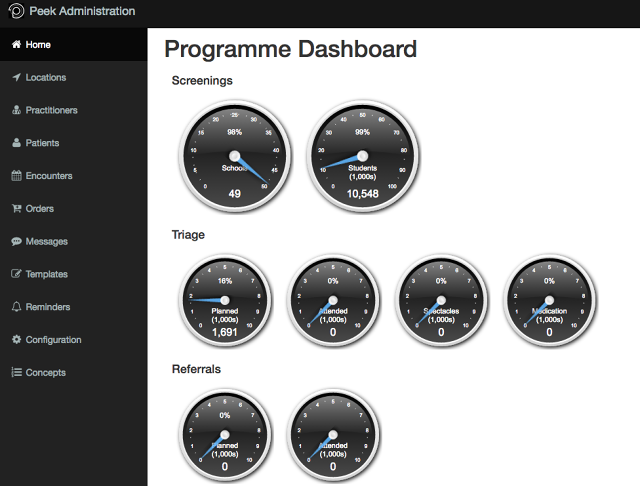
Peek’s System Enables Tracking of Vision Screening and Treatment in Botswana
Peek’s future plans also include image recognition, but Bastawrous believes its application will be limited to pre-screening ocular images for review by human experts. In his view, AI is feasible and indeed valuable, but its deployment must occur under specific conditions. According to Bastawrous, there are greater challenges in AI applications, such as preventing conditions that can lead to blindness. “If AI investment were directed toward diabetes prevention, its impact would be more than 1,000 times greater than it is today.”