

Top Medical Device Companies Are Quietly Transforming: PwC Industry Insight
Medical devices have consistently been deployed in a targeted manner to address thorny challenges in healthcare. In the new medical economy, manufacturers of medical and diagnostic equipment are connecting healthcare systems, healthcare providers, pharmaceutical companies, and other institutions to reduce healthcare costs and improve the quality of care.
Manufacturers of medical devices and technology products are striving to establish long-term, in-depth collaborative partnerships with healthcare systems and other medical service providers. They help hospitals meet growing healthcare demands by developing software, providing data, and offering recommendations. Consequently, the business models for medical products are evolving: in terms of total revenue, half of the top ten medical device manufacturers have launched service-based solutions to support their customers.
The role of medical technology is shifting, driven by rapid technological advancements, downward pressure on healthcare spending, and a growing focus on healthcare value. As established and emerging healthcare institutions respond to these changes, medical device and diagnostic companies are acting as enablers, delivering real-time services to patients and enhancing physician performance. (See Figure 1)
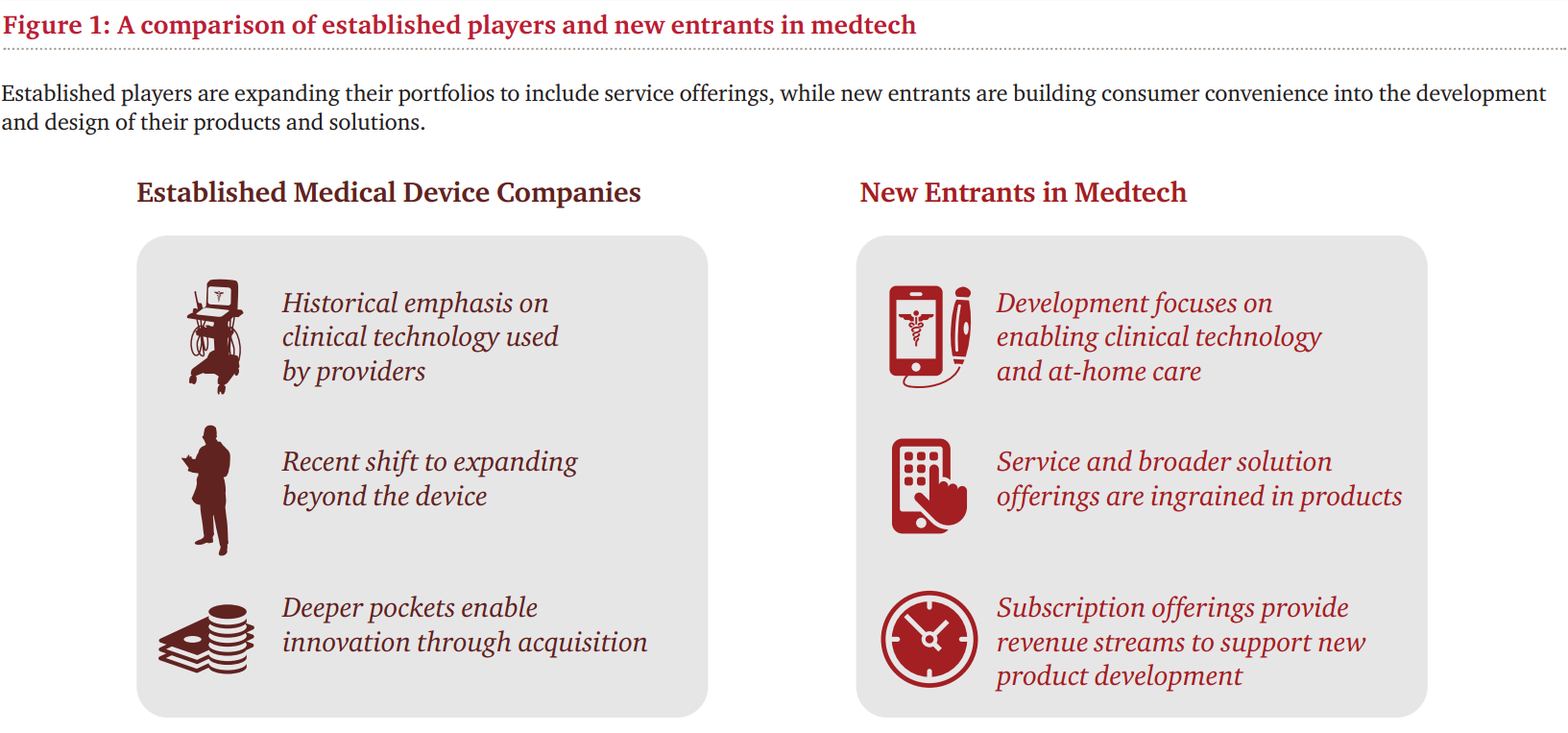
To understand how the medical device and medical technology industries are transforming their business models in areas including diagnostics, imaging, and transplantation, HRI interviewed executives from medtech companies and analyzed recent changes at these medical device firms.
HRI has found that the entire industry is adapting to profound changes in patient needs. Physicians and healthcare systems are adjusting to new economic incentives and reimbursement models, particularly those from the Centers for Medicare & Medicaid Services (CMS), and they require support in meeting patients’ evolving needs. Patients desire convenient, mobile, and user-friendly care. The health technology industry is leveraging digital tools and services to align with these patient expectations and clinician needs, monitor health outcomes, analyze the results of medical interventions, and share this information rapidly and effectively.
Meeting Patients' New Medical Needs
Medical device manufacturers are beginning to offer diversified services that meet patient needs (see Figure 2). For healthcare systems and other healthcare service providers, recording and analyzing healthcare data and information is as important as medical diagnostic equipment and technologies. New patient demands and incentives also present new opportunities for manufacturers.
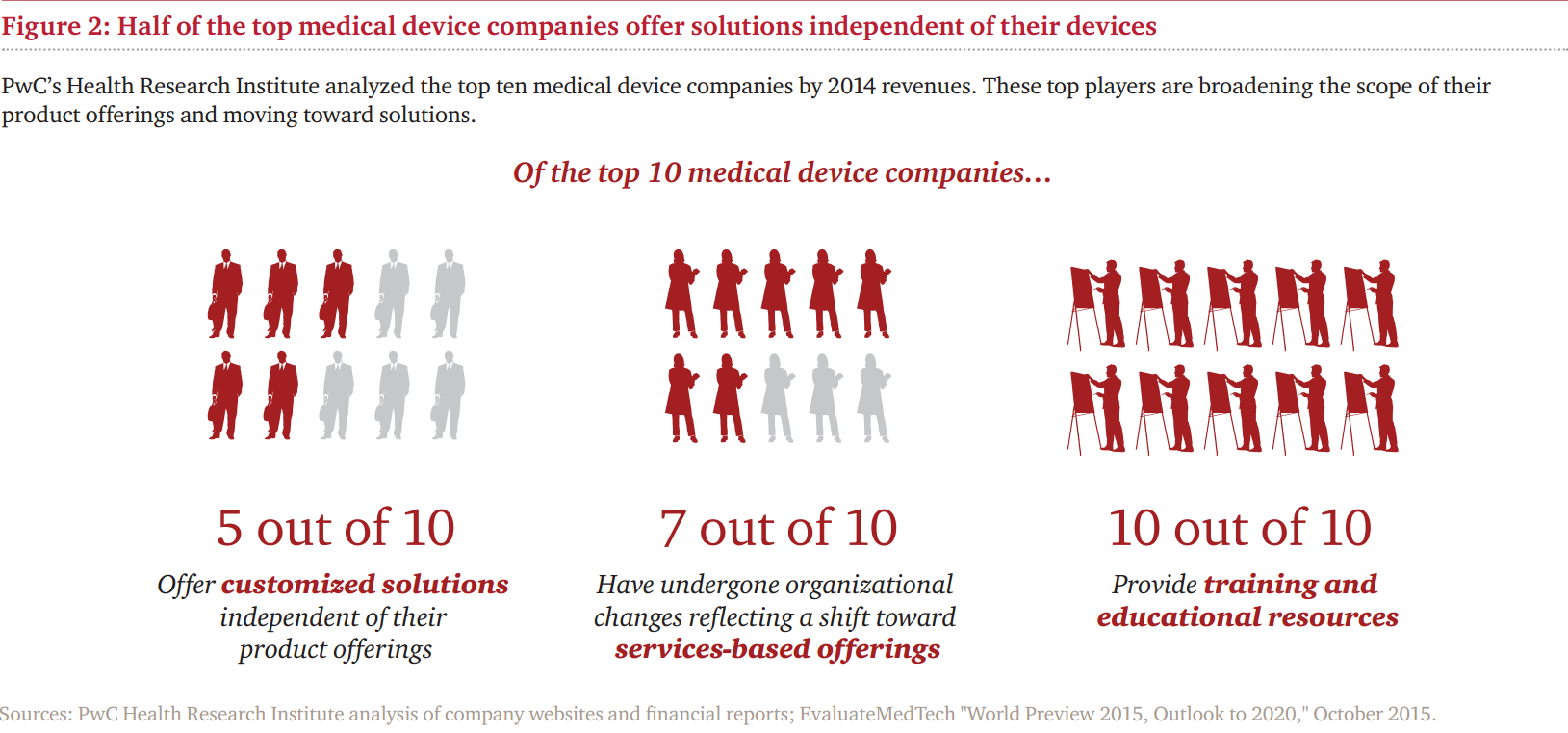
Public and private insurers and providers are advancing payment models that combine reimbursement with quality measures. Furthermore, under the Medicare Access and CHIP Reauthorization Act of 2015 (MACRA), new changes to physician compensation have generated $1.3 billion in medical incentives for doctors. Meanwhile, hospitals, healthcare systems, and physicians all require assistance in data collection and improving standards of care.
Stryker Performance Solutions—a division of Stryker Corporation—is collaborating with hospitals and other healthcare providers to improve care quality, enhance patient satisfaction, and increase profitability, without driving higher utilization of the company’s implant products. Established in 2009, this division focuses on consulting services surrounding Stryker’s orthopedic product portfolio, offering subscription-based data and analytics packages to boost healthcare institutions’ operational efficiency and patient outcomes. As healthcare organizations transition toward value-based care, there is a growing need for data analytics and end-to-end care solutions. “We aim to become closer partners with healthcare institutions and physicians,” said Brian McLeron, Vice President of Stryker Performance Solutions.
In April, Stryker Performance Solutions launched JointCOACH, a web-based portal that connects joint replacement patients with hospital care teams from preoperative preparation through postoperative recovery. This tool helps healthcare providers manage patients throughout the entire care continuum, while also delivering timely information to patients on surgical preparation, expectations, and post-discharge health recovery. These features enable care coordinators to monitor patients during the post-acute care protocol phase and intervene promptly to prevent readmissions, said Ma Kelong.
The Performance of Medical Technology in the Cloud
In the medical technology industry, no sector demonstrates the power of the “cloud” more vividly than radiology. Imaging systems have become increasingly non-invasive and less time-consuming, while also becoming more user-friendly and mobile. However, capturing images remains challenging in clinical practice. Accuracy issues have long plagued radiology departments, particularly in high-volume, 24/7 operational settings. These challenges are precisely where the “cloud” comes into play: medical technology manufacturers are leveraging cloud computing to enhance feasibility and improve the accuracy of image interpretation by combining machine capabilities with physicians’ expertise.
GE Healthcare’s cloud platform is improving clinical workflows and avoiding redundant examinations by enabling patients to easily access their medical images. Efren Iriarte, Software Technology Leader at GE Healthcare, told HRI that technology helps physicians return to their primary mission: treating patients. “Physicians want to spend more time with their patients rather than on data entry,” said Iriarte. Leveraging machine learning capabilities in the cloud, physicians can reduce the time spent on targeted analysis and calculations. Cloud-based applications employ deep learning algorithms to enhance the accuracy of image interpretation, helping physicians read images more efficiently and extract meaningful insights.
With this platform, physicians can access patient data and share knowledge with colleagues, leading to better outcomes. Citing an internal research initiative, Erik noted that the ability to access imaging studies more broadly and flexibly helped improve the accuracy of interpretations. During the project, a healthcare system observed a decline in the accuracy of emergency department interpretations overnight until shift changes. The system leveraged its network of radiologists on the cloud—including colleagues just waking up on the other side of the world—to seek their input. As a result, it “witnessed a significant improvement in the care and insights they provided,” said Erik.
On-Demand Data
Many healthcare providers are extending care services into communities and closer to patients’ homes, aiming to control costs while improving satisfaction. Data from HRI research indicates that two-thirds of patients are interested in receiving care at home. Several healthcare organizations and startups are experimenting with home-based models and mobile technologies to better serve key populations, such as frail and elderly patients. Studies also show that home-based medical care is more effective and less costly than inpatient services. Healthcare companies are driving this trend by developing out-of-hospital products, including patient-engagement mobile applications, at-home diagnostic tests, and remotely monitorable wearable sensors.
“People don’t want to go to the hospital,” said Randy Krog, President and CEO of Omron Healthcare, a medical technology company specializing in cardiovascular health. “Many people visit hospitals simply because that’s what has traditionally been done, not necessarily because it is effective.” Omron has introduced solutions such as wrist and upper-arm blood pressure monitors, enabling patients to receive clinical-grade care in the comfort of their homes, while on the move, or anywhere else. Between 2013 and 2015, the number of individuals using health monitoring tools increased, with the number of patients undergoing remote monitoring rising from 3 million to 4.9 million, a 63% increase. According to data from HRI Research, the proportion of physicians accessing medical device data via mobile devices doubled between 2010 and 2014, growing from 11% to 20%.
To enhance the impact of remote monitoring and improve the health recommendations and analyses derived from patient data, such data must be readily accessible to caregivers. Medical device companies are leveraging biosensors and wearable tracking devices to remotely collect patient data, enabling real-time, actionable monitoring. This monitoring helps patients prevent complications and avoid hospitalizations, leading to better health outcomes and reduced costs.
As medical device companies develop solutions to meet real-time data needs, physicians are tasked with analyzing an ever-increasing volume of data inputs. Executives at medical device companies consistently tell HRI that an unresolved issue remains: physicians’ trust in data received from remote devices. Devices from companies such as Vital Connect, Inc., a provider of biosensor and data management technology, can generate clinical-grade data, which may help alleviate physicians’ concerns. Physicians also face the challenge of managing large volumes of data. “It is critical that assistant physicians have access to clinically valid analytics,” said Nesi, Chairman and CEO of Vital Connect, in an interview with HRI. “Physicians are asking, ‘Where are the analytics that help me understand and act on the data?’”
Designed for Consumer Needs
In the devices segment, products in the medical technology industry are becoming increasingly consumer-centric. In the field of cardiology, manufacturers such as Medtronic and St. Jude Medical have developed miniature pacemakers that reduce the risk of major complications and infections, while companies like Boston Scientific and Biotronik have designed pacemakers that can be safely used during magnetic resonance imaging (MRI). Manufacturers are beginning to unlock the potential of 3D printing by experimenting with substitutes derived from patients’ own cells.
Medical device and technology executives interviewed in this report emphasized the importance of integrating consumer perspectives into product design, which includes making medical technologies and devices more user-friendly (see Figure 3). “A major barrier to the adoption of connected health systems is that these devices are large, cumbersome, and constantly remind you that your life is nearing its end,” Robert Kaul, Founder, President, and CEO of the health monitoring and wearable device company Cloud DX, told HRI. According to Kaul, the driving force behind Cloud DX’s Vitaliti device is to create a “Star Trek-like user experience that inspires you to use these tools.” Vitaliti has not yet been launched on the market; however, components of the device—such as a rapid HIV diagnostic test—will soon be submitted to the FDA for approval, Kaul said.
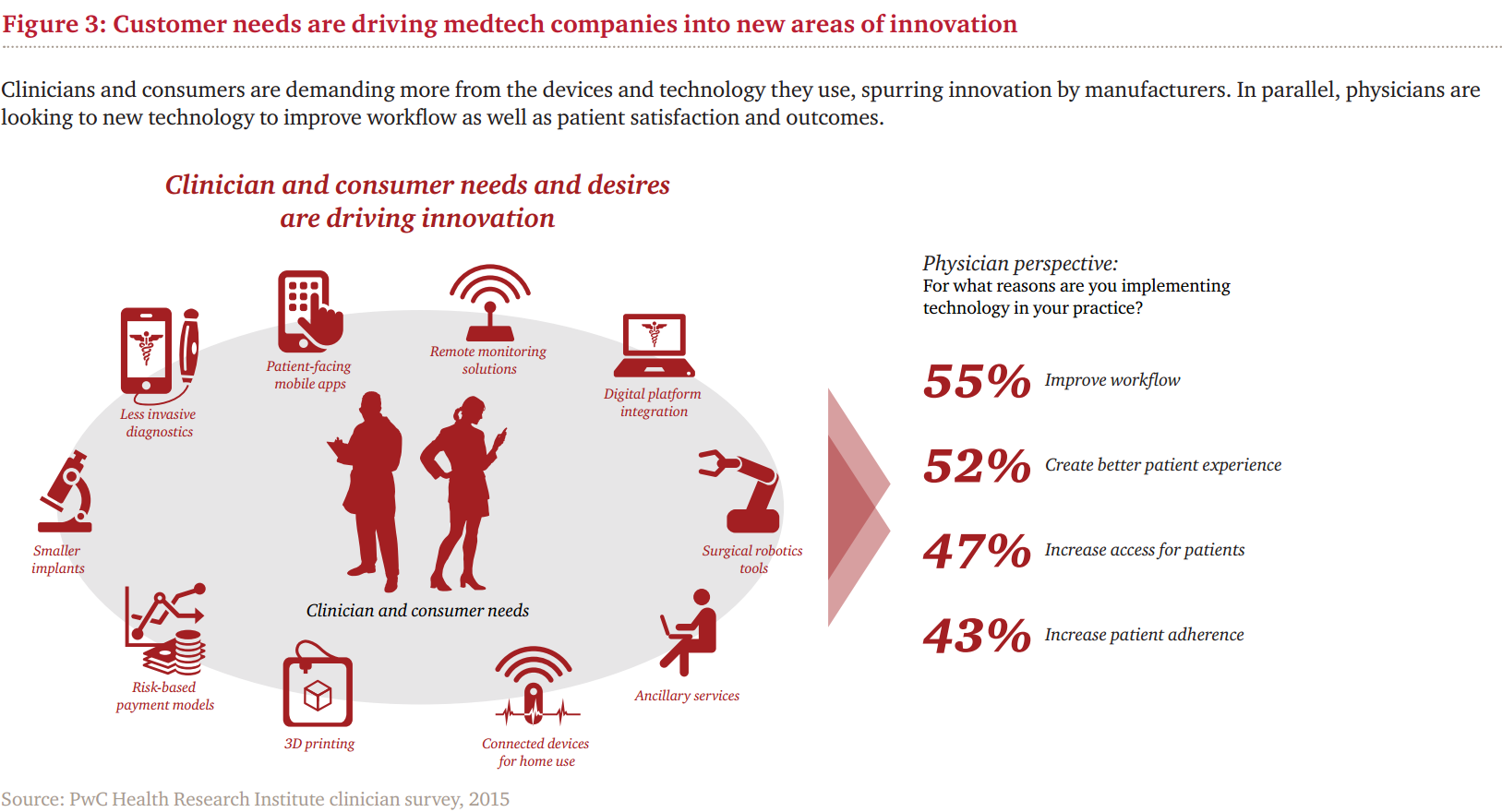
Vitaliti, invented in collaboration with Stanford University for the Qualcomm Tricorder XPRIZE competition, consists of four wireless devices connected to a mobile app, enabling patients to obtain results rapidly. It diagnoses 19 conditions, including chronic obstructive pulmonary disease (COPD), atrial fibrillation, mononucleosis, and sleep apnea, through urine and saliva tests. According to Kaul, its speed and user satisfaction, combined with the Vitaliti platform’s two-way video conferencing and text messaging capabilities, constitute key consumer-facing features. These innovations illustrate the shift among manufacturers toward non-invasive, convenient diagnostic solutions.
Proteus Digital Health is dedicated to improving patient outcomes by enhancing medication adherence and compliance. Under the guidance of physicians, pharmacists can work with doctors to integrate Proteus’s ingestible sensors into prescribed medications. These ingestible sensors, part of Proteus’s “Discover” program, are approximately the size of a grain of sand. Once ingested, the sensor transmits signals to a patch worn by the patient, which then relays the data to the cloud. In the cloud, software analyzes the data containing physiological information, and the insights are subsequently delivered back to the patient via a mobile device. With the patient’s consent, this information is also shared with physicians through a web portal.
Andrew Thompson, a partner and CEO at Proteus, told HRI that the patient’s “life flow”—as opposed to the physician’s workflow—is the top priority. “If patients don’t like these products or find them difficult to use, they won’t use them, and healthcare institutions won’t obtain the data,” said Thompson. Proteus is one of the examples of medical technology companies leveraging patient experience as the most innovative starting point. “We learn from patients and then apply those insights to our systems,” said Thompson. “Patients are at the core of our business model.”
The Proteus “Discovery” platform, sold to healthcare systems as a software license, provides patient access, physician-facing applications, and system analytics. According to Thomson, early adopters of Proteus were healthcare systems operating on risk-based models. “Over the past two decades, the technology industry has created trillions of dollars in value by placing consumers at the center of their business models and seeking solutions accordingly, rather than optimizing solutions first and then expecting consumers to figure them out. In healthcare, this approach represents a significant opportunity to unlock new value.”
Recommendations
Provide solutions or individual products.Newly established companies are embedding customer-centric services into their business models. Traditional companies that choose to broaden their service offerings and shift toward a problem-solving orientation must carefully examine value-based opportunities within specific products, while also understanding the evolving needs of consumers within hospital systems and other healthcare institutions. Regardless of whether they ultimately aim to become solution providers, manufacturers should still integrate the perspectives of users and patients into product design.
Forging New Connections in the Healthcare Ecosystem.Healthcare technology companies are uniquely positioned to alleviate the pain points of the healthcare industry. Insurance companies and healthcare systems are striving to improve quality and reduce costs, physicians are seeking assistance to manage the relentless influx of data, and consumers are demanding more comfortable and convenient healthcare experiences. Manufacturers should consider collaborating with other stakeholders to build the capacity to meet consumer needs.
Be prepared to sign value-based contracts and assume the risks associated with outcomes.Medical device manufacturers have a unique opportunity to help healthcare providers enter into value-based contracts with insurers and government payers. Medtech companies that provide solutions covering the entire treatment continuum and addressing gaps in care must listen to their customers and stay abreast of new developments from health insurance authorities, thereby delivering services that align with evolving demands.
Develop devices capable of providing data feedback.Medical device manufacturers should integrate their data and insights into physicians’ clinical workflows. As an increasing number of treatments are delivered outside hospital settings, diagnostic, monitoring, and imaging devices must be user-friendly for all operators. From physicians’ perspective, devices that provide data and actionable recommendations are significantly more valuable than those lacking such capabilities.