

NextHealth Technologies Files for IPO Following $8.5M Series A to Drive Down Healthcare Costs with Predictive Analytics Platform

NextHealth Technologies
Healthcare Analytics Platform
It is a widely acknowledged fact that healthcare costs in the United States are excessively high. Following the implementation of the Affordable Care Act (ACA), the U.S. insurance industry faced widespread pressure from losses as new enrollees flooded into the system. Under the strain of the ACA, insurers have been willing to pursue any initiative aimed at reducing healthcare costs.

Recently, digital health analytics company NextHealth secured $8.5 million in Series A financing, led by Norwest Venture Partners. To date, the company has raised a total of $10.5 million. NextHealth plans to use these funds to expand its technical team and upgrade its enterprise platform system. NextHealth is a data analytics platform that guides users toward optimized medical care options, helping them avoid unnecessary treatments and reduce healthcare costs. Following this funding round, NextHealth has committed to dedicating its future efforts to helping U.S. insurance companies effectively lower healthcare expenditures.
NextHealth Technologies, Inc. was founded in 2013 and is headquartered in Denver, Colorado. With a workforce of 11–50 employees, it is a leading cloud-based data analytics platform dedicated to reducing healthcare costs.
Although the company promotes standardized and modular data analytics as its key selling point, Grossman, founder and CEO of NextHealth, views it more as a healthcare cost-saving company. Currently, he reveals that half of the company’s employees are engineers or data scientists with extensive experience in data processing, though most are engaged in specific operational tasks.
The company’s current clients include UnitedHealthcare, BlueCross BlueShield of Tennessee, and Florida Blue. Among them, Colorado Access is a nonprofit organization serving over one million Medicaid beneficiaries and is a member of the Children’s Health Insurance Program (CHIP). The Colorado state government has also become a major client of the company through the national Medicaid program.
According to the latest report from the UK’s National Institute for Health and Care Excellence, unnecessary emergency department visits by patients in the United States waste nearly $38 billion annually. Moreover, traditional predictive models have become ineffective as a large influx of newly insured individuals enters the system. To address this issue, NextHealth provides an enterprise platform based on Analytics-as-a-Service (AaaS). This platform aggregates information from multiple channels and integrates analytical approaches such as normative analysis and behavioral economics. It then guides target populations through “carefully designed plans” to utilize network-based diagnostics, telemedicine services, urgent care facilities, or other cost-effective healthcare alternatives, thereby avoiding unnecessary and costly emergency room visits.
The platform analyzes data on members, demographics, lifestyle, and geospatial information to identify specific individuals who are likely to respond successfully to interventions. For example, a young mother may have limited knowledge of emergency department (ED) care; although she may have heard that wait times are long, she might still believe the ED is her only option. NextHealth can now assist her by providing decision-making recommendations, while also helping insurers reduce costs. NextHealth aims to encourage these individuals to adopt more appropriate healthcare-seeking behaviors.
NextHealth announced that 25% of its member patients have adopted the system’s recommended approach, avoiding emergency room visits except for urgent emergencies, thereby saving $12 per person per month in medical costs.
NextHealth’s analytical process consists of four steps implemented over three months: In the first month, data from multiple sources are aggregated and analyzed; in the second month, patterns, cohorts, behavioral shifts, and drivers are identified from the data, and the value and risk scores of each subject are assessed; in the third month, trials are designed based on the profiles of key subjects. Finally, the trials are launched, results are quantified, and the trial design is adjusted. In practice, NextHealth guides the healthcare choices of target populations through tailored direct-mail campaigns, emails, and other channels.
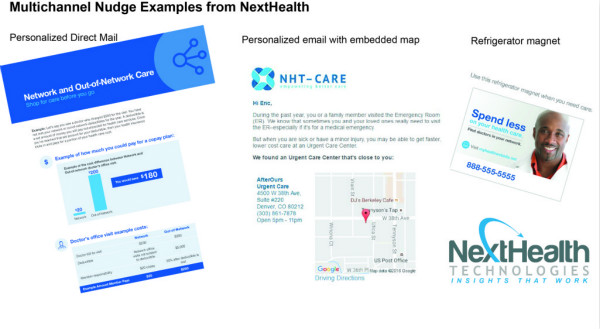
NextHealth guides the healthcare choices of target populations through customized direct mail advertisements, emails, and other channels.
NextHealth has currently partnered with eight insurance companies, half of which have chosen to promote NextHealth pro bono in exchange for a promise of 2.5x future returns. In this process, half of NextHealth’s capital is at risk; when the insurance companies profit, NextHealth will also benefit.
The Affordable Care Act (ACA), implemented in 2011, mandates that the majority of premiums be allocated to medical expenses, prohibiting their use for administrative costs, profits, or rebates to patients. For insurers in the large group market, the minimum Medical Loss Ratio (MLR) is set at 85%. Since NextHealth’s fees are classified as operational expenses and fall within this regulated 85% threshold, the service does not draw from the constrained 15% administrative budget. Therefore, it presents a low-risk opportunity for insurers adopting a wait-and-see approach to consider trialing the solution.
In the future, NextHealth will promote healthcare options for specific conditions—such as telemedicine and urgent care clinics—via phone, email, mail, and even refrigerator magnets. To ensure the accuracy of its interventions, NextHealth conducts regular statistical analyses and controlled trials. The platform currently monitors approximately 2 million members, with diabetes prevention and management slated as its next product offering. Service offerings are expected to expand further in the future, including reminders for cancer screenings and other preventive measures.