

23andMe Expands Pharma Partnerships Leveraging Its Genetic Database of Over 1.2 Million Users
More than a decade ago, genome sequencing was an elite technology far removed from the daily lives of ordinary people, with costs reaching approximately $100 million per genome. With the advent of the $1,000 genome era, personal DNA testing services have begun to enter households in developed countries, and 23andMe stands out as the most successful consumer genetic testing company.

23andMe was founded in 2006 by Anne Wojcicki, the sister of Susan Wojcicki, CEO of YouTube (Google’s online video platform), and the former wife of Sergey Brin, Google co-founder and President of Alphabet. VCBeat (WeChat ID: vcbeat) has compiled an article on the current status of 23andMe, offering insights into the research areas and revenue models of genetic testing companies.
Today, consumers need only spend a little over one hundred dollars to mail their saliva in a genetic testing kit to 23andMe, and within a few weeks they can receive an online DNA report that reveals their ancestral origins and ethnic admixture. Additionally, 23andMe leverages its database to help users identify close relatives who are also in the database.
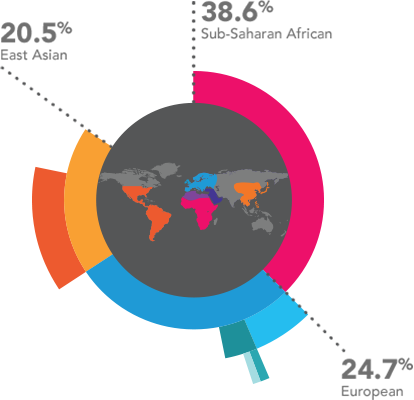
23andMe Website Population Proportions
Furthermore, users can also choose to contribute their DNA data for genetic research aimed at discovering treatments for diseases. Over the past decade since its founding, 23andMe has continuously attracted users to enrich its database through affordable pricing and innovative concepts, with this ever-expanding database serving as the core of its profitability.23andMe currently holds 1.2 million complete datasets, including sequenced genomes and user profiles, which can be accessed anytime and anywhere via mobile devices.
In an era of booming precision medicine, 23andMe leverages big data to identify associations between specific genetic traits and various diseases. Its analytical results and raw data are highly sought after by numerous pharmaceutical companies and research institutions. Through the extensive database it has built, the company’s consumer DNA database has begun to generate returns. However, 23andMe states that its current data and results can barely keep pace with researchers’ demands. Meanwhile, the company faces a dilemma: as providers of DNA data, users believe they should also share in the company’s profits.
Researchers sponsored by Pfizer and Massachusetts General Hospital stated that they had identified several genetic markers associated with depression in August of this year. Spanning decades and leveraging data from more than 120,000 individuals, the study is the largest of its kind. Indeed, the link between many diseases and genetics has been medically confirmed. For instance, a paper published in February suggested that genetics determines whether a person is an “early bird” or a “night owl,” while another study in April explored ways to combat Mendelian childhood disorders, such as cystic fibrosis.
The data used in the above studies all come from 23andMe, a company with ties to Google. Perhaps what left the deepest impression on many people about this company was its high-profile battle with the U.S. FDA in 2013 over the regulation of direct-to-consumer genetic testing. Although 23andMe ultimately had to compromise with the FDA and ceased providing reports on genetic disease risks to general consumers., but over the next three years, by quietly expanding its business, the company’s database has collected DNA data from more than 1 million users.
Individuals who apply to use the company’s $199 testing kit will receive a request asking whether they are willing to participate in research. If users consent, their health data will be added to a separate database. As 23andMe’s business continues to expand, 80% of its users have agreed to take part in surveys, and the resulting massive medical database has become a gold mine coveted by all researchers.
23andMe has engaged nearly 70 academics to collaborate with its in-house researchers, and many of the resulting studies have been published in top-tier scientific journals. Researchers can obtain genetic data, phenotypic traits or characteristics, and feedback through online surveys—data that constitute an invaluable treasure trove for the research community.
Currently, many companies in the market are developing a series of user-friendly tools based on researchers’ needs, but 23andMe is one of the few companies focused on genomics. Large teaching hospitals such as Stanford University School of Medicine and Duke University are using Apple’s ResearchKit to collect health information via iPhones. Fitbit has also invested in this field, with its researchers incorporating step count and heart rate data collected from Fitbit devices into broader population health studies.
Traditional clinical trials often require raising substantial funds and recruiting participants to obtain their genomic sequencing data, followed by in-person surveys. Participants who are unable to visit the research site are excluded from the study. This makes it extremely difficult and costly to recruit a large number of participants for traditional studies.
23andMe takes the opposite approach. It enables participants to complete surveys anytime and anywhere via mobile phones, eliminating the burden of travel. To date, it has performed partial sequencing on approximately 1.2 million genomes.
However, despite these advantages of 23andMe, many researchers remain skeptical about the accuracy of its tools. For instance, even in mobile surveys that ensure privacy, some participants often do not provide truthful answers when asked about their weight or alcohol consumption.
ProofPilot is a startup dedicated to helping researchers conduct clinical trials. Its CEO, Matthew Amsden, noted that well-funded academic researchers almost invariably prefer more expensive and advanced tools. Maxine Mackintosh, a health data researcher at University College London in the UK, added that there was previously a sense of discomfort and distrust toward scholars collaborating with the business sector, but this dynamic has begun to change.
Joyce Tung, Research Director at 23andMe, acknowledges that despite the company having accumulated 350 million consumer survey responses to date, it remains a tough battle to persuade researchers to change their preconceived notions and embrace new tools. The good news is that the efforts of her team are beginning to pay off. Scholars are concerned about the poor quality of user self-reported data, and the company is actively exploring new methods to improve accuracy.
In a recent study on celiac disease, an unusually high number of participants reported being diagnosed with this autoimmune disorder, in which consuming gluten-containing foods causes damage to the small intestine. Tung documented the growing trend toward gluten-free diets. Rather than dismissing these survey responses, she followed up with an additional question: “Were you diagnosed with celiac disease via intestinal mucosal biopsy?” Conducting such follow-ups was straightforward for 23andMe, as it did not require any additional in-person visits. Once the responses to the follow-up question were obtained, the number of participants claiming to have this autoimmune condition dropped to a more realistic level.
Tung also noted that her team is currently struggling to meet the substantial demand from the academic community. In the fall of 2013, 23andMe received 25 research applications, a figure that jumped to 45 by the fall of 2014. Although the numbers for 2015 and 2016 have not yet been released, a company spokesperson revealed that nearly 20 applications were submitted shortly after the completion of a depression study, with the findings having been published only two weeks prior.
23andMe reviews the influx of applications through biennial meetings and determines the number of collaborative projects for the year. In project selection, the team tends to prioritize studies that are difficult to link with genetic factors, such as taste preferences. The company also collaborates with Institutional Review Boards (IRBs) to identify any potential risks associated with the research and to ensure that participants are fully informed about the nature of the trials in which they are involved.
As the 23andMe database continues to expand, individuals of European ancestry, who have historically constituted the representative majority in prior studies, no longer dominate the dataset. This means that 23andMe is now capable of conducting genome-wide association studies (GWAS) in non-European populations. The impact of diseases varies across different ethnic groups; focusing solely on a specific ethnicity would limit researchers’ understanding of certain conditions, such as sickle cell anemia.
With the aid of databases, the company can now begin investigating how various factors influence individual responses to medications. This field of study is known as pharmacology, and its researchers require a large cohort of subjects. Even among a population of one million, only a small fraction may be taking a specific drug; and within this subset, an even smaller proportion will experience adverse drug reactions. Ideally, after obtaining sample data, researchers would stratify and analyze it by groups such as sex and race.
Pharmaceutical companies are certainly willing to pay a premium for such information. Despite 23andMe’s currentMost of the revenue still comes from sales of consumer genetic testing kits(In October 2015, the price of a genetic test rose from $99 to $199), but in the long run, its collaborations with pharmaceutical companies—such as partnering with Genentech to research Parkinson’s disease and with Pfizer to study irritable bowel syndrome and lupus—are a crucial component of its future development.Since its inception, 23andMe has established two distinct business lines: one focused on selling genetic services to individual consumers, and the other on aggregating and selling consumer genetic data to pharmaceutical or biotechnology companies. Clearly, commercial collaborations with pharmaceutical companies represent the most viable profit model for the future.
Since 23andMe has already monetized the consumer health data it collects, some patients argue that the company should consider sharing these profits with its participants. Tung mentioned that she had indeed considered implementing some form of financial incentive in the past, but this raises certain ethical concerns. Disparities in economic status place varying pressures on different research studies, and incentives could create a sense of “coercion,” which is among the most significant issues. Nevertheless, she does not completely rule out the possibility in the future, stating that she will carefully balance ethical considerations with consumer demands.