Seven Global Health Insurance Giants Expand Internet Healthcare Initiatives: IPO Prospectus Highlights

By Gu Beini, Xue Jiao
Traditionally, insurance companies have occupied the downstream end of the healthcare value chain, with claims processed only after patients complete their treatment. Insurers view this position as relatively passive. To shift from a passive to a proactive stance and extend their involvement from the downstream to the upstream stages, insurance companies have introduced a series of disease intervention measures.
In the cardiovascular field, health management and chronic disease control can reduce the risk of cardiovascular diseases among policyholders to a certain extent, thereby saving insurance companies on claim costs. As a result, insurers have undertaken significant innovative efforts in disease intervention, leveraging information technology and digital tools. The guiding principle behind these interventions is to help policyholders lower their probability of developing or worsening conditions, which in turn reduces claim expenses arising from medical treatment.
So, what innovative measures have established overseas commercial insurance companies taken? VCBeat Institute (About VCBeat.) An analysis of seven major insurers, including UnitedHealthcare, Kaiser Foundation Health Plan, Aetna, Humana, CIGNA, Blue Cross Blue Shield, and Bupa, reveals that interventions for cardiovascular diseases primarily focus on the following three key areas:
Cardiovascular Disease Prevention
Cardiovascular Chronic Disease Control
Disease Treatment Improvement
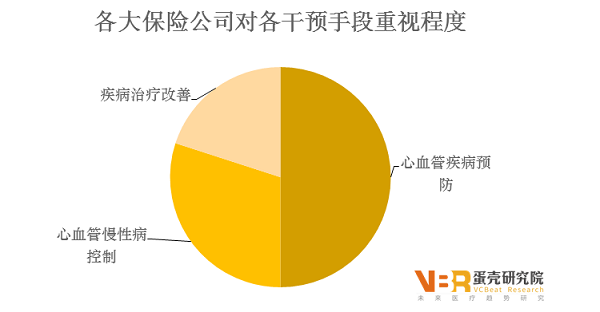
Most of the content in the above three sections is related to internet healthcare. Let us now examine the strategic layouts of the aforementioned insurance companies in the field of internet healthcare.
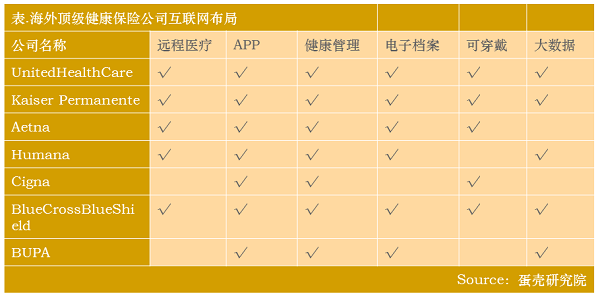
Note:
Electronic records refer to the personal electronic files established by policyholders at insurance companies.
In July 2015, Aetna issued a statement announcing its acquisition of Humana. In July 2015, Anthem (a regional Blue Cross Blue Shield insurer) acquired Cigna.
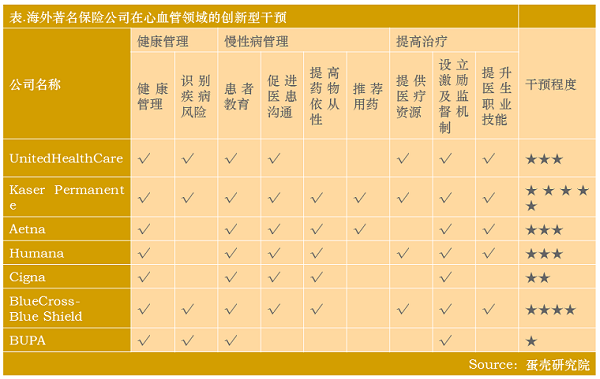
In conjunction with the layout of internet healthcare, we examine the specific content of each disease intervention segment, and the organized results are as follows:
It primarily targets healthy and sub-healthy individuals who are not yet diseased. Intervention measures mainly include two aspects: health management and disease risk identification.
1. Health Management
The core objective of health management is to educate policyholders to adopt healthier lifestyle habits, such as maintaining a balanced diet, increasing physical activity, quitting smoking, and losing weight. Insurance companies employ diverse intervention strategies, including providing educational resources on their official websites, partnering with pharmacies and wearable device manufacturers, and offering health management mobile applications. Notably, some insurers are willing to financially reward policyholders for adopting healthy habits. For instance, UnitedHealthcare has partnered with Walgreens, allowing users to earn credits in their Walgreens accounts by completing physical activities such as walking.
2. Disease Risk Identification
Risk factors such as obesity, diabetes, and smoking are all contributors to cardiovascular disease. By taking online health assessments available on websites, individuals can evaluate their current lifestyle habits, identify potential health risks, and take timely action to improve them through lifestyle modifications. For instance, Kaiser Permanente uses online tools to estimate an individual’s 10-year risk of developing cardiovascular disease.
HealthPlus, a regional insurer in the United States, has developed a blood pressure intervention system leveraging electronic health records to identify members with elevated blood pressure, thereby helping them take action to prevent more serious consequences.
This initiative primarily targets the out-of-hospital disease management of patients with established cardiovascular disease, employing a range of strategies to help curb disease progression and prevent deterioration. Key interventions include patient education, facilitating physician-patient communication, improving medication adherence, and optimizing pharmacotherapy recommendations.
1. Patient Education
One approach involves providing lifestyle guidance to help patients adopt healthier diets, engage in aerobic exercise, and undertake other measures to control their condition and prevent further deterioration. This approach is primarily delivered through online educational resources and community-based training programs. Another approach focuses on enhancing patients’ motivation for self-management, encouraging them to take an active role in controlling their condition. For instance, Blue Shield Blue Cross engages its members through telephone coaching to empower them to play a more proactive part in managing their health.
2. Promoting Doctor-Patient Communication
Effective communication between physicians and patients enables timely assessment of patient conditions and early intervention. Enhancing physician-patient communication requires increased engagement from both parties. From the physician’s perspective, incentives should be provided to encourage better service delivery and more frequent patient interactions; for instance, UnitedHealthCare offers subsidies to compensate physicians for their additional efforts. From the patient’s perspective, patient education initiatives can be implemented to encourage more active communication with their physicians.
3. Improve Medication Adherence
Simply advising heart disease patients to take their medications on time, exercise, and maintain a healthy diet does not ensure compliance. According to research by the U.S. Centers for Disease Control and Prevention (CDC), 21.8% of Americans were taking three or more prescription drugs in May 2015. Unfortunately, nearly half of patients with chronic conditions do not adhere to their prescribed medication regimens. This non-adherence (i.e., lack of medication adherence) adversely affects patient health and adds nearly $300 billion to healthcare costs.
Therefore, improving medication adherence is crucial for disease management in patients with chronic conditions. In the field of cardiovascular disease, insurance companies have adopted diverse intervention strategies. Most insurers educate patients about the importance of medication adherence. HealthPlus has developed a blood pressure intervention system that assesses patients’ medication adherence based on changes in their blood pressure readings. Aetna, in collaboration with Mount Sinai Hospital and the Spanish National Center for Cardiovascular Research (CNIC), aims to introduce the polypill in the United States to enhance patient medication adherence. The polypill is a single capsule that combines multiple commonly prescribed medications, such as aspirin, statins, and ACE inhibitors.
4. Recommended Medications
During the course of patient disease management, insurance companies recommend specific drug combinations to patients that can effectively curb disease progression. For instance, Kaiser Permanente actively promotes the ALL/PHASE programs in hospitals, utilizing low-cost generic medications to reduce heart attacks. The ALL program (an acronym for three medications: aspirin, lisinopril, and lipid-lowering drugs) actively enrolls patients with heart disease and diabetic patients aged 55 and older, incorporating these three medications into their treatment regimens to help reduce their risk of heart attacks and stroke. PHASE builds upon the ALL protocol by adding beta-blockers and emphasizing lifestyle modifications.
The primary focus is on the therapeutic outcomes achieved by patients during their hospital stay, with the aim of improving healthcare quality. Insurance companies facilitate better and faster disease treatment through interventions, thereby reducing claims for diagnosis and treatment costs. These interventions include providing medical resources, establishing incentive and oversight mechanisms, and enhancing physicians' professional skills.
1. Provide medical resources
Insurers’ internet-based strategies include the establishment of electronic health records (EHRs). Through EHRs, insurers can promptly provide physicians with patient information, including basic demographic data and clinical medical data, thereby furnishing a basis for physicians to formulate appropriate treatment plans. Blue Cross Blue Shield possesses the largest integrated data platform in the U.S. healthcare industry; by providing data and advanced analytics technologies, it helps physicians improve the quality of care.
2. Establish Incentive and Oversight Mechanisms
Insurance companies encourage physicians to deliver better services to patients, ensuring that they receive the appropriate treatments at the right time. The intervention strategies employed by insurers in this regard are diverse. Most insurance companies, including UnitedHealthcare (UHC), Aetna, and Humana, collaborate with physician organizations across various regions to improve healthcare quality and enhance patient experience. Additionally, Aetna has implemented scorecards allowing patients to rate their treatment experiences; Kaiser Permanente organizes physicians into multidisciplinary teams, where diverse professional perspectives help identify suitable treatment options more quickly; and Humana invites practicing board-certified cardiologists to review surgical requests, determining whether there is sufficient clinical justification for the procedures, thereby eliminating unwarranted interventional revenue.
3. Enhancing Physicians' Professional Competencies
One aspect of insurer intervention involves helping physicians enhance their professional skills to better serve patients. Nearly all major insurers in the United States provide online educational resources for physicians. Leveraging the advantages of its integrated medical group model, Kaiser Permanente further facilitates interdisciplinary collaboration among physicians from various specialties, thereby broadening their professional perspectives. In contrast, Australia’s BUPA is relatively weaker in this regard, with its interventions limited to collaborations with physician organizations.
Case 1HealthPlus's HOF Intervention Protocol
HealthPlus is an insurance services provider established in 1979, offering health insurance coverage to more than 200,000 individuals across Michigan and the Midwest. For over three decades, it has been dedicated to improving the health and well-being of community members.
In the field of cardiovascular disease, HealthPlus recognizes that although hypertension can lead to severe consequences, including death, it often remains untreated in a timely manner. For insurance companies, the challenge in improving hypertension management lies in the fact that claims data do not include current blood pressure readings. Therefore, HealthPlus has developed an intervention program called Focus on Hypertension (hereinafter referred to as HOF), based on blood pressure values from electronic medical records (EMR). This program can: 1) identify users with elevated blood pressure; 2) assess users' adherence to treatment; and 3) notify physicians of users who are non-adherent and whose blood pressure remains high.
FOH can assist physicians in managing a large volume of hypertensive patients, while also evaluating current medication regimens, lifestyle modifications, dietary habits, and medication adherence. HealthPlus has also established a project team comprising disease management nurses, pharmacists, and data analysts. The aim is to develop interventions based on blood pressure data from electronic medical records (EMR) to identify patients with blood pressure readings above 140/90 mmHg. Once identified, these patients’ adherence to antihypertensive therapy can be assessed using claims data.
Since its implementation in 2010, a total of 3,467 FOH reports have been sent to physicians. Physicians are required to respond with the follow-up measures they intend to take. Currently, the average response rate has increased to 28%. Thanks to these reports, 373 users were advised by physicians to return to the hospital for hypertension testing. Additionally, physicians adjusted or modified the treatment regimens for 83 users based on the reports. An evaluation of FOH revealed that after three months of intervention, 27% of members achieved the blood pressure target of below 140/90 mmHg.
FOH embodies numerous disease management concepts, including preventing diseases by managing existing risk factors and collaborating with family physicians to monitor patients’ adherence to treatment. As HealthPlus’s current EMR technology supports program expansion, HealthPlus is actively recruiting more institutions to participate in the initiative. This intervention also received the Healthcare Innovation Award from the National Kidney Foundation of Michigan in 2011.
This initiative demonstrates that for healthcare organizations, identifying patients with elevated blood pressure through blood pressure values in electronic health records is highly effective. This approach enables timely provision of continuous, reproducible, and reference-worthy reports to physicians.
Case 2BlueCross BlueShield:Better Health,Lower Costs.
Blue Cross Blue Shield of Massachusetts (hereinafter referred to as BCBSM) is a leading individual health insurer in the United States and a not-for-profit organization with a distinguished history in community and healthcare engagement. Its mission is to provide affordable, high-quality health services to individuals, families, and employers. BCBSM is a member company of the Blue Cross Blue Shield Association.
BCBSM provides employee health solutions for enterprises, delivering appropriate health support to employees at the right time, regardless of their current health status. A comprehensive range of health and clinical support services helps employees maintain their well-being while enabling businesses to control cost risks. Through a data-driven collaborative approach, BCBSM offers a portfolio of programs designed to improve employee health outcomes and reduce healthcare costs.
Motivation is crucial to employee engagement. Likewise, activities with clear goals and rewards are highly effective in capturing employees’ attention. This is why the core of every activity plan focuses on strategies to inform employees about available services and encourage their participation in additional programs, such as biometric screenings and walking challenges.
BCBSM encourages employee participation in its programs through personalized, convenient, and effective approaches. From mobile apps to online health coaching on its website, BCBSM employs innovative methods and technologies to engage employees. This entails adopting diverse engagement strategies, such as training staff in the latest motivational interviewing techniques, integrating principles of behavioral economics and member segmentation data into employee communications, and deploying interactive digital channels—including email, text messaging, and mobile applications.
BCBSM offers a suite of programs designed to support employees and their families while helping employers manage both short- and long-term costs. BCBSM provides the necessary support, information, and resources to facilitate the implementation of wellness initiatives, enabling employees to engage more effectively with BCBSM.
1) Help employees achieve health goals
BCBSM’s health plan portfolio helps employees and their families engage in regular physical activity, maintain a healthy diet, manage healthcare utilization, reduce stress, and quit smoking. BCBSM focuses on lifestyle modification areas that yield the highest return on cost savings. All BCBSM members can access mybluehealthma.com, a member-tailored portal. The website helps them set realistic goals and develop customized action plans for smoking cessation, exercise, nutrition, weight management, and stress management. Employees can complete online health assessments, calculate relevant health metrics, track their progress, and consult with health experts and online communities to help achieve their goals.
“When I saw the Blue Cross Blue Shield phone number on my caller ID, I was happy because it was my case manager calling to check in on me. My case manager has been with me every step of the way.”
— A BCBSM Member
2) Provide support for patients with chronic diseases
BCBSM’s chronic disease management program provides targeted support for patients with conditions such as diabetes, coronary heart disease, congestive heart failure, asthma, and chronic obstructive pulmonary disease (COPD). When BCBSM identifies non-adherence to treatment, it employs a range of engagement strategies—including emails, automated reminder calls, and one-on-one nurse coaching—to help patients get back on track.
BCBSM invites chronic disease patients with high complication and hospitalization risks to receive one-on-one nurse coaching. BCBSM also contacts hospitalized patients to provide post-discharge rehabilitation support, ensuring their comprehensive recovery.
3) Provide comprehensive medical record management services
For employees facing complex health challenges, BCBSM’s interdisciplinary case management team works closely with patients, physicians, and family members to provide information and health system navigation throughout complex medical decision-making, care coordination, and transitions.
At BCBSM, medical and behavioral health management are closely integrated, enabling employees with multiple services to be easily identified so that their medical support can be consolidated. Furthermore, BCBSM proactively identifies individuals at risk of hospitalization or readmission through predictive models. BCBSM’s behavioral health clinicians leverage their clinical expertise to help these patients mitigate the risk of requiring acute inpatient care before a crisis occurs.
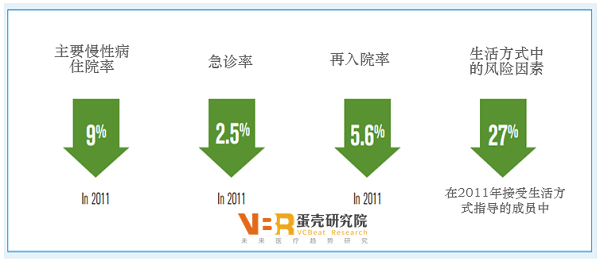
BCBSM continuously evaluates employee health solutions across multiple dimensions, including engagement, self-management, medical quality, health status, and financial metrics. BCBSM monitors and tracks changes in employee health in real time, with ongoing observation of hospitalizations and readmission rates. Its account reporting services enable both employees and employers to gain insights into corporate claims data and employee health trends, laying the foundation for continuous collaboration to enhance BCBSM’s solutions and employer outcomes.
To read more articles by this author, please visitGu Beini Column

By VCBeat. Please credit the WeChat Official Account when reposting:VBResearch2016
↓↓↓