BCG: Three Key Drivers and Two High-Potential Consumer Segments Fuel Growth of Reimbursement-Based Commercial Health Insurance in China
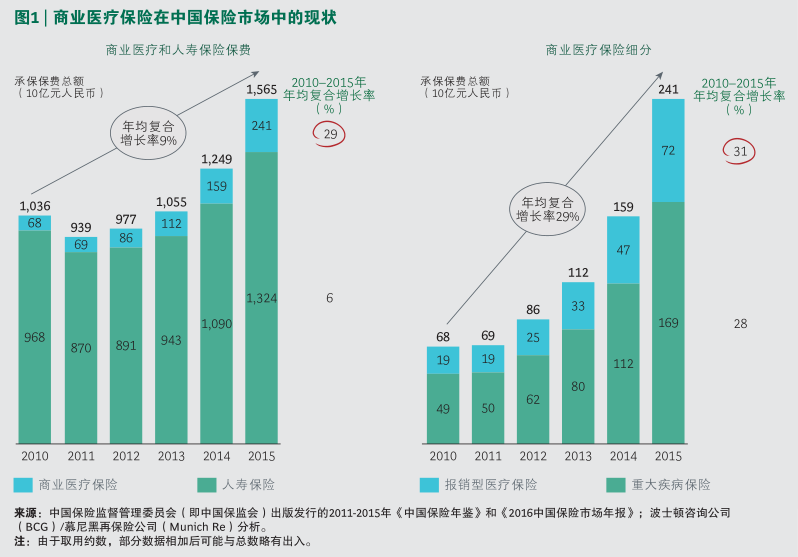
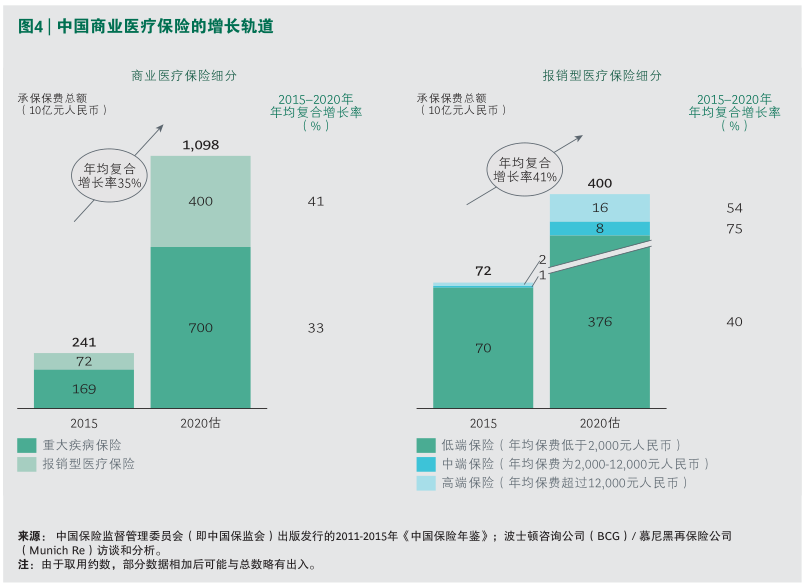
Since 2010, China’s commercial medical insurance market has experienced rapid growth, with an average annual increase of nearly 36%. By 2015, the market size had reached RMB 241 billion. Among these products, critical illness insurance (loss indemnity products sold by life insurance companies) holds a dominant position in the market.
However, the coverage of critical illness insurance is quite narrow, encompassing only a limited number of predefined conditions, such as specific types of cancer. Its structure also has certain limitations; if policyholders require long-term treatment, this type of insurance cannot provide ongoing cost reimbursement. To obtain such coverage, consumers must purchase more straightforward indemnity-based medical insurance, which provides corresponding protection and compensation regardless of the diagnosed disease.
However, major life insurance companies in China continue to roll out critical illness insurance products, while few offer reimbursement-based medical insurance. This is because the profitability of China’s life insurance market far exceeds that of the medical insurance market. For every RMB 1 worth of commercial medical insurance (including both critical illness insurance and reimbursement-based medical insurance) sold, more than RMB 5 worth of life insurance is sold. (See Figure 1)
Furthermore, insurance companies lack robust consumer sales channels and struggle to establish close collaborations with hospitals and other institutions that could provide data on patients and treatment outcomes. These factors result in extremely high and unpredictable loss ratios for reimbursement-based medical insurance.
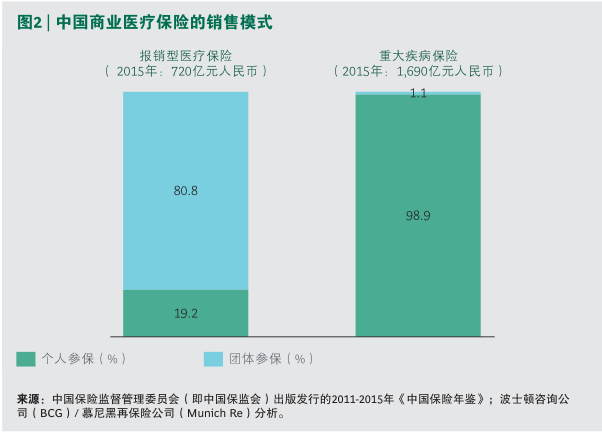
Moreover, in China, most enrollees in reimbursement-based medical insurance are covered through their employers via group insurance plans. (See Figure 2) For instance, multinational corporations operating in China typically purchase high-end reimbursement-based medical insurance for their senior executives to enable them to seek care at private hospitals. However, the insurance benefits available to mid-level managers in these companies are often more limited; for example, their coverage may only include surgical expenses incurred at public hospitals.
However, the group market for indemnity-based medical insurance will continue to grow, driven by demand from domestic enterprises and small-to-medium-sized foreign-invested firms (such as private equity funds). As these two types of enterprises expand in scale and achieve improving profitability, they are increasingly turning to group enrollment in indemnity-based medical insurance to enhance their appeal to top-tier talent.
There are three main aspects:
First, the Chinese government has recently issued a series of policies to encourage and support the development of commercial medical insurance. Relevant measures include preferential individual income tax policies for purchasers of commercial insurance, as well as incentives for commercial insurance companies to collaborate with hospitals.
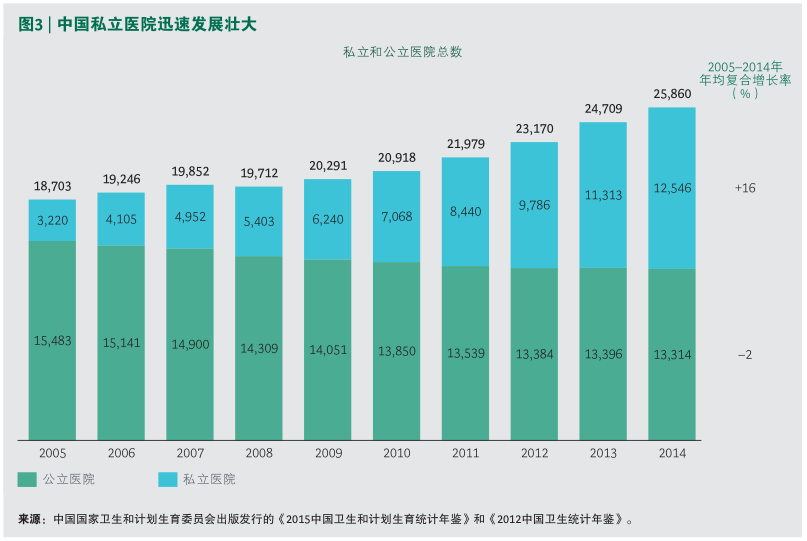
In addition, the Chinese government has introduced a series of incentive policies to support the establishment and operation of more private hospitals. As of 2005, there were only 3,200 private hospitals in China; by 2014, this number had nearly quadrupled, exceeding 12,500. (See Figure 3)
Third, and perhaps most importantly, there is growing demand for reimbursement-based medical insurance among specific demographic groups in China. Many middle-class and affluent individuals are deeply dissatisfied with the public healthcare system—citing difficulties in accessing competent physicians, complex and chaotic hospital layouts, excessive waiting times, and the overuse of intravenous infusion therapy, among other issues. Most have indicated their willingness to pay for commercial medical insurance if it enables them to obtain higher-quality healthcare services.
These trends willIt provides a strong boost to reimbursement-based medical insurance purchased by individuals., making it a rapidly growing new force in China's medical insurance market.
In recent years, the growth rate of this type of insurance has outpaced that of critical illness insurance. BCG expects this trend to continue, with reimbursement-based medical insurance products across all tiers (low, mid, and high-end) entering a prolonged period of rapid growth.
For example, from the present through 2020, the low-end reimbursement-based medical insurance market, with annual per capita premiums below RMB 2,000, is projected to expand at a compound annual growth rate (CAGR) of 40%. The high-end market, with annual premiums exceeding RMB 12,000, is expected to grow even faster, at a CAGR of over 50%.
However, none of them can match the mid-tier market, which boasts the strongest growth potential—namely, indemnity-based medical insurance products with annual premiums ranging from RMB 2,000 to RMB 12,000. (See Figure 4) From the perspective of product supply,Mid-tier products remain a significant gap in China's reimbursement-based medical insurance market.。
There are several reasons driving Chinese consumers to consider purchasing reimbursement-based medical insurance. First, they are acutely aware of the shortcomings of the public healthcare security system and have consequently begun seeking alternative solutions. Parents of newborns, in particular, frequently find themselves in this situation, with many hoping to secure better medical care conditions for their children.This may have become the primary driver for Chinese families choosing to purchase reimbursement-based commercial medical insurance.。
Furthermore,Age and income are the primary determinants of consumers’ willingness to purchase reimbursement-type commercial insurance, followed by education level and occupation.。
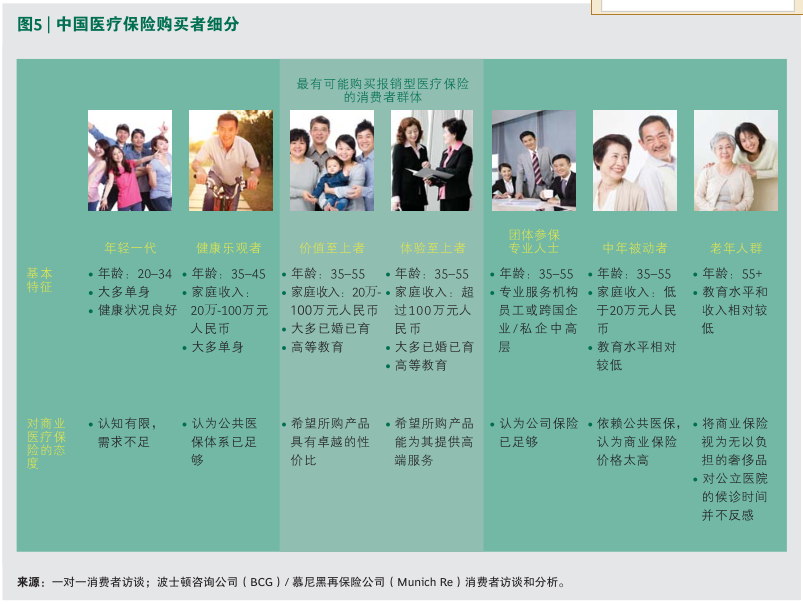
A survey of nearly 1,000 Chinese consumers conducted by Boston Consulting Group and Munich Re reveals that individual medical insurance consumers in China can be segmented into seven distinct groups, among which two exhibit substantial potential for purchasing indemnity-based medical insurance.
The first category of consumers is referred to as “Experience-First Consumers.” (See Figure 5) They are aged between 35 and 55, with household incomes exceeding RMB 1 million. It is projected that by 2020, the number of such individuals across China will surpass 4 million. These consumers are willing to pay the highest premiums for commercial medical insurance, ranging from RMB 10,000 to RMB 20,000 per person annually.
In terms of insurance benefits, they seek a hassle-free and worry-free experience, along with a more pleasant healthcare journey compared to public medical insurance. This means they prefer visiting high-end private hospitals to enjoy convenient outpatient services, with direct billing by insurance companies (rather than paying out-of-pocket and seeking reimbursement later). "Experience-first" consumers also expect insurers to offer more optional services, such as dental care, maternity coverage, and health check-ups.
The second group of high-potential individuals—“Value-Seekers”—are also aged between 35 and 55, with household incomes ranging from RMB 200,000 to RMB 1 million. Compared to “Experience-Seekers,” they exhibit relatively higher price sensitivity and are willing to pay a total annual premium of approximately RMB 12,000 to RMB 15,000 for a family of three. By 2020, the number of such individuals across China is projected to reach nearly 38 million. “Value-Seekers” do not mind seeking care at public hospitals, provided that their insurance covers special-needs/VIP outpatient services (which typically feature shorter waiting times and more attentive physician interactions).
“Value-driven consumers” can be further segmented into two major groups: mid-to-low-end and mid-to-high-end. The mid-to-low-end group is willing to pay RMB 2,000–6,000 annually for personal insurance, while the mid-to-high-end group is willing to pay RMB 6,000–12,000 per year for such coverage. The former have more straightforward objectives, seeking primarily preventive protection; the latter go a step further, demanding additional services such as broader coverage for diseases and medications.
To date, the purchase rates of reimbursement-based medical insurance among “experience-first” and “value-first” consumers remain low.
Low consumer awareness of the product is one of the reasons: many consumers are unaware of the existence of reimbursement-based medical insurance, let alone its associated benefits and advantages.
Another major reason is the inadequacy in product design. For instance, outpatient surgery limits are set at unrealistically high or low levels, secondary medical opinion hotlines are rendered useless, and overseas insurance services are unnecessarily included.
Admittedly, imperfect product design is not an issue exclusive to China’s health insurance industry; every sector worldwide faces the same challenge. The ultimate outcome is singular: if products fail to meet consumer needs, customers will not pay for them.
Source: The Boston Consulting Group
By VCBeat. Please credit the WeChat Official Account when reposting:VBResearch2016
↓↓↓
【Free Access to Research Reports by VCBeat】

Interested parties, click here to view