

Zhong Yan, CEO of TumorTalk: Vast Market Potential in Cancer Education Remains Untapped

With technological advancements, an increasing number of once-feared diseases now have treatment options, leading to an extension in average human lifespan. Among various diseases, tumors pose a significant threat to human life.
According to the Global Cancer Report 2014, the number of global cancer cases is poised for rapid growth, rising from 14 million in 2012 to 19 million by 2025. In 2015, China recorded approximately 4.292 million new cancer cases and 2.814 million cancer-related deaths, averaging about 12,000 new diagnoses and 7,500 deaths per day.
As a country with a large population, China accounts for approximately 22% of new global cancer cases and about 27% of global cancer deaths. Data projections indicate that the global oncology market will reach $111.9 billion in 2020. The vast number of cancer patients requires timely diagnosis and treatment services. Amidst this broad market prospect, both Chinese and foreign enterprises are accelerating their strategic layouts. In every subsector, whether precision medicine, immunotherapy, or anti-tumor drugs, companies are actively establishing their presence.
In recent years, with the rapid development of mobile internet, various industries have leveraged the momentum of the digital era, and healthcare has entered the age of mobile health. According to VCBeat (WeChat ID: vcbeat), the market size of China’s mobile health sector was RMB 2.95 billion in 2014 and RMB 4.27 billion in 2015, representing a growth rate of 44.7%. The market size is projected to exceed RMB 12.53 billion by 2017. Over the past two years, mobile health apps have experienced rapid growth and have entered the commercialization stage. Vast amounts of internet-based information and resources are being integrated and utilized, enabling functions such as appointment registration, basic consultations, scheduling of offline medical visits, post-operative rehabilitation monitoring, and patient community interactions to be conducted via online platforms.
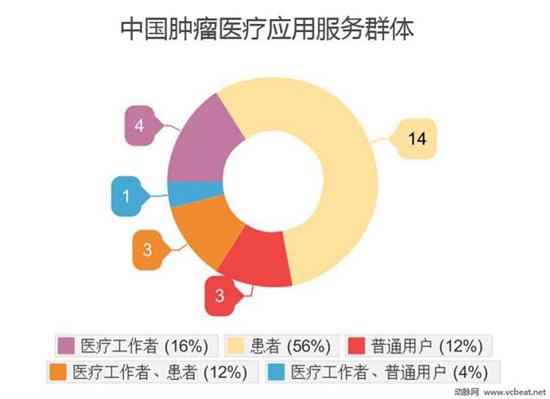
In the era of mobile internet, patients can access a vast amount of information about various diseases online, with specialized information channels available for cardiovascular diseases, diabetes, gastrointestinal disorders, tumors, and more. The user base for cancer-related mobile health applications is divided into three groups: healthcare professionals, patients, and the general public. According to a report by VCBeat (WeChat ID: VBResearch2016), both domestic and international applications primarily target patients, accounting for 56% in China and 50% abroad. The next largest group consists of healthy individuals with a high interest in health maintenance, representing 12% in China and 25% abroad; this disparity may largely be attributed to the greater emphasis on preventive care in foreign products. In addition to these specific user segments, there are applications serving both healthcare professionals and patients. Such platforms enable healthcare professionals to access common and latest chemotherapy regimens, cancer-related news, drug instructions, and frequently used medical formulas, while allowing patients to understand the characteristics and efficacy of their chemotherapy regimens and medications, as well as to communicate with other patients. Applications serving both healthcare professionals and patients account for 12% in China and 13% abroad.
Statistical data show that mobile health applications in the cancer field, both domestically and internationally, prioritize the dissemination of anti-cancer knowledge. In China, the leading application focused on popularizing anti-cancer knowledge is "Tumor Talk." The top three subsectors in the domestic market are cancer prevention, online consultation, and cancer control. Prominent applications specializing in cancer prevention include "Cancer Prevention Guardian," "Cancer Encyclopedia," "Cancer Knowledge Q&A," and "Essential Reading for Cancer Prevention and Control." Applications dedicated to online consultation include "Oncology Circle" and "Cancer Doctor."
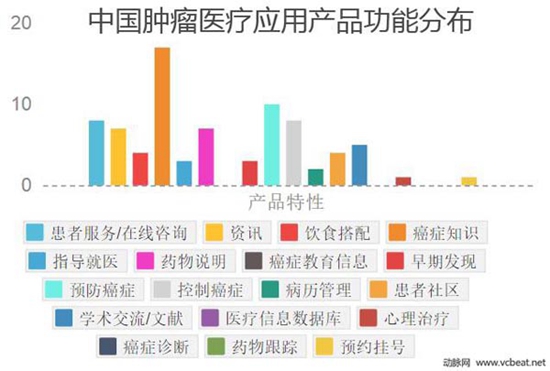
In light of the current landscape in China, where applications focused on popularizing anti-cancer knowledge are prominent, VCBeat (WeChat ID: vcbeat) interviewed Ms. Zhong Yan, CEO of “Tumor Talk,” a company developing applications in this field. Ms. Zhong stated that the process from cancer diagnosis to finalizing a treatment plan typically takes about one month. During this waiting period, patients often experience significant anxiety. “During this time, they lack accessible channels to understand their condition, making them highly susceptible to psychological distress,” said Ms. Zhong. After being diagnosed with cancer, patients proactively seek out extensive information to better understand their condition. This strong user demand explains why applications dedicated to cancer education account for the largest proportion among various types of cancer-related apps. The Chinese market needs enterprises that can integrate domestic and international oncology information and resources from the patient’s perspective.
1
Oncology News + Precision Social Networking + Rehabilitation Tools: Oncology Talk
"Tumor" is a product under World Medical News.The team was established in October 2015, and the app was officially launched in April 2016, accumulating a user base of 240,000.Ms. Zhong Yan, the company’s CEO, brings extensive experience in overseas healthcare operations. The team’s core strengths lie in its deep industry expertise and technical development capabilities within the medical sector.“OncoTalk” aims to be a knowledge-based database focusing on cutting-edge oncology research, treatment regimens, and overseas medications, with an emphasis on popularizing knowledge about cancer subtypes. By the end of this year, OncoTalk is expected to complete the construction of its knowledge base covering all 206 cancer subtypes.
For a mobile application focused on popularizing medical knowledge, the authority and completeness of its database information are crucial. In this regard, Zhong Yan stated that "Tumor Talk" has established a dedicated research institute, where approximately 20 medical professionals conduct research and refine the database.
"Tumor Talk" is an application primarily focused on popularizing oncology knowledge, in addition to knowledge contentIn addition, its unique feature lies in case-based precision social networking.The platform encourages patients to upload their medical records to the app, facilitating more precise communication among patients with similar conditions based on specific disease subfields.Zhong Yan said:“Patients with highly similar conditions often exchange highly valuable information when they communicate with one another.”
Tumor Talk also includes a cancer rehabilitation section. This section aggregates general-purpose tools for recording, analyzing, and evaluating data on cancer patients’ daily status, key indicators, and quality of life, including the “Daily Status Recording Tool” and the “Rehabilitation Assessment Tool.” Patients can use the “Daily Status Recording Tool” to document their physical and psychological conditions, body weight, primary symptoms, and disease severity. The “Rehabilitation Assessment Tool,” based on medically standardized questionnaires, comprehensively evaluates patients’ current physical and mental well-being, helping them identify potential issues such as depression, anxiety, sleep disorders, and malnutrition, so they can seek professional assistance in a timely manner. Tumor Talk provides assessment systems developed by the European Organisation for Research and Treatment of Cancer (EORTC) for various types of cancer, serving as references for evaluating patients’ quality of life and clinical efficacy.
2
Online Oncology Consultation: Oncology Circle
"Tumor Circle," established in August 2014, is a free oncology health Q&A platform developed under the guidance of the China Association for Cancer Biotherapy.
Both patients and their families can ask any cancer-related questions on the Oncology Circle platform. The platform features resources from hundreds of oncologists across more than 30 public Grade A tertiary hospitals in China, with all inquiries answered within 10 minutes. Key features include: Ask a Doctor, Connect with Fellow Patients, Cancer Encyclopedia, News & Updates, Medical Record Keeping, and Pedometer.
The purpose of the Oncology Circle is to create a platform for cancer patients to express their voices, jointly built by oncologists, cancer survivors, volunteers, and fellow patients.
3
Oncology Community + Oncology Solutions: Cancer-Fighting Guardian
Reportedly established in March 2014, Kang Ai Wei Shi (Cancer Guardian) is a vertical mobile health community and patient mutual-aid platform focused on oncology. It provides a platform for cancer patients and their families to share experiences and communicate, and is a product of Beijing Wo Yao Qi Ji Technology Co., Ltd.
The information provided to users in the Anti-Cancer Guardian community covers two aspects: one focuses on psychological issues to foster emotional connection and warmth, while the other offers professional information on oncology.
In terms of commercialization, Kang Ai Wei Shi’s strategy is to provide a comprehensive solution for cancer patients. This holistic solution covers the pre-diagnosis phase (including early screening and diagnosis), the intra-diagnosis phase (such as genetic testing and overseas medical services), and the post-diagnosis phase (including rehabilitation and follow-up care). In addition to medical solutions, it also offers lifestyle support services, such as psychological counseling and nutritional guidance.
Kang Ai Wei Shi’s monetization model is driven by user referrals to third-party institutions. According to data provided by Kang Ai Wei Shi, its current partners include Annoroad Gene Technology, Xiao Yu San, Cedar-Sinai Medical Center, Abbott Laboratories, Pien Tze Huang, and the Psychological Association.
4
Targeting the Cancer Prevention and Treatment Market: Cancer Q&A, Essential Guide to Cancer Prevention and Treatment, Yijiayi
Cancer Knowledge Q&A
The Cancer Knowledge Q&A Application, authored by experts from both research and clinical frontline settings, provides accessible, in-depth interpretations of topics closely related to cancer prevention and control in a question-and-answer format. Readers can conveniently look up cancer-related issues of concern, including the etiologies of various common cancers, early self-diagnosis, prevention and treatment strategies, types, efficacy, and side effects of modern therapeutic modalities, as well as guidance on how patients can cooperate with treatment and how family members can provide caregiving support.
Essential Reading on Cancer Prevention and Control
On this essential platform for cancer prevention and treatment, patients and their families can access information on the fundamentals of cancer, its etiology and risk factors, clinical manifestations and diagnostic approaches, common diagnostic tests, treatment modalities, as well as prevention and rehabilitative care.
In an era of widespread internet accessibility, oncology-focused apps have assisted numerous cancer patients in their recovery. Whether through the psychological comfort derived from peer support communities or the precise dissemination of oncology knowledge, it is undeniable that digital health is gradually transforming human lifestyles. It empowers more cancer patients to overcome fear, confront their disease directly, pursue treatment with a positive attitude, and strive for recovery.