

Kangmei Pharmaceutical Reports H1 Revenue of RMB 11.2 Billion, Driven by 'Internet + Health' Strategy
On August 28, Kangmei Pharmaceutical disclosed its 2016 semi-annual report. VCBeat (WeChat Official Account: vcbeat) has summarized the key points of the report. The report shows that Kangmei Pharmaceutical achieved a total operating revenue of RMB 11.203 billion in the first half of the year, a year-on-year increase of 24%. The net profit reached RMB 1.766 billion, up 23% year on year, while the net profit after deducting non-recurring gains and losses amounted to RMB 1.758 billion, also representing a 23% year-on-year increase.
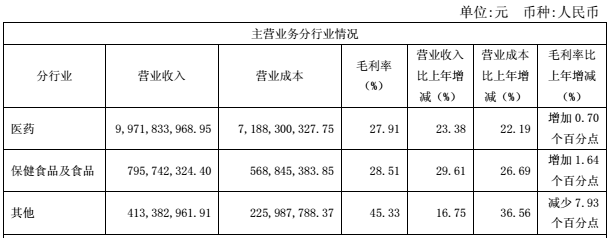
Profitability of Core Business Operations
As can be seen from the breakdown of core business operations by industry, pharmaceuticals remain Kangmei Pharmaceutical’s largest revenue source, maintaining a growth rate of over 23%. Meanwhile, health supplements and other business segments also posted robust growth, with the latter achieving a gross profit margin of 45%, classifying it as a high-margin business.
According to VCBeat (WeChat Official Account: vcbeat), Kangmei Pharmaceutical is currently one of the enterprises in China’s traditional Chinese medicine (TCM) industry with a relatively complete business chain, abundant medical and health resources, and strong integration capabilities. The company’s business system covers upstream cultivation of authentic TCM medicinal materials and resource integration; midstream operations of specialized TCM medicinal material markets, TCM medicinal material trading, and the production and sales of TCM decoction pieces, proprietary Chinese medicines, health supplements, and chemical drugs; as well as modern pharmaceutical logistics and distribution. Downstream, it has established a comprehensive, multi-level marketing network that integrates medical institution resources, pharmacy trusteeship, OTC retail, chain pharmacies, direct sales, pharmaceutical e-commerce, and mobile healthcare.
Kangmei Health Cloud Service Platform
Kangmei Pharmaceutical has leveraged its resource advantages in authentic Chinese herbal medicine resources and specialized Chinese herbal medicine markets to establish the Kangmei Bulk Trading Platform for Chinese Herbal Medicines (Kangmei e-Yaogu), an online B2B e-commerce platform for bulk transactions of Chinese herbal medicines. This platform was among the first batch of demonstration platforms for Chinese herbal medicine e-commerce designated by the Ministry of Commerce. Since its launch, Kangmei e-Yaogu has established 17 regional service centers in Shenzhen, Puning, Bozhou, Anguo, Longxi, Yulin, Wenshan, Guangzhou, Pan’an, Nanjing, Hangzhou, Xining, Wuhan, Pingyi, and Huangshui, along with more than 380 secondary service outlets covering major Chinese herbal medicine production areas across China. The platform has formulated standards for 36 listed varieties.
Among these, the “Kangmei Health Network” B2C pharmaceutical e-commerce platform has accumulated over 2.15 million active users and members since its launch. It has also established close collaborations with mainstream pharmaceutical e-commerce platforms to further expand upstream medical channels. By partnering with Ping An Good Doctor, JiuYi 160, and China Health Cloud, the company has comprehensively laid out its pharmaceutical e-commerce business. Leveraging its extensive offline marketing network, including partner pharmacies, it integrates online and offline resources to enhance the company’s market responsiveness, improve target customers’ consumption experience, and boost operational management efficiency in pharmaceutical e-commerce.
Smart Pharmacy
Currently, Kangmei Pharmaceutical’s first smart pharmacy has been launched in Guangzhou through a partnership with the Guangdong Provincial Hospital of Traditional Chinese Medicine and officially commenced operations in June 2015. Since then, its business scale has grown rapidly, creating a demonstration effect in Guangzhou that has directly stimulated and unlocked demand from other hospitals for collaboration on the company’s smart pharmacy projects. To date, the company has signed contracts with more than 100 medical institutions, including large general hospitals such as the Guangdong Provincial Hospital of Traditional Chinese Medicine, and has reached substantive signing intentions with over 150 additional institutions. Moreover, the implementation of smart pharmacy projects is currently being advanced in Beijing, Shanghai, Shenzhen, and Chengdu.
It is reported that the daily prescription volume of Kangmei Pharmaceutical’s Smart Pharmacy has reached a peak of 11,000 prescriptions. Since June 2015, it has cumulatively processed 1.2 million prescriptions, serving over 10,000 outpatient physicians and 430,000 patients.
Kangmei Pharmaceutical stated that the company will increase capital investment in its “Smart Pharmacy” initiative, comprehensively and rapidly advancing its deployment and implementation in key cities such as Guangzhou, Beijing, Shanghai, Shenzhen, Chengdu, and Chongqing, as well as other target markets, to swiftly establish first-mover and model advantages in the mobile healthcare services sector.
Electronic Payment
During the reporting period, the public notice for the third-party payment license applications of Kangmei Pharmaceutical’s wholly-owned subsidiaries, Guangdong Kangmeitong Information Service Co., Ltd. and Guangdong Kangmei Payment Co., Ltd., has been completed.
During the reporting period, Kangmei Pharmaceutical's revenue from Chinese herbal medicine slices amounted to RMB 1,986,001,900, representing a year-on-year increase of 33.71%.
In the sector of traditional Chinese medicinal herb cultivation, Xin Kai He has further expanded its ginseng planting area, and its under-forest ginseng cultivation project is progressing smoothly. Kangmei Pharmaceutical has cumulatively invested RMB 2,541.15 million, and plans to further increase investment in line with future herbal cultivation requirements. Ji’an Dadi Ginseng Industry Co., Ltd. has completed cultivation on over 15,000 mu of ginseng land, with more than 9,000 mu still available for planting. The company plans to cultivate over 6,000 mu in 2016, and expects its cumulative total planted area to exceed 21,000 mu by the end of 2016, making it one of the enterprises with the largest ginseng cultivation areas in China.
In addition, Kangmei Pharmaceutical has comprehensively expanded its cultivation regions and varieties, advanced the construction of medicinal herb planting bases in Yunnan Province, and established an under-forest ecological Chinese herbal medicine planting base and deep-processing project in Pu’er City. The company has completed planting trials and tissue culture experimental research on demonstration varieties such as Panax notoginseng (Sanqi) and Millettia speciosa (Niudali). Furthermore, it has developed a ginseng germplasm resource nursery and a high-quality ginseng seedling propagation base, undertaking the construction of the “National Essential Medicines Program: High-Quality Seed and Seedling Propagation Base Project for Chinese Herbal Medicines.”
Kangmei Pharmaceutical’s subsidiary, Kangmei Pharmaceutical (Wenshan) Medicinal Herb Planting Management Co., Ltd., expanded the “Kangmei Pharmaceutical High-Quality Chinese Herbal Medicine Germplasm Center” in the first half of 2016, boosting its production capacity to 30 million seedlings annually. The company developed culture medium formulations for various categories, including Chinese herbal medicines, fruit trees, and ornamental flowers. During this period, it achieved large-scale production of varieties such as Bletilla striata, Dendrobium officinale, Dendrobium chrysotoxum, Dendrobium thyrsiflorum, and Rhynchosia rubiginosa. The acclimatized Bletilla striata seedlings produced were highly popular in the market, with demand outstripping supply.
In addition, the subsidiary Kangmei (Bozhou) Century National Pharmaceutical Chinese Herbal Medicine Co., Ltd. has adopted a standardized cultivation model of “enterprise + base + cooperative,” establishing standardized cultivation bases in Shijiuli Town, Bozhou, Anhui; Wumazhai, Bozhou, Anhui; and Lixing Town, Taihe, Anhui. The construction of cultivation bases for White Peony Root (Bai Shao), Tree Peony Bark (Mu Dan Pi), and Balloon Flower Root (Jie Geng) has been completed. In the second half of the year, plans are in place to add strategic alliance cultivation bases for three additional varieties—Rhubarb (Da Huang), Szechuan Lovage Rhizome (Chuan Xiong), and Alisma Rhizome (Ze Xie)—to further optimize resource allocation.