Americans Wary of 'Superhuman' Biotech: Gene Editing, Brain Chips, and Synthetic Blood Face Public Skepticism

Cutting-edge biomedical technologies capable of enhancing human capabilities, such as gene editing, brain-computer interface implants, and synthetic blood, are likely to become available in the near future. In response, the Pew Research Center conducted a survey revealing that the public holds cautious attitudes toward these technologies. As the full report is quite lengthy, VCBeat has excerpted selected portions for our readers’ benefit.(The full English report is quite lengthy and will be shared in the VBR WeChat group. Please stay tuned. To join the group, follow this subscription account and navigate to the menu bar: VBR+ → Apply for WeChat Group, or scan the QR code at the end of this article.)
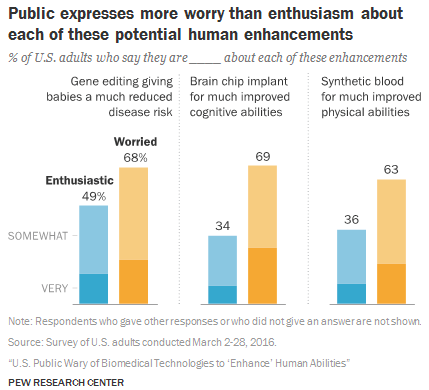
So, how do cutting-edge technologies provide enhancement? Here are a few examples: gene editing can reduce the risk of newborns developing certain severe diseases; brain chip implants can endow individuals with exceptional focus and information-processing capabilities; and synthetic blood can grant people greater speed, strength, and endurance.
However, it should be noted that the aforementioned technologies are not currently available for public use; they remain in the research and development stage or have only been tested therapeutically in limited settings.
Survey data reveal several key reasons why the American public is concerned about these technologies:
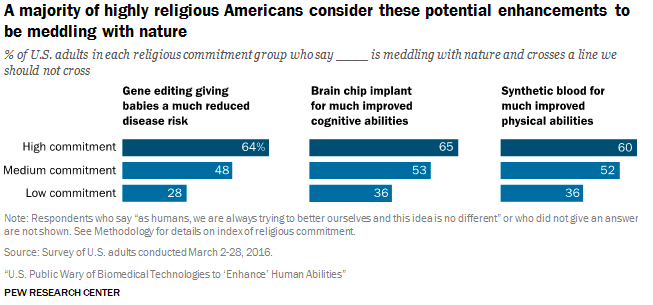
First, concerns about excessive interference with nature.Differences in religious beliefs and their intensity have led to varying public perceptions of these technologies. Individuals with stronger religious convictions argue that such technologies interfere with nature and cross ethical boundaries that should not be breached. In contrast, those with weaker religious ties believe that the centuries-old pursuit of “human self-improvement” is understandable. For all three technologies—gene editing, brain chip implantation, and synthetic blood—more than 60% of respondents expressed significant concern about their excessive interference with nature.
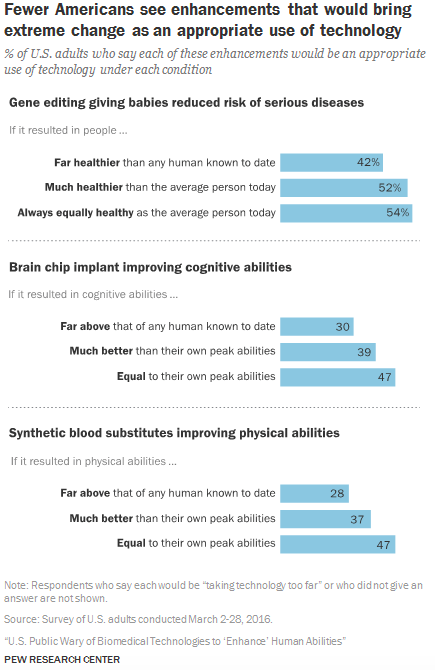
Second, restricted use is more readily accepted, as people do not wish to become superhumans.. Most people believe that these frontier technologies would be acceptable if the changes they bring were more stable and less dramatic than those depicted in science fiction films. For instance, 47% of respondents considered the use of synthetic blood to be an appropriate application of frontier technology if it maintained human capabilities at the highest known levels, rather than enhancing them far beyond natural human limits.
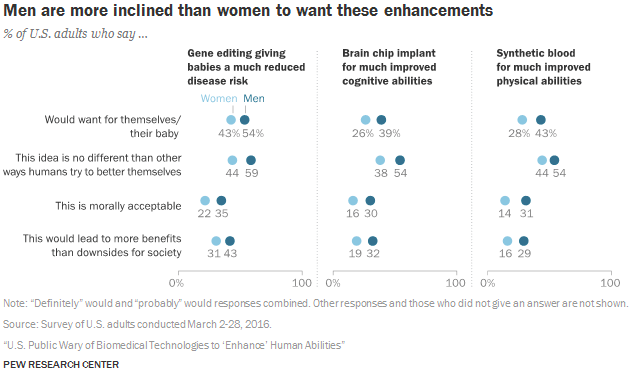
Third: Women hold more conservative attitudes. Women are more hesitant than men to adopt these new technologies, and their expectations and predictive judgments regarding these frontier technologies are also more negative. For instance, 57% of female respondents stated they would not subject their babies to gene editing. Meanwhile, nearly two-thirds of female respondents indicated they would not use brain chip implants or synthetic blood.
Human Enhancement refers to the improvement of human capabilities through a broad range of biomedical interventions, including but not limited to three specific technologies. Simply put, this approach utilizes biomedical technologies, surgical procedures, and other techniques to enhance cognitive, psychological, and physical abilities. Discussions on human enhancement can be traced back to Julian Huxley’s 1957 article, which pointed out that humans could improve themselves through interventions involving biology-related technologies. For the past millennium, humans have continuously attempted to enhance their own capabilities. However, human enhancement differs from ordinary improvements in physical health; it leaves certain biological markers on the body through biotechnology and is more transformative than conventional health enhancements.
The American public shows little interest in enhancing cognitive and physical capabilities through brain chip implants and synthetic blood.. Surveys show that none of these three enhancement plans have generated significant interest among the American public.50% of Americans say they do not want to use gene editing to reduce their babies' risk of diseaseCompared with gene editing, the American public is even less inclined to accept brain chip implants and synthetic blood. Nearly two-thirds (66%) of respondents indicated that they are not interested in brain chip implants, while 63% expressed reluctance toward the use of synthetic blood as a substitute.
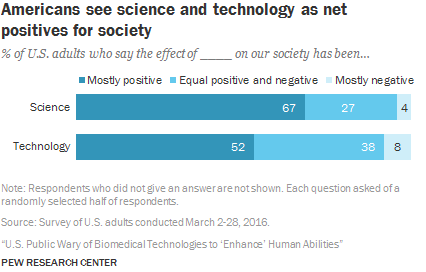
The Possibilities of Human Enhancement Stem from Scientific and Technological Advancements. Although a majority of Americans remain cautious about the use of these cutting-edge technologies, most hold a positive view regarding the benefits of science and technology to American society. Among respondents, 67% believed that science has a positive impact on American society; similarly, 52% also considered technology’s influence on American society to be positive.
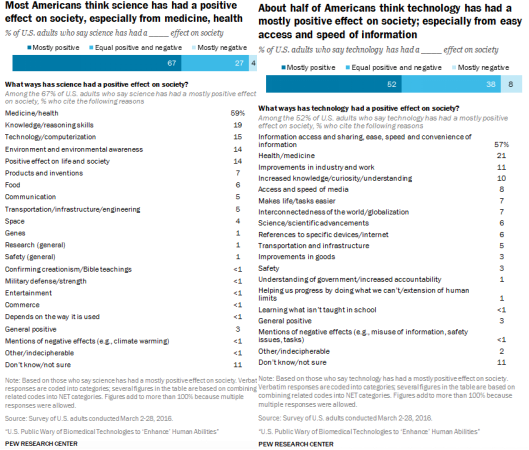
It is worth noting that,Among respondents who hold a positive view of science, 59% cited as their primary reason the significant role science plays in advancing medical research, extending life expectancy, and improving quality of life within the healthcare and pharmaceutical sectors.. By comparison, those who believe that technology has a positive effect do so because 57% of respondents feel that technology makes it easier and faster for people to access and share information.
By VCBeat. Please credit the WeChat official account: VBResearch2016 when reposting.