

Will Psychiatrists Be Replaced? AI-Powered Mental Health Diagnosis Gains Traction with Key Clinical Applications
In conventional psychotherapy, clinicians first conduct an initial assessment of the patient’s mental status, relying on intuition developed through several sessions akin to psychological interviews to evaluate symptoms. Based on clinical experience, they diagnose the specific type of mental disorder and then formulate a targeted treatment plan, including the choice of medication and dosage. However, due toDoctorLimitations of subjective judgment and experience may lead to diagnostic errors, resulting in delayed diagnosis or incorrect determination of medication types and dosages, thereby delaying treatment.
In this era where machine learning is prevalent, the application of artificial intelligence in psychiatry is becoming increasingly widespread, with involvement in both diagnostic and therapeutic stages. AI has demonstrated considerable diagnostic accuracy in experimental settings, showing a trend toward surpassing human performance, and is expected to play a significant role in the future diagnosis and treatment of mental disorders.
However, the use of artificial intelligence to assist in pharmacological interventions for mental disorders requires rigorous research and validation. For instance, while language analysis techniques have demonstrated considerable accuracy in diagnosing schizophrenia, this finding stems from a single trial. Moreover, no corresponding models have yet been established for the symptoms of depression and bipolar disorder.
The practical application of AI still has a long way to go, particularly regarding the demand for precision. Siri frequently struggles with recognizing Scottish accents, which may be harmless in everyday contexts; however, in the medical field, even minor errors can have devastating consequences. “If a technology has a 20% error rate (or an 80% accuracy rate), I would absolutely not use it on patients,” said Professor Vahabzadeh of Harvard University.
When factors such as age, gender, race, and geographic region are taken into account, the risks associated with artificial intelligence (AI) become even more pronounced. If an AI system is trained on data sourced exclusively from a single demographic group, its application to other populations may result in misclassification, even for normal samples. “For certain ethnic groups whose speech patterns are softer, or for individuals whose physical activity is limited due to physiological factors, it is understandable that AI might mistakenly diagnose them with depression.” To enhance the application of machine learning in mental health care, it is currently essential to provide more extensive “training” through larger databases of human behavior. Perhaps in the near future, AI technology will be able to address the shortage of mental health professionals and significantly reduce labor costs.
Nevertheless, several promising AI-assisted diagnostic solutions for mental disorders have already emerged on the market. VCBeat (WeChat: vcbeat) introduces some applications and emerging trends of artificial intelligence in the field of psychiatry, as well as the challenges they face.
1.NeuroLex Diagnostics:Assisting in the Diagnosis of Schizophrenia
Individuals with schizophrenia exhibit highly distinctive speech patterns, often characterized by involuntary vocalizations. Their speech typically consists of short sentences, disorganized semantics, and a high frequency of vague words such as “this,” “that,” and “one,” resulting in ambiguous meaning across connected sentences. In 2015, a team of researchers developed an artificial intelligence model based on these linguistic features of schizophrenia. By analyzing conversation transcripts, the model accurately predicted which group of young people was at risk of developing psychosis (a primary symptom of schizophrenia).
Jim Schwoebel, CEO of NeuroLex Diagnostics, aims to leverage this technology to assist primary care physicians in screening for schizophrenia. The logic behind NeuroLex’s product is as follows: audio-recording devices, such as smartphones, are discreetly placed in therapy rooms to capture conversations. These recordings are then analyzed using the artificial intelligence models employed in the aforementioned research to identify indicators of the disorder. The system automatically quantifies the severity of the condition with digital metrics—similar to how a sphygmomanometer measures blood pressure—and provides diagnostic references for physicians.

NeuroLex Diagnostics is committed toAnalyzing Discourse, Enhancing Health
The invention of the schizophrenia screener has already earned Schwoebel an award from the American Psychiatric Association. Furthermore, NeuroLex aims to develop a product for patients undergoing psychiatric treatment in hospitals that, in addition to diagnosing mental disorders, can perform longitudinal language analysis to track disease progression.
Schwoebel had a significant personal motivation for undertaking this work: his brother suffers from schizophrenia. Before receiving a definitive diagnosis, he underwent more than ten initial consultations, and subsequent pharmacological treatments repeatedly proved ineffective. This experience led Schwoebel to consider how individuals with schizophrenia who require medication can rapidly identify the optimal therapeutic regimen and appropriate dosage.
To investigate medication management for schizophrenia, NeuroLex has devised a clinical observation protocol for patients: if linguistic analysis indicates a reduction in symptoms following a specific medication regimen, the regimen is deemed effective; conversely, the artificial intelligence system will recommend promptly initiating an alternative treatment plan to mitigate the harms associated with inappropriate medication. As data accumulates, the system can also analyze historical cases with similar characteristics to recommend effective medication regimens.
2.Companion:"Passive Observation" Psychological State
For individuals with compromised mental health, such as those suffering from depression or post-traumatic stress disorder (PTSD), a mental breakdown may manifest as a gradually developing condition, and an emotional crisis will not fully emerge from a single psychotherapy session.
“Each episode of depression or mania may cause some damage to the brain,” said Thilo Deckersbach, a Harvard professor practicing at Massachusetts General Hospital. The hospital’s online “Mood Disorders Network” will partner with Cogito AI to test a mobile app called “Companion,” which monitors patients’ activity, phone calls, text messages, and speech patterns to flag early signs of mental health issues.
Compared with methods such as having patients keep illness diaries, these “passive observation” approaches yield more significant results. According to Harvard Professor David Ahern, the process of subjective recording is overly burdensome and is mostly abandoned within three months. For instance, mental health scales require patients to answer six questions about their psychological state daily (e.g., how often they feel calm and relaxed) and eight questions about lifestyle factors (e.g., sleep and exercise), while also recommending daily (or weekly) tracking of the presence or absence of 17 symptoms associated with mental disorders, such as low mood and aggressive behavior. “Sadly, most people just don’t do it well,” says Deckersbach. “They don’t want to be constantly monitoring their emotions.”
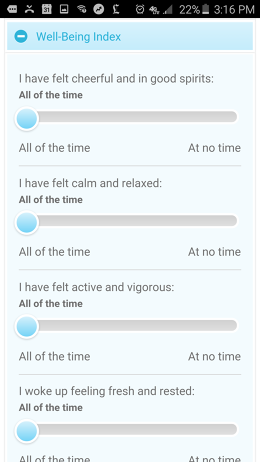
Most Self-Administered Mental Health Scales Are Abandoned Within Three Months
“Passive observation” does not distract individuals emotionally. Simply by carrying a smartphone, data from GPS, accelerometers, and call and text message logs can gather substantial information about mental status. The “Out and About” feature in the Companion app monitors activity levels, which is one of the metrics for assessing depression. The volume of calls and messages can also reveal the extent of a patient’s social connectedness, an indicator used in evaluating post-traumatic stress disorder (PTSD). The only task requiring active user participation is recording a daily audio clip lasting 10 seconds to 10 minutes; psychological status is then assessed by analyzing tone, speech rate, and “vocal tension.”
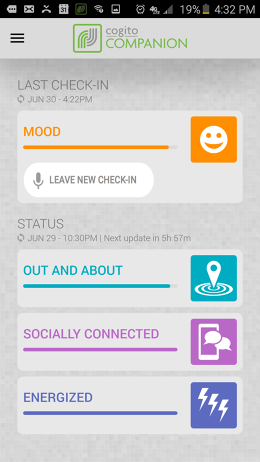
Companion App records voice, activity levels, and social interactions; “passive observation” yields favorable outcomes
When the Ginger.io app first launched in 2011, it served as a free tool for professional psychological quantification. If the results indicated a risk of certain mental disorders, it would alert the user’s family members or physicians. The app also leveraged machine learning techniques to trace symptom patterns and correlate users’ psychological traits with specific mental health conditions. To date, Ginger.io has collected more than 1.4 million completed questionnaires, and over 40 medical institutions have used Ginger.io to assist in case management.
“Over the past few years, we have realized that the opportunity for Ginger.io is much larger than we initially anticipated,” said Anmol Madan, CEO of Ginger.io. The company now offers its own paid subscription service for mental health care, enabling users to engage in unlimited communications with counselors known as “mental health coaches.” It has also launched 50-minute video therapy sessions in California, positioning itself as the “Uber of mental health.”

Ginger.io Combines AI with Physician Video Consultations, Creating the “Uber of Mental Health” with Its “Mental Health Coach” Service
“Relying solely on a technological approach will not take us far,” said Madan. “We believe that ensuring universal access to high-quality mental health care should be recognized as a human right. However, relying exclusively on technological means to achieve this ideal is clearly unworkable.” The optimal solution for the future treatment of mental disorders may lie in combining precise analysis of complex symptoms using artificial intelligence with the genuine emotional support provided by psychiatrists.