

Global Medical Invests RMB 2 Billion in PPP Partnership with The First Affiliated Hospital of Xi’an Jiaotong University to Build International Land Port Hospital
On August 30, the formal contract for the joint establishment of the International Land Port Hospital of the First Affiliated Hospital of Xi’an Jiaotong University (hereinafter referred to as “International Land Port Hospital”) by Universal Medical Finance and Technical Consulting Services Co., Ltd. (hereinafter referred to as “Universal Medical”) and the First Affiliated Hospital of Xi’an Jiaotong University was signed at the First Affiliated Hospital of Xi’an Jiaotong University. Relevant leaders from Shaanxi Province, Xi’an City, and the International Trade & Logistics Park, as well as senior executives from China General Technology Group, Xi’an Jiaotong University, the First Affiliated Hospital of Xi’an Jiaotong University, and Universal Medical, jointly attended the signing ceremony.
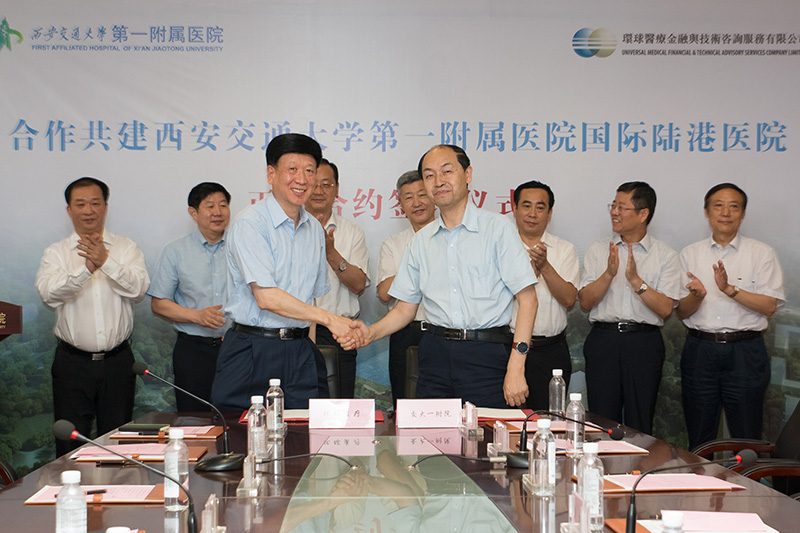
According to VCBeat (WeChat ID: vcbeat), Universal Medical will invest up to RMB 2 billion in the construction of International Land Port Hospital. Upon completion of the project, it will participate in the management and operation of International Land Port Hospital through a series of mechanisms mutually agreed upon by both parties. Additionally, the Group will contribute another RMB 28 million to jointly establish a joint venture with the First Affiliated Hospital, which will be fully responsible for providing procurement, logistics, and other services to International Land Port Hospital, the First Affiliated Hospital, and other third-party hospitals. The Group’s investment returns will primarily consist of concession fees for construction and operational services, as well as dividends from the management and operating company.
In 2013, the First Affiliated Hospital of Xi’an Jiaotong University reached an agreement with the Xi’an International Trade & Logistics Park to build the International Land Port Hospital. In January this year, Universal Medical and the First Affiliated Hospital of Xi’an Jiaotong University signed the “Framework Agreement on Cooperative Construction of the International Land Port Hospital of the First Affiliated Hospital of Xi’an Jiaotong University” in Xi’an. Reportedly, this marks the first time that a regional central hospital under the administration of the National Health and Family Planning Commission has partnered with a social capital company (Universal Medical).
Collaborating via the PPP Model to Build an Integrated International Land Port Hospital
The International Land Port Hospital Project is a “medical, educational, research, elderly care, and rehabilitation integrated” initiative developed through a public-private partnership (PPP) between Universal Medical and the First Affiliated Hospital of Xi’an Jiaotong University, with support from national policies. The project covers a planned area of 375 mu, with a gross floor area of approximately 340,000 square meters and a designed capacity of 1,000 beds. It aims to establish a premier high-tech medical center in Northwest China, while leveraging this platform to build an internationally benchmarked community integrating medical and elderly care services, thereby positioning the project as a national model for the development of integrated medical and elderly care.
Guo Weiping, CEO of Universal Medical, stated that as China’s largest integrated healthcare service provider, Universal Medical offers comprehensive healthcare service solutions to hospital clients, with business operations spanning four major sectors: healthcare finance, hospital investment-construction-operation, medical technology services, and healthcare informatization. Future in-depth cooperation with the First Affiliated Hospital of Xi’an Jiaotong University will further promote the hospital’s external management outreach. Coupled with the infusion of talent and technology, this collaboration will comprehensively enhance the hospital’s scale, efficiency, and strength. Through this Public-Private Partnership (PPP) model of “co-construction,” a wide range of high-quality domestic and international healthcare resources can be supplied to hospitals, including optimization of management concepts, physician training, expert deployment, departmental enhancement, discipline development, equipment introduction, and healthcare informatization. This approach can rapidly extend the brand influence of high-quality medical resources to primary healthcare institutions, significantly improving the service levels of grassroots hospitals. By collaborating with the First Affiliated Hospital of Xi’an Jiaotong University, Universal Medical aims to establish a new paradigm for cooperation between state-owned central enterprises and university-affiliated hospitals, thereby contributing to the health and well-being of people in western China.
Zhao Minggang, Director of the Medical Management Guidance Center under the National Health and Family Planning Commission, stated regarding this collaboration: “China’s public hospitals are currently facing a prominent contradiction between insufficient medical resources and the enormous demand for healthcare services among the public. This situation also presents an opportunity to introduce other forms of capital into healthcare reform. By jointly building the International Land Port Hospital through the Public-Private Partnership (PPP) model, we can further unlock the potential of high-quality medical resources, break free from institutional constraints, address funding bottlenecks, and achieve strong alliances and mutual value enhancement of state-owned capital from both parties.” He emphasized that this cooperation holds significant importance for further improving healthcare infrastructure in the Xi’an International Trade & Logistics Park and surrounding areas, establishing a high-level medical center serving the Northwest region, and enhancing healthcare access and conditions for the public.
Shi Bingyin, President of the First Affiliated Hospital of Xi’an Jiaotong University, stated, “Under the public-private partnership (PPP) model for co-construction, the First Affiliated Hospital of Xi’an Jiaotong University will be responsible for injecting brand value, providing medical technical support aligned with brand requirements, supplying leading technical experts and professional teams, and introducing a mature hospital management system. It will also oversee medical operations during the hospital’s operational phase.” He further pointed out that this initiative to co-establish the International Land Port Hospital will help address the uneven distribution of high-quality medical resources in the short term, with the general public being the primary beneficiaries.
“Specialized Departments, Comprehensive Support”: Building a High-Level Medical Center
Universal Medical Company, a subsidiary of China General Technology Group, is currently the largest integrated healthcare service provider in China. Leveraging its extensive experience and resources in the medical sector, the company offers clients a comprehensive suite of healthcare service solutions, including medical finance, hospital investment-construction-operation, medical technology, and healthcare informatization.
The First Affiliated Hospital is a leading comprehensive Grade III Class A hospital in Northwest China. Established in 1956, it is directly administered by the National Health and Family Planning Commission. The hospital emphasizes specialized development and features distinctive medical services. It has developed significant expertise in the application of advanced technologies—including liver transplantation, kidney transplantation, hematopoietic stem cell transplantation, coronary artery bypass grafting (CABG), congenital heart disease occlusion, interventional procedures, and minimally invasive surgery—as well as in the medical and surgical management of complex conditions such as tumors, cardiovascular and cerebrovascular diseases, and metabolic disorders. Its overall capability in treating difficult and critical cases, along with its case mix index, ranks among the most advanced in China.
Following the collaborative establishment, International Land Port Hospital is planned to operate as a tertiary general hospital featuring a “strong specialized departments, compact general services” model, providing international diagnostic and treatment services, and running on an efficient information platform. Meanwhile, elderly care apartments, public service centers, and commercial and lifestyle support facilities will be planned and constructed in the vicinity of the hospital. The collaboration is expected to significantly enhance medical service capacity for patients in Shaanxi Province and surrounding regions, delivering substantial benefits to residents in Northwest China. In light of the future development trends of public hospitals, partnering with social capital to co-establish hospitals and develop distinctive specialized departments not only facilitates the optimization and adjustment of departmental resources at the main campus but also drives the development of key departments in district and county-level hospitals, representing a win-win outcome for both public hospitals and their partners.