

Hospital-Side Reforms Drive New Market-Oriented Models: 'Six Criteria' Define Elasticity in Specialized Segments
Recently, Founder Securities released an industry report titled “Supply-Side Reform in Healthcare Facilitates Market-Oriented Pricing of Medical Services.” The report offers constructive insights into the challenges facing current healthcare reforms and the direction of reform from a supply-side perspective. VCBeat (WeChat Official Account: vcbeat) has distilled the core viewpoints into four chapters, which are being presented sequentially in recent days.
The fundamental issue in the healthcare industry is the mismatch between supply and demand. Therefore, the core of healthcare reform lies in supply-side structural reform. Since physicians’ professional and economic needs cannot be adequately addressed by the market and must be fully met by public hospitals, these hospitals have become inextricably linked to physicians, resulting in stagnant physician resources. Consequently, the crux of healthcare supply-side reform is to decouple physicians from hospitals. Only by breaking the existing paradigm and enabling the mobility of physician resources will new industry opportunities emerge.Below, we analyze the evolving trends on the supply side of healthcare services from the hospital’s perspective.
As shown in the figure below, public hospitals are overly reliant on drug markups, with patients’ largest expense being medication costs. In contrast, the proportion of medical service fees is very low, whereas in the United States, medical service fees account for a significant share, reflecting normal market-based pricing.
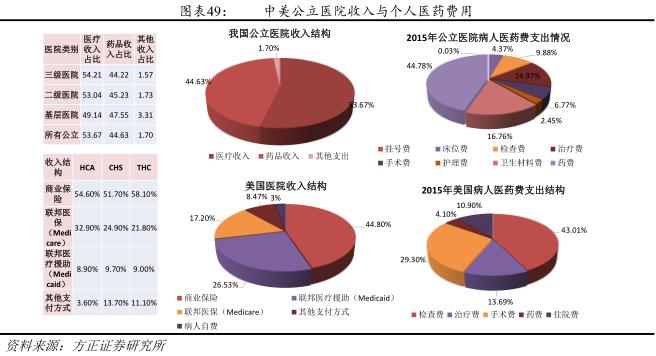
The substantial increase in expenses for pharmaceuticals, laboratory tests, and other services reveals the profit-driven nature of public hospitals after they became responsible for their own profits and losses:
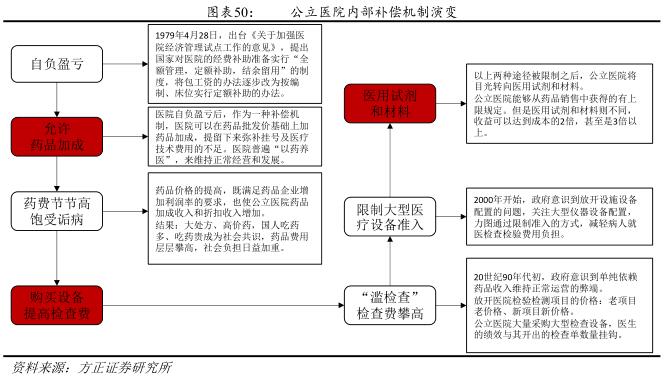
After hospitals became financially self-sufficient, a compensation mechanism allowed them to apply markups on the wholesale price of drugs, retaining the proceeds to offset deficiencies in registration fees and charges for medical technical services. Hospitals widely adopted the practice of “subsidizing medical care with drug profits” to sustain normal operations and development. The rise in drug prices not only met pharmaceutical companies’ demands for higher profit margins but also increased public hospitals’ revenue from drug markups and discounts. Consequently, the prevalence of excessive prescriptions and high-priced medications has led to a societal consensus that people in China consume too many drugs and pay exorbitant prices. Drug costs have escalated at multiple levels, increasingly burdening society.
In the early 1990s, the government recognized the drawbacks of relying solely on drug revenues to maintain normal hospital operations. It deregulated the pricing of hospital laboratory and diagnostic tests, implementing a dual-track pricing system: existing items retained their original prices, while new items were assigned new prices. Public hospitals extensively procured large-scale diagnostic equipment, and physicians’ performance evaluations were linked to the volume of test orders they prescribed. Starting in 2000, the government acknowledged the issues arising from the liberalization of facility and equipment allocation, shifting its focus to the configuration of large-scale medical devices. It sought to alleviate patients’ financial burden for diagnostic and laboratory services by restricting market access.
With the above two channels restricted, public hospitals have turned their attention to medical reagents and materials. There are caps on the revenue public hospitals can generate from drug sales. In contrast, medical reagents and materials are different, with profit margins reaching two or even more than three times the cost.
We have consistently emphasized that supply-side reform in the healthcare sector is the true direction for generating incremental market growth. At the core of public hospital reform lies the adjustment of the current revenue structure, reducing reliance on drug markups, laboratory tests and examinations, medical reagents, and consumables, particularly the practice of subsidizing medical services with drug profits.
Therefore,Reforming public hospitals requires reducing drug prices and costs, and improving services on the supply side.
Hospital:As the mainstay of the hospital sector, public hospitals will revert to their public-welfare role and become the primary platform for providing basic medical services to society against the backdrop of the abolition of drug markups, while simultaneously attracting greater inflows of social capital.
Doctor:As the true suppliers in the healthcare industry, they will be appropriately decoupled from hospitals to discover real value through market-based allocation of scarce resources, thereby advancing supply-side reform in healthcare.
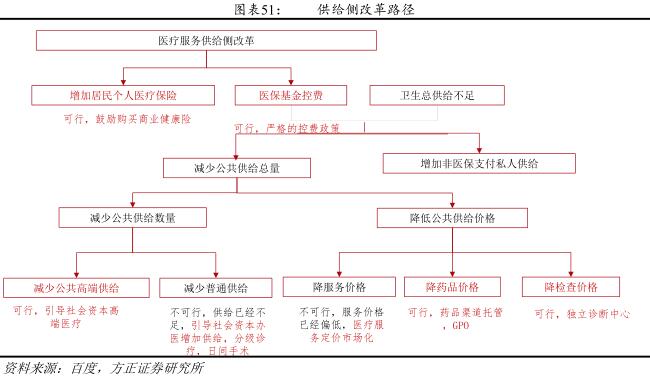
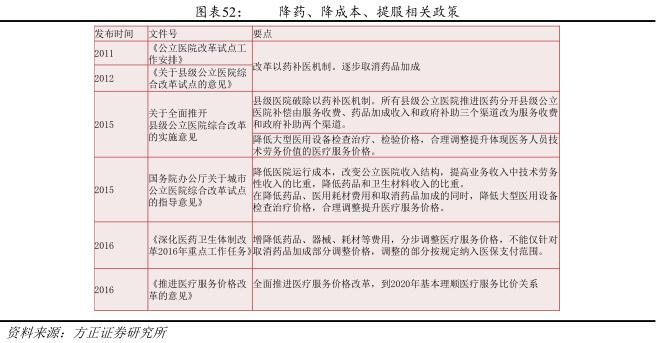
With drug prices and costs falling while service quality improves, the supply-side structure of medical services is bound to change. Public hospitals, which originally integrated outpatient care, surgery, inpatient care, physicians, pharmacies, and diagnostics under one roof, will outsource certain functions to reduce costs. Driven by policies promoting tiered diagnosis and treatment, multi-site practice, and private healthcare provision, we are optimistic aboutDevelopment of New Medical Service Models, such as physician groups, third-party ancillary departments, and family doctors.
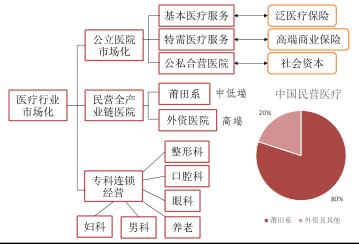
The marketization of the healthcare industry can be divided into several aspects:Marketization of Public Hospitals, Private Full-Industry-Chain Hospitals, and Specialized Chain Operations。
The Emergence and Development of Premium Medical Services
Special-needs medical services emerged in the 1990s, evolving from outpatient clinics for foreign guests and wards for senior cadres.There are two reasons for the emergence of this service:
Leveraging the hospital's high-end resourcesSolving Complex and Refractory Diseases, meeting patients' needs beyond basic medical services.
As a significant measure of healthcare reform, special-needs medical services are primarily targeted at high-end clients and boast extremely high profit margins, enablingIncrease Hospital Revenue。
Current Status of Special Medical Services
The essence of premium medical services is to differentiate ordinary patients from those willing to pay a premium, by providing enhanced services to the latter at higher fees, thereby achieving high profitability.
The services provided mainly include:
1. Outpatient Appointment: Faster and More Convenient Medical Care;
2. Expert Services: Consultations are provided by physicians with senior titles and advanced expertise. Dedicated staff offer end-to-end assistance, including registration, diagnosis and treatment, payment, and medication pickup. Outpatient services include wheelchair escort for patients with mobility impairments or severe conditions.
3. Premium Environment: Equipped with independent consultation rooms and waiting areas, along with high-end facilities; some hospitals may also feature dedicated treatment rooms.
Shanghai Special Medical Services
Taking Shanghai as an example, the city leads China in both basic and high-end medical resources.Its special-needs medical services are also relatively well-developed.
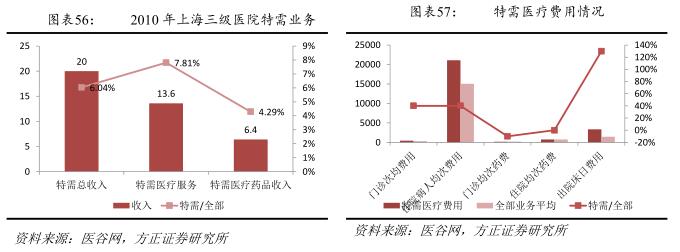
Analysis of Revenue from Special Medical Services in Shanghai’s Tertiary Hospitals Shows That Special Medical Services, Regardless ofWhether for outpatient or inpatient care, pharmaceutical expenditures are not higher than those for non-special needs medical services, and may even be lower, indicating thatSpecial medical services better reflect the pricing of medical technical services, reflectingThe Value of Physicians in Healthcare Services。
Collaboration with Insurance Providers
Most large hospitals’ premium medical services have already been integrated with commercial insurance providers.
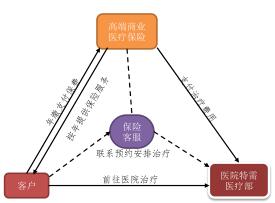
a. Case 1: China Life Guardian Expert VIP Medical Group Medical Insurance
When the insured undergoes medical procedures within the scope of agreed benefits, the company, from the individual's special needs medicalPay the individual special-needs medical insurance benefit from the therapeutic account, while deducting the corresponding claims administration fee. WhenWhen the balance of the individual special-needs medical account reaches zero, this insurance coverage shall terminate. The utilization pattern of individual special-needs medical benefits is identical to that of group special-needs medical benefits, with both having an insurance period of one year.
b. Case Study 2: Peking Union Medical College Hospital and Cigna & Merchants
When a patient purchases Cigna & CMB's Global Supreme High-End Medical Insurance, sudden illness can lead toCall the insurance company’s hotline to have the insurer contact the hospital and physicians—patients can receive medical careNo need to queue for registration, saving time—this insurance is accepted at medical institutions worldwide, allowing you to enjoy full coverage without paying cash upfront.
Current Issues in Special Needs Medical Services
Special-needs medical services are heavily influenced by policy. However, due to various constraints, the government is unable to address thiseffective regulation of blocks. Over time, hospital medical resources have become increasingly unable to meet all patient demands. Profit-driven motives have begun to give rise to numerous problems.
1.Lack of Standardization:Many hospital “experts” fail to live up to their reputation; while many hospitals, both large and small, offer “premium services,” the quality varies significantly.
2.Lack of restrictions and regulation on the revenue portion:Registration fees for special-needs outpatient clinics often carry a 25%–40% commission, and this portion of income is tax-exempt. This presents a significant incentive for physicians;
3.Service Discrimination:Given the fixed medical resources of public hospitals, the widespread development of "special-needs medical services" across China has crowded out ordinary medical resources in public hospitals, thereby harming the interests of general patients.
4.Waste of resources.Generally, patients visit special-needs outpatient clinics for complex or difficult-to-diagnose conditions. However, some experienced senior specialists no longer offer regular outpatient services after retirement, and appointments for regular outpatient care are often extremely difficult to secure. Currently, due to the lack of reasonable patient triage by hospitals and the allowance of unrestricted patient choice, a large number of patients with minor ailments can access special-needs outpatient clinics simply by paying higher fees, thereby resulting in a waste of medical resources.
Currently, private hospitals in China are mainly divided into two types: foreign-funded and those affiliated with the Putian network.Representative private hospitals. The two currently have different positioning: foreign-funded ones lean toward the high-end segment, while the Putian-affiliated hospitals, originally positioned in the low-end market, are now beginning to expand into the high-end sector.
From a business development perspective, foreign-funded medical institutions focus on vertical integration and patient referral expansion along the industry chain, whereas the Putian-affiliated providers prioritize horizontal service expansion, concentrating primarily on low-cost, high-margin procedures.
There are two revenue models:
1. Generate revenue beyond “medical services” through supply chain layout, i.e., income from pharmaceuticals, consumables, and medical devices;
2. IPO fundraising.
Furthermore, private hospitals are currently focusing on the premiumization of specialized services, such as obstetrics and gynecology.This is because private healthcare institutions are still unable to compete with public hospitals across various dimensions; therefore, securing patient volume through specialized services represents the viable path for their survival and development.
Foreign-Invested Hospitals — United Family Healthcare
United Family Healthcare is a typical representative of foreign-invested hospitals in China, focusing on middle- and high-income groups in Beijing, Shanghai, and Guangzhou.Population. United Family Healthcare entered China in 1997, establishing its first hospital in Beijing with an initial investment of $4 million. It is the most well-known foreign-funded general hospital in China, specializing in obstetrics and gynecology. Its main services include over 20 medical specialties such as obstetrics and gynecology, pediatrics, cardiology, and adult ICU.room. United Family Healthcare’s target demographic is high-income individuals.
Currently, Fosun Group holds a controlling stake in United Family Healthcare’s parent company, Sino-American United Laboratories (SAUL), through Fosun Pharma.Quan, profitability of United Family Healthcare will not be a short-term consideration; the focus is on opening multiple new branches in Beijing, Shanghai, Guangzhou, Chengdu, Qingdao, and other cities to capture market share.
From the case of United Family Healthcare, high-end private hospitals cannot fully adapt to China’s national conditions in the short term.conditions, achieving high profitability. The group to which it belongs focuses onA full-industry-chain layout positions the hospital as a portal website, aiming to maximize traffic volume and drive referrals for medical devices, consumables, and pharmaceuticals within the industry chain.
Considering the proportion of revenue derived from medical equipment, consumables, and pharmaceuticals in high-end hospitals. From the perspective of the entire industryFrom the perspective of the industry chain, it does not matter if the hospital itself operates at a loss; as long as the hospital can attract a sufficiently large patient flow, profitability can naturally be achieved across the entire industry chain.
In early 2016, Wanda Group and International Hospitals Group (IHG)Group Limited (hereinafter referred to as “IHG”) signed a cooperation agreement in Beijing. Wanda will invest a total of RMB 15 billion to build three comprehensive international hospitals in Shanghai, Chengdu, and Qingdao. These hospitals will be operated and managed by IHG under the IHG brand (known in Chinese as “Yinci Wanda International Hospital”).
This is the largest investment by a Chinese enterprise in the healthcare industry, and also IHG's first in ChinaHospital Operations Management Project.
Putian-affiliated Private Hospitals
“The Putian System” generally refers to private hospitals established by people from Putian, Fujian Province, which have primarily relied onAttract customers through Baidu's pay-for-performance ranking.
Well-known Renai Hospital, Mylike Plastic Surgery, Shuguang Andrology, Hemei Women's and Children's Hospital, TianInfertility clinics, Yuanda Thoracic Hospital, and the vast majority of such institutions are owned by individuals from Putian.
Putian (China) Health Industry Federation was established in June 2014, claiming to be the world’s largestA major health industry alliance with over 8,600 private hospital members across China, providing employment for more than one million medical professionals and generating an annual turnover of RMB 260 billion.
The Putian network focuses more on second-tier cities such as Chengdu and Kunming. China’s private obstetrics and gynecologyHospitals: The Putian network accounts for over 90% of the market share; nearly all tier-2 cities and above have Putian-affiliated hospitals.
Operational Model: 1) Build two to three additional hospitals after Series A financing to expand operations; 2) ConductSeries B financing; under normal circumstances, each hospital begins to turn a profit after two to three years of operation, with the long-term goal being an initial public offering (IPO).
Excluding negative incidents such as the Wei Zexi case, Putian-affiliated hospitals are highly favored in the financing sector: 1)The Putian system has a mature operational mechanism, rapid expansion of its business model, and promising prospects, but there is a lack in Chinaviable investment targets to compete with them; 2) Putian-affiliated hospitals focus on consumption by the mid-to-low-end demographic,Together, and even now, they will possess a market broader than the high-end healthcare market.
Chain Healthcare
Chain healthcare providers generally offer specialized services, such as aesthetics, pediatrics, ophthalmology, and emergency care.China’s chain medical model bears some resemblance to private hospitals, with the distinction that chain medical providers offer more specialized and limited services.
In addition, the services provided by chain medical institutions are generally characterized by low cost, high profit, and a high degree of standardization.specialties characterized by high standardization, significant reliance on equipment, and ease of training, particularly in aesthetics and dentistry,Ophthalmology, and even veterinary medicine.
Chain hospitals have established relevant main services and formats that are independent of the hospitals themselves.bodies, such as testing centers, rehabilitation centers, nursing centers, and logistics centers, to achieve resource sharing;
Core medical institutions within the chain group enhance the capabilities of affiliated hospitals through mobile surgical services and talent training.technical and managerial capabilities; chain hospital groups have significantly enhanced the overall brand image of hospitals, facilitated patient access to medical care, and reduced consultation costs.
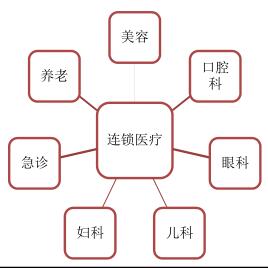
The primary advantages of chain healthcare lie in the sharing of medical resources and physician expertise, as well as shared business modelsOptimized resource allocation through sharing of benefits and management expertise, reducing costs via economies of scale. Quick to establish in the short term with high profitability.While ensuring that gross profit remains unchanged or even grows steadily, it is still possible to significantly reduce the burden on patients.patient treatment costs.
Private chain hospitals will become an effective supplement to public hospitals in the future, revitalizing the entireMechanisms of the Healthcare Market.
Franchising
The franchising business model is the most controversial among various forms. It primarily involvesTo three parties: the government, public hospitals, and social capital.
The emergence of franchised hospitals is due to the extreme difficulty in reforming public hospitals, with many constraining factors rootedDeeply entrenched, private hospitals struggle to leverage their strengths due to a lack of human resource advantages. FranchisingThe government sets the overall direction for hospitals, with large public hospitals striving to adapt as much as possible amid healthcare sector reforms.The outcome of efforts made to safeguard one's own interests, with its advantage lying inIntroducing Social Capital into the Healthcare Sector Without Disrupting the Existing System。
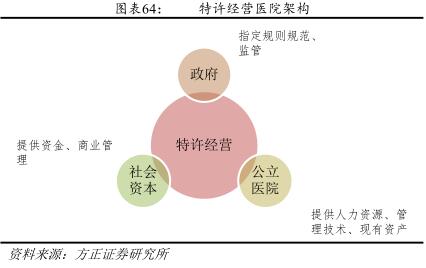
Public-private collaboration in healthcare takes many forms, beyond social capital directly participating as shareholdersIn addition to entering public hospitals, collaboration between public and private hospitals also represents one of the diverse forms of partnership.
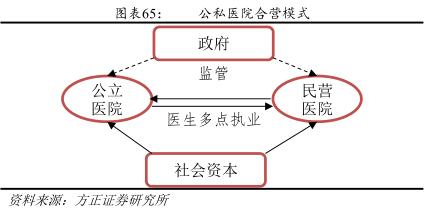
Some companies are co-operating hospitals, and the model of doctors practicing at multiple locations has already emerged: Beijing Children's HospitalThe hospital established a New Century Children's Hospital, where its physicians provide clinical services after their regular shifts. This model has enabled the hospital to retain medical talent and maintain its brand reputation, while also securing government support.
The preceding text analyzed the numerous forms of healthcare service supply; in addition, specialized medical departmentsThe segmentation is complex, encompassing general hospitals, specialized hospitals, ophthalmology, rehabilitation, dentistry, obstetrics and gynecology, health check-ups, medical imaging, and more. How can we distinguish high-elasticity sub-sectors? We believe the criteria for judgment are:
Standardization of Clinical Diagnosis and Treatment Processes
Low medical risk
Low Level of Manual Operation
Greater dependence on equipment than on humans
Replicable Business Model
Policy Support
In terms of volume, hospital transactions in China increased year by year from 2013 to 2015.In 2015, the transaction volume of specialized hospitals experienced a significant decline; in contrast, the investment scale and number of general hospitals continued to grow, surpassing specialized hospitals in 2014 and maintaining growth in 2015. From an industry perspective, most investors are optimistic about A-share listed healthcare companies expected to undergo horizontal integration within the health industry, including pharmaceutical firms, medical device manufacturers, and healthcare management investment groups.
From the perspective of specialty segmentation, chain-type models with strong profitability, high replicability, and low medical riskSpecialized hospitals, favored by investors for their potential to rapidly scale and recoup capital, were particularly popular in the fields of dentistry and maternal and child health. However, as capital flooded into the sector, such investment targets became scarce, leading to a significant decline in transaction volume in 2015.
Note: This report is reprinted from Founder Securities.
[Related Reading]