

RNA-Based Targeted Therapy Firm Files IPO to Advance MicroRNA Platform for Shrinking Malignant Tumors
Twenty years ago, scientists discovered that short RNA strands, known as microRNAs, help cells fine-tune gene expression. When cells break down or lose a portion of their microRNAs, dysregulated expression may occur; therefore, restoring microRNA levels holds potential for cancer therapy.
The primary challenge in implementing this cancer therapy lies in effectively delivering microRNA to tumors. Recently, researchers at the Massachusetts Institute of Technology (MIT) published a new study demonstrating successful delivery of microRNA into tumor cells. By twisting RNA strands into a triple-helix structure and embedding them within a biocompatible gel, the team achieved not only efficient delivery of the RNA segments but also significant reduction of malignant tumors in mice.
Simultaneous activation of a tumor-suppressive microRNA and an oncogenic microRNA induces chaotic gene expression within cancer cells. Leveraging this technology, researchers have significantly improved cancer survival rates. They believe that this approach can be used not only to deliver other types of RNA but also to transport DNA and other therapeutic molecules.
“This platform can deliver any gene you wish to transmit,” said Natalie Artzi, a scientist at the MIT Institute for Medical Engineering and Science and an assistant professor at Brigham and Women’s Hospital. “Studies have demonstrated the feasibility of localized cancer therapy. In particular, in the context of gene diagnosis and therapy, the triple-helix structure enhances RNA stability while improving uptake and transfection efficiency.”
This new technology reflects a shift in cancer research toward the design of more targeted and selective therapies. Artzi added, “Cancer is considered a systemic disease that requires systemic treatment. However, in some cases, localized cancers can be effectively treated with local interventions, such as gene therapy and chemotherapy.”
To create a new system, researchers independently developed a material composed of two types of dendritic dextran polymers to serve as a tissue adhesive.
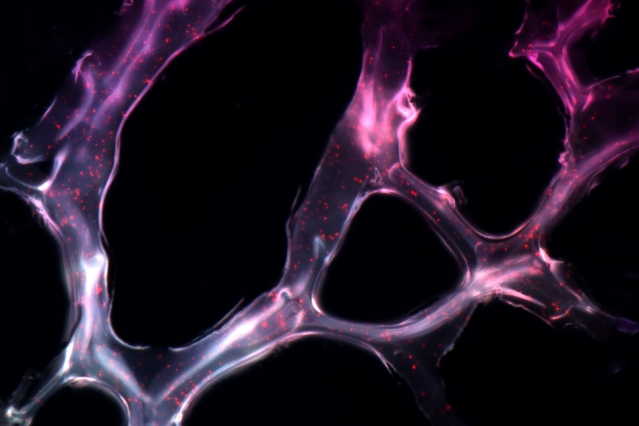
The study’s lead author is Ames Postdoctoral Fellow João Conde, who, together with Artzi, utilized dendrimers to form a self-assembling structure containing the required microRNA. First, three RNA strands were intertwined to create a triple-helix structure, yielding a molecular architecture more stable than single- or double-stranded RNA. These triple helices were then conjugated with dendrimers to form nanoparticles, which were incorporated with dextran into an injectable hydrogel formulation and administered via injection above the tumor.
Upon reaching the tumor site, the gel slowly releases microRNA nanoparticles, which are taken up by tumor cells. Once inside the cells, RNase cleaves each triple-helix structure into three separate microRNA strands.
MicroRNAs alter gene expression by disrupting messenger RNA molecules, which carry DNA instructions for protein synthesis. The human genome contains over 1,000 microRNAs, and their dysfunction can lead to disease.
In this study, the researchers delivered two target microRNA sequences, while a third sequence served solely to stabilize the triplex structure. One sequence mimicked the naturally occurring microRNA miR-205, which frequently suppresses cancer cells. The other, miR-221, typically promotes hyperactivity in cancer cells.
Researchers conducted tests on a mouse bearing a triple-negative breast tumor, a type of cancer that lacks the three most common breast cancer markers: estrogen receptor, progesterone receptor, and HER2. Such tumors are typically difficult to cure.
Through comparative experiments in mice, researchers found that triplex helix-structured microRNA therapy was significantly more effective than standard chemotherapy. Following treatment with the triplex helix structure, tumors shrank by 90%, and the mice survived for up to 75 days. In contrast, those receiving other treatments (including single-stranded or double-stranded homologous microRNAs) survived for less than one week.
MicroRNA sequences inhibit cancer cell growth and their adhesion to other cells by interfering with messenger RNA.“This research is highly significant,” said Mauro Ferrari, President and CEO of the Houston Methodist Research Institute. Although he was not involved in the experiment, he affirmed its value: “MicroRNA inhibition has often been regarded as a promising approach for targeted therapy, but delivering microRNAs has consistently remained a major challenge.”
Currently, Artzi and Cond are seeking microRNA combinations capable of combating other types of tumors. This technology may represent the most effective approach currently available for targeting tumor cells, with potential applications in the treatment of brain, breast, and colorectal cancers.
Moreover, microRNA therapies disrupt gene expression in cancer cells and can effectively prevent their metastasis throughout the body. Multiple microRNA sequences have been identified as playing critical roles during the metastatic process.
“Many microRNAs are involved in the metastatic process. This is indeed a promising area for development,” said Conde.
Researchers are striving to leverage this technology to deliver other classes of nucleic acid agents, including short-chain RNAs for RNA or DNA interference, with the aim of achieving gene therapy. It is believed that this technology will undoubtedly mark a significant advance in targeted therapy, and it is hoped that clinical application will be realized soon, bringing hope to cancer patients.