

G20 Internet Development Report: Internet Economy Emerges as a 'Primordial Force' Driving Global Growth
The report systematically reviews and summarizes the development history and experiences of the internet in G20 countries and regions from multiple perspectives and fields, including internet penetration rates, online social networking, e-commerce retail, mobile internet innovation, internet development, and cyberspace strategy. It conducts an in-depth study of the practices and philosophical propositions of internet governance in various countries, the challenges facing internet development, and future trends. The aim is to serve as an important reference for gaining insight into and grasping the dynamics and trends of global internet development, thereby providing crucial decision-making support for China in formulating national and international strategies for internet governance, participating in global cyberspace competition, and expanding international cooperation and exchanges.
★ Highlight 1: Internet Penetration in G20 Developed Nations Hits a Bottleneck, While Emerging Markets Show Huge Potential
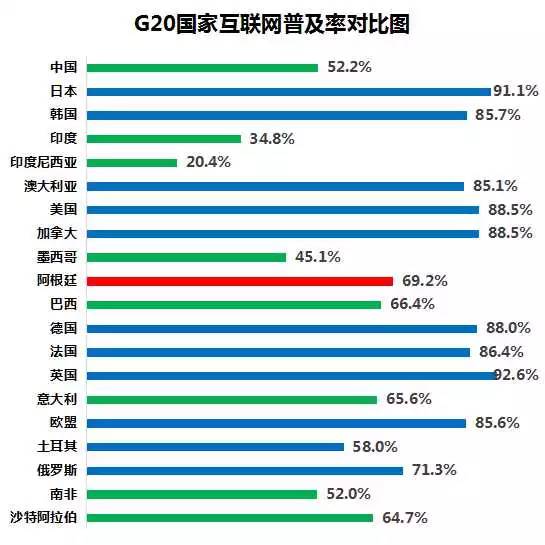
Note: Data source: Internet Live Stats, July 1, 2016; “Research Report on Internet Development in G20 Countries”
The report shows that the average internet penetration rate in G20 countries has reached 69%, higher than the global average. Developed countries have encountered a bottleneck in the rise of penetration rates, while emerging countries still have significant room for growth. Among them, India's late-mover advantage in user growth is evident, making it the fastest-growing country in terms of internet users within the G20, with enormous market potential.
★ Highlight 2: Significant Differentiation in Online Social Networking; China Needs to Break Through Upward Resistance
The average level of online social networking in G20 countries stands at 48%, higher than the global average of 31%. Among these, South Korea boasts the fastest average internet speed worldwide, providing a crucial foundation for its citizens’ use of social networks. Although India is a key market for global social media platforms such as Facebook and WhatsApp, its domestic social networking platforms have a relatively small user base. China’s level of online social networking exceeds the global average but remains slightly below the G20 average; having nearly reached saturation relative to internet penetration rate, it now faces challenges in achieving further growth.
★ Highlight 3: The U.S. “Leads” in Retail E-commerce, with Clear China-Japan Competition
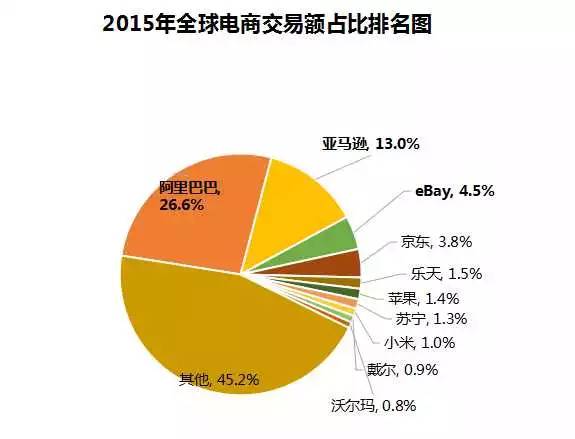
Note: Data sourced from Internet Retailer’s “Global 1000: The Revolution in Global E-commerce Retail” and the “Research Report on Internet Development in G20 Countries.”
In the retail e-commerce sector, reports indicate that the global gross merchandise volume (GMV) of retail e-commerce transactions reached $1.74 trillion in 2015, maintaining an average annual growth rate of 20% over the preceding three years. There is a significant divergence in the level of e-commerce development among G20 nations; however, no super-platform has yet emerged to hold a monopolistic advantage globally. E-commerce enterprises from China, the United States, and Japan dominate the global top ten, accounting for 54.8% of the total global transaction volume. The United States leads by a substantial margin in total e-commerce transaction value, with the B2B market comprising more than 90% of this figure. China and Japan have similar total e-commerce transaction volumes, characterized by intense competition and distinct respective advantages. While Japan’s B2B transaction scale exceeds that of China, China holds a clear advantage in the B2C segment. Meanwhile, countries such as Indonesia, Argentina, and Saudi Arabia exhibit lower levels of e-commerce development, influenced by factors including shifts in online consumer habits and a lack of confidence in the security of e-commerce transactions.
★ Highlight 4: The Internet Economy Becomes the “Primordial Force” Driving Economic Growth, Surpassing the Developed Nations’ Average
In terms of the internet economy, the average share of the internet economy in GDP among G20 developed countries is 5.5%, while the average for developing countries is 4.9%. China’s internet economy accounts for 6.9% of its GDP, surpassing the average level of developed nations. The United Kingdom has consistently maintained a leading position, with the internet economy contributing more to its GDP than in both the United States and China. The share of the internet economy in GDP is a key indicator reflecting the development of a country’s internet industry, and the internet economy has become an important new driver of economic growth.
★ Highlight 5: G20 Nations Heavily Dependent on U.S. Internet Companies
Among the top 10 internet services by traffic in G20 countries, only China and the United States are entirely served by domestic companies. In South Korea, Russia, Indonesia, and Turkey, domestic and U.S. internet companies each hold half of the market share, with local firms primarily providing blog and news portal services. Other countries basically rely on imported services from U.S. companies. Germany and Canada depend entirely on U.S. internet companies, with no domestic firms ranking in the top 10. Except for Brazil’s news portals, which extend their reach to Argentina and Mexico due to geographic proximity, the top 10 internet services in G20 countries are almost all dependent on imports from U.S. internet companies.
★ Highlight 6: The Market Cap Gap Between U.S. and Chinese Internet Giants Is Widening
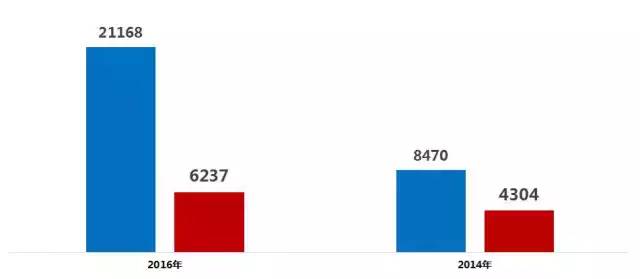
Note: Blue represents the United States, and red represents China. Data source: Market capitalization of listed companies as of August 2016; "Research Report on Internet Development in G20 Countries"
Among the top 20 internet companies by market capitalization globally, the gap in total market value between U.S. and Chinese firms widened from 2 times in 2014 to 3.4 times in 2016.
★ Highlight 7: Internet Application Innovation in China and the US Remains the Most Dynamic Sector; Mobile Internet Is Driving Innovation Momentum in Emerging Markets
In the realm of internet application innovation, China and the United States remain the most dynamic regions. The combined valuation of U.S. companies valued at over $1 billion exceeds $68 billion, while that of Chinese companies surpasses $150 billion. Meanwhile, mobile internet is driving innovation momentum in emerging markets. E-commerce, internet finance, and O2O (Online-to-Offline) services are continually emerging in countries such as India, Indonesia, and Brazil. In the future, these nations will not only serve as target markets for major internet powers but also become one of the main arteries fueling the vigorous growth of the global digital economy.
★ Key Point 8: G20 Nations Jointly Face Cybersecurity Challenges
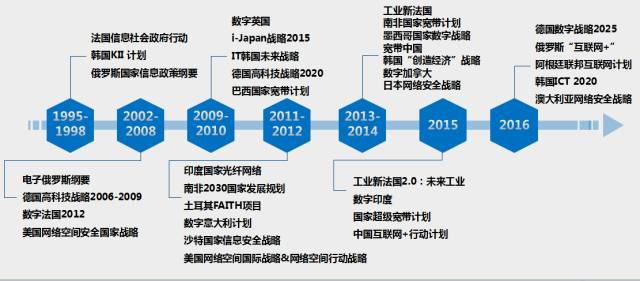
Note: The relevant development strategic plans of the G20 countries involved are not fully presented; representative examples are selected for illustration.
The report posits that the internet development strategies of G20 nations are evolving along a trajectory that begins with network infrastructure, progresses to internet development and security strategies centered on information technology (IT), and ultimately advances toward future industrial strategies characterized by the deep integration of IT and industrial technologies. G20 countries collectively face cyberspace security challenges, focusing on issues such as the alignment between physical sovereignty and cyber sovereignty, online infiltration by terrorism and religious extremism, and cross-border data flows. The digital divide in developing countries remains a focal point. Developed countries jointly confront challenges related to high commercial and labor costs, while developing countries continue to grapple with low market efficiency, lagging infrastructure development, and the difficult task of balancing openness with cybersecurity threats in internet development.
Source: 199IT