

Wuhan Central Hospital Launches China's First Real-Time Commercial Health Insurance Direct Claim System by Bridging the Data Channel
Source: HIT Expert Network Reporter: Zhu Xiaobing
“The claims settlement process, which used to take more than a month, can now be completed in seconds or within a few hours.” Yang Guoliang, Vice President of Wuhan Central Hospital, used these figures to highlight the significant changes brought to health commercial insurance policyholders after the hospital launched an online direct claims settlement service for commercial health insurance.
On the early morning of August 24, Wuhan Central Hospital’s Houhu Campus was bustling with patients as usual. Although this new campus has been open for less than two years, its daily outpatient volume has already reached nearly 3,000. At that moment, dozens of media outlets gathered in the conference hall on the sixth floor of the outpatient building, where Wuhan Central Hospital hosted the press conference for the “Online Direct Settlement of Commercial Health Insurance” initiative.
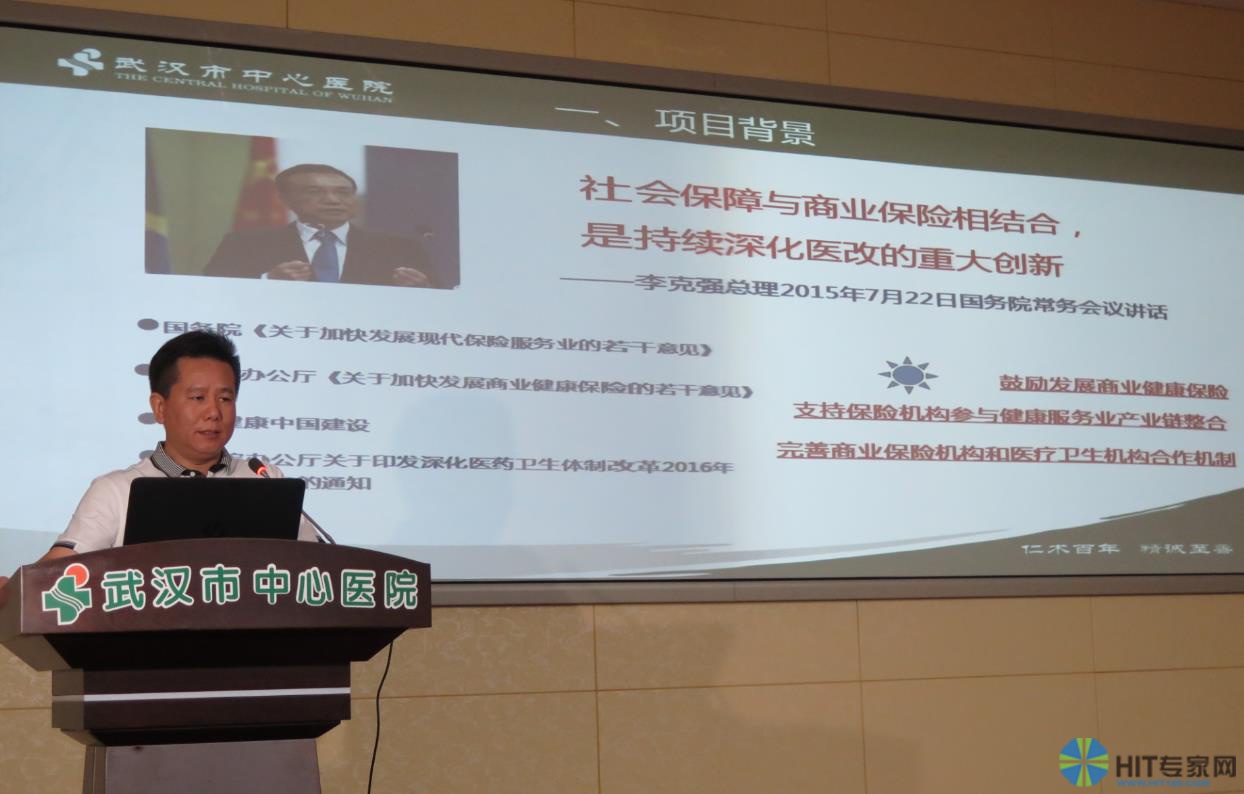
Wuhan Central Hospital's Vice President Yang Guoliang Introduces the Hospital’s Direct Billing Model for Commercial Health Insurance
As payers, both basic medical insurance and commercial health insurance will play an increasingly important role in the healthcare system. “This is a major development in China’s commercial health insurance sector and an important milestone demonstrating how Chinese hospitals are leveraging information technology to enhance their comprehensive payment capabilities,” commented Xiao Xingzheng, Deputy Director of the Information Center of the Hubei Provincial Health and Family Planning Commission.
Vice President Yang Guoliang introduced that the launch of online direct billing for commercial health insurance is driven, on one hand, by national policy guidelines and the requirements for deepening healthcare reform, and on the other hand, by the medical institution’s ongoing commitment to improving medical services and enhancing patients’ healthcare experience. After Wuhan Central Hospital achieved breakthroughs in online payment for basic medical insurance in March this year, the rollout of online direct billing for commercial insurance had already been under planning since the beginning of the year. Innovations in payment methods have demonstrated highly tangible effects in improving healthcare efficiency and enhancing the public’s healthcare experience.
In fact, Vice President Yang Guoliang has even more long-term considerations. The hospital faces numerous challenges in promoting tiered diagnosis and treatment: How can it foster interaction with community-based family doctors? How can it incentivize both the hospital’s expert teams and family doctors? And how can medical care be integrated with health services? “Therefore, we turned to commercial insurance, hoping to leverage its power to help resolve these issues and enhance the level of health protection for residents,” Yang Guoliang candidly stated.
However, if we were to engage with commercial insurance companies directly through insurance products, there would be a “disconnect,” as the claims processing cycle for commercial health insurance is excessively long. “The current state of commercial insurance claims settlement is characterized by relatively outdated methods. Therefore, we decided to focus on the payment stage, as it represents a major pain point in the commercial health insurance sector,” said Yang Guoliang. “In early 2015, we initiated discussions with Wuhan Molian, which was well-positioned to integrate certain commercial insurance resources.”
Wuhan Central Hospital began planning for direct settlement with medical insurance two years ago, while the inclusion of direct claims settlement with commercial health insurance on its agenda dates back one year. After extensive discussions, senior management from the hospital and leading commercial insurers such as Taikang and Ping An reached a consensus in the first half of 2016. Following systematic integration and joint testing, online direct claims settlement for commercial health insurance was successfully implemented.
Under the direct reimbursement model, hospital information systems, commercial insurance companies, and “cleaners” such as Wuhan Molian Co., Ltd. jointly undertake extensive preparatory work.
First, commercial insurance companies need to intelligentize the claims processing workflows and payout rules for all health insurance products. This is a substantial undertaking and a prerequisite; otherwise, all other objectives will fail to materialize. In reality, insurers still have considerable work ahead to achieve full intelligentization across their health insurance portfolios. The fundamental reason lies in the wide variety of commercial health insurance products, whose claims rules are often highly customized. Just Taikang and Ping An, two major insurers, collectively offer more than 10,000 health insurance products.
Hospitals must not remain “idle” in preparing their information systems—integration platforms and payment platforms must be ready in advance, which entails standardized medical workflows and data. This is precisely the advantage that Wuhan Central Hospital has accumulated and developed through its years of informatization efforts.
President Yang Guoliang particularly emphasized, “There is another very important point,”"Faced with numerous commercial insurance companies, it is not feasible for our hospital to establish direct point-to-point connections with each insurer."“Wuhan Molian has keenly grasped the hospitals’ perspective by helping them integrate insurance companies’ resources to jointly build an open commercial insurance payment platform. This arrangement is mutually beneficial, as it eliminates the need for hospitals to individually connect with each commercial insurer’s system. Commercial insurers can simply integrate with the platform by digitizing and automating the claims adjudication rules for their various products.”
Therefore, IT plays a core and critical role in supporting the entire project. According to Yang Guoliang, the comprehensive payment platform developed through the collaboration between Wuhan Central Hospital and Wuhan Molian extends beyond basic medical insurance and commercial insurance to encompass the hospital’s full patient self-service system—including self-service kiosks, mobile apps, Alipay, and WeChat Tenpay. As such, it serves as an innovative payment platform and a nexus for integrating payment resources, eliminating the need for hospitals to undertake point-to-point integration of numerous disparate payment methods.
The integration between hospital information systems and commercial insurance information systems primarily involves three key tasks: first, information exchange; second, the standardization of data formats to ensure seamless interoperability between hospital and insurer data; and third, unified reconciliation. The finance department must ensure that account records are highly accurate. This integrated payment platform is designed precisely to accomplish these objectives. “It serves as a bridge, an interpreter, and also a management tool,” commented Yang Guoliang.
Since March 2016, Wuhan Central Hospital has enabled online medical insurance payments based on facial recognition. The recent launch of online direct reimbursement for commercial health insurance is a natural progression and a valuable enhancement. If a patient is covered by both social security and commercial health insurance products, they can enjoy online direct reimbursement from both sources at Wuhan Central Hospital, provided the treatment falls within the coverage scope. The patient only needs to pay the out-of-pocket portion directly to the hospital. Furthermore, the commercial health insurance component supports cross-regional enrollment without geographic restrictions.

Commercial Insurance Leverages the Internet to Accelerate Its Embrace of Healthcare
“When the first claim settlement was processed through the integration between our system and Taikang, we were all thrilled. We witnessed a new approach to insurance claims processing and the success of this innovative initiative. We are confident that this platform will play a pioneering and leading role in connecting insurers with hospitals, thereby enhancing customer experience,” said Liu Dawei, Assistant President and Chief Information Officer of Taikang Life Insurance.
Coinciding with Taikang Life’s 20th anniversary on August 22, Liu Dawei introduced that over the past two decades, Taikang has processed claims for a cumulative total of 13.93 million customers. Previously, these claims were handled through stacks of paperwork, involving lengthy processing cycles and complex procedures before customers received compensation from the insurer. “Logically, customers, especially patients, should receive claim payments much more quickly. The online direct billing platform for commercial health insurance, recently launched by Wuhan Central Hospital, will significantly improve this process,” Liu Dawei admitted. He noted that while Taikang had previously made numerous attempts to enhance convenience for insurance customers, it found that implementation was difficult without the support of physical hospitals. By taking the lead in introducing online direct billing for commercial insurance, Wuhan Central Hospital aims to leave the administrative complexities to insurers and hospitals, thereby providing patients with an optimal medical experience.
Ni Jianwen, General Manager of Ping An Health Cloud, believes that commercial insurance alone may not comprehensively address the public’s healthcare challenges. In 2015, out of a total healthcare expenditure of RMB 3 trillion, the commercial insurance industry generated RMB 150 billion in revenue, yet it covered only RMB 50 billion of the total spending. The population covered by commercial insurance remains quite limited. To promote commercial insurance more effectively, a comprehensive protection framework is needed, driven by innovative commercial insurance and financial products. Therefore, Ping An Technology has launched the “Hospital One-Account Pass” service, which offers: first, expedited and direct insurance claims settlement; second, one-stop payment and convenient public services; and third, internet-based financial services.
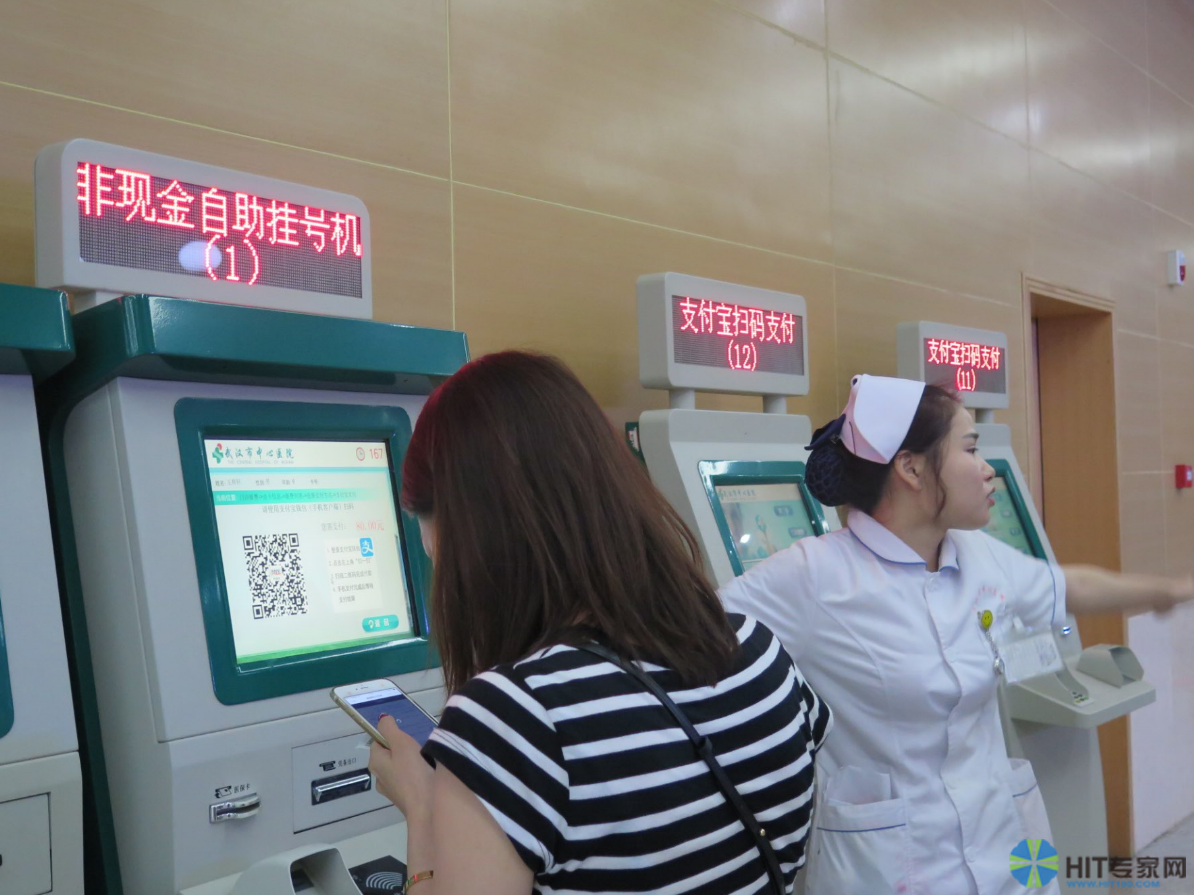
Wuhan Central Hospital Patients Scan Codes to Pay at Self-Service Kiosks
Innovative Health Insurance Payment Is Just the Beginning
Since the trial launch of the direct billing channel for commercial health insurance at Wuhan Central Hospital in early August, it has achieved its expected objectives. The improvement is most notable for inpatients: whereas the claims settlement process previously took up to a month, reimbursement from insurers is now generally processed on the same day, or even in real time. Due to variations in insurance products and claims adjudication rules among different commercial insurers, patients visiting the same department for the same condition may experience different claims processes depending on their chosen insurer. Some insurers can settle claims within seconds, while others may require several hours.
According to Yang Guoliang, Deputy Director of the hospital, Wuhan Central Hospital ranked second in terms of medical visits among all commercial insurance policyholders in Hubei Province in 2015. Against this backdrop, Wuhan Central Hospital has taken the lead in launching online direct settlement for commercial health insurance, which will further enhance the healthcare experience for individuals covered by commercial insurance. Whenever a patient with commercial health insurance is admitted, the hospital’s information system can immediately identify their status upon registration and automatically file a claim with the insurance company.
Innovative payment methods are not an end in themselves; Wuhan Central Hospital will leverage payment mechanisms to integrate commercial insurance resources with the medical services industry.
First, there is mutual customer referral between hospitals and insurance companies.Behind the direct billing service of commercial health insurance, it can also directly channel patients to hospitals; meanwhile, hospitals have deeply integrated with insurers’ pools of health insurance policyholders, enabling patients to view personalized solutions from different insurance companies available at participating hospitals via the App.
Liu Dawei, Assistant President and Chief Information Officer of Taikang Life Insurance, revealed that through the Taikang Medical Cloud, Taikang has piloted a “network hospital” model by integrating its premium resources with Wuhan Central Hospital. This initiative connects customers online with Wuhan Central Hospital, making the hospital’s resources accessible to its 8 million customers. Additionally, Taikang Cloud provides a cloud-based Hospital Information System (HIS) platform. In the future, physicians conducting on-site corporate health visits can use this platform to document medical records, including prescriptions and comprehensive management of the entire care process. “Taikang’s 400,000 sales agents may also serve as marketers for Wuhan Central Hospital in the future,” he said.
Second, to provide residents with more valuable health management services.Vice President Yang Guoliang stated, “First, we have integrated our online direct-payment platform with internet hospitals such as AliHealth, Taikang Cloud, and Jointown Haoyaoshi, to provide value-added health management services to insured individuals, including online consultations for patients with chronic diseases or those requiring follow-up visits, and the delivery of electronic prescriptions. Second, we are addressing the core issue—providing health management and services to residents. Starting with chronic disease management, we have currently focused on diabetes and hypertension. By leveraging commercial health insurance products offered by commercial insurers and integrating wearable devices, we deliver health management services directly to residents’ homes. Not all chronic conditions require specialist care. With these new commercial health insurance offerings, we can connect family doctors with specialists, thereby improving patient experience and effectively implementing tiered diagnosis and treatment.”
“The ultimate goal is to strive to provide the people with health and healthcare services throughout their entire life cycle, as proposed by General Secretary Xi Jinping,” said Vice President Yang Guoliang.
Source: HIT Expert Network
【Related Reading】
How Can the Insurance Industry Thrive Amid the Wave of Healthcare Reform?