

Academician Zhao Qinping: VR+Healthcare Poised to Disrupt Life Sciences and Pharmaceutical Industries
Recently, at the 2016 China Health Information Technology Exchange Conference held at the Nanjing International Exhibition Center, Academician Zhao Qinping of the Chinese Academy of Engineering (Professor at Beihang University) delivered a speech on “Virtual Human: A New Platform for Medical and Pharmaceutical Research.”
In fact, the virtual human has become a new conceptual platform and experimental tool for translational medical research from “bench to bedside,” and is widely applied in fields such as medical research, new drug development, virtual surgery, medical device development, medical education and training, and rehabilitation training.
Zhao Qinping pointed out that in the next decade, virtual human bodies may have a disruptive impact on the fields of life sciences and medicine, ushering in a new chapter for VR+ healthcare.The following is relevant content compiled by VCBeat (WeChat ID: vcbeat).
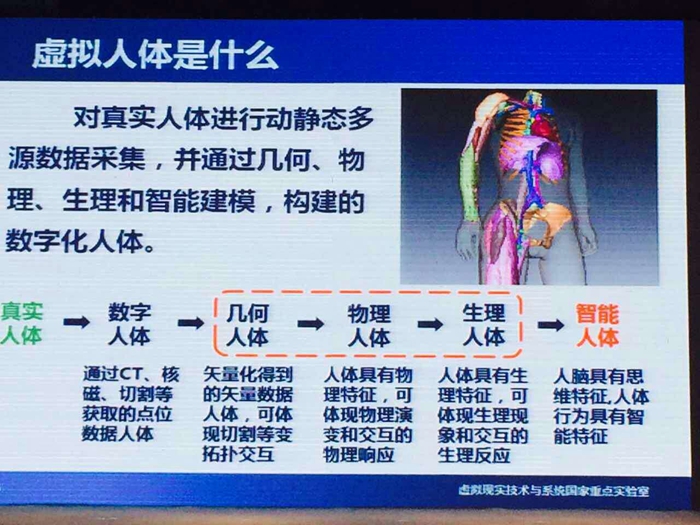
What Is a Virtual Human?Acquire dynamic and static multi-source data from real human subjects, and construct a human body model through geometric, physical, physiological, and intelligent modeling.
From the real human body to the intelligent human body: Data acquired from points obtained via CT, MRI, and sectioning are vectorized for interaction, thereby forming a physiological human model and an intelligent human model. So, where does this data come from?
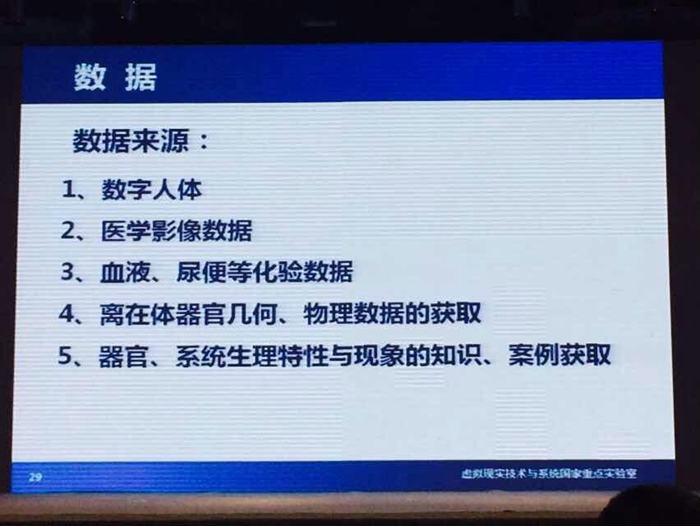
These data can be acquired through digital human models, medical imaging data, laboratory test results (such as blood, urine, and stool analyses), ex vivo and in vivo organ geometric and physical measurements, as well as knowledge and case studies related to organ and system physiological characteristics.

Function of These Data: By integrating static and dynamic data, it is possible to analyze statistical patterns and correlations; meanwhile, small-data analysis can uncover innovative insights and emerging trends, thereby addressing specific problems.
According to Zhao Qinping, many countries around the world have incorporated virtual reality (VR) technology into their national strategic plans for scientific and technological development, with China being among the early adopters. “In 2006, the Chinese government issued the Outline of the National Medium- and Long-Term Program for Science and Technology Development (2006–2020), in which virtual reality technology was listed as one of the three priority frontier technologies in the field of information technology.”
In fact, in 2007, the Japanese government released the “Science and Technology Basic Plan for Innovation 2025,” listing virtual reality technology as one of 18 key development directions. In 2008, the U.S. National Academy of Engineering announced the 14 Grand Challenges for Engineering in the 21st Century, which included virtual reality technology. In 2012, the United States further issued a strategy outlining eight emerging science and technology clusters for 2015–2020, six of which involved modeling, simulation, and virtual content.
“It is evident that countries are attempting to enter the field of virtual reality through two avenues: one is national development strategy, and the other is public life and consumption. From governments to corporations, all are vying for dominance in the virtual reality sector,” said Zhao Qinping.
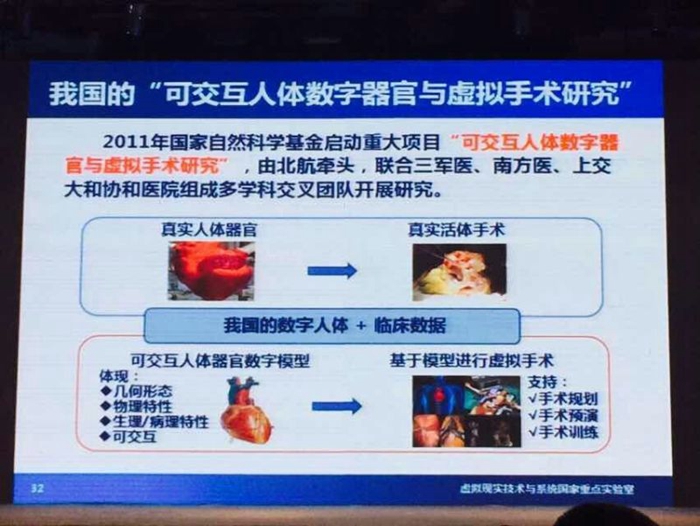
In 2011, the National Natural Science Foundation of China launched a major project titled “Research on Deliverable Human Digital Organs and Virtual Surgery,” led by Beihang University, which assembled an interdisciplinary team in collaboration with the Third Military Medical University, Southern Medical University, Shanghai Jiao Tong University, and Peking Union Medical College Hospital.

After decades of advancement, key technologies underlying virtual reality (VR) have matured sufficiently to support the growth of the VR industry. VR has achieved remarkable application outcomes across many sectors, emerging as a new information technology platform that underpins industrial development. First, there is a shift from predominantly 2D displays to primarily 3D experiences. Second, it overcomes the physical size limitations of conventional screens and field-of-view constraints. Third, it transitions from user-controlled movement for scene observation to natural human motion-based viewing. Fourth, it evolves from keyboard-and-mouse operations to coordinated, natural human–computer interaction. Fifth, it breaks through temporal and spatial constraints, augmenting and extending diverse human capabilities. Sixth, VR serves as a new gateway to the internet, enabling face-to-face interactions in virtual environments rather than relying on email.
Ultimately, the overarching goal of the virtual human is to construct a digital human (virtual human) by acquiring dynamic and static multi-source data from the real human body and integrating geometric, physical, physiological, and intelligent modeling. Research on virtual humans has garnered significant attention in several developed countries.
1. By "decoding" human organs to study physiological, pathological, and cognitive phenomena, we can advance our understanding of the human body, life processes, and intelligence;
2. Conduct data planning, language modeling, and training based on virtual human models to enhance surgical treatment proficiency;
3. Conduct research on pathology and drug effects based on virtual human models to support new drug development;
4. The vehicle of translational medicine, which first applies the achievements of basic medicine to virtual human bodies, and then conducts clinical trials after improvement and perfection;
5. Research findings from initiatives such as the Human Genome Project and the Human Proteome Project, the increasing availability of data, and the powerful computational capabilities of computers have created the conditions for constructing virtual human bodies.
Physiological models of human body units at various scales, along with models of the human brain and its intelligent characteristics, represent the ultimate research goal of virtual reality.
We look forward to the day when, from birth, a fully equivalent digital twin of the human body will accompany the child’s synchronous growth, serving as their health record and subject for medical experimentation.