

Baiti Bio Proposes 'Research 5.0' to Revolutionize Medical Innovation and Address Complex Health Challenges
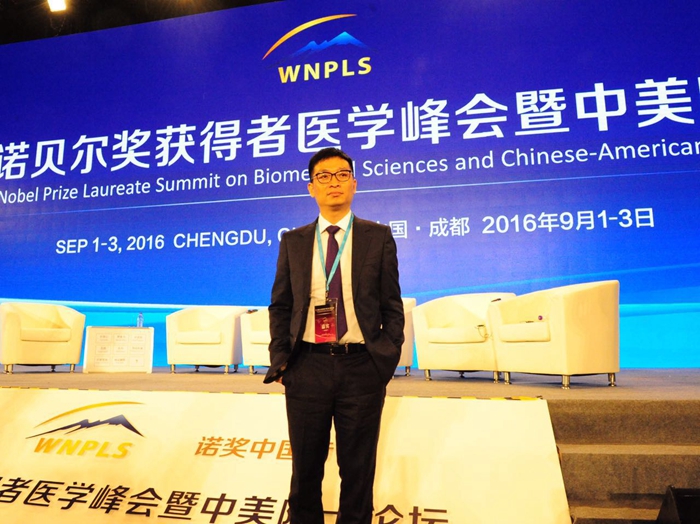
Dr. Lei Guo, Baituo Bio
At the recently concluded 2016 Third Nobel Laureates Medical Summit and Sino-US Academicians Forum, Dr. Guo Lei of Better Biotech proposed a novel and highly efficient research paradigm—“Research 5.0”—which drew attention from numerous prominent Chinese and international scientific figures, including Harald zur Hausen (2008 Nobel Prize in Physiology or Medicine), Craig Mello (2006 Nobel Prize in Physiology or Medicine), Sheldon Glashow (1979 Nobel Prize in Physics), Academician Liu Xinyuan of the Chinese Academy of Sciences, and Academician Zhan Qimin of the Chinese Academy of Engineering. Notably, Academician Zhan Qimin expressed his willingness on the spot to write the preface for the forthcoming book Research 5.0 and to recommend it to young researchers.
Guo Lei’s extensive experience in scientific research and research consulting has enabled him to identify various drawbacks inherent in the current model of medical research. “Current practices in medical research are, in essence, isolated creative activities conducted independently within individual laboratories. Throughout this research process, excessive resources are redundantly allocated and wasted.”
In 2010, Guo Lei resigned from his position at Zhejiang University and founded Best Biotechnology Co., Ltd. Headquartered in Hangzhou, the company currently operates five major centers in Zhejiang, Shanghai, Beijing, Jiangsu, and Southwest China.. Baitai Biology specializes in customizing research solutions for clinicians, offering scientific consulting and technical services that encompass study design, project implementation, data analysis, and report summarization. The company’s strategic goal is to become the “Alphabet” of the medical and health sector, and it is currently undergoing another round of financing.
Drawing on his extensive research background and subsequent entrepreneurial experience, Guo Lei has proposed the “Research 5.0” model. This model aims to establish an efficient paradigm for scientific research by connecting and integrating individuals or organizations possessing technological capabilities or resources, with direct market and user participation, and operating on the principle of voluntary, mutually beneficial collaboration.
So, what exactly is the “Research 5.0” model? How does it work? And what are its positive values? Guo Lei provided detailed answers to these questions in an interview with a reporter from VCBeat (WeChat ID: vcbeat).
A paradox exists in contemporary scientific development: major innovations can only be initiated and realized when driven by the inspiration of human intellect. Significant scientific discoveries or innovations often manifest as sudden flashes of insight from brilliant minds. However, against the backdrop of current social transformations, a trend contrary to the nature of human creativity has emerged, wherein scientific research is increasingly becoming a profession exclusively pursued by career scientists and specialists. A growing number of researchers are motivated not by personal interest or passion, but by the necessity of treating scientific research as a livelihood to support themselves and their families. Furthermore, the problems addressed by scientific innovation are becoming increasingly profound and complex, compelling professional research teams to expand in scale and diversify in composition.
Human creativity requires individuals who participate in innovation to possess independent thinking and minds, as well as inspiration and serendipity. Large-scale team collaboration, on the other hand, requires all members to share unified goals and coordinated actions. After recognizing this paradox, Guo Lei proposed a new research model based on his own experiences and insights in scientific research and entrepreneurship, aiming to resolve the contradictions between the individual and the whole, as well as between innovation and inheritance. Guo Lei refers to this approach as the “Research 5.0” model—a paradigm for scientific research activities conducted by various individuals or organizations possessing technological capabilities or resources, through connection and integration, under the principles of direct market and user participation and voluntary mutual benefit. The law of scientific development dictates that non-mainstream, unconventional science and technology will gradually replace conventional science and technology to become the mainstream in the future. Scientific research and innovation are also shifting from a primary focus on meeting basic human physiological and safety needs to placing greater emphasis on fulfilling human aesthetic and emotional needs.
Against this backdrop, the emergence of new research paradigms is inevitable. Under such a model, it is expected that various constraints will be overcome, significantly enhancing the efficiency of scientific innovation.
There are numerous cases where seizing serendipitous opportunities has led to major scientific discoveries. For instance, five hundred years ago, Christopher Columbus accidentally discovered the Americas while attempting unsuccessfully to sail to China; there is the story of how Archimedes discovered the principle of buoyancy; and the tale of how Isaac Newton formulated the law of universal gravitation. These stories are not only fascinating but also deeply thought-provoking. On the surface, these great discoveries appear to hinge on chance. However, upon closer examination, we are compelled to ask: Why was it Columbus, Archimedes, and Newton who made these groundbreaking discoveries, rather than others? The crux of the relationship between scientific discovery and serendipity lies in the fact that those who make such discoveries possess a solid knowledge base, an intense curiosity about the unknown, and analytical minds. Consequently, they are able to encounter these “opportunities” and leverage them effectively. In other words, without these essential attributes, one would not be positioned to capitalize on the serendipitous moments that lead to scientific breakthroughs.
The emergence of new perspectives and approaches is a crucial factor in advancing scientific development. This aligns with Einstein’s assertion that posing questions is more important than solving them. New perspectives and approaches, proposed after rigorous scientific evaluation and mature deliberation, are highly meaningful to pursue and implement, and will ultimately gain societal recognition. While some of these new perspectives and approaches may be refuted during subsequent validation, the act of proposing them itself constitutes a breakthrough. What is truly detrimental is intellectual rigidity and complacency.
Scientific discovery actually comprises two phases: posing questions and solving them. Formulating genuine scientific questions requires creative imagination and profound insight; it marks true scientific progress and is undoubtedly the more critical step. While scientific discovery often depends on serendipity, the serendipity involved in raising good, authentic scientific questions is even more significant. Many major scientific discoveries have emerged vigorously simply from asking the right questions. Therefore, we often state that the most valuable assets in the research process are ideas that are creative, scientifically sound, feasible, and practical. Scientists should devote more of their precious time and energy to formulating valuable scientific questions.Posing creative questions with scientific significance demands extensive knowledge accumulation, independent thinking and spirit, as well as inspiration and opportunity. The phases of solution and verification can leverage more specialized expertise; moreover, it is acceptable if a problem cannot be resolved immediately. For instance, a century elapsed between Einstein’s proposal of the concept of gravitational waves and their observational verification. Individuals or organizations possessing scientific knowledge, technical capabilities, or resources may all pose questions of significant scientific importance, without being constrained by immediately visible resources and conditions; solutions can be achieved through connection and integration. The principle that “posing questions is more important than solving them” is also a key tenet aligned with the philosophy of the Research 5.0 model.
Each era presents distinct societal demands for science, an inevitable outcome of social development. Today, the three major factors of “population aging,” “environmental pollution,” and “food safety” are driving a continuous increase in healthcare needs in China, marking a significant trend. There is growing demand for clinical services provided by clinicians, particularly renowned specialists at top-tier (Grade A Tertiary) research-oriented hospitals. Meanwhile, numerous unresolved mysteries in the life sciences continue to await exploration by medical researchers.
However, in China, principal investigators of medical research projects often juggle multiple responsibilities, including scientific research, clinical practice, teaching, and administrative duties. With the exception of a few large-scale research teams, there is a lack of dedicated research management personnel, and research implementation is frequently carried out by graduate students. For physicians who also engage in clinical work, seeing nearly 100 outpatients per day and spending an average of 60 hours per week on patient care is common. Assuming a six-day workweek with 12-hour full-capacity shifts each day, clinicians have at most 12 hours per week remaining for research. This situation significantly constrains the actual output of medical scientific research in China.
Meanwhile, the development trend of contemporary medical scientific research is characterized by both high specialization and high integration. Conducting modern medical research requires large-scale, multi-center collaborations equipped with various sophisticated and expensive instruments to achieve genuine breakthroughs. Scientific research is increasingly becoming a field inaccessible to non-specialists. A growing number of researchers are driven not by interest or passion but by the necessity of treating research as a livelihood. This phenomenon contradicts the inherent creative nature of human beings. It is not unique to China but also prevalent in Europe and the United States, representing a global issue.
Against this backdrop, Baite Bio has proposed the Research 5.0 model, which to some extent resolves the aforementioned contradictions and addresses various shortcomings inherent in existing research paradigms.
1. End-users of research outcomes directly participate in scientific research; scientific development is built upon user needs, and medical research questions proposed by clinicians are more specific, valuable, and practically significant;
2. Extensive Application of Network and Connectivity Thinking: The knowledge, capabilities, and resources of any individual or single organization are limited. However, by leveraging networks and connectivity thinking, we can link the resources of every individual and entity, integrate them, achieve rational resource utilization and mutual benefit, and maximize global resources.
3. It is conducive to disruptive innovation at the disciplinary margins and intersections. In the context of today’s highly advanced science and technology, achieving major breakthroughs requires focusing on these marginal and interdisciplinary areas. The Research 5.0 model can break down barriers between disciplines, meeting researchers’ needs for innovation at the boundaries and intersections of fields.
4. It is a long-recognized truth that posing questions is more important than solving them. This principle not only supports and emphasizes the first characteristic but also serves as the primary driving force behind the advancement of medical research. Important medical research questions are raised by clinicians, while their resolution is undertaken by professional researchers. Such a reasonable division of labor makes medical research more efficient.
In medical research, problem-solving ability merely reflects the level of logical or experimental skills. In contrast, posing valuable new questions requires creative imagination and signifies genuine progress in scientific research. The selection of research topics in medicine reflects a researcher’s scientific thinking, research capabilities, and intended objectives. Formulating high-quality medical research questions is the first and most critical step for clinicians embarking on scientific research.
When selecting medical research topics, four key principles should be adhered to: innovation, scientific rigor, feasibility, and practicality. Among these, the most critical and challenging aspect is formulating highly innovative research questions. However, through an in-depth analysis of various methodologies for topic selection in medical research, it becomes evident that identifying highly innovative medical research topics is neither difficult nor mysterious.
Innovative topics in medical research actually follow certain patterns. In summary, innovative methods in medical research can be categorized into six basic approaches: namely, the Substitution Method, the Population Shift Method, the Screening and Elimination Method, the Combination Method, the Displacement Method, and the Reversal Method. These are referred to as the “Six Meridian Swords” of innovation in medical research.
I. Substitution Method: An innovative approach that involves substituting different molecules, cells, tissues, or animal models, or employing alternative technical methods and tools, based on existing medical research findings;
II. Population Substitution Method: An innovative approach that involves substituting the target population for the final application of research findings, based on existing medical scientific discoveries, with the aim of obtaining new insights and applying new outcomes in the new population;
3. Screening Method: An innovative approach that utilizes specific molecular interactions to design experiments for isolating target molecules, cells, or individuals from large-scale molecular collections, such as genomes;
IV. Additive Method: A method for achieving innovation in medical research by combining two or more new technological approaches or scientific discoveries that appear to have no direct connection, and integrating them into the study of a specific disease;
5. Displacement Method: Applying scientific discoveries or treatment methods developed for one disease to a different disease can also create an innovative sense of “dazzling” novelty;
VI. The Counter-Positioning Method: A scientific innovation approach that involves formulating and proposing scientific hypotheses contrary to traditional views or common scientific knowledge, and designing experiments to verify and elaborate on them.
These six strategies can be further categorized into two types: “Minor Innovations” and “Major Innovations.” Minor innovations, which are less challenging, include the Substitution Method (replacing materials or objects) and the Personnel Replacement Method; these fall under the realm of follow-up scientific research. Major innovations, which are more difficult, encompass the Screening/Elimination Method, the Addition/Combination Method, the Reverse Positioning Method, and the Displacement/Misalignment Method, and are characterized by strong originality. The design of a high-quality medical research project should not rely on just one or two of these strategies; rather, it requires the comprehensive and integrated application of multiple strategies to achieve optimal innovative outcomes.
Currently, doctor-patient tensions are significant. The underlying cause is that current medical technology fails to meet societal demands; specifically, at the present level of medical research and development, many diseases remain incurable. Baiti Biopharma aims to serve physicians at top-tier hospitals through our efforts in medical research consulting and technical services, leveraging the Research 5.0 model. This initiative will equip doctors with more advanced modern medical knowledge and a deeper understanding of the pathogenesis of complex and refractory diseases. By jointly addressing current challenges in medical research, we strive to provide better diagnostic and therapeutic services to the public, thereby improving the health status of the Chinese population. Through “Leading Medical Research,” we aim to solve these medical challenges and ultimately achieve the goal of “Enhancing the Health of the Chinese Population,” delivering tangible benefits to the general public.