

Designing Effective Stock Option Mechanisms: Lessons from the Feng Dahui-DXY Dispute
The recent departure of Feng Dahui, former CTO of DXY.cn, has sparked widespread discussion on stock options. Recently, Legal VC published an article titled “The Final Chapter in the Stock Option Dispute Between Feng Dahui and DXY.cn: Who Won and Who Lost? Precedents from Alibaba and SouFun.” This article analyzes the incident from a legal perspective. VCBeat (WeChat Official Account: vcbeat) republishes this piece not to determine who won or lost, but because stock options are one of the most common incentive mechanisms used by startups, as well as a double-edged sword. We aim to foster rational discussion to enhance understanding of stock options and help readers avoid common pitfalls.
Setting aside emotional factors, the dispute between tech influencer Feng Dahui and his former employer fundamentally stems from conflicting interests, with stock options at the core. This issue highlights flaws in the company’s mechanisms for managing human capital. Currently, discussions are taking place on both moral and legal fronts, with the focus centered on the exit mechanism for stock options. Regardless of whether the parties choose settlement or litigation, the ultimate outcome will likely be determined by expectations based on legal rules and precedents.
VCBeat’s legal team has long provided equity structure design services to entrepreneurs on the front lines, gaining deep insights into co-founder disputes. Today, we examine the outcome of Feng Dahui’s stock option dispute by drawing on the experiences of founding members’ departures and their option handling at two well-known internet companies—SouFun and Alibaba—as well as relevant court rulings.The most critical aspect is for founders to prioritize the design of equity option mechanisms, ensuring that this premier incentive tool in the era of human capital is not misused or undermined.

Are Repurchase Clauses to Blame?
Feng Dahui joined DXY in June 2010 and has been with the company for six years. After his departure, he sought to claim his rightful equity interests. Reportedly, DXY did not allow him to exercise his stock options but instead proposed a buyback. However, the two parties failed to reach an agreement on the buyback price, leading to a public dispute over stock options on social media platforms. Many articles published by self-media outlets have pointed out that DXY failed to clearly stipulate the repurchase price when granting stock options to Feng Dahui. I believe that such a simplistic inference underestimates DXY’s legal team.
Let us examine the repurchase provisions in an industry-standard option grant agreement.
Figure 1 is a template of an industry-standard stock option grant agreement, in which Article 9 stipulates repurchase due to cause, and Article 10 stipulates repurchase without cause. Preliminarily, Feng Dahui’s case appears to fall under Article 10, with the repurchase price set at fair market value. Currently, most disputes are likely attributed to the fact that after Feng Dahui’s resignation, DXY.cn, as a startup valued at nearly $1 billion, found it difficult for both parties to reach a consensus on the fair market value. Even with mediation by a former partner of Shunwei Capital, the efforts ultimately proved fruitless.
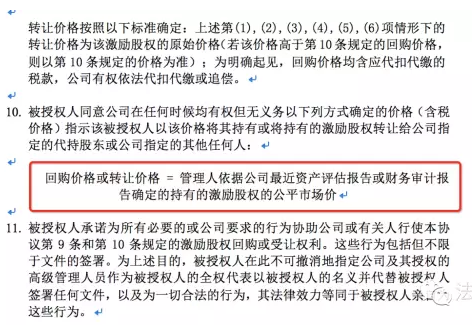
[Figure 1: Option Grant Agreement Template]
However, attentive observers will note that the clause stipulates an equity repurchase, whereas Feng Dahui currently holds options in DXY.cn rather than actual equity. This raises the question of how a repurchase can even be negotiated, as there appears to be no need to repurchase options. Therefore, it is necessary to clarify the mechanism of stock options.
What is stock option incentive?
In equity incentive plans, stock options represent a right that allows the incentive recipients to purchase a specified number of the company’s shares when future conditions are met. From a definitional perspective, this involves at least several key milestones: grant (vesting), vesting (vested), exercise, and liquidation. These stages also encompass concepts such as the exercise price (grant price) and the liquidation (sale/transfer) price, as illustrated in Figure 2.
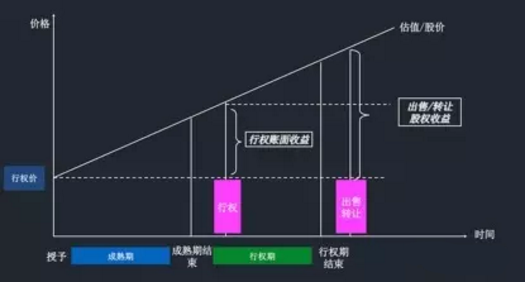
【Figure 2: Option Exercise Phase】
From a temporal perspective, there are two critical periods: the vesting period and the exercise period. Vesting refers to the process of earning stock options. The standard vesting schedule typically spans four years, with 25% (1/4) of the total options vesting after one year of service, and the remaining portion vesting monthly at a rate of 1/48 of the total grant per month.
Feng Dahui has been with the company for six years, and as per standard practice, his stock options have fully vested. Another critical factor is the exercise period. Exercise refers to the right of the incentive recipient to require the company to fulfill its obligations under the option agreement at the agreed-upon time, price, and method. The exercise period, also known as the “exercise window,” spans from the date when exercise is permitted until the expiration of the exercise right; this period is typically 90 days following departure from the company. As Feng Dahui has already left the company, he should, in accordance with standard practice, exercise his options within 90 days.
From a pricing perspective, there are two key figures: the exercise price and the realization price. The exercise price is explicitly stipulated in the agreement and is fixed, although it may vary depending on the grant date. Typically, the exercise price is set at a discount to the valuation paid by investors in the most recent financing round. This discount reflects the differential in rights between ordinary shares and preferred shares; notably, preferred shareholders have priority in liquidation preferences, which significantly impacts valuation differences. The exercise price is determined by the Board of Directors. Under offshore structures, the prevailing market practice is to set the price at no less than 20% of the reference valuation, whereas for domestic limited liability companies, this price can be as low as 10%. The realization price refers to either the market trading price following an Initial Public Offering (IPO), or the price achieved through company share buybacks or transfers to third parties in pre-IPO scenarios. Clearly, the spread between these two prices represents the economic benefit accrued by the incentive recipients.
The mechanism of stock options is clear: employees invest their youth and wisdom, accompany the company’s growth, and share in its value.
What to Do in the Event of Employee Resignation?
This is the very dilemma Feng Dahui is currently facing.
Not all employees will stay with the company until its IPO. So, how should stock options be handled upon departure? The standard practice in Silicon Valley is that unvested options are forfeited when an employee leaves; as for vested options, they too will be forfeited if not exercised within 90 days after departure. However, this rule can be overly stringent, as exercising options may require employees to pay a substantial amount of cash. Consequently, some companies extend the exercise period to 10 years.
The issue arises: if an employee departs after all options have fully vested and retains the right to exercise them within a 10-year period, this creates inequity compared to current employees. Upon post-departure exercise, the individual holds actual stock or equity interests, thereby enjoying passive gains without further contribution. In Feng Dahui’s case, his currently vested options present two key questions: first, whether the company will permit him to exercise these options, thereby allowing him to become a shareholder in DXY.cn, to which he dedicated six years of his career; and second, whether the company will repurchase the equity acquired through such exercise, and at what price would be considered fair and mutually acceptable to both parties.
Of course, it would be most advantageous for Feng Dahui to exercise his stock options. By doing so, he would only need to pay a sum of cash, and after leaving DXY, he could still embark on an entrepreneurial venture. Particularly given the current boom in self-media content startups, raising capital through Feng Dahui’s personal public account, “Whispers,” would not be problematic. In this scenario, it would seem unfair to the employees who continue to strive at DXY, as Feng Dahui would be able to enjoy both the returns from DXY’s future IPO exit and the value generated by his own entrepreneurial endeavors.
Therefore, as is currently speculated, the company may have engaged in discussions with Feng Dahui regarding the repurchase of his stock options, aiming to allow him to cash out early. However, the proposed repurchase price was significantly lower than the market valuation of the corresponding equity after exercise. Despite prolonged negotiations, the two parties failed to reach an agreement.
Case Study of SouFun.com
If Feng Dahui insists on exercising his options, he shall pay the corresponding consideration and acquire shares in DXY.com in accordance with the agreement. DXY.com adopts an offshore structure, establishing a company in an offshore jurisdiction such as the Cayman Islands to serve as the entity for financing and listing. This offshore entity controls the Chinese operating company through a Variable Interest Entity (VIE) structure, while the Chinese company serves solely as the entity for actual operations.
Employee stock option plans are typically based on the shares of an offshore company, meaning that upon exercise, Feng Dahui would hold equity in the offshore entity. In the past, many companies with offshore structures often refused employees’ requests to exercise their options, citing reasons such as foreign exchange registration requirements, and instead terminated the agreements by providing certain compensation.
Will Feng Dahui’s request to exercise his options receive support? Let’s first examine a case from [SouFun.com]:
Sun Yun joined SouFun.com in its second year of establishment. In 2001 and 2002, he was granted a total of 55,000 stock options by the company and successively served as Deputy General Manager and Editor-in-Chief. However, after nine years with the company, he was dismissed shortly before its initial public offering (IPO).
On June 23, 2009, seven days before the termination of Sun Yun’s employment relationship with the company, Sun Yun sent an email to Mo Tianquan, founder and chairman of SouFun, requesting to exercise his stock options. Mo Tianquan replied that while the request was reasonable, no employees had exercised their options thus far, and suggested addressing the matter jointly once the company had finalized its plan.
In September 2010, Fang.com officially listed on the New York Stock Exchange. However, the company had yet to resolve Sun Yun’s stock option exercise matter. Consequently, Sun Yun emailed Mo Tianquan again to inquire about exercising his options. Nevertheless, despite Sun Yun’s repeated requests, the company failed to process his stock option exercise.
On March 11, 2011, Sun Yun filed a lawsuit against Fang.com. At the time of the filing, Fang.com’s stock price was $19.95, and the market value of Sun Yun’s stock options exceeded $1 million.
Civil Judgment (2011) Yi Zhong Min Chu Zi No. 5995 of the Beijing No. 1 Intermediate People’s Court: SouFun.com Lost the Case! The judgment requires that SouFun Company shall, within ten days after the judgment becomes effective, deliver to Sun Yun 55,000 shares of stock as stipulated in the “Stock Option Agreement” (among which, 10,000 shares shall be exercised at HK$1 per share, 40,000 shares at HK$2 per share, and 5,000 shares at HK$5 per share).
SouFun.com refused to accept the judgment and filed an appeal.
On October 29, 2012, the Beijing Higher People's Court issued Civil Judgment No. 1879 of the Final Instance (2012) Gao Min Zhong Zi, ruling against SouFun.com.
Fang.com Files an Appeal!
On June 20, 2013, the Supreme People's Court once again ruled against SouFun!
Could Feng Dahui be so fortunate? Let’s take another look at one of Alibaba’s founding veterans.
The Case of Alibaba
This is a case of equity and stock option dispute involving a nine-year veteran employee at Alibaba.
On November 5, 2001, Xu Yu joined Alibaba Network Co., Ltd. with employee ID 000460, working in sales within the Sales Department.
On July 31, 2007, Alibaba Network Company, authorized by Alibaba.com Corporation, issued the “Notice of Stock Option Grant under the Alibaba.com Corporation 2007 Equity Incentive Plan” toXu Yu, this Notice states: This Notice shall form part of the Award Agreement, subject to the terms and conditions set forth in the Plan and this Award Agreement.Xu YuGranted the right to purchase common stock of the Company, with specific grant number 07-1401, grant date July 31, 2007, first exercise date July 31, 2008, exercise price per share US$2.37, and total number of restricted stock units granted 20,000.
December 6, 2010Xu YuResignation Application.
December 9, 2010,Xu YuComplete the “Notice of Exercise of Options under the 2007 Stock Option Plan” to indicate agreement to exercise options on December 9, 2010, pursuant to the stock option agreement entered into on July 31, 2007, to purchase 15,000 ordinary shares of Alibaba Group Holding Limited, agree to pay the total exercise price in accordance with the agreement, and agree to be bound by the terms and conditions of the Plan and the Option Agreement. Meanwhile,Xu YuThe “Investment Representation Statement” and “Power of Attorney Certificate” were also signed and mailed to the address designated by the Company. The counterparty replied acknowledging receipt of the original documents.
December 12, 2010Xu YuIssue a written statement to transfer 37,469 ordinary shares of Alibaba Group to Zhang Chen. In its reply dated December 20, Alibaba Group confirmed that the transfer procedures had been completed and that the equity transfer would be formally registered.
December 15, 2010,Xu YuA remittance of RMB 79,136.43 was wired to Alibaba (China) Co., Ltd., and subsequently transferred to the designated Hong Kong USD account of Alibaba Group Holding Limited, with a transfer amount of USD 35,550. On December 17, April Leung (mailto:aprilleung@hk.alibaba-inc.com) sent an email toXu Yu, stating: "Principal, taxes, and original documents have been received. Your exercise procedures have been completed. You will receive a confirmation email next month; please stay alert."
On February 21, 2011, Alibaba Network Co., Ltd. issued a written noticeXu Yu, as stated in the notice:Xu YuFollowing the employee’s departure, the Company discovered that during their tenure, they engaged in self-dealing and fraudulent activities, which constituted a serious violation of the Alibaba Business Conduct Guidelines and the Company’s core values. The Company hereby formally notifies the individual that, for internal purposes, their resignation shall be treated as a termination for cause. At the request of Alibaba Group Holding Limited, the Company specifically draws the individual’s attention to the following matter: Alibaba Group will repurchase [the relevant equity interests] at their original exercise price.Xu YuCurrently holding 52,469 shares of Alibaba Group obtained through share options granted under its 2007 Equity Incentive Plan. Additionally, Alibaba Group will not process the transfer procedures for the Alibaba Group shares that he has applied to transfer to Zhang Chen.
March 15, 2012Xu YuFile a lawsuit with the People's Court of Binjiang District, Hangzhou City, Zhejiang Province, requesting the court to order Alibaba Network Company and Alibaba Group toXu YuDeliver the stock certificates for 15,000 shares and complete the relevant registration procedures.
On November 28, 2013, the court of first instance ruled to dismissXu Yuall of its claims.
The Court held:Xu YuAs an employee of Alibaba Network Company, during his tenure, he invested in and established a company with others and entered into contracts with affiliates of the Alibaba Group, but failed to disclose such activities to the Company. This constitutes a serious violation of the rules and regulations stipulated in his employment contract, specifically the provisions on conflicts of interest set forth in the “Alibaba Group Business Conduct Guidelines” involved in this case. Such conduct falls under specific grounds (ii), namely, a material breach of any agreement or understanding between the “Participant” and the “Company” or any of its “Subsidiaries,” and (iii) making false statements or omitting any material facts related to his service as or engagement by the “Service Provider.” Accordingly, the Alibaba Group is justified in refusing to process relevant equity registration and other transfer procedures. Therefore, regardingXu YuThe Court does not support the claims.
Balancing Employee and Corporate Interests
Whether it is the current issues faced by Feng Dahui and DXY, or the adjudication rules on employee stock options revealed in the cases of SouFun and Alibaba, these situations basically reflect that the greatest challenge in the practical implementation of stock option mechanisms lies in handling the options of departing employees, a matter concerning the balance of interests among all parties.
For employees who stay the course, the difficulty of liquidating stock options and the excessively long waiting periods pose significant challenges. This is particularly acute as many tech companies are delaying their IPOs. Founding employees often find themselves in a dilemma: the company hires large numbers of talented individuals at salaries well below market rates, compensating them with substantial equity grants. However, these employees are given little opportunity to sell their shares and realize gains. If they choose to leave, they face either the forfeiture of their options or the cash flow burden of exercising them.
For example, Travis Kalanick, CEO of Uber, stated, “We will postpone our initial public offering (IPO) for as long as possible,” and has indicated on multiple occasions that there are no plans to go public within the next three to five years. Lei Jun, founder of Xiaomi, also remarked that since establishing Xiaomi in 2010, he had anticipated that it would take at least ten years for the company’s business model to be widely understood and accepted, with an IPO potentially occurring only after fifteen years—placing the expected timing around 2025.
Therefore, to balance interests, if a company insists on engaging in a protracted struggle, it should appropriately design the liquidity mechanism for stock options to provide certain liquidity for employee options. For example, employees could be allowed to cash out an appropriate proportion of their options during later-stage financing rounds, requiring new investors to purchase these options. Naturally, restrictions can be imposed, such as: (1) limits on the number of shares that can be repurchased or sold, for instance, capping the repurchase or sale at a certain percentage of the equity held by the employee, or limiting the number of shares that can be repurchased or sold from a specific tranche of granted options; (2) requirements regarding the employee’s tenure, such as allowing only current employees or those who have served with the company for a specified number of years to request the company to repurchase their options or sell their held options.
For departing employees, they face not only complex exercise procedures but also the Sword of Damocles posed by repurchase mechanisms triggered by “specific causes.” For instance, a founding executive at Alibaba was “forced” to have his options repurchased at the original price under the guise of such “specific causes.” Typically, when handling stock options for departing employees, companies stipulate that they may internally repurchase these options at a reasonable price under various circumstances. One scenario involves repurchase due to fault-based reasons (i.e., specific causes), where punitive pricing mechanisms are established, such as repurchasing at the original grant price or even at a nominal price of RMB 1. The other scenario covers repurchases in cases of no-fault departures. In no-fault situations, fairness dictates imposing limitations on both the quantity and value subject to the company’s repurchase rights, including the repurchase ratio and price. The repurchase ratio can be determined through negotiation between both parties to establish a minimum retention threshold, while the repurchase price should reflect the company’s fair market value, such as applying a certain discount to the latest valuation.
Equity options are a crucial mechanism adapted to the era of human capital; do not let founders misuse them.
Human capital is a unique form of property right, grounded in the ownership of an individual’s health, physical strength, experience, knowledge, skills, and other intangible assets. Since the owner of this capital is the individual themselves, its value must be realized through incentives directed at the person. Regarding the handling of stock options for departing employees, considerations should include the interests of both the company and current employees. Most critically, the design must be based on the characteristics of human capital; only through relatively balanced rule-making can the well-being of all parties be maximized.
Note: All names in the cases mentioned in this article are pseudonyms.
Author:Legal VC (WeChat ID: fawuxiaov). Republished with authorization from VCBeat.FaWu VC is a company dedicated to providing one-stop equity legal services for innovative and entrepreneurial enterprises.Service offerings include: top-tier equity structure design and exit mechanisms for partners, structuring of external equity transactions, equity and option incentive plans for employees and senior executives, financing legal advisory, ongoing legal services, VIE structures, NEEQ listings, and IPOs.