

2016 Nobel Laureate Medical Summit Innovation & Entrepreneurship Competition Final Successfully Concluded in Chengdu
On September 3, 2016, as the Third Nobel Laureates Medical Summit, focusing on international medical exchange and emphasizing the application and development of precision medicine, convened in Chengdu, the Finals of the First Innovation and Entrepreneurship Competition of the Nobel Laureates Medical Summit—targeted at young and middle-aged scientists, university students, and entrepreneurs from both domestic and overseas communities, and serving as a key innovative component of the Summit—were also successfully held at the Shangri-La Hotel in Chengdu.
VCBeat (WeChat ID: vcbeat.top) reporters provided full coverage of the conference and compiled key insights for our readers.
Since the launch ceremony of the “First Innovation and Entrepreneurship Competition of the Nobel Laureates Medical Summit” and the China-US Biopharmaceutical Project Roadshow, held at the Peking University Healthcare Industrial Park on July 12, 2016, and co-hosted by the Organizing Committee of the Nobel Laureates Medical Summit and other entities, with Shenuo Capital as the organizer, the Organizing Committee and Shenuo Capital, in collaboration with Yiyao Qiantuhui and several other institutions, have consecutively conducted three rounds of multi-format online and offline roadshows. From more than 300 domestic and international participating and exhibiting projects, nearly 30 innovative pharmaceutical companies were selected to travel to Chengdu to compete in the finals of the “Nobel Laureates Medical Summit Innovation and Entrepreneurship Competition.”
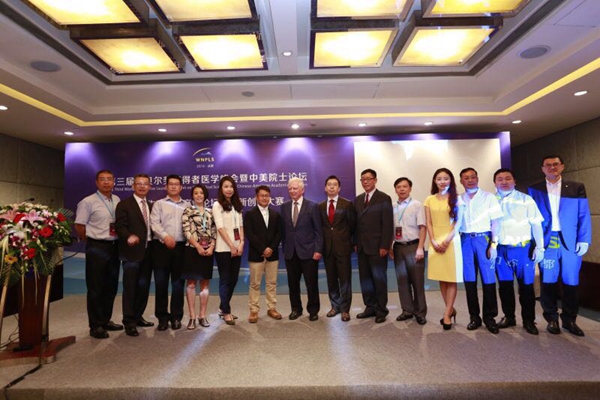
On the morning of September 3, Professor Dong Dong from the Shanghai Jiao Tong University Cancer Institute was invited by the Organizing Committee to deliver a keynote speech titled “Treatment of Non-Small Cell Lung Cancer” at the finals of the Nobel Laureate Medical Summit Innovation and Entrepreneurship Competition. A special dialogue session themed “Policy, Capital, and Transformation of Scientific and Technological Achievements” featured 2008 Nobel Laureate Harald zur Hausen and other distinguished guests. The panel was moderated by Zong Xiang, U.S. Partner at Shinuo Capital, who traveled specially from the United States for the event. Panelists included Harald zur Hausen (2008 Nobel Laureate in Physiology or Medicine, Germany), Zong Xiang (Shinuo Capital), Wang Hui (Honghui Capital), Li Gangyi (Dean of Duoying Institute for Translational Medicine), and Jiang Huixia (Chairman of Beike Society).
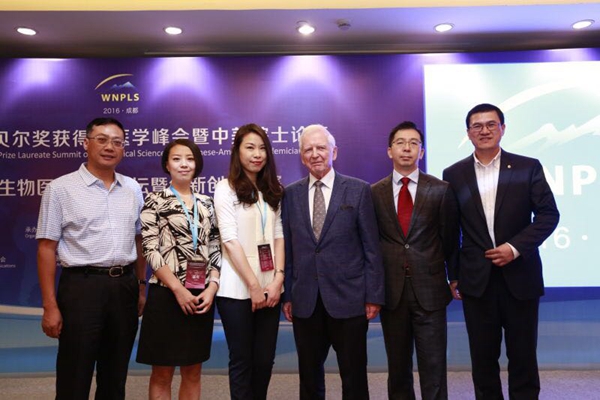
Guests generally agreed that, in any country, technology is one of the primary drivers of economic development in the new economy era, and that technological advancement cannot be achieved without government policy support and venture capital assistance.
After the finals of the Nobel Laureate Medical Summit Innovation and Entrepreneurship Competition officially commenced, Ms. Li Xiaojian, CEO of Jintai Holdings (the Chinese subsidiary of the European-listed company), served as the guest host for the entire duration of the competition.
Advisors to the Organizing Committee of the Finals of the Innovation and Entrepreneurship Competition at the Nobel Laureates Medical Summit include:
1. Richard J. Roberts, 1993 Nobel Laureate in Physiology or Medicine
2. Craig C. Mello, Winner of the 2006 Nobel Prize in Physiology or Medicine
3. Harald zur Hausen, 2008 Nobel Laureate in Physiology or Medicine
4. Martin L. Chalfie, Winner of the 2008 Nobel Prize in Chemistry
5. Sheldon L. Glashow, 1979 Nobel Laureate in Physics
6. Aaron Ciechanover, winner of the 2004 Nobel Prize in Chemistry,
7. Steve A. Kay (Member of the U.S. National Academy of Sciences)
8. David P. Ryan (Director, Division of Hematology and Oncology, Massachusetts General Hospital, Harvard Medical School)
9. Noopur S. Raje (Director, Multiple Myeloma Center, Massachusetts General Hospital, USA)
10. Christopher Coburn (Vice Chairman of Innovation, Partners HealthCare)
11. John Mackenzie (CEO, Roslin BioCentre)
12. Denver Dale, Advisor to the U.S. Office of the Secretary of Defense, Founder and CEO of Taito Capital
The organizers and members of the Final Committee for the Nobel Laureate Medical Summit Innovation and Entrepreneurship Competition include: Executive Chairman of the Competition Organizing Committee, Harald zur Hausen (2008 Nobel Laureate); Executive Chairman of the Competition Organizing Committee, Sheng Xueming (Executive Director of the Nobel Summit Organizing Committee); Director of the Competition Organizing Committee, Li Hebao; as well as members from government departments, industrial parks, investment firms, and research institutions both domestically and internationally: John Mackenzie (CEO of the Roslin Institute), Dale (Economic Advisor to the U.S. Department of Defense), Zong Xiang, Wang Hui, Huang Hua, Jiang Huixia, Li Xiaojian, Sun Hao, Wang Yongping, Bao Zhihua, Tang Xiaoying, Hou Xinyu, Zhang Zebo, Lin Min, Lin Chen, and others.
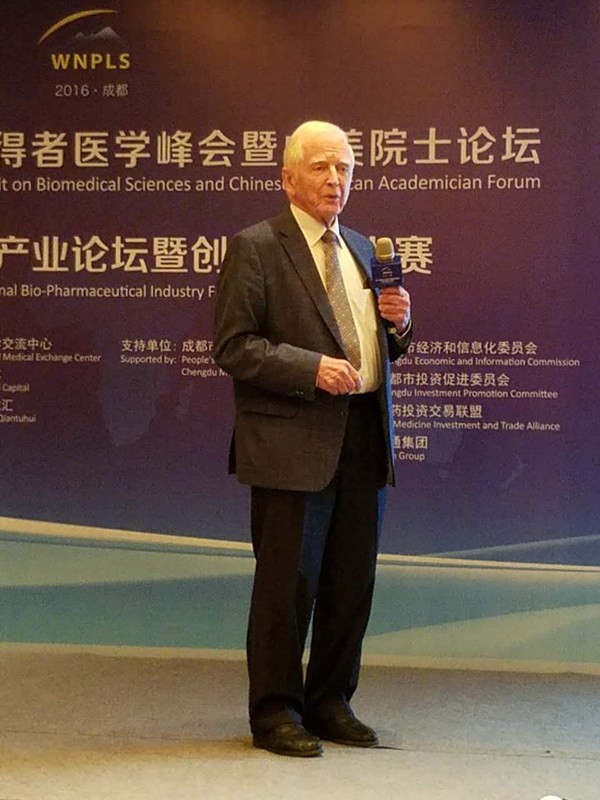
Harald zur Hausen at the Lecture Venue
The final-round judges who traveled to Chengdu, China, from around the world to attend the conference included: Li Hebao, Partner at Sinovate Capital; Zong Xiang, Partner at Sinovate US; Huang Hua, Chairman of MedFuture Hub; Song Qingwei, Vice President of Jietong Group; Wang Hui, Founder of Honghui Capital; Li Anmin, Chairman of Jiuyin Holdings; Li Xiaojian, President of Jintai Holdings; Jiang Hongbing, Deputy General Manager of Zhongzhi Enterprise Group; Niu Hongsen, Founder of Sino-US Pharmaceutical Investment; Zhou Yong, Chairman of Gaochuanghui; Hong Wenping, Vice President of Yinlan Medical; Zhang Shuaixin, Vice President of Kunming Pharmaceutical Group; Gao Tiejun, Vice President of Shoutai Group; Song Zhengyang, Investment Representative at Kangmei Pharmaceutical; and Ye Jing, Board Secretary of Chengdu Huashen Group, among others.
The competition featured three award categories: the Most Investment-Worthy Award, the Most Promising Investment Award, and the International Innovation Award. Following a rigorous and meticulous evaluation by the judging panel, the final results were announced at noon on the same day, with a total of 18 companies receiving various awards. Li Hebao, Director of the Organizing Committee for the 2016 Nobel Prize in Medicine Summit Innovation and Entrepreneurship Competition, read out the list of winners on behalf of the committee.
At approximately 13:00 on the afternoon of June 3, Hao Sen and Sheng Xueming, both Executive Chairmen of the Organizing Committee for the Nobel Prize Medical Summit Innovation and Entrepreneurship Competition, jointly took the stage to present award certificates to the winning companies and posed for group photos with representatives from each enterprise.
The project roadshow and the grand final of the competition garnered widespread recognition from numerous investment firms present on-site. Many projects were fiercely competed for by multiple investors on the spot, while the rest largely secured expressions of interest in investment cooperation.
Sheng Xueming, Executive Director of the Organizing Committee for the Nobel Prize in Medicine Summit, provided a unified response to journalists’ questions regarding the overall organization of the summit and the innovative initiatives of the competition. He pointed out that the summit enjoyed favorable timing, geographical advantages, and strong human support.
First, the convening of this conference coincides with the promotion by the CPC Central Committee and General Secretary Xi Jinping of the priority development concept of “Healthy China.” This summit focuses on the exchange of advanced international medical technologies, with a particular emphasis on the application of precision medicine. Building upon the exchanges from the first two forums, it demonstrates “four interactions”: interaction between policy and market, between traditional Chinese medicine and Western medicine, between technology and capital, and between projects and implementation. Local governments, particularly the Chengdu Municipal Government, strongly support and encourage the introduction and implementation of various advanced overseas pharmaceutical technologies and projects in China and specifically in Chengdu.
Secondly, Sheng Xueming pointed out: As the third Nobel Prize Laureates Medical Summit, while continuing a series of activities from the previous summit such as the “Nobel Star” selection, we have undertaken new initiatives and innovations in response to proposals from Chinese scientists and university students both in China and abroad. For instance, the “1st Nobel Medical Summit Innovation and Entrepreneurship Competition,” which launched its preliminary round two months ago, has attracted numerous outstanding entrepreneurial teams and advanced technology groups from home and abroad, garnering widespread attention and considerable influence both domestically and internationally.
Third, the special session themed “Policy, Capital, and Technological Translation” and the dialogue event with Nobel laureate Haus also received high praise from attendees. Finally, this event garnered significant attention from the National Health and Family Planning Commission, the China Association for Science and Technology, and leaders in Sichuan Province, particularly Chengdu City, who provided various forms of guidance, assistance, and support. It can be said that the successful hosting of all summit activities, especially the Innovation and Entrepreneurship Competition, was inseparable from the support of governments and leaders at all levels.
In response to questions regarding the specific organizational aspects of the Innovation and Entrepreneurship Competition, Li Hebao, Director of the Competition Organizing Committee, provided his insights. He identified three key features of this year’s competition.
First, this competition primarily serves to showcase internationally top-tier technologies and projects, including those developed by Nobel laureates, to China, thereby establishing the event as a unique new window for numerous overseas projects seeking to establish their presence in China. Notably, it is particularly encouraging that Nobel laureate Harald zur Hausen took the lead in responding this time, bringing his “HPV project” to the stage of our Innovation and Entrepreneurship Competition. Additionally, Jone, CEO of the UK’s Roslin Biocenter, noted that Dolly the sheep has already reached over 20 years of age and expressed intentions to seek strategic partnerships and equity investors in China.
Secondly, the competition adopts a diverse format that combines phased stages with both online and offline components. The multi-format preliminary and final rounds have expanded the number of participating projects, objectively ensuring quality and thereby increasing the success rate of matchmaking between projects and capital. Meanwhile, exhibitions and roadshows are conducted not only offline but also online.
Third, for this competition, we specially invited representatives from more than ten high-tech industrial parks across China, including those in Beijing, Tianjin, Liaoning, Zhejiang, Fujian, Sichuan, and Jiangsu. We maintained close attention throughout the event and facilitated direct communication afterward. In doing so, we not only brought together stakeholders from academia, research, and investment, but also included production bases and industrial parks, thereby achieving a “package deal” that enables technology, projects, and capital to settle jointly in these parks. This approach serves as a new economic engine, promoting sustained economic development across various regions.