

Revolutionizing Biomedicine: An Overview of 4D Bioprinting Applications and Technological Advancements
3D printing technology is becoming increasingly mature and has been widely applied across various fields. 3D printing works by using computer control to layer “printing materials” one upon another, ultimately transforming digital blueprints into physical objects. Recently, bioprinting has emerged as a new development. Bioprinting leverages 3D printing technology, using biocompatible materials and living cells as bioinks, to fabricate complex three-dimensional functional tissue structures. These printed functional tissues and organs can be applied in multiple biomedical areas, such as organ transplantation and drug screening.
Despite its numerous benefits and applications, 3D bioprinting has a major drawback: it only considers the initial state of the printed object and assumes that the object is static and non-living. For instance, 3D bioprinting technology is based on the premise that printed cells can rapidly aggregate through processes such as cell adhesion, cell sorting, and cell fusion to form tissues, and then begin synthesizing an extracellular matrix that provides and maintains the desired geometric shape and mechanical properties within the tissue.
To address this issue, “4D printing technology” has emerged. The so-called “4D printing technology” introduces the variable of “time” into traditional 3D printing technology. It encompasses not only the three spatial dimensions of length, width, and height but also adds a temporal dimension, enabling printed objects to intelligently self-adjust their morphological structure over time, ultimately achieving the pre-designed specifications automatically. Furthermore, compared with other cell deposition techniques such as electrospraying and cell jetting, it is evident that electrospraying suffers from lower spatial resolution due to limitations in needle diameter. In addition, screw extrusion imposes stringent requirements on materials; cell tissues can be generated only when the materials meet the criteria of softening at high temperatures and hardening at low temperatures.
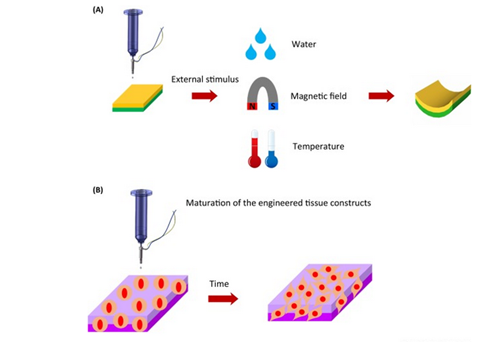
Schematic Diagram of 4D Bioprinting (A) Material Deformation-Based 4D Bioprinting. (B) Tissue Engineering Construct Maturation-Based 4D Bioprinting
The first approach involves printing “smart” materials, which typically leverage the inherent properties or functions of responsive materials to enable self-reshaping under external stimuli. This technology is akin to well-known phenomena such as self-folding, assembly, and disassembly. The second approach entails printing cellular “microtissues” over a defined period, allowing them to mature intracellularly across cell membranes and gradually develop into functional tissues.
As an emerging technology, 4D bioprinting holds promise for addressing medical needs such as tissue regeneration and is poised for widespread application in the biomedical field. However, researchers have yet to fully grasp 4D bioprinting technologies and concepts. This article aims to enhance public awareness, particularly among researchers, of 4D bioprinting. VCBeat (WeChat: vcbeat) outlines the principles of 4D bioprinting and recent research advances in tissue engineering and drug delivery.
With advancements in materials science, 3D printing has successfully fabricated various polymers, lipids, and liquid metal materials. The materials used in 4D bioprinting are responsive, biocompatible substances capable of changing their function and reshaping their structure in response to external stimuli such as temperature, water, and magnetic fields. By leveraging the technological foundation of 3D printing and incorporating responsive materials, the introduction of “time” as a fourth dimension enables the fabrication of more complex structures resembling native liver and cardiac tissues. Consequently, this approach will make significant contributions to the bioprinting of functional tissues or organs.
The most commonly used stimulus in bioprinting is temperature. In response to temperature changes, thermosensitive materials can fold, contract, or expand, with the phase transition temperatures of certain polymers being close to physiological temperature. A typical example is the polymer PNIPAAm, a material widely applied in drug delivery and tissue regeneration. For instance, a bilayer structure composed of PNIPAAm and the water-insoluble polymer PCL can self-unfold and fold in response to temperature variations. This structure can be utilized for the encapsulation and release of yeast cells, as illustrated in the figure below:
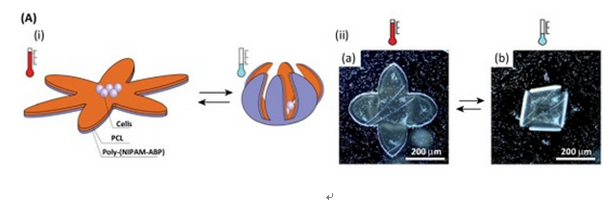
(A) Temperature-responsive behavior of materials in bioprinting. (i) Schematic diagram of the bilayer structure of folded star-shaped polymers. Upon cooling, the temperature-sensitive hydrogel swells and folds into a capsule-like structure. (ii) Upon heating, the capsule opens and releases the encapsulated cells.
Another typical material is a polymer composite of PNIPAAm and ceramic powders, which can undergo a sol-gel transition under thermal stimulation. Typically, this process involves mixing the thermosensitive polymer with cells, nutrients, and growth factors. After injection into the human body, the polymer undergoes a phase transition due to the increase in temperature, forming a gel that releases its contents from the 3D structure.
Another stimulus for bioprinting is water. Material deformation occurs due to differential swelling caused by varying degrees of water absorption within different scaffold intervals. After the bioprinted scaffold is immersed in water, its water uptake changes over time and across spatial locations, leading to expansion into distinct shapes. For example, this includes the printing process of bilayer PEG membranes with different molecular weights, as shown in the figure below:
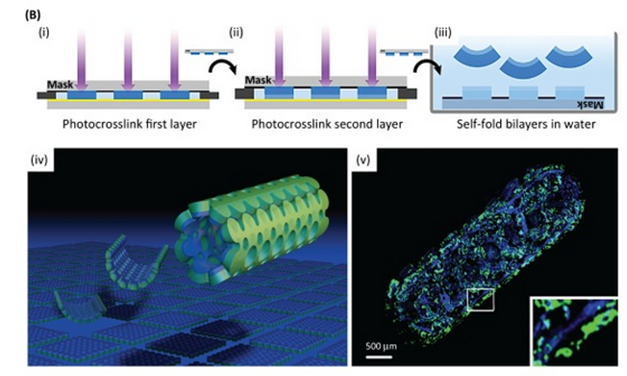
(B) Deformation of bioprinted scaffolds under water stimulation. (i–iii) Schematic illustration of the fabrication of bilayer PEG membranes. (iv) Conceptual diagram of the self-folding of bilayer PEG hydrogels. (v) Representative fluorescence images showing fibroblasts stained with Hoechst (blue) encapsulated within the inner gel layer and fibroblasts stained with Calcein-AM (green) encapsulated on the outer gel layer.
Differential swelling of the PEG bilayer in aqueous solution induces self-folding deformation of the scaffold. Cells are encapsulated within the PEG bilayer, and the cell-laden scaffolds autonomously fold into cylinders of varying radii underwater. This folding process does not compromise cell viability, with cell survival rates reaching as high as 90% after eight weeks. With rational design, such 3D bioprinted responsive scaffolds can be customized to create various anatomy-related microgeometries.
Under the influence of a magnetic field, magnetically responsive materials can also serve as a stimulus for bioprinting. During the printing process, the applied magnetic field can control the oriented deposition of anisotropic particles containing magnetized hard platelets. Additionally, multi-nozzle and dual-component mixing units can be employed to regulate the local composition of the printed materials, integrating multiple materials into a single geometric structure. This approach enables the fabrication of diverse functional structures that closely mimic natural biological architectures.
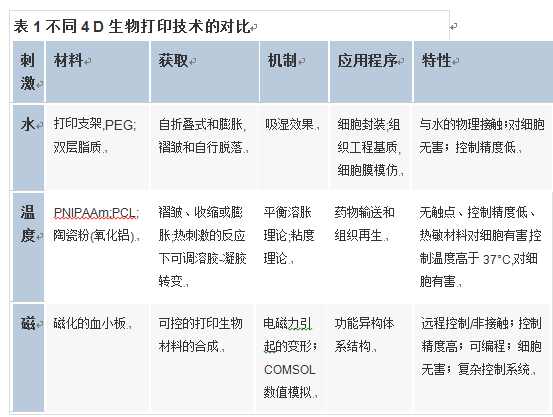
Comparison of Different 4D Bioprinting Technologies
Bio-printed materials that deform in response to external stimuli can be used to create highly complex tissues. This goal can also be achieved through self-organizing cells encapsulated within bioprinted scaffolds. By precisely embedding living cells and growth factors into 3D-printed biomaterial scaffolds, engineered tissue structures with high similarity to native tissue architecture can be obtained. However, due to the incomplete formation process of the tissues, printed tissue structures are not yet ready for practical applications. Processes such as cell membrane development, cellular self-organization, and matrix deposition can promote the maturation of printed tissue structures. The introduction of tissue maturation techniques enables 3D bioprinting to produce engineered tissue structures with functionality comparable to that of native tissues, thereby advancing 3D bioprinting technology toward 4D printing.
Cell Membrane
Coating the lumen of engineered vessels with an endothelial cell membrane is a widely adopted approach in 4D bioprinting for fabricating mature blood vessels. This endothelial lining reduces thrombosis, prevents vascular occlusion, and ensures normal blood flow through the implanted printed vessels. Embedded vascular structures within the engineered tissue were successfully obtained by removing the aqueous support ink after printing. A suspension of human umbilical vein endothelial cells (HUVECs) was injected into the tubular vessels to promote endothelialization. After 48 hours, the HUVEC layer successfully confluentized within the lumen of the printed vessels, as shown in the figure below:
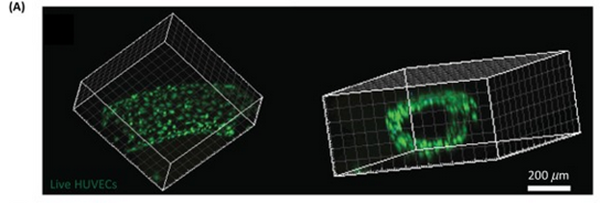
Confocal images show a layer of human umbilical vein endothelial cells (HUVECs) coated on the microchannel walls of the printed structure.
Cellular Self-Organization
4D bioprinting technology employs cell self-assembly to construct ring-shaped blood vessels containing human smooth muscle cells. Discrete cell spheroids are printed into a tightly packed ring structure, after which the spheroids fuse together, forming a ring-shaped blood vessel through cell self-organization, as shown in the figure below:
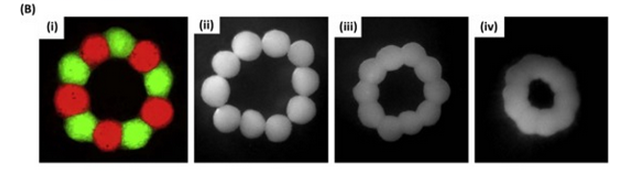
(B) (i) Ring-shaped vascular tissue structures printed from human smooth muscle cells, with discrete cell spheroids in acellular mixtures stained with green and red fluorescence; (ii–iv) Cell spheroid particles fuse to form ring-shaped blood vessels.
Similarly, tubular grafts are also fabricated with the aid of cellular self-organization. To construct tubular structures, cell-laden helical tubes containing human ovarian granulosa cells are printed into small-diameter capillaries. After printing, each ring undergoes a 72-hour cellular self-organization process, resulting in the closure of inter-ring gaps and the formation of connective tissue-like tubular grafts. Viable cells within the printed tubular grafts communicate via various signaling molecules and adjust their positions within the matrix, thereby forming connective tissue and cohesive tubular grafts. This process of cellular self-organization advances the maturity of bioprinting technologies and provides the necessary mechanical properties for tissue transplantation.
Matrix Deposition
Similar to cell membranes and cellular self-organization, intracellular matrix deposition has facilitated the maturation of 4D bioprinting technology. Hydrogels are frequently employed in 3D bioprinting due to their favorable properties, including high water content, ease of processing, and excellent biocompatibility with encapsulated cells. However, hydrogels also have drawbacks; for instance, their rapid degradation compromises the ultimate strength of tissue engineering scaffolds and threatens the integrity of printed constructs. To address this issue, human bone marrow mesenchymal stem cells (hMSCs) were seeded into bioprinted tissue construct lattices. Owing to matrix deposition and environmental remodeling by hMSCs, the degradation time of the constructs in culture medium was extended from 2 days to two weeks, as illustrated below:
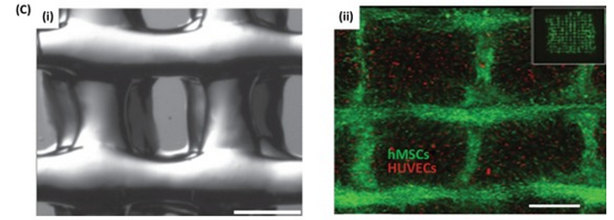
(c) (I) Internal structure of a four-layer printed matrix with a grid pattern. Scale bar = 500 μm. (II) Printed reconstructed grid pattern formed through matrix deposition by human bone marrow-derived mesenchymal stem cells (MSCs).
Due to the deposition of cell-derived matrix, the grid-like pattern retains sufficient strength to be processed. Matrix deposition by embedded cells and optimized degradation processes are crucial for functional tissue engineering. In summary, incorporating the dimension of time into bioprinting technology enables printed tissue constructs to mature progressively, increasingly resembling native tissue architecture.
Due to the inherent advantages of 4D bioprinting technology, it has been widely applied in the biomedical field, such as in tissue regeneration and drug delivery systems. Its advantages include: (i) based on 3D complex tissue structures made from responsive materials, the shape and function can be altered in response to environmental changes; (ii) cell populations are printed within a programmable framework, enabling the fabricated tissues to closely resemble natural tissues. Below, we discuss several examples of the use of 4D bioprinting technology in tissue engineering and drug delivery.
Tissue Engineering
Recently, rapid advancements in 4D bioprinting technology have made the in vitro construction of biomimetic blood vessels increasingly feasible. For instance, self-folding polymers can be used to fabricate blood vessels by encapsulating different types of cells, forming multi-layered tubular structures in aqueous environments. Another approach leverages the self-organization capability of cells within 4D bioprinting to engineer blood vessels.
Angiogenesis is a critical challenge in tissue engineering, and due to the high demand for vascularization, this issue requires urgent resolution. Blood vessels are essential for maintaining cellular function by providing nutrients and oxygen while removing metabolic waste. When distances exceed 100–200 μm, mass diffusion becomes the only effective means of nutrient delivery to tissues; however, in the absence of an adequate vascular network, this mechanism limits tissue size. 4D bioprinting technology offers a potential solution to this problem. Through layer-by-layer bioprinting, cells embedded in hydrogels can be fabricated into vessel-like cylindrical structures. Under the influence of maturation factors, vascular cells rapidly mature to form blood vessels. For instance, various cell types, such as bone marrow mesenchymal stem cells, fibroblasts, and endothelial cells, can be printed into diverse patterns within hydrogels using 4D technology. Cell migration and aggregation occur during a 16-day culture period, after which complete vascular structures are formed. In this context, several factors—including growth factors, interactions between endothelial cells and mesenchymal stem cells (EC–MSC), extracellular matrix (ECM) components, hemodynamics, and mechanical factors—can influence the formation of functional vascular systems. Three-dimensional tissue structures can be readily fabricated, and networks can fold into complex architectures via osmotic pressure gradients, demonstrating significant potential for constructing vascularized tissue structures. However, due to the limited resolution of current systems, this approach cannot yet generate small-scale vascular structures.
Unlike the aforementioned approach that utilizes residual stress and elastic modulus to form blood vessels, an alternative method relies on self-folding driven by tangential tension generated by cells within the extracellular matrix or on the cell substrate. Micropatterned two-dimensional plates roll along their diagonals under the influence of cellular traction forces. Furthermore, the diameter of the resulting tube can be adjusted by varying the angle of the diagonal. Cylindrical tubes fabricated using bovine carotid artery endothelial cells and human umbilical vein endothelial cells have now been employed to construct blood vessels.
Bioprinted agarose rods have also been used to fabricate blood vessels, and this study successfully designed vessels with specific geometries, as shown in the figure below:
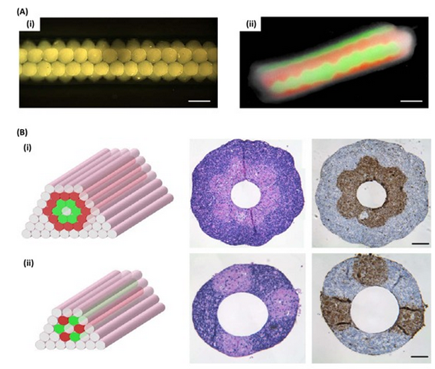
(A) Fabrication of vessel-like structures using 4D bioprinting technology. (i) Human dermal fibroblast spheroids were printed based on agarose rod templates and assembled into vessel-like structures. (ii) Red and green fluorescently labeled cells within the assembled tubular constructs gradually fused and matured over 7 days of culture. (B) After 3 days of fusion, human venous smooth muscle cells and human dermal fibroblasts self-assembled according to a specific pattern.
Human skin fibroblast spheroids were printed using agarose rod templates and assembled into vessel-like structures, which gradually fused and matured during culture. However, the need to remove the agarose filler limits their ability to form more complex architectures. For 4D bioprinting technology, these approaches reduce operational complexity and hold promise for fabricating relatively large vascular tissues. Nevertheless, such methods can only produce simple, single-layered structures, whereas human blood vessels typically comprise three distinct layers (namely, fibroblasts, vascular smooth muscle cells, and vascular endothelial cells). Therefore, constructing a complete vascular structure requires incorporating these specific cell types and structural layers.
4D bioprinting technology is also employed to fabricate hard tissues such as bone. Initially, a polymeric bone scaffold with a grid pattern is printed, and then coated with mesenchymal stem cells derived from inferior turbinate tissue to facilitate mineralization prior to transplantation. After a brief culture period, the printed bone constructs mature for transplantation. In vitro and in vivo studies of decellularized grafts have demonstrated enhanced osteoinductive and osteoconductive properties. However, the transplanted bone lacks the mechanical strength of native bone. Further efforts are required to improve the mechanical integrity of these 3D-printed bone tissues.
Drug Delivery
4D bioprinting technology enables precise control over the spatial distribution of various components, thereby allowing for the programmable release or encapsulation of drugs and cells. For instance, small oil droplets enclosing water droplets, known as “multisomes,” can be printed in an aqueous environment, as illustrated below:
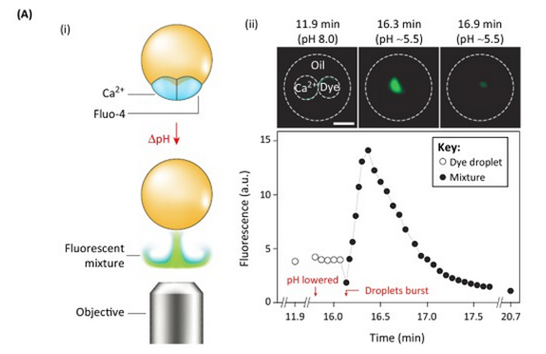
(A) Encapsulated water droplets are released from multosomes by altering the pH value. The multosomes consist of a mixture of coating material and oleic acid, containing conjugated fluorescent dextran-4 and Ca²⁺ ions. The diffusion of multosomes in water was observed using fluorescence microscopy.
Droplets adhere to one another, forming interfacial bilayer membranes. When the temperature or pH of the surrounding environment changes, substances within the droplets can be released. Such a multisome framework can serve as a miniature bioreactor for drug or cell delivery. Multisomes can also be functionalized via membrane proteins; for instance, protein-based channels specifically designed to transmit electrical signals can be engineered between multisomes. Furthermore, multisome networks can be programmed using osmotic gradients to undergo opening and folding into complex structures, thereby encapsulating and releasing drugs to achieve targeted delivery. The schematic diagram is shown below:
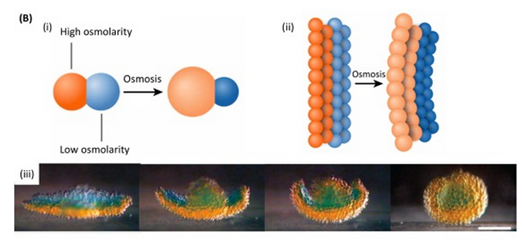
(B) Droplet networks formed by self-folding. (i) Schematic representation of two droplets with different osmotic pressures separated by a lipid bilayer, where water flow across the bilayer causes the droplets to expand or contract. (ii) A network containing two droplets with different osmotic pressures can deform to generate a curved structure. (iii) A flower-like network that spontaneously folds into a hollow sphere; the orange and blue droplets initially contained 80 mg and 8 mg of potassium chloride, respectively.
Another approach leverages differentially swelling polymer hydrogel layers to form self-folding devices, enabling targeted drug encapsulation and release. The device employs two swelling layers and an adhesive layer for drug loading. This bilayer structure consists of two layers with distinct swelling ratios: one is a pH-sensitive hydrogel layer composed of poly(methacrylic acid) (PMAA), which swells upon contact with fluids; the other is a non-swelling layer made of poly(2-hydroxyethyl methacrylate) (PHEMA). Due to the differential swelling rates of the bilayer membrane, the device spontaneously folds into a mucoadhesive configuration, significantly enhancing mucosal adhesion. The PHEMA layer also serves as a diffusion barrier, reducing drug loss within the intestinal tract. Bovine serum albumin (BSA) is encapsulated within the bilayer structure and is released after successfully traversing the mucosal barrier.
In summary, 4D bioprinting technology adds "time" as the fourth dimension to 3D printing. Its implementation primarily relies on two approaches: one based on material deformation and the other on the maturation of tissue-engineered constructs. While 4D bioprinting has made progress in areas such as acquiring functional tissue structures, achieving stimulus-induced structural deformation, and controlling drug release, it remains in its early stages, with many challenges yet to be addressed.
First, the range of responsive materials suitable for printing is limited. Most materials respond to only a single stimulus. However, in the human body, complex microenvironments are regulated by multiple systems to maintain homeostasis, such as neural regulation, humoral regulation, and autoregulation. Therefore, self-morphing printable materials capable of responding to multiple physiological signals are highly advantageous for the medical applications of 4D bioprinting technology. For instance, 4D-printed microcapsules can undergo self-deformation in response to gastric acid; upon reaching gastric ulcer sites, their transformed morphology can both cover the wound and prevent further corrosion by gastric acid. In addition to discovering new materials, future research directions include enabling existing responsive materials to be printable while simultaneously addressing issues of biocompatibility and immune rejection.
Second, the structural deformations currently achievable with 4D bioprinting are limited to simple forms, such as folding, unfolding, and self-assembly. This is primarily because these deformations occur at the macroscopic scale, which constrains precise control over the evolutionary process of the printed constructs.
A future task involves precisely controlling the direction, functionality, shape, and other microscopic aspects of 4D bioprinting by modulating external stimuli. Improving printing resolution may be a viable approach to achieving precise control over morphological transformations; therefore, greater efforts should be devoted to researching responsive biomaterials to enhance printing resolution. Based on cell-matured 4D bioprinting technology, better mimicry of in vivo tissues can be achieved if cell alignment is controlled. For instance, blood vessels typically consist of three layers: endothelial cells, smooth muscle cells, and fibroblasts. By leveraging 4D technology, if cell positioning—particularly the orientation of smooth muscle cells—can be controlled, the structures can be functionalized, resulting in printed constructs that more closely resemble human tissues. In summary, 4D bioprinting technology opens a new frontier in bioengineering, serving as a novel tool to address challenges in tissue engineering and drug delivery.