

JD Health's Comprehensive Strategic Layout in the Pharmaceutical Sector: Beyond Speed, Convenience, Quality, and Affordability
As China’s largest self-operated e-commerce enterprise, JD.com has experienced a rather turbulent expansion in the pharmaceutical sector. In 2011, JD.com formed a joint venture with Jointown Pharmaceutical Group, the largest private pharmaceutical distributor in China, to launch the online pharmaceutical platform “JD Haoyaoshi.” Within less than a year, reports emerged that the partnership between the two parties had broken down. In July 2013, JD.com transferred its entire 49% equity stake in Haoyaoshi to Jointown, marking the end of “JD Haoyaoshi” as a historical chapter.
In June 2016, JD.com announced the formal integration and launch of the “JD Health B2B Distribution Platform,” designed for upstream and downstream industry partners and distribution channels, as well as the “JD Pharmacy” business, which provides consumers with self-operated over-the-counter (OTC) drugs and health care products. How has JD.com strategically planned and structured this multi-dimensional, multi-tiered business ecosystem? VCBeat (WeChat ID: vcbeat) has conducted a detailed analysis.
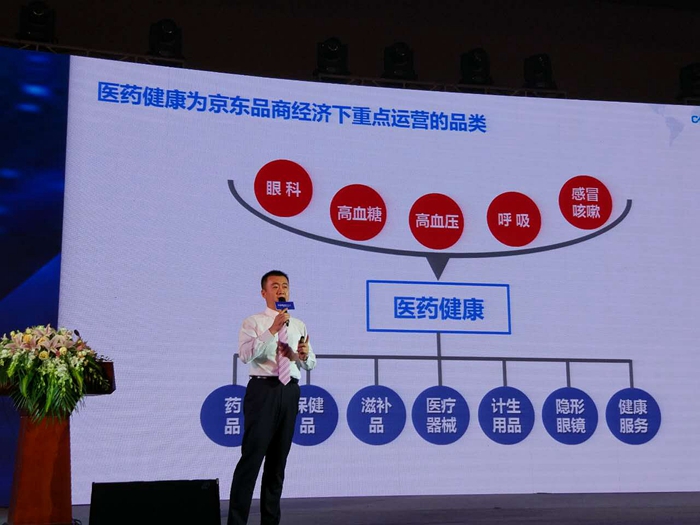
Currently, JD Health’s B2C business encompasses seven major categories: pharmaceuticals, health supplements, traditional tonics, medical devices, family planning products, contact lenses, and health services. However, JD Health’s B2C marketing strategy is driven by user demand characteristics, with a strong emphasis on scenario-based marketing. For instance, for consumers interested in eye care, their primary product need may be eye drops, but they also require vitamin-based health supplements, medical devices such as eye patches, diagnostic services under health offerings, and contact lenses. When targeting such consumer groups, JD Health presents these related products through a scenario-based approach.
JD Health operates under three business models: JD Self-Operated, Brand Flagship Stores, and Third-Party Pharmacy Flagship Stores. Among these, JD Self-Operated accounts for the largest share, followed by Brand Flagship/Specialty Stores, with Pharmacy Flagship Stores comprising the smallest portion.
“Many people compare JD Health with its competitors, believing that there is a significant gap in sales scale between JD Health and its rivals. Here, I would like to clarify that since the flagship stores of large pharmacies account for only a small proportion of JD Health’s overall business, it is unreasonable to use the total sales volume of these flagship stores as a basis for comparing JD Health with its competitors.” Wei Kai, General Manager of JD.com’s Healthcare Division, specifically emphasized this point. The principle of JD Health is to prioritize depth over breadth; by adopting an asset-heavy model, JD Health controls more aspects of the consumer journey, thereby creating greater value.
In the future, JD.com plans to build a health cloud platform, featuring four key segments: health management, wearable devices, disease management, and value-added services.
Health Management: Health Records, Chronic Disease Management, Self-Health Assessment, Vital Signs Monitoring, etc.;
Wearable Devices: Blood pressure monitors, blood glucose meters, smart scales, etc.;
Disease Management: Appointment Scheduling, Online Consultations, Pharmaceutical Shopping Guides, Post-Consultation Recovery, Physical Therapy, etc.;
Value-Added Services: Health Consulting, Fitness Coaching, Physical Examination Interpretation, Insurance Recommendations, Dietary Guidance, etc.
In JD.com’s healthcare strategy, the company aims to leverage its pharmaceutical sales as a foundation and use its health cloud platform to connect services based on user needs, thereby delivering greater value to users. As the JD Health segment achieves significant product sales volume and builds a large user base, it can also conduct public health education through dedicated medical topics, fostering a unique community ecosystem for enhanced user engagement.
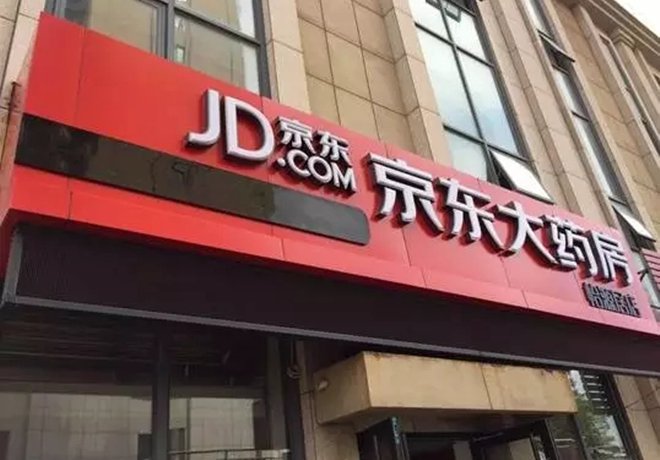
In 2014, JD.com’s subsidiary, JD Shanyuan (Qingdao) E-Commerce Co., Ltd., acquired Qingdao Anjitang Pharmacy. In June 2016, it was officially renamed JD Pharmacy (Qingdao) Chain Co., Ltd., with its offline pharmacies simultaneously rebranded. Over-the-counter (OTC) drugs can be purchased directly online and are delivered by JD Pharmacy. Qingdao Anjitang Pharmacy obtained the Internet Drug Transaction Service Certificate C in November of last year.
At the 2016 Westphal Conference, Wei Kai introduced that JD Pharmacy is a brand under JD’s self-operated B2C business within the JD Health sector, radiating across China from Qingdao. After undergoing warehouse upgrades, system improvements, store renovations, establishing a pharmacist service center, and obtaining GSP certification for the entire process, JD Pharmacy officially launched. Currently, JD Pharmacy primarily focuses on B2C pharmaceutical operations, with warehouses fully compliant with GSP certification standards.
Over the next two years, JD Pharmacy will expand its coverage to seven regions, implementing the “211” delivery standard—same-day delivery for in-stock orders placed before 11:00 AM, and delivery by 3:00 PM the following day for in-stock orders placed before 11:00 PM—aligning with the delivery standards of other JD self-operated categories. Additionally, it will seamlessly integrate with Tencent’s traffic ecosystem, construct multi-dimensional consumption scenarios, and offer diverse, expedited payment options to meet varying payment needs.
It is reported that the Qingdao JD Pharmacy warehouse has achieved a daily processing capacity of 100,000 orders and is staffed with a pharmaceutical care team to ensure medication safety for users. According to Wei Kai, this pharmaceutical care team differs from customer service teams at other online pharmacies in that their performance is not evaluated based on sales figures; instead, consumer satisfaction serves as the sole metric. They are responsible for safeguarding users’ health by providing appropriate recommendations, such as advising adequate rest and professionally assessing whether specific medications are suitable for patients.
In addition to its pharmaceutical sales business, JD Pharmacy will also drive an internet-based flexible supply chain in the future. It will collaborate with research institutions on medical research; partner with pharmaceutical organizations for drug R&D, data-driven marketing, and drug manufacturing; and connect with public health centers, fitness centers, physical examination institutions, insurance companies, and health consultation centers to deliver diversified services including precision marketing, market segmentation, product development, risk control, disease prevention, and health guidance.
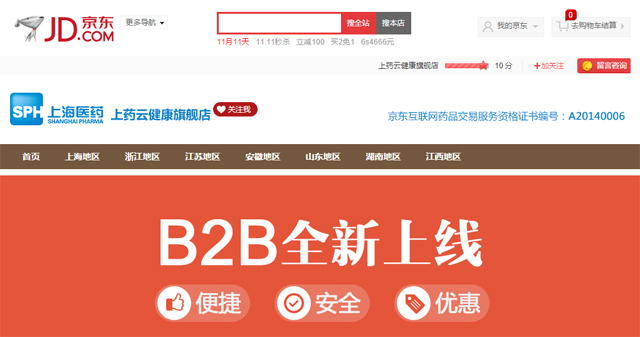
JD Health B2B Distribution Platform is JD’s integrated platform for upstream and downstream industry partners and distribution channels, aiming to create a pharmaceutical trading marketplace with pharmaceutical manufacturers and wholesalers as the upstream supply side, and retail pharmacies, clinics, and private hospitals as the downstream demand side. The platform currently covers categories such as chemical preparations, respiratory and gastrointestinal medications, cardiovascular and cerebrovascular drugs, obstetrics and gynecology medications, and traditional Chinese medicine proprietary products, with plans to introduce medical devices and health supplements in the future.
In May 2015, JD.com and Shanghai Pharmaceuticals signed a strategic cooperation agreement to jointly expand the internet pharmaceutical market. As one of the initial projects implementing this strategic partnership, Shanghai Pharmaceuticals Cloud Commerce Big Health Co., Ltd., a subsidiary of Shanghai Pharmaceuticals, became the first merchant to join JD Pharma’s B2B distribution platform and launched the “Shanghai Pharma Cloud Health Flagship Store.” Leveraging the flagship store, JD Pharma City combined its corporate platform advantages in quality assurance with Shanghai Pharmaceuticals Group’s professional expertise in the pharmaceutical industry to jointly build a full-category B2B online sales platform and offline distribution network.
By leveraging resource integration, JD Health will help streamline the supply chain hierarchy and improve distribution efficiency; broaden procurement channels and enhance bargaining power for retail enterprises; and create incremental value for upstream partners to enable larger-scale business growth.
In addition, the JD Health B2B platform will offer a wide range of value-added services, such as financial products for upstream and downstream partners, marketing services for upstream suppliers, and controlled distribution services. It aims to foster collaboration between pharmaceutical companies and end-point retail customers, establishing a nationwide distribution network.
JD Daojia entered the pharmaceutical O2O sector in 2015 by launching its “Pharmaceuticals and Health” segment, covering major categories including prescription drugs, health supplements, home medical devices, cosmeceuticals, family planning products, and eyewear. Currently, this segment has achieved significant scale, partnering with 140 pharmacy chains and over 2,600 stores.
In April 2016, JD.com merged its “JD Daojia” business with Dada, China’s largest crowdsourced logistics platform. In exchange for approximately 47.4% of the equity in the newly merged entity, JD.com contributed JD Daojia’s operations, its own business resources, and $200 million in cash, becoming the single largest shareholder of the new Dada company. This transaction meant that JD Daojia was carved out from JD Group, and since JD’s shareholding did not exceed 50%, it did not hold a controlling interest. Nevertheless, the O2O platform would continue to operate under the “JD Daojia” brand.
Therefore, “JD Health at Home” (the pharmaceutical and healthcare segment of JD Daojia) has also become a new business for the company and is unrelated to JD Pharmaceutical Healthcare.
Following its spin-off from the JD.com ecosystem, JD Daojia is preparing to launch a large-scale promotion of its home healthcare services. Leveraging its logistics advantages to enhance user experience, it will reduce medication delivery times from the previous two-hour window to one hour and extend operations to provide 24/7 medication delivery. Given the significant differences between pharmaceutical O2O (Online-to-Offline) and B2C (Business-to-Consumer) operational models, JD Health Daojia has positioned this business segment to provide regional traffic integration, logistics delivery, and operational services for pharmacies.
Currently, many enterprises are partnering with JD Health At-Home, partly to generate profits and partly to learn from its business model. Shao Qing, General Manager of JD Health At-Home, frankly stated, “I actually encourage this approach. All chain pharmacies and partners can develop their own solutions, adopt JD At-Home’s methodology, or even focus on the areas where they hold competitive advantages.” The goal of JD Health At-Home is to excel at both ends of the value chain: driving user traffic on the front end and providing delivery services on the back end—two aspects that tend to be challenging for chain pharmacies.
In terms of user traffic, even though some chain pharmacies possess membership data numbering in the millions, they struggle to establish profitable business models. This is largely due to low member loyalty and a lack of services that foster user stickiness; consequently, these seemingly established members are not truly engaged, rendering a large data base alone ineffective. JD Health’s “Home Delivery” initiative aims to leverage offline services to channel JD Daojia’s existing 500,000–600,000 members to pharmacies, while pharmacies reciprocate by directing their offline members to the JD Daojia app. This mutual traffic exchange not only expands the base of effective members but also fosters interaction among them, thereby enhancing customer experience.
Logistics poses a significant challenge for every pharmacy, with many companies unable to dedicate specialized personnel or maintain on-call staffing. JD Health At Home believes that outsourcing delivery operations to JD Daojia’s logistics network is the most hassle-free solution. In the future, one-hour delivery services will be implemented for medication deliveries, covering an area of hundreds of thousands of square kilometers—a reach unattainable by chain pharmacies.
JD Pharmacy has established a comprehensive system for pharmaceutical warehousing, distribution, and customer service, shifting the traditional offline sales model to online platforms and providing users with diverse consumption scenarios. Leveraging the platform and technological advantages of “Internet+,” JD Health’s B2B pharmaceutical distribution platform reshapes the circulation mechanisms in the traditional pharmaceutical sector through the integration of resources within its ecosystem. JD Health is exploring a new pathway for pharmaceutical distribution as part of the supply-side reform in the industry, using its own approach. Its holistic strategy not only improves the hierarchical structure of traditional pharmaceutical distribution but also enhances the speed and breadth of coverage for drug distribution networks. Finally, Wei Kai noted that, in response to the broader trend of consumption upgrading, JD Health needs to incorporate professional services into each segmented product line—adopting a model of “professional services + professional products”—to serve customers and earn their trust.