

Mayo Clinic's Prof. Raymond C. Tervo Proposes Launching Remote Developmental Behavioral Pediatrics Services in Shenzhen
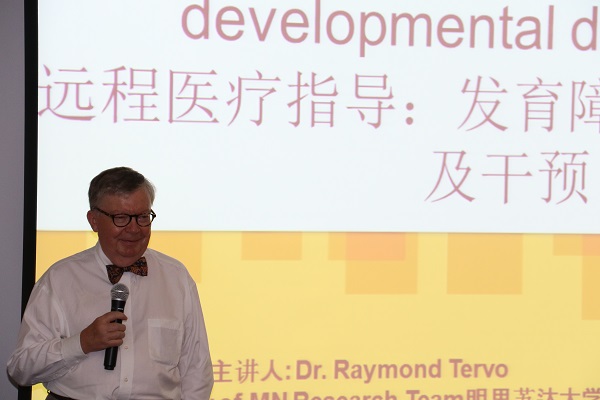
Photo of Professor Telvo’s lecture session
The trend of high-quality overseas medical resources entering the Chinese market through telemedicine is becoming increasingly prominent. Recently, Professor Telwar from the Mayo Clinic visited China to promote a telemedicine project in collaboration with the University of Minnesota. VCBeat (WeChat Official Account: vcbeat) has learned some details about this development.
As the Shenzhen Special Economic Zone Medical Regulations, regarded as the “basic law” of healthcare in Shenzhen, was passed, an effort was made to better apply U.S. experience in the assessment and intervention of developmental disorders in children to Shenzhen. On September 4, the Department of Rehabilitation and the Department of Child Health Care of Shenzhen Children’s Hospital, the initiating organization of the Shenzhen Pediatric Medical Alliance, jointly with Shenzhen Changhe Dayun Children’s Rehabilitation Outpatient Clinic, invited Professor Raymond C. Tervo, a senior pediatrician at the Mayo Clinic—hailed as “the best hospital in the world”—to deliver a lecture on advanced practices in “Behavioral Analysis and Intervention for Children with Developmental Disorders and Behavioral Problems.” The event was attended by more than 200 pediatricians, rehabilitation therapists, and special education teachers from Shenzhen and surrounding areas.
With the rapid development of healthcare in China, patients’ understanding of medical care has evolved from a basic focus on curing diseases to seeking higher-quality models of medical treatment and nursing. In particular, developmental-behavioral pediatrics is garnering increasing attention. There is a growing recognition that this discipline plays a vital role in children’s health, behavior, and overall development. Consider this: if a child cannot speak, use their hands, or even walk, they will be unable to realize their full potential, which will adversely affect their future development. For many citizens, the primary concern is whether medical resources can meet demand—specifically, whether pediatric developmental-behavioral specialists, pediatric rehabilitation physicians, and rehabilitation therapists in Shenzhen can address children’s developmental issues quickly and effectively, in line with advanced international practices. Addressing the difficulty of accessing care for children with developmental and behavioral disorders in Shenzhen requires not only medical collaboration but also a rapid enhancement of the professional competencies of technical personnel.
Mayo ClinicProfessor Telvo’s presentation aimed to rapidly enhance the assessment and intervention capabilities of physicians in Shenzhen within relevant fields. The professor provided an in-depth introduction to “patterns of developmental delay in children,” offered meticulous instruction on the use of various assessment scales, and drew upon 40 years of experience to elaborate in detail on how to identify common types of developmental delay, recognize their typical clinical symptoms, and determine the appropriate timing for intervention. Furthermore, Professor Telvo integrated the latest “Internet Plus Healthcare” model to discuss and propose visions for “telemedicine-guided assessment and intervention for problem behaviors in children with developmental disorders,” as well as for implementing remote telemedicine guidance for child development and behavior in Shenzhen.
Professor Telwo explained how remote video guidance can improve problem behaviors in children with developmental disorders, demonstrate intervention outcomes, and be applied in clinical interventions and training. The professor noted that by using Applied Behavior Analysis (ABA) methods to remotely guide parents of affected children, telemedicine has shown significant effectiveness in three areas: “describing problem behaviors in children with developmental disorders,” “examining intervention outcomes,” and “guiding behavioral interventions for children with problem behaviors via telemedicine.” As a result, children’s problem behaviors were significantly reduced, and their communication skills improved substantially. In multiple fields, including child developmental behavior, telemedicine is already able to provide medical resources professionally equivalent to those available on-site, while offering greater timeliness and lower costs. A large number of U.S. physicians not only conduct patient assessments and provide intervention guidance but also offer online training and coordination advice to parents or caregivers through internet and video conferencing platforms. With continuous hardware upgrades and rapid advancements in the technological environment, including sensor technology, remote consultations will be increasingly adopted and are poised to soon become a standard component of routine medical services.
Currently, Professor Telwo is collaborating with the University of Minnesota to promote the development of telemedicine projects in China, and he hopes that this project will be implemented in Shenzhen as soon as possible. Professor Telwo provided a detailed introduction to the current structure of the Remote Monitoring Behavior Laboratory, which constructs a telemedicine system for children’s developmental behaviors through dedicated laboratories, home telemedicine communication tools, home video models, and video conferencing platforms. The implementation of this project will provide children in China with developmental behavioral disorders the opportunity to receive more professional, timely, and effective interventions through remote video guidance, thereby gaining more direct access to high-quality medical resources in the United States.
Professor Wen Feiqiu, Party Secretary of Shenzhen Children’s Hospital; Director Cao Jianguo of the Department of Rehabilitation; and Director Yang Binrang of the Department of Child Health Care, respectively shared with Professor Telvo the current status, progress, and efforts in addressing pediatric developmental issues in Shenzhen. They expressed their hope that medical institutions in Shenzhen, represented by Shenzhen Children’s Hospital, would engage in multilateral cooperation with overseas medical institutions to provide more specialized care for children in need.
This marks Professor Telwo’s first visit to China for academic exchange. At the invitation of Changhe Medical, in addition to Shenzhen, the Professor delivered lectures and conducted training on the assessment and intervention of children with developmental disorders in Beijing, Shanghai, and Kunming.