

Internet Healthcare Survival Report (III): Why Did 38 Companies Fail? (With Full List)
In the second report, we conducted a comprehensive review of investment and financing data as well as founder backgrounds for “Internet + Healthcare” enterprises established since 2011. We also compiled statistics on the number of companies and total investment amounts across nine sub-sectors. The aforementioned data focused exclusively on currently operating “Internet + Healthcare” companies, aiming to identify the factors contributing to their survival and determine which sectors have demonstrated stronger growth. Moving forward, we will compile a list of “Internet + Healthcare” companies that have ceased operations, analyzing their respective industry contexts and reasons for failure. This analysis may offer even greater reference value for currently operating “Internet + Healthcare” enterprises, enabling them to continually self-assess and avoid repeating the mistakes of others.
The Survival Report on Internet Healthcare is divided into three parts:
Internet Healthcare Survival Report (II): Why Do They Survive? In-Depth Analysis of 9 Key Subsectors
Survival Report on Internet Healthcare (III): Why Did They Fail? The Capital Winter Cannot Be the Scapegoat
The following is Part III
Once, a “death list” of mobile health companies circulated online, drawing significant attention from entrepreneurs. The list disclosed more than 20 defunct “Internet Plus Healthcare” enterprises, yet only four of them had secured angel investment; the majority had failed without ever obtaining funding. Analyzing this list holds limited value, as countless new companies are established each year, and many may fold before they can even be cataloged.
This time, the list of deceased companies we compiled consists entirely of internet-plus-healthcare enterprises that had received investment.Having secured investment, first, indicates that the founders, teams, and business models of these enterprises have gained preliminary recognition from capital; second, with financial backing, these companies are better positioned to realize their visions. Therefore, the insights derived from this “list of failures” hold even greater value.
1How We Determine When a Company Has Failed
Given our focus on the viability of “Internet + Healthcare” enterprises, we will begin with the internet sector and conduct corporate investigations primarily across the following four aspects.
First, check the update date of the company’s mobile app before downloading and using it. Mobile apps are generally the primary digital products through which “Internet + Healthcare” companies establish their online presence. If an app has not been updated for more than six months, add the company to a list of defunct enterprises for further investigation.
Second, review corporate WeChat Official Accounts by following and using them; those with no content updates for over three months shall be added to the list of defunct enterprises for further investigation.
Third, for enterprises without a mobile app or WeChat official account, locate their official website; if corporate news has not been updated for more than three months, add the enterprise to the list of defunct companies for further verification.
Fourth, look up the customer service and work phone numbers published on the company’s official website, and call during business hours to see if someone answers.
The above outlines the common methods we, as users, employ to test products and contact these companies. Of course, determining whether a company has ceased operations requires extreme caution; all four of the aforementioned criteria must be met before a final determination can be made. In the initial round of company screening, we identified 66 internet-plus-healthcare companies suspected of having ceased operations. However, after two subsequent rounds of telephone verification, we excluded 28 companies, resulting in a final confirmed list of 38 defunct companies.
The 28 companies excluded from the list were initially included due to certain product-related issues, such as long periods without updates to their mobile apps and corporate WeChat official accounts, or inaccessible websites. Although subsequent telephone verification confirmed that these companies are still operational, leading to their removal from the list, neglecting content updates on internet and mobile platforms is hardly advisable for “Internet+ Healthcare” enterprises. While they remain in business for now, how long they can sustain operations remains questionable.
2Complete List of 38 Deceased Internet + Healthcare Companies
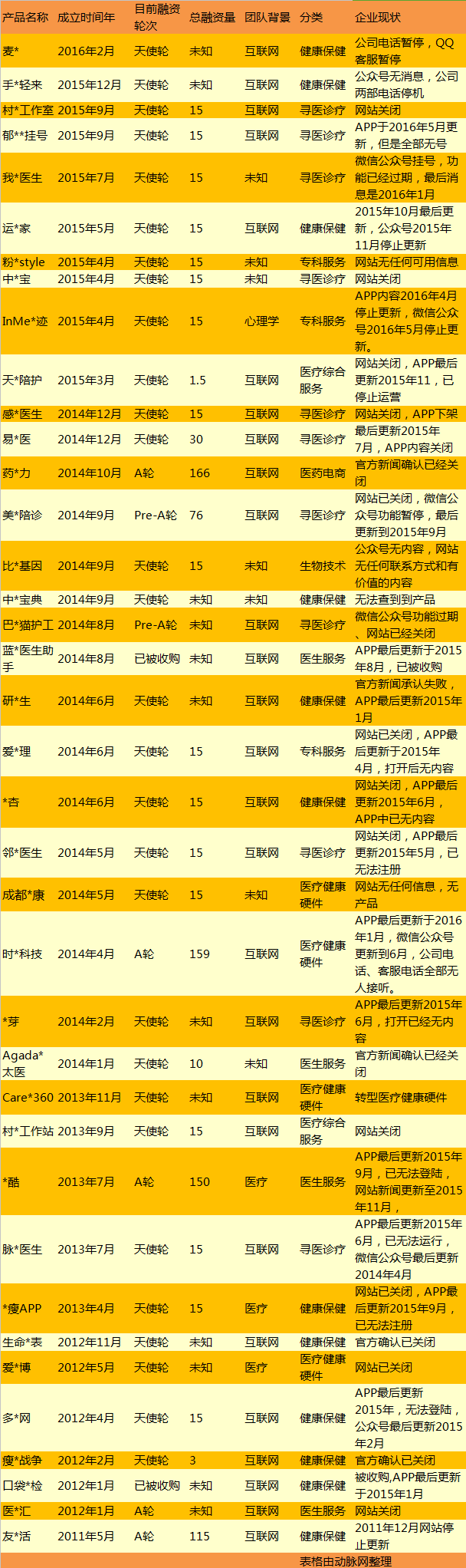
Note: Out of respect, we have omitted one character from the company name. If there are any errors in the registered company information, please feel free to contact us; contact details are provided at the end of this article. Thank you.
3Total financing for 38 companies approaches $10 million
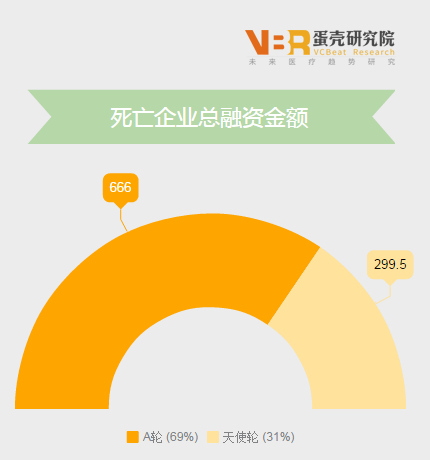
The total financing secured by these 38 companies reached $9.65 million. When including undisclosed funding data from some enterprises, the aggregate amount likely exceeded $10 million. Among them, “Yao Gei Li,” which garnered the highest media visibility this year, received the largest investment, totaling $1.66 million. The company secured several million RMB in its angel round and tens of millions of RMB in its Series A round, led by Tongdu Ventures, Ping An Capital (Ping An Innovation Investment), and Ceyuan Ventures. Ranking second was a smart health hardware manufacturer, which raised a total of $1.59 million. Although its smart body fat scales remain available for purchase online, the company’s WeChat official account ceased updates in June 2016, its official website forum has been shut down, and both its office landline and 400 customer service hotline went unanswered for three consecutive days, suggesting that the company has likely encountered significant difficulties.
47 Companies Enter Series A Funding Round
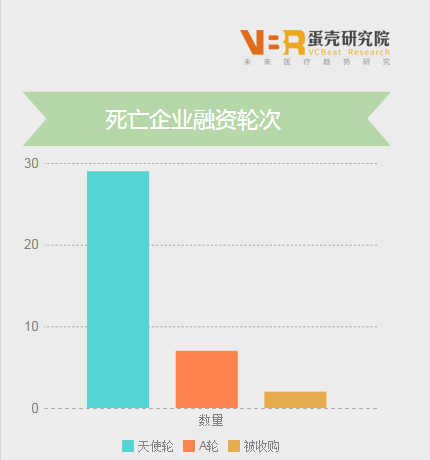
Most of the defunct companies remained at the angel investment stage, with the majority securing funding amounts around RMB 1 million. However, after product validation revealed low market acceptance and an unclear profitability model, these companies struggled to secure further financing. Seven companies managed to advance to Series A financing, accounting for a significant proportion of 18.4%. These enterprises had already established a certain foundation in terms of brand recognition and user metrics. While capital is crucial for businesses, their failures stemmed from multifaceted factors.
5The Internet background is the keyword.
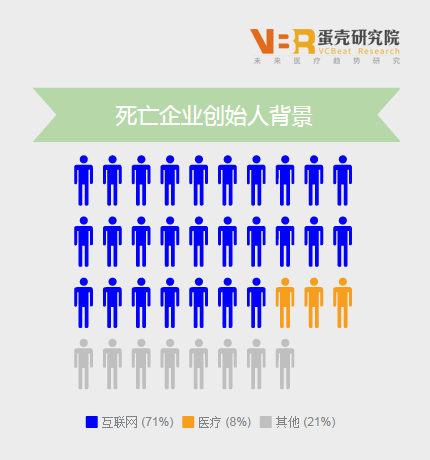
A total of 27 companies, accounting for 71%, have founders with backgrounds in the internet industry, while only three companies, representing 7.9%, have founders with medical backgrounds. The medical field is highly specialized; if internet entrepreneurs fail to gain a deep understanding of the healthcare sector, they may misjudge market pain points and struggle to identify viable profit models, leading to a high risk of failure. Moreover, the healthcare industry has high entry barriers, and access to genuine medical resources is often the decisive factor determining survival. How to accurately capture patients’ true needs and translate them into products is a critical issue that mobile health enterprises cannot afford to overlook.
6Healthcare and medical consultation services account for the largest share.
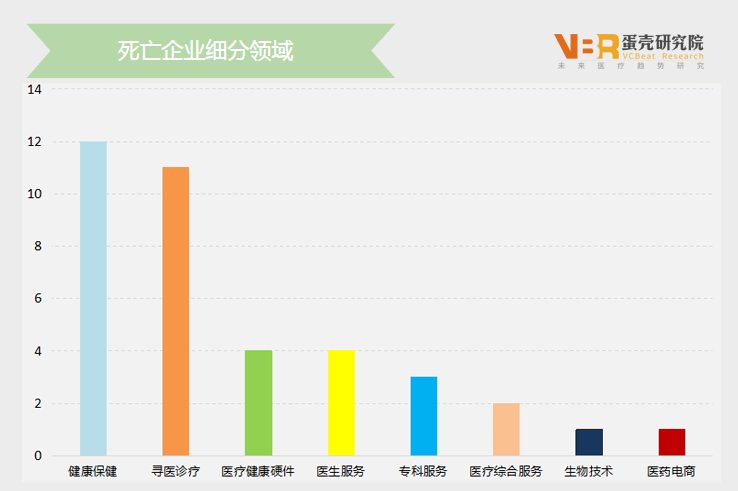
The vast majority of internet professionals can only enter the health care and medical consultation markets, which have relatively low entry barriers, as these sectors are characterized by light medical services and low technological intensity. However, many niche segments within these two fields already have industry unicorns, making it extremely difficult to achieve success. In particular, fewer health care and medical consultation enterprises established in the past two years have managed to succeed, unless they are projects like “Ping An Good Doctor” that can leverage the support of a large platform.
7Average Survival Time
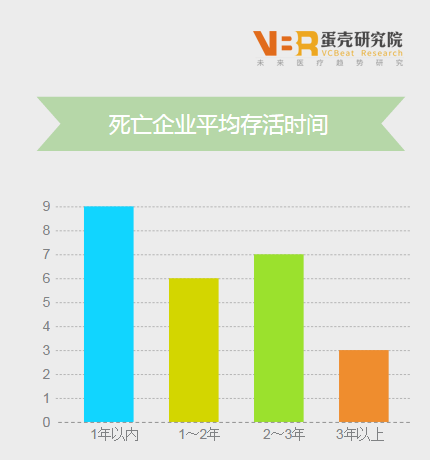
We analyzed 25 companies for which the last product update date could be clearly identified, recording their lifespan from inception to closure. The average survival time for these enterprises was 19.6 months. A significant proportion of companies survived beyond 24 months, while an equally substantial number failed within less than a year. This highlights two critical junctures in the lifecycle of startup failures: the early stage and the third year after establishment. All the companies included in our analysis had secured angel funding, indicating that their business models had initially gained investor recognition. However, if market validation reveals deviations from the founders’ original assumptions within this first year, subsequent financing will face immediate challenges. The situation becomes even more perilous if founders focus exclusively on refining their business model while neglecting the parallel pursuit of fundraising. Therefore, to successfully bridge the gap from the angel round to Series A, startups must achieve validation in both their business model and their product.
Meanwhile, the third year is also a critical hurdle for startups. At this stage, while companies may have better financial backing, if their business model has not achieved a breakthrough and their products are not profitable, relying solely on subsidies to burn cash and accumulate users can easily lead to failure at this juncture, particularly for offline O2O enterprises.
8Capital Shortage Is Not the Primary Cause of Death
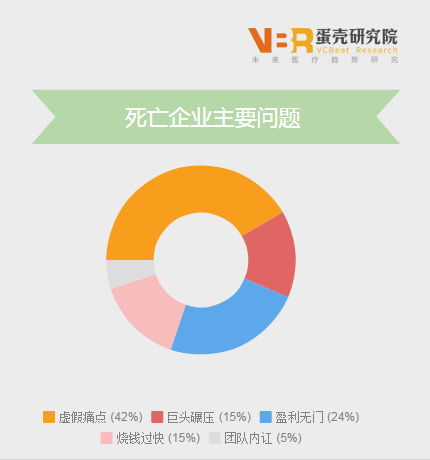
Among defunct companies, addressing pseudo-pain points ranked as the leading cause of failure. As the first online-to-offline (O2O) medication delivery startup to secure Series A funding, Yaogei Li’s collapse this year sent shockwaves through the industry, failing just at the threshold of Series B financing. According to an announcement by Lian Jiaxing, Yaogei Li’s Marketing Director, the primary reason for suspending services was a broken capital chain resulting from failed fundraising. “Our team, despite the challenging fundraising environment, had pinned our hopes on a traditional pharmaceutical company that had confirmed its investment from last December until now. We even completed the investment agreement, but the reversal happened overnight, leaving us no time to adjust.” Attributing failure to funding issues appears to be a common explanation among many O2O startups.
However, from VCBeat’s perspective, the root cause of Yaogeili’s demise lay in the inherent unsustainability of its easily replicable offline O2O business model. First, pharmaceuticals are low-frequency, essential goods, particularly over-the-counter (OTC) drugs. Second, substantial logistics expenditures further strained operations, rendering the profit model incapable of supporting continued growth. Finally, Yaogeili’s data were inflated—order volumes artificially boosted by promotional sales of band-aids at RMB 0.1 and user acquisition driven by heavy cash burn held little real value. Such manipulated metrics had long ceased to inspire confidence among investors. Moreover, as highlighted in our previous report, total investment and financing amounts in 2016 had already surpassed those of the same period the prior year. It is therefore inappropriate to attribute corporate survival challenges solely to a “capital winter.”
Graduate students also represent a case worthy of analysis. The founder, Ji Shisan, holds a Ph.D. in neurobiology and has experience with two successful internet projects, Songshu Hui (Science Squirrels) and Guokr.com, giving him a dual background in both the internet and healthcare sectors. In an interview, Ji Shisan stated that he was optimistic about the women's health market, which led to the launch of this preconception care app. However, due to limited resources, the team increasingly recognized the significant challenges involved as the product development progressed; the overall resource requirements exceeded the team's capabilities. Another major factor may have been an overestimation of the market size for preconception care and the app's user retention potential. For women, preconception is a phase that occurs only once or twice in a lifetime, with each instance involving a short attention span of just two to three months. Consequently, the product faced fatal issues from the outset, including an insufficient user base and low user retention.
9Recommendations for the Development of Internet-Plus Healthcare Companies
User engagement in the “Internet + Healthcare” sector remains relatively low, necessitating a distinct path rather than simply replicating the experiences of the broader internet industry. Based on our previous analysis, we do not subscribe to the notion of a “winter” for the “Internet + Healthcare” sector. On the contrary, investment and financing amounts in the mobile health industry have reached record highs this year. To survive and thrive, mobile health companies must delve deeper into the industry to identify genuine market pain points. For the “Internet + Healthcare” sector, where profitable business models remain unclear, the “spring” has not yet truly arrived. We look forward to identifying the most appropriate model to provide affordable and convenient services for healthcare reform, medical institutions, and patients, thereby seamlessly integrating in-hospital and out-of-hospital processes across the entire healthcare journey.
We recommend that entrepreneurs consider the following points when addressing development bottlenecks as they enter the “Internet + Healthcare” industry.
"Internet + Healthcare": More important than the "Internet" aspect is the practice of medicine. Only hospitals and physicians can truly meet this demand. The role that hospitals and physicians play in this service cannot be replaced by any internet-based product. To break through the profitability dilemma, one must focus on the core element of "medical care." Entering this industry rashly without access to medical resources risks becoming mere collateral damage.
Mobile healthcare must grasp patients’ true needs and design products with accurate positioning. Good products can solve specific problems that patients genuinely need addressed. For instance, in chronic disease management for diabetes, patients require long-term monitoring of blood glucose levels and dietary control. However, by 2016, the “Internet + Healthcare” sector had already become saturated. Numerous companies had entered various segments, including front-end health management, self-diagnosis, and self-treatment; mid-stage appointment scheduling and diagnosis/treatment; and back-end management and rehabilitation. To identify a blue ocean strategy and stand out, entrepreneurs must rely on their wisdom.
This is the key to a company’s survival, as the ultimate goal of doing business is to make money. First, identify who pays for the product among hospitals, doctors and nurses, pharmaceutical companies, and patients, and then enhance the product’s core competitiveness. For internet-based products, traffic is paramount; monetization can only be discussed once sufficient traffic is secured. Among the more than 700 companies we surveyed, fewer than 40 appeared to have failed. However, a large number of enterprises launched apps that achieved only a few hundred downloads in niche markets, raising the question: how can they possibly achieve monetization?
After analyzing data from over 700 companies, we have come to realize that healthcare entrepreneurship is generally more elite-driven compared to the TMT sector. Student-style startups or those relying solely on imagination rarely succeed. Regardless of whether founders come from an internet or healthcare background, a prerequisite for success is strong individual capability and the ability to build and integrate cohesive teams within their respective fields.
Why is this the case? As we can see, most failed companies suffered from imprecise pain-point identification and difficulties in cross-sector integration. This holds true for entrepreneurs with backgrounds in both the internet and healthcare industries.
At least so far, the healthcare industry has not followed the TMT model of rapidly inflating the market through capital injection to cultivate user habits and then capture market share. To date, even the unicorn companies in the internet healthcare sector have not achieved massive scale solely by burning cash.
In a word, healthcare entrepreneurship must be heartfelt. Whether in a capital winter or a capital spring, these conditions are not the primary determinants of whether a company scales up or fails.
End.
Advertisement: We are conducting research and analysis on cross-border healthcare. Entrepreneurs, investors, and industry professionals are welcome to contact us. Please reach out to the author, Liu Zongyu, via WeChat:q19930797。
Planner: Liu Huiguang
Written by | Liu Zongyu
Mo Renying and Wang Guanglong also contributed to this report.
Note: The information in VCBeat’s series of reports is primarily sourced from the VCBeat Research Institute database and select publicly available materials. While we ensure objective analysis of the data, we cannot guarantee the authenticity of certain data sources themselves. We have strived to maintain objectivity and impartiality in the report’s content; however, the views, conclusions, and recommendations presented herein are for reference purposes only.
For any feedback on the report, please feel free to contact the author, Liu Zongyu, via WeChat: q19930797.
Related Reading:
Internet Healthcare Survival Report (II): Why Do They Survive? In-Depth Analysis of 9 Key Subsectors