

Onduo Files IPO Prospectus: A Verily-Sanofi Joint Venture Revolutionizing Type 2 Diabetes Care Through Digital Health Integration
Recently, Verily, the life sciences company under Google, and Sanofi, a renowned French diabetes pharmaceutical manufacturer, have jointly established a new company called Onduo to co-develop products for type 2 diabetes. Sanofi has contributed $248 million in cash for a 50% equity stake, while Verily has made an equivalent non-cash contribution. According to VCBeat (WeChat ID: vcbeat), as a digital health platform, Onduo plans to fully integrate devices, software, medications, and services, aiming to leverage technology to deliver innovative therapies for diabetes patients and achieve breakthroughs in diabetes monitoring and treatment, as well as in patient behavior research.

Onduo CEO Joshua Riff at Johns Hopkins Hospital, Optum 、All targets have extensive work experience.
What types of products will Onduo actually develop? Joshua Riff, the company’s CEO, stated, “Since we have not yet clarified which specific diabetes-related issues we aim to address, there are currently no detailed plans for the new platform’s operational model or its specific product development. However, one thing is certain: unlike traditional type 2 diabetes research, which tends to focus on clear clinical treatment objectives—such as reducing the risk of amputation and blindness—Onduo focuses on studying feasible behavioral and lifestyle modifications. Our goal is to enhance medication management and improve patients’ daily habits, for example, by controlling blood glucose fluctuations through healthy daily routines and dietary planning, rather than relying on conventional titration methods or continuously switching to new medications.”
In fact, as early as last August, Verily partnered with Sanofi on a diabetes detection and treatment project. The two parties can complement each other’s strengths to some extent: Verily has accumulated expertise in micro-electronic devices, data analytics, and software development, while Sanofi brings extensive clinical pharmaceutical knowledge and experience.
This collaboration comes at an opportune time for Sanofi. Due to declining demand for Lantus, its best-selling drug, the company reduced its three-year sales forecast last year and began restructuring its diabetes business. Currently, Sanofi is offsetting the revenue loss from Lantus with Toujeo, its leading next-generation insulin. The company hopes this partnership will help mitigate the decline in sales volume driven by ongoing pricing pressures in the U.S. healthcare market.
Diabetes is a common chronic disease worldwide, with nearly 400 million patients globally. Among them, patients with type 2 diabetes (adult-onset diabetes, typically developing between the ages of 35 and 40) account for more than 90% of all cases. Without healthy lifestyles and appropriate treatment regimens, the number of patients is projected to increase significantly in the coming years.
Currently, there is a wide variety of companies in the market offering diabetes treatments. Some focus on early-stage management, such as Omada Health, Welldoc, MySugr, Glooko, and Livongo. Even device manufacturer Medtronic has partnered with IBM to develop a digital health management app that collects insulin pump data to help patients better adjust their lifestyles. Additionally, the artificial pancreas is a core focus for many companies. Startups like Beta Bionics and Bigfoot Medical, along with established players such as Insulet, Johnson & Johnson, and Medtronic, are leaders in this field.
Surrounded by formidable competitors, Onduo feels little pressure. Riff emphasizes that even with an artificial pancreas, patients cannot maintain long-term blood glucose stability without a reasonable diet and lifestyle habits, as well as adherence to medical advice—precisely the challenge Onduo aims to address. Sanofi and Verily will focus on improving medication management and patient lifestyle behaviors, striving for a win-win outcome in both blood glucose control and cost reduction.
Verily was renamed from Google’s life sciences research division, which was formerly part of Google X.VerilyEstablished (and renamed) in July 2015, Verily signifies “truth” or “genuine” in Middle English. It holds the significance of a “moonshot” initiative within Alphabet’s (Google’s parent company) strategy. Core members include CEO Andy Conrad, Ph.D., CTO Brian Otis, Ph.D., CMO Jessica Mega, M.D., MPH, Engineering Lead Linus Upson, Head of Software Tom Stanis, and Head of Science Vikram (Vik) Bajaj, Ph.D., among others.
Although Alphabet’s largest revenue stream still comes from Google’s core business, entities such as DeepMind and Verily embody a broader ambition to improve human life. On Verily’s official website, the company’s vision is articulated in a simple yet grand statement: “How to leverage technology to map out the blueprint of human health!”
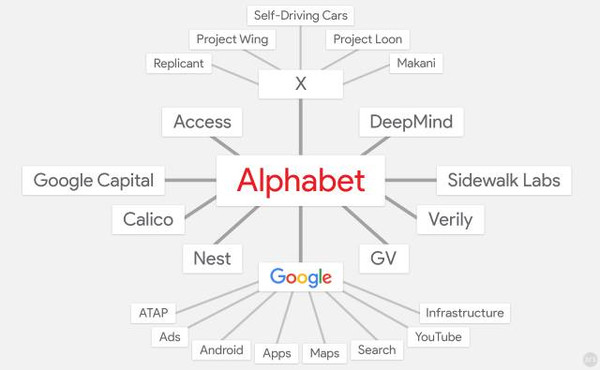
Alphabet’s Strategic Layout and Division
Tracing its origins, Google Life Sciences evolved from Google’s diabetes project, with the goal of addressing diseases and health issues that afflict tens of millions of people, such as the prevention, detection, and management of cancer and mental illness. Its current CEO is Andy Conrad, a leading figure in cell biology. In March 2013, Conrad officially joined Google X Lab, where he led a research team comprising hundreds of experts from fields including physiology, biochemistry, optics, imaging, and molecular biology. This was the predecessor of Life Sciences. After Life Sciences was renamed Verily, Conrad stated that Verily would primarily focus on several areas within the life sciences: healthcare software, high-tech devices, and clinical research.
“Verily is an independent subsidiary dedicated to leveraging technology to help people understand health, and to prevent, detect, and manage disease,” said Andy Conrad, CEO of Verily. “Verily has assembled a multidisciplinary team comprising physicians, engineers, chemists, data analysts, behavioral scientists, and other experts. Here, cutting-edge research tools, large-scale computational capabilities, and specialized technical talent seamlessly integrate technology with life sciences, unlocking deeper insights into the unknown aspects of disease and health.”
Judging from the intermittent emergence of groundbreaking medical technologies, Google’s strides in healthcare have been remarkably steady and unhurried, seemingly at odds with its traditional approach.
As early as July 2014, Google partnered with Novartis, one of the world’s top three pharmaceutical manufacturers based in Switzerland, to develop smart contact lenses embedded with glucose sensors—a cutting-edge technology. They hoped these novel contact lenses would help patients with diabetes continuously monitor their health by measuring glucose levels in tears, thereby eliminating the need for painful finger-prick blood tests. Additionally, the contact lenses were designed to auto-focus, automatically adjusting focal length according to visual distance to help users restore their vision. However, this project sparked significant controversy, as did Google’s nanoscale “cancer-sensing pill.”
In the same year, the Baseline Project, conducted in collaboration with Duke University and Stanford University, aimed to leverage Google’s large-scale computing capabilities to collect biological samples and map the biological data of a healthy human. The goal was to identify biomarkers corresponding to each disease, thereby establishing big data-based technologies for disease prevention and diagnosis. As the sample size continues to grow, experts will be able to use comprehensive data to fully characterize a healthy human. Medical diagnostics based on Baseline will enable patients to identify all potential diseases at once, rather than only those that have already manifested, thus effectively preventing conditions such as heart disease and cancer.
In January 2015, Google X and Biogen entered into a long-term collaboration in the field of multiple sclerosis (MS) to jointly investigate the progressive nature of the disease and the reasons for inter-patient variability. Currently incurable, MS manifests differently across patients; while some experience only transient numbness, others may suffer paralysis. By analyzing patient data, Google aims to identify the underlying causes of these disparities, with the goal of developing more targeted therapies.
In the realm of diabetes treatment, Google Life Sciences has partnered with DexCom to develop a monitoring device no larger than a coin, which is more affordable than conventional continuous glucose monitoring (CGM) devices for type 2 diabetes. It is reported that the hardware platform to be developed by Onduo in the future may utilize this next-generation, miniaturized continuous glucose monitoring sensor created through their joint efforts.
In late August 2015, Google’s life sciences research division partnered with Sanofi. Google aimed to provide comprehensive solutions for patients through blood glucose monitoring, enabling physicians to easily track real-time daily fluctuations in patients’ blood glucose levels and thereby offer timely, authoritative guidance on dietary adjustments and insulin dosing. A year later, this collaboration bore fruit with the establishment of a new company, Onduo.
In December 2015, Verily and Johnson & Johnson jointly established a new company named Verb Surgical to develop robotic-assisted surgical systems, with each party holding a 50% equity stake; the specific investment amounts were not disclosed. It is reported that Verb Surgical will participate in the development of a comprehensive surgical solutions platform, integrating technologies such as robotic surgery and novel medical devices for use by operating room professionals. Leveraging Alphabet’s extensive expertise in machine learning, the system enables machines to learn how to properly handle various intraoperative scenarios by analyzing existing imaging data. The robots they plan to produce are only 20% the size of conventional models, allowing surgeons to work closer to patients, and, more importantly, will be significantly more affordable.
This August, Verily and GlaxoSmithKline (GSK), the UK’s largest pharmaceutical company, established Galvani Bioelectronics to enter the field of bioelectronic medicine. GSK will hold a 55% stake in Galvani, while Verily will hold the remaining 45%. The two parties plan to invest £540 million over the next seven years. Reportedly, they are committed to developing miniature implantable devices that intervene in neural synaptic signals, thereby regulating irregular or disordered pulses caused by certain diseases. Their goal is to achieve a major milestone by 2023: obtaining official regulatory approval for therapeutic applications of implantable electronic devices.
Verily is also developing wearable medical devices and biosensors, such as cancer-detection equipment. Verily’s partnership strategy is clear: it aims to leverage partners’ extensive clinical and patient management expertise, combining them with its own robust capabilities in engineering, data processing, and deep learning, to deliver better healthcare solutions for consumers.

Hardware
The hardware team is developing devices that are more compact, more powerful, and more convenient than previous models. When issues arise, these devices can rapidly monitor signals with greater consistency and reliability. For example, they are developing smart contact lenses embedded with glucose sensors, aiming to make it easier for diabetic patients to monitor their blood glucose levels by measuring the glucose content in their tears.
Software
Information is embedded throughout our bodies, ranging from genetic data to sleep patterns. Verily’s software engineers, data analysts, and user experience designers are developing platforms, products, and algorithms capable of analyzing this complex health information. The team strives to develop appropriate models to help detect early signs of disease, enable more accurate diagnoses, and identify more effective treatments.
For instance, in research projects on multiple sclerosis, wearable sensors are integrated with traditional clinical tests to collect data on biological, physiological, behavioral, and environmental variables. By leveraging machine learning algorithms and computational techniques, software teams can gain deeper insights into the disease and precisely analyze individual patient conditions.
Clinical
The goal of clinical team-based work is to generate information and insights that the health research community can leverage in the future. Verily, together with its partners—including industry players, hospitals, governments, academic centers, medical societies, and patient groups—applies cutting-edge technologies to the study of health and disease.
The clinical team will collaborate with hardware and software teams to guide product and platform development, addressing the genuine needs of patients. The Baseline project serves as the core initiative for this clinical collaboration, having dedicated itself for many years to mapping the biological data of healthy humans and identifying biomarkers corresponding to each disease.
Science
Scientific teams are investigating the precise etiologies of diseases such as cancer, heart disease, and diabetes, while developing automated experimental and computational systems biology and life science tools to uncover more biological data related to disease mechanisms and physiological functions. For instance, biomolecular nanotechnology can be applied to precision diagnostics and therapeutics, advanced imaging techniques, and surgical robotics. Verily aims to leverage these tools to deeply mine biological data, thereby facilitating disease prevention, detection, and management.
Of course, as Verily makes significant inroads into the healthcare sector, it also faces numerous challenges and skepticism. Its previously developed smart glasses project, which aimed to monitor blood glucose levels by analyzing glucose content in wearers’ tears, drew criticism due to its inability to accurately measure blood sugar. Overall, Verily’s products remain largely in the early stages of research and development, far from reaching widespread adoption.
Additionally, according to revelations from foreign media, Verily CEO Andrew Conrad has always prioritized new projects and occasionally shifts resources on a whim, which has significantly strained its relationships with partners and regulatory authorities.
However, judging from their performance over the past two years, both DeepMind and Verily have increasingly adopted a more conservative approach. Early this year, the United States Patent and Trademark Office published a new patent application filed by Google for a wearable device capable of reminding users to ingest absorbable substances, such as medications, during meals.
The core innovation of this patent lies in its ability to determine the optimal timing for notifying patients to take their medication. The device is equipped with one or more sensors and leverages predefined activity data to monitor whether the user is eating. To ensure the accuracy of these notifications, the device also collects data on blood glucose levels, sounds associated with eating, GPS-derived location information, and facial recognition data captured via camera. This patent is critical for managing certain conditions, such as diabetes, as it focuses on cultivating and modifying patient behaviors. This raises the question of whether it shares commonalities with the products and platforms currently under development by Onduo.
“Don’t be evil” Google has a grand vision for healthcare. Every project, from conception to commercial implementation, has faced numerous challenges, careful deliberations, and even skepticism. Despite the long and arduous road ahead, Verily continues to boldly strategize toward a comprehensive blueprint for human health.