

Proclara Biosciences Completes $47 Million Series E Financing as Alzheimer’s Drug NPT088 Enters Phase 1b Clinical Trials

In September 2016, Proclara announced on its official website that it had completed a $47 million Series E financing round. On the same day, the company’s website reported that its key candidate product for the treatment of Alzheimer’s disease, NPT088, had entered Phase 1b clinical trials.
Proclara, founded in 2007, is a U.S. biotechnology company dedicated to developing novel therapies for protein misfolding diseases, with a focus on treating Alzheimer’s disease and other neurodegenerative disorders. In September 2016, the company was renamed from NeuroHage to Proclara. Dr. Franz Hefti, the company’s CEO, stated that this renaming marks a significant milestone, signaling the company’s commitment to pursuing new treatments for debilitating protein misfolding diseases and addressing the urgent needs of a broad patient population.
This round of financing was led by private investors and the French investment firm Merieux Développement. The funds will be used to research candidate products for Alzheimer’s disease, Parkinson’s disease, and other conditions; to support further clinical studies of NPT088; and to advance research on molecules targeting the latent phase of disease. Including the previous four rounds of financing, Proclara has raised a total of $108.8 million, all dedicated to the treatment of Alzheimer’s disease and other neurodegenerative disorders. Below is an overview of its financing history.
On February 21, 2008, NeuroPhage secured $7 million in Series A financing to develop a unique disease-modifying approach for the treatment of Alzheimer’s disease and other neurodegenerative disorders;
On March 1, 2012, Neuro Phage completed a $21.4 million Series B financing round to fund research into the mechanism of action and clinical development of NPT002, a drug candidate for the treatment of Alzheimer’s disease;
In May 2013, Neuro Phage secured $6.4 million in Series C private equity financing. These funds were allocated to the research of NPT002 and to investigate the developmental potential of second-generation fusion proteins for treating certain neurodegenerative diseases, including Alzheimer's disease;
On January 14, 2015, NeuroHage completed its Series D financing round, raising a total of $27 million to accelerate the clinical development of its novel drug candidate NPT088;
In September 2016, the company completed a $47 million Series E financing round to support candidate products for Alzheimer’s disease, Parkinson’s disease, and other conditions, further clinical development of NPT088, and advancement of research into prodromal-stage molecules.
Based on the data above, we can observe that Proclara’s fundraising pace has been accelerating, with the amounts generally showing an upward trend. In fact, these figures merely reflect surface-level phenomena; underlying events are always driving this momentum.
In 2008, they proposed a unique disease-modifying approach to treating Alzheimer’s disease, which helped them secure their first round of financing. In March 2011, the company launched a $12.4 million Series B funding round, and by March 2012, it had oversubscribed the round, raising $21.4 million. During that intervening year, the company was named one of the Top 10 Central Nervous System Biotech Companies and received financial support from the Michael J. Fox Foundation (the Michael J. Fox Foundation is dedicated to improving the lives of people with Parkinson’s disease by funding research into Parkinson’s and other neurological disorders. To date, the foundation has contributed more than $275 million to research institutions).
In January 2013, Antitope announced that it had entered into a strategic agreement with Proclara to jointly develop drugs for the next generation of neurodegenerative diseases. Antitope is a private UK-based company primarily dedicated to research in therapeutic antibodies, protein engineering, and immune antibodies, and maintains collaborations with multiple biotechnology and pharmaceutical companies worldwide. In May 2013, Proclara secured $6.4 million in Series C financing.
On March 25, 2014, Proclara initiated a $17 million Series D financing round. On April 22, 2014, an article was published stating that GAIM-changing molecules had been discovered to combat Alzheimer’s disease and other neurodegenerative disorders. In November 2014, the GAIM technology was designated as a “priority project technology” at a regional partnership conference held in Boston. Subsequently, in January 2015, Proclara announced the completion of its $27 million Series D financing round.
The figure below illustrates Proclara’s project progress. It is evident that the company has expanded from its initial single project, NPT088, to currently conducting research on three projects simultaneously. Furthermore, NPT088, the company’s key candidate product for the treatment of Alzheimer’s disease, has entered Phase 1b clinical trials, which facilitated the securing of this round of financing.
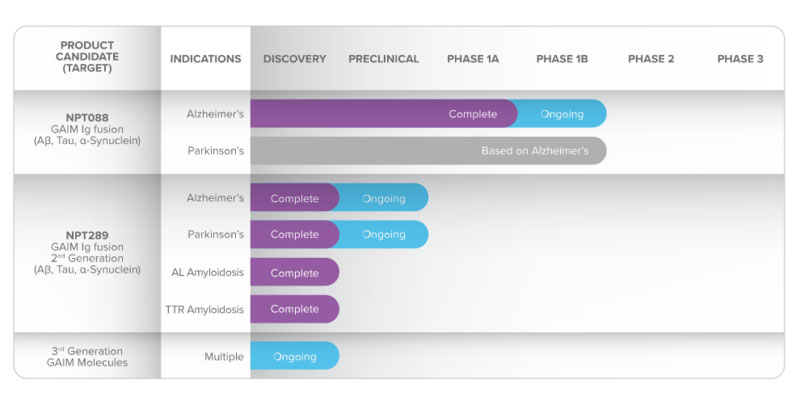
Project Progress Update
Proclara offers transformative therapies for patients with Alzheimer’s disease and other neurodegenerative disorders. Investigations have revealed that most current research on neurodegenerative diseases targets only a single type of misfolded protein, whereas Proclara’s proprietary General Amyloid Interaction Motif (GAIM) platform can simultaneously target multiple misfolded proteins. NPT088, Proclara’s lead candidate, is an intravenously administered fusion protein based on the GA scaffold of human immunoglobulin. It acts against two protein aggregates implicated in Alzheimer’s disease—amyloid-beta (Aβ) and tau protein—making it the most suitable approach currently available for treating this complex disease.
Proclara has recently completed the Phase I safety study of NPT088, enrolling a total of 40 healthy volunteers. The experimental results showed that no adverse reactions occurred in volunteers receiving different doses of the drug.
The company is conducting a Phase Ib clinical study of NPT088, in which it will randomly enroll 66 patients diagnosed with Alzheimer’s disease. The trial will employ a controlled-variable approach, varying factors such as NPT088 dosage, patient age, sex, and duration of drug exposure to evaluate the efficacy of NPT088.
In this round of financing, Daniel Lynch, who has extensive experience in the biotechnology sector, was appointed as Executive Chairman of Proclara’s Board of Directors. Previously, he served as Chief Executive Officer and Chief Financial Officer of ImClone Systems. During his tenure, ImClone’s novel cancer therapy Erbitux (cetuximab) received FDA approval. Lynch led negotiations between ImClone and Bristol-Myers Squibb, resulting in a major strategic partnership. He is confident that Proclara’s GAIM-based therapy will modify the disease progression trajectories of multiple neurodegenerative disorders.
The company was co-founded by Professor Beka Solomon and a team from the University of Cambridge. Professor Solomon is a leading researcher in biotechnology for neurodegenerative diseases at Tel Aviv University. Franz Hefti, the current Chairman and CEO, holds an honorary doctorate from the University of Zurich and completed his postdoctoral fellowship at the Massachusetts Institute of Technology (MIT). He brings over 20 years of experience in the biological and pharmaceutical industries. In addition to Mr. Hefti, the company employs eight staff members and engages seven scientific advisors. Although these advisors are not present at the company on a daily basis, they are technical experts whose guidance has significantly accelerated the company’s research progress while simultaneously reducing personnel costs.
Proclara’s research partners include General Electric (GE); Abzena, a UK-based public company primarily engaged in biotechnology research and the production and development of therapeutic proteins and antibodies, with over 300 employees; the Michael J. Fox Foundation; Aragen, a privately held US biotechnology company founded in 1993, with fewer than 20 employees and also engaged in protein and antibody research; and Sartorius, a German company established in 1870, with 5,500 employees worldwide, serving as a supplier of bioprocessing solutions and equipment.
Manufacturing partners include Patheon and Rentschler. Founded in 1974, Patheon is a global leading pharmaceutical company with over 8,400 employees. Established in 1927, Rentschler is a privately held, independent biopharmaceutical company based in Germany.
The investors are primarily the French investment firm Merieux Developpement and the UK pharmaceutical giant Shire, along with several other private investors. Merieux Developpement’s investment focus lies mainly in in vitro diagnostics and life science tools, medical devices, patient management services, preventive medicine, and nutrition.